Have you ever stopped while writing because you could not decide whether censor vs censure vs sensor was the right choice? I have seen this confusion many times in editing, schoolwork, emails, and online writing.
These three words look and sound similar, but they have very different jobs. One is about removing or hiding information. Another means to strongly criticize someone or something. The third is a device that detects or measures something. 😅
Once you connect each word to its main idea, the difference becomes much easier to remember. In this guide, I will break down the meanings, grammar rules, examples, common mistakes, and memory tricks so you can choose the right word with confidence.
By the end, you should be able to spot the difference quickly, whether you are writing a report, sending a message, or checking a sentence. Carat vs Caret vs Carrot vs Karat | Canvas vs Canvass | Broach vs Brooch:
🎯 Quick Answer: Censor vs Censure vs Sensor
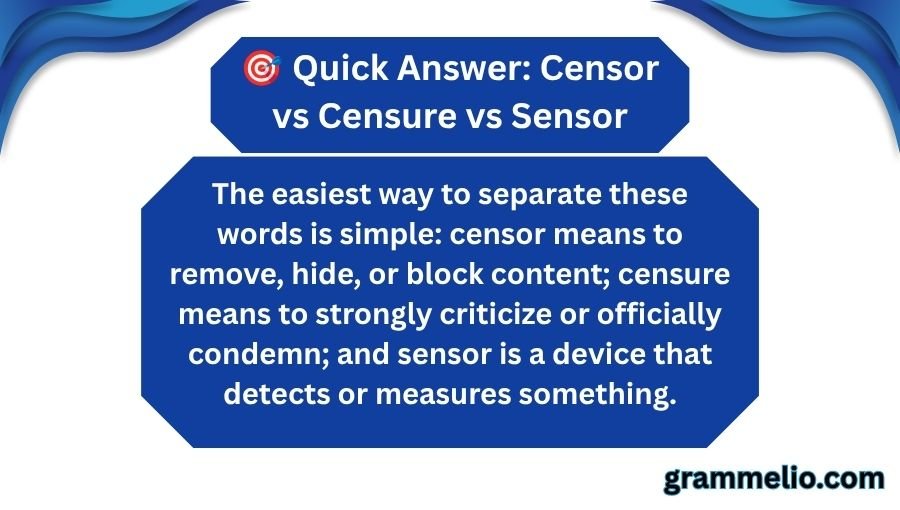
The easiest way to separate these words is simple: censor means to remove, hide, or block content; censure means to strongly criticize or officially condemn; and sensor is a device that detects or measures something.
Think of three different actions:
- Censor → hide or block information.
- Censure → criticize or condemn.
- Sensor → detect or measure.
For example, a government may censor a news report, a board may censure an official, and a motion sensor may detect movement.
🔤 Related Word Forms and Close Variations
The three words have related forms that can make the spelling even more confusing. Understanding their forms helps you recognize them when they appear in different sentences.
| Form | Type | Example |
|---|---|---|
| censor | noun/verb | The editor decided to censor the image. |
| censors | plural noun/third-person verb | The censors reviewed the film. |
| censored | past tense/past participle | The article was censored. |
| censoring | present participle | The platform is censoring the post. |
| censure | noun/verb | The committee voted to censure him. |
| censured | past tense/past participle | The official was censured. |
| censuring | present participle | The group is censuring the policy. |
| sensor | noun | The sensor detected heat. |
| sensors | plural noun | The car has several sensors. |
Notice that censor and censure can both work as nouns and verbs, while sensor is normally a noun. That difference gives you a useful first clue.
📚 Understanding the Basics of Censor vs Censure vs Sensor
The core difference is based on what each word does. Censor deals with information or content. Censure deals with criticism. Sensor deals with detection.
| Form | Type | Meaning | Example | Correct/Incorrect |
|---|---|---|---|---|
| censor | noun/verb | A person who removes or blocks content; or the act of doing so | The station censored the scene. | ✅ Correct |
| censure | noun/verb | Strong criticism or formal condemnation | The board censured the manager. | ✅ Correct |
| sensor | noun | A device that detects or measures something | The sensor detected smoke. | ✅ Correct |
| sensor | verb | To officially criticize someone | The board sensor the manager. | ❌ Incorrect |
| censure | noun/verb | A device that detects movement | The censure detected movement. | ❌ Incorrect |
| censor | noun/verb | Formal criticism | The council censored the mayor for his actions. | ❌ Incorrect in this meaning |
A useful mental picture is this:
Censor = content
Censure = criticism
Sensor = sensing
That three-word chain is enough to solve most everyday questions.
❓ Is Censor the Same as Censure?
No. Censor means to suppress, remove, hide, or restrict content, while censure means to express strong disapproval or condemnation.
For example:
The network censored the violent scene.
The committee censured the executive.
In the first sentence, something was removed or restricted. In the second, a person received strong criticism.
I often tell students to imagine a red editing pen for censor and an angry formal letter for censure. The images are different, so the words become easier to separate. ✏️
Censor as a verb
As a verb, censor means to remove or block material that someone considers unsuitable, offensive, secret, or restricted.
The publisher censored several passages.
The important idea is that content is being controlled.
Censor as a noun
A censor can also be a person or official who reviews material and decides what should be removed or restricted.
The censor reviewed the film before its release.
Censure as a verb
As a verb, censure means to criticize someone strongly, often in a formal setting.
The committee censured the official for violating the rules.
The person is not being edited. Instead, the person is being condemned or formally criticized.
Censure as a noun
As a noun, censure means strong disapproval or formal criticism.
The senator faced public censure after the decision.
Sensor as a noun
A sensor is a device that detects or measures something such as light, heat, pressure, sound, motion, or temperature.
The motion sensor turned on the light.
A sensor does not criticize anyone. It detects something.
💡 Test Tip: Ask What Is Happening
When I need to choose between these words quickly, I ask one question:
Is something being blocked, criticized, or detected?
| If the sentence involves… | Choose | Example |
|---|---|---|
| Blocking information | censor | The website censored the image. |
| Hiding content | censor | The report was censored. |
| Strong criticism | censure | The committee censured him. |
| Formal condemnation | censure | The action brought censure. |
| Detecting movement | sensor | The sensor detected motion. |
| Measuring temperature | sensor | The sensor measured the temperature. |
This test works because the three words have different meanings even though their spellings are close.
📝 Case Study: A Workplace Email
Imagine that an employee sends this email:
“The manager was censored for breaking company rules.”
That sentence may be wrong if the writer means the manager was officially criticized.
The better sentence would be:
“The manager was censured for breaking company rules.”
Now imagine a different situation:
“The security camera’s sensor detected movement.”
Here, sensor is correct because a device detected something.
Finally:
“The company censored confidential information in the public report.”
Here, censored is correct because information was removed or hidden.
| Workplace Situation | Correct Word | Example |
|---|---|---|
| Removing private information | censor | The company censored private details. |
| Officially criticizing an employee | censure | The board censured the employee. |
| Detecting movement | sensor | The sensor detected movement. |
I once edited a short workplace memo in which an employee had written “censored” when they meant “censured.” The sentence sounded reasonable at first glance, but the meaning changed completely. That is why I always check the action before checking the spelling.
⚙️ Grammar Rules Explanation
The grammar rule is based on meaning and word function.
Censor is used when something is suppressed, removed, hidden, or restricted. It can describe a person who performs that job or the action itself.
Censure is used when someone expresses strong disapproval. It can be a verb or a noun.
Sensor is a noun for a device or mechanism that detects or measures something.
The difference is not just one letter. The words belong to different meaning groups.
Standard English reference sources agree on these basic distinctions. You do not need to memorize a complicated grammar rule. You only need to identify the action in the sentence.
Correct vs Incorrect at a Glance
| Sentence | Correct/Incorrect | Why |
|---|---|---|
| The editor censored the photograph. | ✅ Correct | The photograph was restricted or removed. |
| The board censured the official. | ✅ Correct | The official was strongly criticized. |
| The sensor detected smoke. | ✅ Correct | A device detected something. |
| The committee sensor the director. | ❌ Incorrect | Sensor is not the verb for criticism. |
| The article was censured by the editor. | ❌ Usually incorrect | Censored is the normal word for removing content. |
❓ Why Do People Confuse Censor, Censure, and Sensor?
People confuse these words because their spellings are very close and their pronunciations can sound similar in fast speech. The shared cens- beginning also makes them look related when you see them on a screen.
Another problem is typing speed. When people write quickly, they often remember the general sound rather than the exact meaning.
Autocorrect can make things worse. A spelling tool may recognize a word as correctly spelled even when it is the wrong word for the sentence.
Three common causes of confusion
| Reason | What Happens | Example |
|---|---|---|
| Fast typing | The writer chooses the first similar-looking word | “The board censored him” |
| Autocorrect | A valid but incorrect word remains | “The sensor reviewed the report” |
| Lack of knowledge | The writer does not know the meaning difference | “The sensor removed the image” |
I once caught myself typing sensor when I meant censor while writing about online content. The sentence looked fine for a second because “sensor” is a real English word. Reading the sentence for meaning immediately exposed the problem.
⚠️ Common Mistakes With Censor vs Censure vs Sensor
The most common errors happen when writers remember the sound but forget the meaning.
| Wrong Form | What’s Wrong | Correct Form |
|---|---|---|
| The official was censored for his behavior. | This usually means content about the official was suppressed. | The official was censured for his behavior. |
| The sensor removed the offensive scene. | A sensor is a detecting device. | The censor removed the offensive scene. |
| The committee sensor the director. | Sensor is not the verb for criticism. | The committee censured the director. |
| The editor censured the photograph. | The intended meaning is likely removal or restriction. | The editor censored the photograph. |
| The censor detected heat. | A censor does not normally detect heat. | The sensor detected heat. |
| The sensor criticized the policy. | A sensor is not a person giving formal criticism. | The official censured the policy. |
❓ How Can You Remember the Difference Between Censor and Censure?
Use a simple three-part memory trick:
Censor = content
Censure = criticism
Sensor = sensing
You can also connect the endings to the meaning:
- -sor → think of a device that senses.
- -sure → think of a formal judgment or strong criticism.
- censor → think of an editor deciding what people can see.
Here is another quick memory table:
| Word | Memory Link | Main Idea |
|---|---|---|
| censor | content control | Hide or remove |
| censure | serious criticism | Condemn |
| sensor | senses something | Detect or measure |
If you remember only one thing, remember content, criticism, detection.
✍️ Censor vs Censure vs Sensor in Everyday Writing
In everyday conversation, all three words can appear, but they are used in different situations.
| Context | Which Term to Use | Example |
|---|---|---|
| Everyday conversation | censor | They censored the scene on TV. |
| Professional writing | censure | The committee voted to censure the member. |
| Creative writing | censor | The government censored the story. |
| Social media/texting | censor | The platform censored the post. |
In casual writing, people often use censor when discussing blocked posts, edited videos, restricted words, or hidden images.
Censure appears more often in formal situations. You may see it in news reports, government discussions, workplace policies, or official statements.
Sensor is common in technical and everyday settings. Cars, phones, doors, lights, alarms, and appliances can all contain sensors.
❓ When Should You Use Censor?
Use censor when someone removes, blocks, edits, hides, or restricts information or material.
For example:
The network censored the scene.
The word can also describe a person whose role involves reviewing material.
The censor rejected the scene.
Correct and incorrect examples
✅ Correct: The editor censored the graphic image.
❌ Incorrect: The editor censured the graphic image.
If the meaning is that the image was removed or blocked, censored is the better choice.
| Meaning | Correct Example |
|---|---|
| Remove content | The editor censored the article. |
| Block information | The website censored the post. |
| Review material | The censor examined the film. |
❓ When Should You Use Censure?
Use censure when someone is strongly criticized or formally condemned.
For example:
The council censured the official.
Here, the official is receiving criticism. Nothing is being physically removed.
As a noun:
The decision attracted public censure.
This means the decision received strong public disapproval.
| Use | Example |
|---|---|
| Verb | The committee censured him. |
| Noun | He faced public censure. |
| Formal criticism | The board issued a censure. |
❓ When Should You Use Sensor?
Use sensor when you mean a device that detects or measures something.
Examples include:
- motion sensors
- temperature sensors
- light sensors
- pressure sensors
- smoke sensors
- parking sensors
A sensor collects information from its surroundings.
| Sensor Type | What It May Detect |
|---|---|
| Motion sensor | Movement |
| Temperature sensor | Heat or cold |
| Light sensor | Light level |
| Pressure sensor | Pressure |
| Smoke sensor | Smoke |
So if a device notices something, sensor is usually the word you need.
🧩 Common Phrases With Censor, Censure, and Sensor
These words appear in several common phrases. Learning them as groups can make usage easier.
| Phrase | Meaning |
|---|---|
| censor content | Remove or block material |
| government censorship | Official control of information |
| self-censorship | Choosing to limit your own expression |
| public censure | Strong public criticism |
| formal censure | Official condemnation |
| motion sensor | Device that detects movement |
The phrase self-censorship is especially useful. It means a person chooses not to say or publish something because they expect criticism, consequences, or restrictions.
🔍 Synonyms and Alternatives
Sometimes you can replace one of these words with a simpler word. However, the replacement must match the exact meaning.
| Alternative | Works When | Does Not Work When |
|---|---|---|
| block | Content is prevented from being seen | You mean formal criticism |
| remove | Material is taken away | You mean a detecting device |
| criticize | Someone receives negative judgment | Information is being hidden |
| condemn | Someone or something receives strong disapproval | A machine detects movement |
| detector | A device finds or measures something | You mean content restriction |
For example, criticize can often replace censure, but it may sound less formal. Detector can sometimes replace sensor, depending on the device and context.
❓ Can Censor and Censure Ever Mean the Same Thing?
No, they should not normally be treated as interchangeable. Censor focuses on controlling content, while censure focuses on expressing strong disapproval.
Consider these two sentences:
The editor censored the article.
The editor censured the writer.
The first sentence says the article was restricted or changed. The second says the writer was strongly criticized.
The objects also give you a clue. Content, images, words, films, and reports are common objects of censor. People, actions, decisions, and policies can be targets of censure.
❓ Is Sensor a Verb?
In standard everyday English, sensor is normally used as a noun for a device that detects or measures something.
For example:
The sensor detected movement.
Do not use sensor when you mean “criticize” or “remove content.”
| Intended Meaning | Correct Word |
|---|---|
| Detect movement | sensor |
| Remove an image | censor |
| Criticize an official | censure |
This is one of the easiest ways to eliminate the wrong choice.
📱 Censor vs Censure vs Sensor in Digital Communication
Digital writing creates many chances for these words to become confused. Social media platforms may censor certain content. Users may censure a company or public figure in comments. Devices may contain sensors that support automatic functions.
| Digital Situation | Correct Word | Example |
|---|---|---|
| A post is blocked | censor | The platform censored the post. |
| Users strongly criticize a policy | censure | The policy drew public censure. |
| A phone detects light | sensor | The light sensor adjusted the screen. |
| A video hides a word | censor | The creator censored the word. |
When writing online, read the sentence aloud and ask what is actually happening. That small step catches many word-choice errors.
🎯 Key Differences Between Censor, Censure, and Sensor
The easiest comparison is to focus on the target of the action.
| Word | Main Target | Action | Example |
|---|---|---|---|
| censor | Content | Restrict or remove | They censored the report. |
| censure | Person, action, or decision | Strongly criticize | They censured the official. |
| sensor | Physical condition or signal | Detect or measure | The sensor detected heat. |
This table gives you the full rule in one glance.
If the target is information, think censor.
If the target is behavior or a decision, think censure.
If the target is something a device can detect, think sensor.
❓ Why Does Getting These Words Right Matter?
Correct word choice makes your meaning clear. A spelling mistake can be more than a small error when the wrong word creates a completely different idea.
Imagine writing:
“The board censored the employee.”
Readers may think the employee’s words or information were suppressed.
But if you mean the board formally criticized the employee, you need:
“The board censured the employee.”
That one letter changes the meaning.
Why accuracy matters
| Situation | Why Getting It Right Matters |
|---|---|
| Resume | Shows careful writing |
| Client email | Prevents confusion |
| Published content | Builds trust |
| Social post | Keeps your meaning clear |
A useful writing rule is: “Correct spelling is helpful, but correct meaning is essential.”
🛠️ How To Choose the Right Word in Seconds
When you are unsure, use this three-step method.
Step 1: Find the action
Ask: What is happening?
- Is content being blocked?
- Is someone being criticized?
- Is something being detected?
Step 2: Identify the target
Ask what receives the action.
- Article, image, video, or information → censor
- Person, policy, action, or decision → censure
- Heat, light, motion, pressure, or another measurable condition → sensor
Step 3: Replace the word
Try a simple substitute.
| If you can replace it with… | Use |
|---|---|
| block or remove | censor |
| criticize or condemn | censure |
| detector or measuring device | sensor |
If the replacement works, you have probably found the correct word.
❓ What Are the Most Common Censor vs Censure vs Sensor Errors?
The most common mistakes are meaning errors, not simple spelling errors.
Error 1: Using sensor for censor
❌ The website sensor the post.
There is no standard verb sensor in this meaning.
✅ The website censored the post.
Error 2: Using censor for censure
❌ The committee censored the official for misconduct.
If the committee formally criticized the official, the better word is:
✅ The committee censured the official.
Error 3: Using censure for censor
❌ The editor censured the offensive image.
If the editor removed or blocked the image:
✅ The editor censored the offensive image.
📊 Practice Examples for Censor vs Censure vs Sensor
Try to choose the word before reading the answer.
| Sentence | Answer | Reason |
|---|---|---|
| The platform ___ the violent video. | censored | The video was restricted. |
| The board ___ the director. | censured | The director was formally criticized. |
| The door ___ detected movement. | sensor | A device detected movement. |
| The newspaper ___ certain details. | censored | Details were removed or hidden. |
| The official faced public ___. | censure | The official faced strong criticism. |
These examples show why meaning matters more than spelling.
🧠 A Simple Memory Story
Imagine three people in one office.
The first person is an editor. She removes a private paragraph from a report. She censors the report.
The second person is a committee member. He formally criticizes the manager. He censures the manager.
The third object is a small machine near the door. It detects movement. It is a sensor.
Now connect the three:
Editor → censor
Critic → censure
Device → sensor
That story is easier to remember than a list of definitions.
❓ Are Censor and Censure Pronounced the Same?
They are not identical words, even though many speakers may find them very similar in fast speech. Their meanings remain different regardless of how similar they sound.
Because sound alone may not help, I recommend using context as your main test.
If you hear someone say something that sounds like one of these words, ask:
Was content removed? Was someone criticized? Did a device detect something?
Context will usually give you the answer.
❓ What Is the Difference Between Censorship and Censure?
Censorship is the act or practice of controlling or suppressing information or content. Censure is strong criticism or formal condemnation.
For example:
The newspaper faced censorship.
This means information was controlled or restricted.
The official faced censure.
This means the official faced strong criticism.
| Word | Meaning |
|---|---|
| censorship | Control or suppression of content |
| censure | Strong criticism or condemnation |
| sensor | Detection device |
These words may appear in similar news stories, but they describe different things.
❓ Can a Person Be Censored?
Yes, but the meaning needs context. A person’s speech, writing, artistic work, or public expression can be censored. The person is not necessarily being formally criticized.
For example:
The speaker’s comments were censored before the broadcast.
The focus is on the comments being restricted.
Compare:
The speaker was censured for making the comments.
Here, the speaker was strongly criticized.
The difference is subtle but important: censor controls expression; censure condemns behavior or expression.
❓ Can a Sensor Detect Anything?
A sensor can detect or measure many different things, depending on its design. Common examples include motion, temperature, pressure, light, sound, and smoke.
For example:
The temperature sensor detected a sudden rise in heat.
The device is collecting information. That is why sensor is the correct word.
A sensor does not “censor” information. It simply detects something.
❓ What Is an Easy Trick for Remembering These Three Words?
Use the three C’s and S idea:
Censor = control content.
Censure = criticize.
Sensor = sense.
The first two begin with cens-, so focus on their meanings. The third contains sens, which can remind you of sense and detection.
| Word | One-Word Reminder |
|---|---|
| censor | Control |
| censure | Criticize |
| sensor | Sense |
If you can recall these three reminder words, you can usually choose correctly without stopping to think about spelling.
❓ Which Word Should You Use for Formal Criticism?
Use censure when you mean strong or formal criticism.
For example:
The council voted to censure the official.
This is stronger and more formal than simply saying the council criticized the official.
Use censor only when the action involves restricting or removing content.
❓ Which Word Should You Use for a Device?
Use sensor.
For example:
The car’s parking sensors detected an obstacle.
The same rule works for many devices:
- smoke sensor
- motion sensor
- light sensor
- pressure sensor
- temperature sensor
When a machine detects something, think sensor.
🔄 Quick Recap Checklist
Use this checklist whenever you are unsure.
| Question | If Yes → Use |
|---|---|
| Am I talking about blocking or removing content? | censor |
| Am I talking about strong criticism? | censure |
| Am I talking about a detecting device? | sensor |
| Is information being hidden? | censor |
| Is a person being formally condemned? | censure |
| Is heat, motion, light, or pressure being detected? | sensor |
Practice examples
- The publisher removed several sensitive details. → censored
- The committee formally criticized the director. → censured
- The device detected movement near the door. → sensor
❓ FAQs About Censor vs Censure
What is the difference between censor and censure?
Censor means to remove, hide, block, or restrict content. Censure means to criticize or formally condemn someone or something.
Is censor a verb or a noun?
Censor can be both a verb and a noun. As a verb, it means to restrict content. As a noun, it can refer to a person who reviews material for that purpose.
Is censure a verb or a noun?
Censure can also be both a verb and a noun. As a verb, it means to criticize strongly. As a noun, it means strong or formal criticism.
What does sensor mean?
A sensor is a device that detects or measures something. Examples include motion sensors, temperature sensors, and light sensors.
Is “sensor” the same as “censor”?
No. A sensor detects or measures something. A censor controls or restricts content.
Is “censored” the same as “censured”?
No. Censored means content was restricted or removed. Censured means someone was strongly criticized or formally condemned.
How do you use censor in a sentence?
You can say, “The editor censored the photograph.” This means the photograph was removed, blocked, or restricted.
How do you use censure in a sentence?
You can say, “The committee censured the official.” This means the committee strongly criticized or formally condemned the official.
How do you use sensor in a sentence?
You can say, “The motion sensor detected movement.” Here, sensor refers to a device that detects something.
What is the easiest way to remember censor, censure, and sensor?
Remember three words: content, criticism, detection. Censor controls content, censure expresses criticism, and a sensor detects something.
🏁 Conclusion
Censor vs censure vs sensor becomes much easier once you connect each word to its main action. Censor means to remove, block, hide, or restrict content. Censure means to strongly criticize or formally condemn. Sensor is a device that detects or measures something. The best shortcut is to remember three ideas: content, criticism, detection. If information is being blocked, choose censor. If a person or action is being formally criticized, choose censure. If a device is detecting movement, heat, light, pressure, or another condition, choose sensor. ✨ I recommend checking the meaning before checking the spelling because these words can look almost interchangeable when you type quickly. Once you practice a few examples, the difference becomes natural. Clear word choice makes every sentence stronger, and these three words are a perfect example: control content, condemn conduct, detect conditions. 🎯


[…] you learn the key rule, you will be able to tell these words apart with confidence. Censor vs Censure vs Sensor | Carat vs Caret vs Carrot vs Karat | Canvas vs […]
[…] examples, and give you easy memory tricks you can use whenever you are unsure. Cereal vs Serial | Censor vs Censure vs Sensor | Carat vs Caret vs Carrot vs […]