I have seen accept vs except confuse students, writers, and even careful professionals because the two words look and sound similar. If you have ever paused while writing an email and wondered which one belongs in your sentence, you are not alone. I often explain this difference to US English learners by using one simple idea: accept means to receive or agree, while except means to leave out or exclude. Once you connect each word with its main job, the difference becomes much easier to remember.
In this guide, I will show you how to use both words in everyday conversation, schoolwork, professional writing, social media, and formal communication. You will also see clear examples, common mistakes, memory tricks, and practice questions.
By the end, you should feel much more confident choosing the right word. 😊 Adapt vs Adopt
🎯 Quick Answer: Accept vs Except
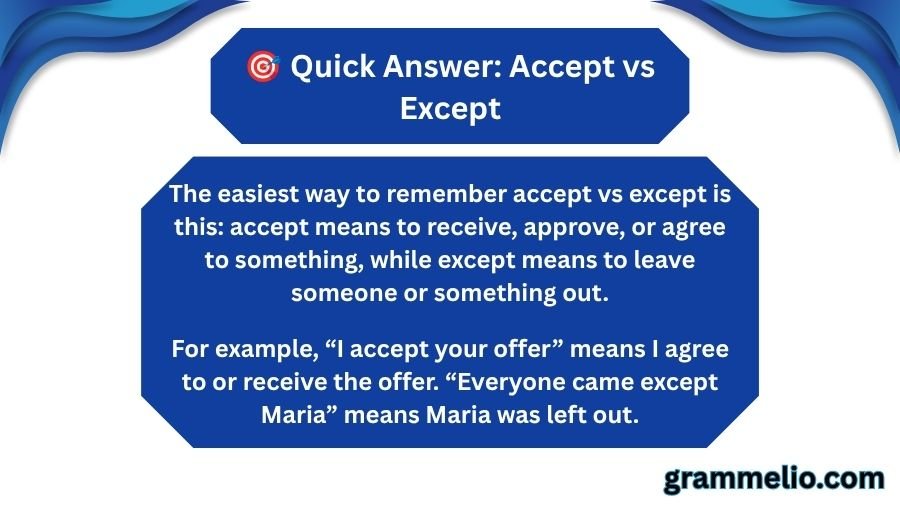
The easiest way to remember accept vs except is this: accept means to receive, approve, or agree to something, while except means to leave someone or something out.
For example, “I accept your offer” means I agree to or receive the offer. “Everyone came except Maria” means Maria was left out.
| Word | Main Meaning | Simple Memory |
|---|---|---|
| Accept | Receive, approve, or agree | Accept = agree or receive |
| Except | Leave out or exclude | Except = exclude |
Is Accept the Same as Except?
No, accept and except are not the same. They have different meanings and usually perform different jobs in a sentence.
Accept is commonly used as a verb. It describes receiving something, agreeing to something, or approving something.
Except usually means “not including” or “excluding.” It can work as a preposition, conjunction, or verb depending on the sentence.
Compare these examples:
- “I accept your apology.”
→ I receive or agree to the apology. - “Everyone was invited except Tom.”
→ Tom was not included.
A useful trick is to replace except with “not including.” If the sentence still makes sense, except is probably the right choice.
📝 Accept vs Except at a Glance
The main difference is simple: accept adds something through agreement or receipt, while except removes something through exclusion.
| Form | Type | Meaning | Example | Correct/Incorrect |
|---|---|---|---|---|
| Accept | Verb | Receive or agree | I accept your invitation. | ✅ Correct |
| Except | Preposition | Not including | Everyone came except Jake. | ✅ Correct |
| Accept | Verb | Approve | She accepted the plan. | ✅ Correct |
| Except | Verb | Leave out | The rule excepts this case. | ✅ Correct |
| Except | Used for agreement | Receive something | I except your offer. | ❌ Incorrect |
Accept: Meaning and Correct Use
Accept is a verb with several closely related uses. The basic idea is receiving, agreeing to, or approving something.
1. Accept means to receive
Use accept when someone receives something that is offered, given, or presented.
Examples:
- I accepted the gift.
- She accepted the package.
- He accepted the award.
- They accepted the payment.
The action moves toward receiving something.
2. Accept means to agree
You can also use accept when you agree to an offer, invitation, suggestion, or request.
Examples:
- I accepted the job offer.
- We accepted their invitation.
- She accepted his proposal.
- The manager accepted my suggestion.
Here, accept means that you said yes or agreed.
3. Accept means to approve or recognize
The word can also describe approval or recognition.
Examples:
- The school accepted my application.
- The company accepted the new policy.
- The system accepted my payment.
In each case, something is approved or allowed.
| Meaning | Word Type | Example Sentence |
|---|---|---|
| Receive | Verb | I accepted the package. |
| Agree | Verb | She accepted the invitation. |
| Approve | Verb | The board accepted the proposal. |
| Recognize | Verb | He accepted that the plan had failed. |
💡 Test Tip: How Can You Check Accept?
Try replacing accept with receive, agree to, or approve.
If one of those replacements makes sense, accept is likely correct.
For example:
I ___ the offer.
“I received the offer” works.
“I agreed to the offer” also works.
So the correct word is accept. ✅
When Should You Use Except?
Use except when you want to show that someone or something is left out.
For example:
Everyone passed the test except Ben.
This means Ben did not pass.
You can often replace except with “not including.”
Everyone passed the test not including Ben.
The sentence sounds less natural, but the meaning is clear.
Except as “Not Including”
This is one of the most common uses.
- I like all fruits except bananas.
- The store is open every day except Sunday.
- Everyone attended except Sarah.
- The box contains everything except batteries.
Except in Comparisons
You may also see except when a statement is true with one unusual case left out.
- The room was quiet except for the loud music outside.
- I would go with you, except I have to work.
- The house looks perfect except for one broken window.
Except as a Verb
In less common formal use, except can mean to exclude.
For example:
The rule excepts emergency cases.
This means the rule excludes emergency cases.
Most everyday writers do not need this use often. The “not including” meaning is much more common.
| Use of Except | Meaning | Example |
|---|---|---|
| Not including | Leaves something out | Everyone came except Alex. |
| With a noun | Excludes an item | I eat everything except fish. |
| Except for | Shows an exception | The room was clean except for one corner. |
| As a verb | Excludes formally | The rule excepts certain cases. |
Why Do People Confuse Accept and Except?
People confuse these words because they look and sound very similar. The difference is only one letter in spelling, but the meanings are completely different.
I once reviewed a short school essay in which a student wrote “I except your apology.” The student clearly meant “I accept your apology.” We changed one word, and the meaning became correct immediately. That small error is easy to make when you type quickly.
There is also a sound issue. In normal conversation, the words can be easy to mix up. When people hear them instead of seeing them, they may not notice which spelling is correct.
Another reason is that both words often appear in short sentences:
- I accept.
- Everyone except me.
- We accept.
- All except one.
Because they are short and familiar, writers sometimes type the wrong one without noticing.
| Confusion | Correct Word | Why |
|---|---|---|
| Agree to an offer | Accept | Accept means agree or receive |
| Leave someone out | Except | Except means excluding |
| Receive a gift | Accept | You receive the gift |
| Everyone but John | Except | John is excluded |
| Approve an application | Accept | The application is approved |
Accept vs Except in Everyday Sentences
The easiest way to learn these words is to see them in natural sentences.
Accept examples
- I accept your apology.
- She accepted the invitation.
- We accept credit cards.
- He accepted the challenge.
- The store accepts returns.
- They accepted my application.
Except examples
- Everyone is ready except Mike.
- I like every subject except math.
- The office is open every day except Saturday.
- We invited everyone except our old neighbor.
- The restaurant serves everything except breakfast.
Notice the direction of meaning.
Accept brings something in.
Except leaves something out.
| Sentence | Word | Meaning |
|---|---|---|
| I accept your offer. | Accept | I agree to it. |
| Everyone came except Lisa. | Except | Lisa was not included. |
| The bank accepted my application. | Accept | The bank approved it. |
| I like all colors except orange. | Except | Orange is excluded. |
📝 Case Study: A Workplace Email
Imagine that a manager sends this email:
“We are happy to accept your proposal. Everyone on the team supports the plan except Daniel.”
Both words are correct because they perform different jobs.
Accept your proposal means the manager agrees to the proposal.
Except Daniel means Daniel is the one person who does not support it.
A few years ago, I once edited a workplace message where the writer had typed “except” instead of “accept” in an approval email. The sentence looked small, but it changed the meaning. After correcting it, the message sounded clear and professional.
| Original Idea | Correct Sentence | Reason |
|---|---|---|
| Agree to a proposal | We accept your proposal. | Accept = agree |
| Leave one person out | Everyone agreed except Dan. | Except = excluding |
| Approve an application | We accepted your application. | Accept = approve |
| Exclude one item | All items were included except one. | Except = leave out |
Grammar Rules Explanation
Accept is a verb. It normally describes an action involving receiving, agreeing, approving, or recognizing something.
Examples:
- She accepted the invitation.
- I accept your decision.
- The company accepted the application.
Except commonly functions as a preposition or conjunction. It introduces a person, thing, or situation that is excluded from a statement.
Examples:
- Everyone came except John.
- I like all vegetables except peas.
- I would help, except I am busy.
The grammar difference follows the meaning. If the sentence needs the idea of receiving or agreeing, use accept. If it needs the idea of excluding or leaving out, use except.
Most standard English reference sources make the same basic distinction. The key is to focus on meaning rather than spelling alone.
Correct vs Incorrect at a Glance
| Sentence | Correct/Incorrect | Why |
|---|---|---|
| I accept your apology. | ✅ Correct | Accept means receive or agree to it. |
| I except your apology. | ❌ Incorrect | Except does not normally mean receive or agree. |
| Everyone came except John. | ✅ Correct | John was excluded. |
| Everyone came accept John. | ❌ Incorrect | Accept does not mean “excluding.” |
| She accepted the job. | ✅ Correct | She agreed to take it. |
⚠️ Common Mistakes With Accept and Except
Most mistakes happen because writers remember the sound but not the meaning.
Three common causes are:
- Fast typing: You know the right word but type the wrong one.
- Autocorrect: A keyboard may not understand the meaning of your sentence.
- Lack of knowledge: New English learners may not yet know the difference.
I once caught myself typing “except” when I meant “accept” in a quick message. I noticed it only after rereading the sentence. That reminded me why a quick meaning check is useful.
| Common Confusion | Correct Choice | Simple Rule |
|---|---|---|
| It’s / Its | Depends on meaning | It’s = it is; its = possession |
| You’re / Your | Depends on meaning | You’re = you are; your = possession |
| They’re / Their / There | Depends on meaning | They’re = they are |
| Then / Than | Depends on meaning | Then = time; than = comparison |
| Accept / Except | Depends on meaning | Accept = receive; except = exclude |
Common Wrong Forms and Uses
| Wrong Form | What’s Wrong | Correct Form |
|---|---|---|
| I except your offer. | “Except” does not mean agree. | I accept your offer. |
| Everyone accept Tom came. | “Accept” does not mean excluding. | Everyone except Tom came. |
| We except your application. | The company approves it. | We accept your application. |
| All students accept Maya passed. | Maya is excluded. | All students except Maya passed. |
| Please except this gift. | The speaker means receive. | Please accept this gift. |
| I accept everyone but John. | The intended meaning is exclusion. | Everyone is included except John. |
How Can You Remember the Difference?
The best memory trick is to connect each word with a simple action.
Accept = allow in.
Except = leave out.
Imagine a party.
If you accept an invitation, you say yes and join the event.
If everyone is invited except one person, that person is left out.
Another useful trick is the letter X in except. Think of X as crossing something out.
Except = X it out. ❌
This is not a grammar rule. It is simply a memory trick.
| Word | Memory Phrase | Meaning |
|---|---|---|
| Accept | “I agree.” | Receive or approve |
| Except | “Leave it out.” | Exclude |
| Accept an offer | Say yes | Agree |
| Except one person | Leave one out | Exclude |
Accept vs Except in Different Contexts
The basic rule stays the same in every type of writing. What changes is how often each word appears.
| Context | Which Term to Use | Example |
|---|---|---|
| Everyday conversation | Accept or except | I accept your invitation. |
| Professional writing | Accept or except | We accept the revised proposal. |
| Creative writing | Accept or except | Everyone left except the old guard. |
| Social media/texting | Accept or except | I accept your challenge! |
Everyday Conversation
In normal speech, accept often appears with invitations, apologies, offers, and decisions.
“Do you accept my apology?”
Except often appears when someone or something is excluded.
“Everyone is coming except Josh.”
Professional Writing
Accuracy matters in emails, reports, resumes, and business messages.
Consider:
“We are pleased to accept your application.”
This sounds professional and clear.
Now compare:
“All applications were approved except two.”
Again, each word has a separate role.
Creative Writing
Writers may use except to add contrast.
“The street was silent except for the rain.”
They may use accept to show emotional agreement or willingness.
“She finally accepted the truth.”
Social Media and Texting
Informal writing is more relaxed, but the difference still matters.
“I accept the challenge! 😎”
“Everyone liked the post except me.”
Short messages can still become confusing when the wrong word is used.
Common Phrases With Accept and Except
Both words appear in useful phrases that are worth learning as complete patterns.
| Phrase | Meaning |
|---|---|
| Accept an offer | Agree to an offer |
| Accept an apology | Receive or acknowledge an apology |
| Accept responsibility | Admit responsibility |
| Accept a challenge | Agree to take on a challenge |
| Except for | Excluding one person or thing |
| Everyone except | Everyone but a specific person or group |
Common Phrases With Accept
- accept responsibility
- accept an invitation
- accept an offer
- accept an apology
- accept a challenge
For example:
“She accepted responsibility for the mistake.”
Common Phrases With Except
- except for
- everyone except
- all except
- anything except
- nothing except
For example:
“The room was empty except for one chair.”
What Are Good Alternatives to Accept and Except?
Sometimes you can replace these words with simpler phrases. This can help you check whether you chose the right one.
| Alternative | Works When | Does Not Work When |
|---|---|---|
| Receive | Accept means getting something | You mean excluding something |
| Agree to | Accept means saying yes | You mean leaving something out |
| Approve | Accept means approving | You mean “not including” |
| Exclude | Except means leaving something out | You mean receiving something |
| Leave out | Except means excluding | You mean agreeing |
Try the replacement test.
I ___ the invitation.
“I agree to the invitation” gives you the right idea, so accept works.
Everyone came ___ John.
“Everyone came excluding John” gives you the right idea, so except works.
Why Does Getting Accept and Except Right Matter?
Correct word choice makes your meaning easier to understand. A single letter can change the message.
Imagine writing a job email that says:
“We are pleased to except your application.”
The reader may understand what you meant, but the mistake makes the message look careless.
Clear writing helps in:
- school assignments
- resumes
- client emails
- published articles
- social media posts
- workplace communication
A simple writing principle is worth remembering:
Clear words make clear messages.
| Situation | Why Getting It Right Matters |
|---|---|
| Resume | Shows attention to detail |
| Client email | Builds trust and professionalism |
| Published content | Protects clarity and quality |
| Social post | Prevents avoidable confusion |
Can Accept and Except Ever Appear Together?
Yes. In fact, using both words in the same sentence is a great way to understand their different jobs.
Consider:
“I accept everyone’s decision except Mark’s.”
Here, accept means agree to or recognize something. Except shows the person who is left out.
Another example is:
“The company accepts all major cards except one.”
The company accepts cards. One card is excepted, or left out.
| Sentence | Accept Role | Except Role |
|---|---|---|
| I accept everyone’s choice except mine. | Agree to the choice | Shows exclusion |
| We accept all payments except checks. | Receive payments | Excludes checks |
| She accepted every invitation except Friday’s. | Agreed to invitations | Excludes one invitation |
Is “Except for” Different From “Except”?
“Except for” is closely related to except and usually introduces an exception to a larger statement.
For example:
“The house was perfect except for the kitchen.”
This means the house was generally good, but the kitchen was a problem.
You can also say:
“Everyone was ready except for James.”
The phrase except for is common in both everyday and formal English.
| Expression | Example | Meaning |
|---|---|---|
| Except | Everyone came except Maria. | Maria was excluded |
| Except for | Everyone was ready except for Maria. | Maria was the exception |
| Accept | I accept your offer. | I agree |
| Accept the fact | He accepted the fact. | He recognized it |
How Does Accept Differ From “Approve”?
These words can overlap, but they are not always interchangeable.
Accept can mean agreeing to receive or take something.
I accepted the invitation.
Approve usually focuses more directly on giving permission or agreeing that something is acceptable.
The manager approved the request.
Sometimes either word can work, but the sentence and situation decide which sounds best.
| Word | Main Idea | Example |
|---|---|---|
| Accept | Receive or agree | She accepted the offer. |
| Approve | Give permission or support | The manager approved the plan. |
| Except | Leave out | Everyone agreed except Dan. |
How To Check Your Sentence in Five Seconds
When I edit a sentence containing one of these words, I use a simple three-step test.
Step 1: Ask what the sentence means
Are you talking about receiving or agreeing?
Use accept.
Are you talking about leaving something out?
Use except.
Step 2: Try a replacement
For accept, try:
- receive
- agree
- approve
For except, try:
- excluding
- not including
- leaving out
Step 3: Read the whole sentence
Do not judge the word by sound alone. Read the sentence and check its meaning.
| Question | If Yes → Use |
|---|---|
| Does it mean receive something? | Accept |
| Does it mean agree to something? | Accept |
| Does it mean approve something? | Accept |
| Does it mean leave someone out? | Except |
| Does it mean not including something? | Except |
Quick Recap Checklist ✅
The difference can be reduced to two short ideas.
| Question | If Yes → Use |
|---|---|
| Am I receiving something? | Accept |
| Am I agreeing to something? | Accept |
| Am I approving something? | Accept |
| Am I leaving something out? | Except |
| Am I saying “not including”? | Except |
Practice Examples
- “I ___ your invitation.”
Answer: accept — You are agreeing to it. - “Everyone came ___ Sarah.”
Answer: except — Sarah was not included. - “The company will ___ your payment.”
Answer: accept — The company will receive it.
FAQs About Accept vs Except
What is the simple difference between accept and except?
Accept means to receive, agree to, or approve something. Except means to leave someone or something out.
Is it “accept your apology” or “except your apology”?
The correct phrase is “accept your apology.” You receive or acknowledge an apology, so accept is the right word.
Is it “everyone accept John” or “everyone except John”?
The correct phrase is “everyone except John.” John is the person who is left out.
How do I remember accept vs except?
Remember: accept = agree or receive, while except = exclude or leave out. You can also think of the X in “except” as a reminder to cross something out. ❌
Can accept be used for an invitation?
Yes. If you agree to an invitation, you accept it.
Example:
“I accepted her invitation to dinner.”
Can except mean “but”?
Yes. In many sentences, except can introduce an exception and may have a meaning similar to “but” or “not including.”
Example:
“I would help except I am working.”
Which word means “not including”?
Except means “not including” or “excluding.”
Example:
“All students attended except Ben.”
Which word means “agree”?
Accept can mean “agree to” or “say yes to.”
Example:
“She accepted the job offer.”
Is “except for” correct English?
Yes. Except for is a standard expression used to identify an exception.
Example:
“The report was complete except for the final page.”
Why do accept and except sound confusing?
They have similar spellings and sounds, so it is easy to mix them up, especially when typing quickly. Focusing on meaning is the best way to choose the correct word.
Conclusion
Accept vs except becomes much easier when you remember one basic rule: accept means receive, agree, or approve, while except means exclude or leave out. That simple difference can help you choose the right word in emails, essays, conversations, reports, and social posts. If you are unsure, stop and ask yourself what the sentence is doing. If something is being received or agreed to, choose accept. If a person or thing is being left out, choose except. I recommend using the replacement test whenever you hesitate: try “receive” or “agree” for accept, and “exclude” or “not including” for except. With a little practice, this common spelling problem becomes almost automatic. The next time these two words compete for your attention, remember the shortest rule: accept brings in; except leaves out. ✨ Keep that rule in mind, and your writing will be clearer, sharper, and more confident.




[…] Once you see that basic difference, the pair becomes much easier. In this guide, I will show you how to use both words correctly, where people go wrong, and how to remember the difference for good. Accept vs Except […]