Have you ever looked at a drink menu and wondered whether liqueur vs liquor is the right way to describe what you are seeing? I have seen this mix-up often, even in otherwise polished writing. The two words look and sound almost the same, but they do not mean the same thing. 🍸
If you are writing a recipe, ordering a drink, studying English, or simply trying to improve your vocabulary, knowing the difference can save you from an awkward mistake. I like to teach this pair with one simple idea: liquor is the broad category, while a liqueur is a sweetened, flavored type of alcoholic drink made from a distilled spirit.
Once you understand that relationship, the spelling and meaning become much easier to remember. Links vs Lynx | Liable vs Libel | Levee vs Levy
🎯 Quick Answer: Liqueur vs Liquor
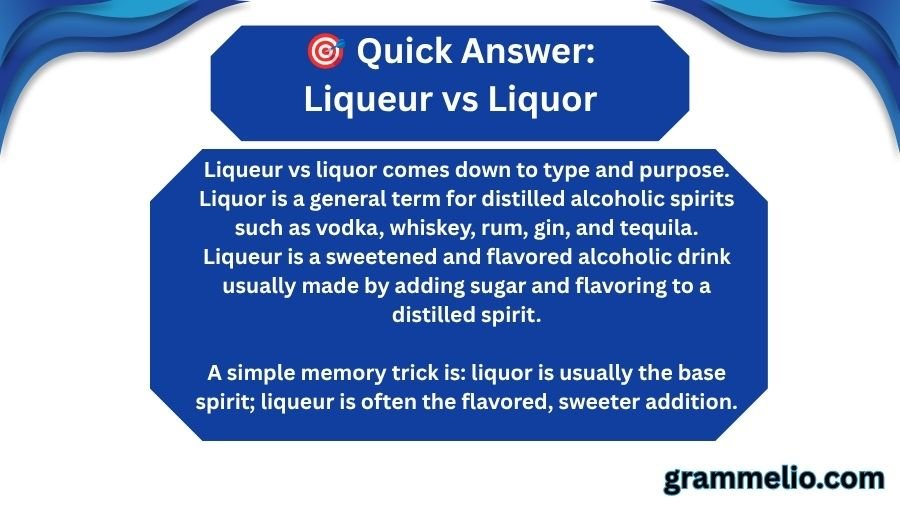
Liqueur vs liquor comes down to type and purpose. Liquor is a general term for distilled alcoholic spirits such as vodka, whiskey, rum, gin, and tequila. Liqueur is a sweetened and flavored alcoholic drink usually made by adding sugar and flavoring to a distilled spirit.
A simple memory trick is: liquor is usually the base spirit; liqueur is often the flavored, sweeter addition.
Related Word Forms for Liqueur and Liquor
Both words have normal plural forms. Their meanings stay the same when they become plural.
| Form | Type | Example |
|---|---|---|
| liquor | Singular noun | The store sells liquor. |
| liquors | Plural noun | The bar has several types of liquors. |
| liqueur | Singular noun | She added a coffee liqueur to the drink. |
| liqueurs | Plural noun | The menu lists several fruit liqueurs. |
| liquor’s | Possessive noun | The liquor’s label was hard to read. |
| liqueur’s | Possessive noun | The liqueur’s flavor was very sweet. |
The apostrophe forms are possessive. They show that something belongs to or is connected with the liquor or liqueur.
For example:
- The liquor’s bottle was broken.
- The liqueur’s flavor was strong.
Do not use an apostrophe simply to make either word plural. Liquors and liqueurs are plural without an apostrophe.
🍹 Understanding Liqueur vs Liquor
The main difference between liqueur vs liquor is that liquor is a broad category, while liqueur is a more specific type of alcoholic drink.
Liquor usually refers to distilled spirits. These drinks are made through distillation and include familiar categories such as:
- Vodka
- Whiskey
- Rum
- Gin
- Tequila
- Brandy
Liqueurs are usually made with a distilled spirit as their base. They are then flavored and sweetened. Their flavors may come from fruit, herbs, spices, coffee, nuts, flowers, or other ingredients.
Liqueur: A Sweet and Flavored Spirit
A liqueur is generally a sweetened, flavored alcoholic drink.
For example:
She added orange liqueur to the cocktail.
Here, liqueur is correct because the drink is a flavored and usually sweetened spirit.
Other examples include coffee-flavored, cream-based, fruit-flavored, and herbal liqueurs.
Liquor: The Broad Spirit Category
Liquor is a general word for distilled alcoholic spirits.
For example:
The restaurant has a large liquor selection.
The sentence does not identify one particular spirit. It refers to distilled alcoholic drinks as a group.
Liqueur vs Liquor at a Glance
| Form | Type | Meaning | Example | Correct/Incorrect |
|---|---|---|---|---|
| liquor | Noun | Distilled alcoholic spirit | He ordered a glass of liquor. | ✅ Correct |
| liqueur | Noun | Sweetened and flavored spirit | She added coffee liqueur. | ✅ Correct |
| liquor | Noun | A specific sweet flavored drink | She added orange liquor to the cocktail. | ❌ Usually incorrect |
| liqueur | Noun | General category for all spirits | Vodka is a liqueur. | ❌ Incorrect |
| liquors | Plural noun | Several distilled spirits | The shop sells many liquors. | ✅ Correct |
| liqueurs | Plural noun | Several flavored and sweetened spirits | The bar offers fruit liqueurs. | ✅ Correct |
A Simple Rule I Teach
When I explain liqueur vs liquor, I ask students to think about the drink’s role.
If it is a basic distilled spirit such as vodka or whiskey, liquor is usually the right word.
If it is a sweetened and flavored spirit added for taste, liqueur is usually the better word.
That distinction is not a perfect description of every production method or product. However, it is an excellent everyday rule for choosing the right word.
🧠 Is Liqueur the Same as Liquor?
No, liqueur and liquor are not exactly the same. Liquor is a broad term for distilled spirits, while liqueur describes a narrower group of usually sweetened and flavored spirits.
This means the two words can be related without being interchangeable.
Think of the relationship like this:
Liquor → broad category
Liqueur → flavored and sweetened type within the broader spirit world
That is why saying “liqueur” when you mean all distilled spirits can make your sentence too narrow.
For example:
✅ The store sells liquor.
This can refer broadly to distilled spirits.
❌ The store sells liqueur.
This suggests that the store sells sweetened and flavored spirits specifically.
💡 How Can You Remember Liqueur vs Liquor?
The easiest way to remember liqueur vs liquor is to connect the spelling with the idea of flavor.
Liqueur = flavored and usually sweet.
Liquor = general distilled spirit.
You can also remember the extra e in liqueur by thinking of extra flavor.
That is not a formal language rule. It is simply a memory trick.
Test Tip
Before choosing the word, ask yourself:
“Am I talking about a broad distilled spirit category, or a sweetened and flavored drink?”
- Broad distilled spirit → liquor
- Sweetened and flavored spirit → liqueur
This quick test works well when writing recipes, menus, school assignments, and everyday messages.
✍️ Correct Meanings and Uses
The two terms appear in several common situations. Understanding the context makes the choice easier.
Using Liquor in Everyday English
Use liquor when referring to distilled spirits generally.
Examples:
The store has a large liquor section.
He works at a liquor store.
The recipe calls for a clear liquor.
In each sentence, the writer is talking about distilled spirits rather than one particular flavored and sweetened product.
Using Liqueur in Recipes
Recipes often use liqueur when a sweet or flavored spirit is part of the dish or drink.
Examples:
Add a small amount of coffee liqueur.
The dessert contains orange liqueur.
She used a fruit liqueur to add sweetness.
The word helps readers understand that the ingredient is more than a plain base spirit.
Using Liquor in Business and Retail
Liquor is common in phrases related to stores and the alcohol trade.
For example:
The liquor store closes at 9 p.m.
The business sells beer, wine, and liquor.
Here, the word works as a broad category.
Using Liqueur in Food and Drink Writing
Liqueur is especially useful in recipes and cocktail descriptions.
For example:
The bartender used a chocolate liqueur to create a rich dessert drink.
The word gives the reader a clue about the ingredient’s character.
Meaning Summary
| Meaning | Word Type | Example Sentence |
|---|---|---|
| Distilled spirits in general | Noun | The store sells liquor. |
| A sweetened flavored spirit | Noun | The recipe uses coffee liqueur. |
| Several distilled spirits | Plural noun | The shop carries different liquors. |
| Several flavored spirits | Plural noun | The menu features fruit liqueurs. |
📝 Case Study: A Menu Description
Imagine that I am editing a restaurant menu.
The original description says:
“Our chocolate cocktail contains premium chocolate liquor.”
At first glance, the sentence looks fine. But the writer actually means a sweetened, chocolate-flavored alcoholic ingredient.
I would change it to:
“Our chocolate cocktail contains premium chocolate liqueur.”
That one letter makes the meaning much clearer.
I once edited a short food article where the writer used liquor several times when describing flavored cocktail ingredients. The writing was otherwise excellent. We corrected the terms because readers could reasonably understand “liquor” as the general spirit rather than the specific sweetened ingredient.
This is a useful lesson: a small spelling difference can create a real meaning difference.
📚 Grammar Rules Explanation for Liqueur vs Liquor
The difference between liqueur vs liquor is mainly lexical, meaning it involves the meanings and uses of two different nouns.
Neither word is simply a “correct spelling” of the other. They are separate words.
Liquor generally refers to distilled alcoholic spirits.
Liqueur generally refers to a sweetened and flavored alcoholic drink based on a spirit.
Both can function as nouns. Their spelling should match the meaning you intend.
Standard English dictionaries treat these as distinct words, and ordinary US English usage follows the same basic distinction.
The important point is not to treat the extra letters in liqueur as a decorative spelling choice. They identify a different word.
Correct vs Incorrect at a Glance
| Sentence | Correct/Incorrect | Why |
|---|---|---|
| She added orange liqueur to the cocktail. | ✅ Correct | The word refers to a flavored, sweetened spirit. |
| The store sells many types of liquor. | ✅ Correct | The sentence refers broadly to distilled spirits. |
| He added coffee liquor to the dessert. | ❌ Usually incorrect | If the intended ingredient is a sweetened coffee spirit, “liqueur” is appropriate. |
| Vodka is a type of liqueur. | ❌ Incorrect | Vodka is a distilled spirit, not generally a liqueur. |
| The recipe calls for a fruit liqueur. | ✅ Correct | A flavored, sweetened spirit is intended. |
⚠️ Common Mistakes With Liqueur and Liquor
People confuse these words for several simple reasons.
Fast Typing
The words look similar, so a person may type one while thinking of the other.
Autocorrect
Autocorrect may not always recognize the intended meaning. A spelling suggestion can make a sentence look polished while leaving the wrong word in place.
Lack of Knowledge
Some writers have simply never learned that the words have different meanings.
Similar Sound and Appearance
Both words are associated with alcoholic drinks. That makes the difference easy to overlook.
I once caught myself typing liquor in a sentence about a flavored cocktail ingredient. I knew the distinction, but the similar spelling still caused a quick typing slip. That reminded me that even people who know the rule should proofread carefully.
Other Common Word Confusions
| Confusing Pair | Common Problem | Quick Reminder |
|---|---|---|
| its / it’s | Possessive vs contraction | its = belonging; it’s = it is |
| your / you’re | Possessive vs contraction | your = belonging; you’re = you are |
| their / there / they’re | Possession, place, contraction | Check the sentence meaning |
| affect / effect | Verb vs noun in common uses | Check the role in the sentence |
| then / than | Time vs comparison | then = time; than = comparison |
| liqueur / liquor | Flavored spirit vs broad spirit term | liqueur is the more specific term |
Common Wrong Spellings and Uses
| Wrong Form | What’s Wrong | Correct Form |
|---|---|---|
| liquer | Missing a letter | liqueur |
| liqure | Letters are in the wrong order | liqueur |
| liqour | Misspelled form | liquor |
| liquior | Extra letters change the spelling | liquor |
| liqueor | Incorrect letter sequence | liqueur |
| liquorss | Incorrect plural ending | liquors |
The safest approach is to slow down when the word appears in a formal piece of writing.
🕰️ Word History and Spelling
The two words are related in a broad historical sense because both are connected with terms for liquid and alcoholic drinks. However, their modern spellings and meanings developed into distinct English words.
For everyday grammar and writing, you do not need to memorize a long history. The useful lesson is that liqueur and liquor became established as separate English terms with different uses.
| Period | Form | Note |
|---|---|---|
| Earlier English use | liquor-related forms | The word was connected with liquid or fluid and later alcoholic drinks. |
| Later English use | liquor | The word became strongly associated with distilled alcoholic spirits. |
| Later development | liqueur | A distinct term became associated with flavored and sweetened alcoholic drinks. |
| Modern English | liquor / liqueur | Both remain standard words with different meanings. |
The history is interesting, but today’s usage matters most when you are writing.
🌎 Usage in Different Contexts
Context can help you choose between the two words.
Everyday Conversation
In casual speech, liquor is common when talking about distilled spirits as a group.
“Do you have any liquor at home?”
For a specific flavored product, liqueur is more precise.
Professional Writing
Menus, restaurant descriptions, food articles, and product descriptions should use the more specific term when appropriate.
A professional writer should not rely on the fact that readers may understand the general idea. Precision makes the writing stronger.
Creative Writing
Creative writers have more freedom, but the meaning still matters.
If a character orders a specific flavored drink, liqueur may be the natural choice.
If a character discusses a bottle of distilled spirits in general, liquor may work better.
Social Media and Texting
People often shorten words or type quickly online. Still, using the correct word helps prevent confusion.
| Context | Which Term to Use | Example |
|---|---|---|
| Everyday conversation | liquor or liqueur, depending on meaning | The store sells liquor. |
| Professional writing | Choose based on exact meaning | The recipe includes coffee liqueur. |
| Creative writing | Choose based on context | He reached for the bottle of liquor. |
| Social media/texting | Either, depending on meaning | This dessert has orange liqueur. |
🍸 Common Phrases With Liquor
Some expressions naturally use liquor.
| Phrase | Meaning |
|---|---|
| liquor store | A retail store that sells alcoholic drinks, especially spirits |
| hard liquor | A common term for distilled alcoholic spirits |
| liquor cabinet | A place where alcoholic drinks are stored |
| liquor bottle | A bottle containing liquor |
| liquor license | Legal permission for a business to sell or serve alcohol |
| liquor selection | The range of spirits offered by a store or business |
These phrases are useful because they show how strongly liquor is tied to the general category of distilled spirits.
Common Phrases With Liqueur
Liqueur also appears in useful food and drink phrases.
| Phrase | Meaning |
|---|---|
| fruit liqueur | A liqueur flavored with fruit |
| coffee liqueur | A liqueur with coffee flavor |
| cream liqueur | A creamy type of liqueur |
| herbal liqueur | A liqueur flavored with herbs |
| chocolate liqueur | A liqueur with chocolate flavor |
| orange liqueur | A liqueur flavored with orange |
These phrases make the meaning especially clear because the word often appears beside the flavor.
🔄 Synonyms and Alternatives
There are times when you can replace one of these words with another phrase. However, not every alternative works in every sentence.
| Alternative | Works When | Does Not Work When |
|---|---|---|
| spirit | You mean a distilled alcoholic drink | You need to highlight sweetness or flavor |
| distilled spirit | You want a precise general term | You specifically mean a flavored liqueur |
| alcoholic drink | You are speaking very broadly | You need to identify a spirit |
| alcoholic beverage | You want a broad formal term | You need the specific meaning of liqueur |
| flavored spirit | You want to describe a liqueur simply | You are referring to plain vodka, whiskey, or similar spirits |
For example, spirit can sometimes replace liquor, especially in formal or international writing. But flavored spirit may be a better explanation when discussing a liqueur.
🎯 Why the Liqueur vs Liquor Difference Matters
Knowing liqueur vs liquor matters because precise words make communication easier.
Clarity
A recipe that says “liqueur” tells the reader that a sweetened, flavored spirit is intended.
A recipe that says “liquor” may leave the reader wondering which type of spirit is needed.
Professionalism
Correct word choice makes menus, articles, product descriptions, and business documents look more polished.
Digital Communication
Online readers often scan quickly. A precise word helps them understand the message without stopping to guess what the writer means.
“Good word choice removes guesswork.”
That simple idea applies to almost every type of writing.
| Situation | Why Getting It Right Matters |
|---|---|
| Resume or professional profile | Shows attention to language |
| Client email | Prevents confusion |
| Published content | Improves accuracy and trust |
| Social media post | Makes the message easier to understand |
🍹 Is Liqueur a Type of Liquor?
In everyday usage, a liqueur can be understood as a more specific type of alcoholic spirit within the broader world of liquor. However, the two terms should not be treated as exact synonyms.
For example, saying “liqueurs and other liquors” can make sense when you want to separate flavored liqueurs from other spirits.
The key is context.
If you mean the broad category, choose liquor.
If you mean a sweetened and flavored spirit, choose liqueur.
❓Why Do People Confuse Liqueur and Liquor?
People confuse them because the words look and sound similar, and both refer to alcoholic drinks.
The difference is easy to miss during fast writing. The extra letters in liqueur also make the spelling harder to remember.
The best solution is to connect the word with its meaning instead of memorizing the spelling alone.
Think:
Liquor = broad spirit term.
Liqueur = flavored and sweetened spirit.
📝 Can You Use Liqueur and Liquor Interchangeably?
No. They can overlap in broad discussions about alcoholic drinks, but they are not interchangeable when precision matters.
If a recipe specifically calls for a sweetened coffee-flavored spirit, changing liqueur to liquor makes the description less precise.
Likewise, calling every distilled spirit a liqueur would incorrectly narrow the meaning.
How Can You Avoid the Spelling Mistake?
A simple way to avoid a liqueur vs liquor spelling mistake is to decide what you mean before checking the spelling.
Step 1: Decide what you mean.
Step 2: Check the spelling.
If you mean a general distilled spirit, write liquor.
If you mean a sweetened and flavored spirit, write liqueur.
Then reread the sentence once.
This method is faster and safer than trying to remember the spelling without thinking about meaning.
Special Exception: Broader Informal Use
One edge case is informal conversation. In casual speech, people may use broad alcohol-related words loosely. A listener may understand what someone means even if the most precise term was not chosen.
That does not mean the words are exact synonyms.
In careful writing, especially recipes, menus, educational content, and professional communication, it is better to select the word that matches the intended meaning.
🔍 Liqueur vs Liquor in Recipes
Recipes are one of the places where the distinction becomes especially useful.
Consider these examples:
✅ Add one ounce of orange liqueur.
The ingredient is a flavored and sweetened spirit.
❌ Add one ounce of orange liquor.
The reader may understand the sentence, but the spelling does not identify the intended type of ingredient as clearly.
Now consider a broader statement:
✅ The recipe can be made with different types of liquor.
This works when discussing distilled spirits generally.
The context tells you which word fits.
🧾 Liqueur vs Liquor in Professional Writing
Professional writers should choose words based on meaning, not appearance.
Suppose a beverage company writes:
“Our product range includes premium liquor and fruit liqueurs.”
That sentence clearly separates a broad spirit category from a more specific flavored category.
A food writer might write:
“The cake contains a small amount of coffee liqueur.”
That wording gives the reader useful information.
In contrast, replacing liqueur with liquor can make the sentence less exact.
📱 Liqueur vs Liquor in Text Messages
Text messages are informal, so mistakes are common.
Someone might type:
“I need to buy some liquor for the recipe.”
That could be perfectly fine if the recipe requires a general distilled spirit.
But if the recipe specifically needs a sweetened coffee or fruit spirit, liqueur is the better choice.
Even in casual writing, meaning should guide spelling.
🧠 A Fast Memory Trick
Here is the memory trick I recommend most:
Liqueur has extra letters because it is the more specific word.
Then connect that idea to flavor:
Liqueur → sweet + flavored
Liquor → distilled spirit in general
You can also remember this mini-pair:
Liquor is broad. Liqueur is specific.
That one sentence captures the main difference.
⚠️ Quick Recap Checklist
Use this checklist whenever you are unsure.
| Question | If Yes → Use |
|---|---|
| Am I talking about distilled spirits generally? | liquor |
| Am I describing a sweetened, flavored spirit? | liqueur |
| Am I talking about a liquor store? | liquor |
| Am I describing coffee, fruit, chocolate, or orange flavor in a spirit? | liqueur |
| Am I writing a recipe with a flavored spirit? | Usually liqueur |
Practice Examples
1. The store has a large selection of distilled spirits.
→ Liquor is the better choice.
2. The dessert contains a sweet coffee-flavored spirit.
→ Liqueur is the better choice.
3. The restaurant offers several types of distilled spirits.
→ Liquors can work in the plural.
FAQs About Liqueur vs Liquor
What is the main difference between liqueur and liquor?
Liquor is a broad term for distilled alcoholic spirits. Liqueur is generally a sweetened and flavored alcoholic drink made with a spirit base.
Is liqueur a type of liquor?
A liqueur is a more specific kind of alcoholic spirit within the broader category of distilled drinks. However, the words are not exact synonyms.
Is vodka a liqueur or liquor?
Vodka is generally considered a type of liquor or distilled spirit. It is not normally classified as a liqueur.
Is whiskey liquor or liqueur?
Whiskey is generally liquor. It is a distilled spirit rather than a typical sweetened and flavored liqueur.
Is coffee liqueur a liquor?
Coffee liqueur is a sweetened and flavored alcoholic spirit. In broad terms, it belongs within the wider world of distilled alcoholic drinks, but liqueur is the more precise word.
Why is liqueur spelled differently from liquor?
They are separate English words with different meanings and established spellings. The extra letters in liqueur are part of the word and should not be removed.
Which is correct: orange liquor or orange liqueur?
If you mean a sweetened, orange-flavored alcoholic spirit, orange liqueur is the correct choice.
Which is correct: liquor store or liqueur store?
Liquor store is the standard phrase for a store that sells alcoholic beverages, especially distilled spirits. Liqueur store would suggest a store focused specifically on liqueurs.
Can I use liquor to mean any alcoholic drink?
In some informal contexts, people use alcohol-related terms broadly. However, in careful US English, liquor usually refers specifically to distilled spirits rather than all alcoholic beverages.
How can I remember liqueur vs liquor?
Remember this rule: liquor is broad, while liqueur is usually sweetened and flavored. If you are describing a coffee, fruit, chocolate, or herbal flavored spirit, liqueur is usually the word you want.
🎯 Final Takeaway
Liqueur vs liquor becomes much easier once you stop treating the words as two spellings of the same thing. Liquor is the broad term for distilled spirits, while liqueur is a more specific term for a usually sweetened and flavored spirit. 🍸 When you are unsure, ask yourself what you are describing. If you mean vodka, whiskey, rum, gin, or distilled spirits in general, liquor is usually the right choice. If you mean a sweetened, flavored spirit used to add taste to a drink or dessert, liqueur is usually correct. Keep the simple rule in mind: liquor is broad; liqueur is flavored and specific. Master that distinction, and you will avoid one of the easiest spelling and vocabulary traps in food and drink writing. ✨

[…] will explain the difference in simple terms so you can choose the right word with confidence. 😊 Liqueur vs Liquor | Links vs Lynx | Liable vs […]