Have you ever typed a sentence and suddenly wondered whether you need main vs mane? I have seen this mix-up many times in everyday writing, especially when someone is typing quickly or relying on autocorrect. The two words look and sound alike, but they have very different meanings.
One usually describes something that is most important, while the other refers to the long hair that grows around the neck of certain animals. 📝 If you are a student, teacher, blogger, job seeker, or simply someone who wants to write clear American English, knowing the difference can save you from an awkward mistake.
I will walk you through the simple rule, show you real examples, and give you easy memory tricks. By the end, choosing the right word should feel almost automatic. 🦁 Lumbar vs Lumber | Locale vs Local | Liqueur vs Liquor
🎯 Quick Answer: Main vs Mane
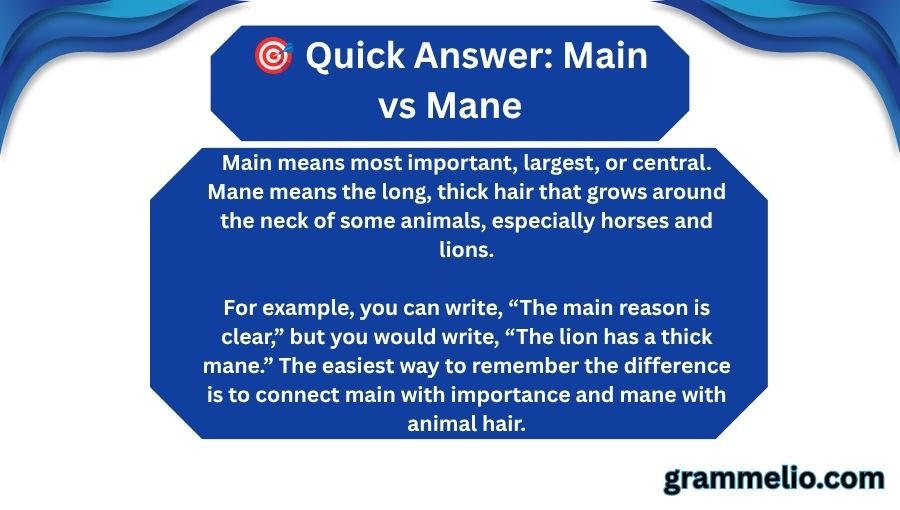
Main means most important, largest, or central. Mane means the long, thick hair that grows around the neck of some animals, especially horses and lions.
For example, you can write, “The main reason is clear,” but you would write, “The lion has a thick mane.” The easiest way to remember the difference is to connect main with importance and mane with animal hair.
| Word | Part of Speech | Basic Meaning | Example |
|---|---|---|---|
| main | Adjective; noun | Most important or central | The main road is closed. |
| mane | Noun | Long hair around an animal’s neck | The horse shook its mane. |
Is Main the Same as Mane?
No, main and mane are not the same word. They may sound the same in many varieties of English, but they have different spellings, meanings, and uses.
Main is commonly used when talking about importance, position, size, or a central part of something. Mane is a noun used mainly when describing animals and their long hair.
Consider these two sentences:
- ✅ The main problem is the cost.
- ❌ The mane problem is the cost.
The first sentence is correct because “problem” is being described as the most important problem.
Now look at the animal meaning:
- ✅ The horse has a long mane.
- ❌ The horse has a long main.
The second sentence is wrong because the word for the hair around a horse’s neck is mane.
The key lesson is simple: main is about what matters most, while mane is about hair on certain animals.
Main vs Mane at a Glance
The quickest way to understand main vs mane is to compare their meanings side by side. Once you connect each spelling with its meaning, the confusion becomes much easier to avoid.
| Form | Type | Meaning | Example | Correct/Incorrect |
|---|---|---|---|---|
| main | Adjective | Most important | This is the main issue. | ✅ Correct |
| main | Noun | A main pipe, line, or central feature | A water main broke. | ✅ Correct |
| mane | Noun | Long hair around an animal’s neck | The lion’s mane was thick. | ✅ Correct |
| mane | Adjective | Not normally used as a general adjective | The mane reason is unclear. | ❌ Incorrect |
| main | Noun for animal hair | Animal neck hair | The horse’s main was beautiful. | ❌ Incorrect |
A useful shortcut is to ask yourself what you are describing. If the answer is importance or something central, choose main. If the answer is hair around an animal’s neck, choose mane.
Why Do People Confuse Main and Mane?
People confuse these words mainly because they are pronounced alike in many forms of English. When two words have the same sound but different meanings and spellings, it is easy to choose the wrong one while typing.
I once reviewed a student’s short story about a horse. The student wrote that the horse had a “beautiful main.” The sentence sounded perfectly normal when read aloud, so the mistake was easy to miss. Once we changed it to “beautiful mane,” the meaning was clear.
Other common reasons include:
- Fast typing
- Autocorrect
- Spell-check tools that focus on spelling rather than meaning
- Hearing the word instead of seeing it
- Limited reading experience
- Confusing words that sound alike
- Writing quickly during school or work
This is why understanding the meaning is more useful than trying to remember the spelling alone.
| Reason | Why It Causes Confusion | Best Solution |
|---|---|---|
| Fast typing | You may type the first spelling that comes to mind. | Pause and check the meaning. |
| Autocorrect | Software may not understand your intended meaning. | Read the whole sentence. |
| Same sound | You cannot hear the spelling difference. | Learn the meaning of each word. |
| Limited reading | Less exposure means fewer memory clues. | Read more examples. |
| Similar spelling | The words differ by only one letter. | Use a memory trick. |
Main: Meaning and Correct Use
Main describes something that is most important, central, primary, or major. It is usually an adjective, but it can also be a noun in certain expressions.
Main as an Adjective
The most common use of main is to describe something that has the greatest importance.
For example:
The main reason for the delay was heavy traffic.
Here, main tells us that the reason is the most important reason.
More examples include:
- The main goal is to improve customer service.
- We entered through the main door.
- Her main concern was safety.
- The main road leads to the city.
- That is the main difference between the two plans.
Notice that main comes before a noun in these examples. It tells us that the noun is central or most important.
Main as a Noun
Main can also be a noun when it refers to a major pipe, wire, line, or central supply system.
For example:
The workers repaired the water main.
Here, main is not describing something as important. It refers to a large pipe that carries water.
Another example is:
The gas main was damaged during construction.
This use is less common in everyday conversation, but it is still correct.
| Meaning | Word Type | Example Sentence |
|---|---|---|
| Most important | Adjective | This is the main reason. |
| Central or primary | Adjective | Use the main entrance. |
| Major road or route | Adjective | We took the main highway. |
| Large supply pipe | Noun | The water main needs repair. |
💡 Test Tip
Replace main with most important. If the sentence still makes sense, main is probably the right choice.
For example:
The main issue is time.
Replace the word:
The most important issue is time.
The meaning stays clear. That is a strong clue that main is correct.
Mane: Meaning and Correct Use
Mane is a noun. It refers to the long, thick hair that grows around the neck of certain animals.
The word is especially common when talking about horses and lions.
Examples include:
- The horse’s mane was dark and shiny.
- The lion shook its mane.
- She gently brushed the horse’s mane.
- The animal’s thick mane made it look powerful.
Unlike main, mane is connected with animal hair.
A simple picture in your mind can help. Imagine a lion standing on a rock with thick hair surrounding its head and neck. That hair is its mane. 🦁
| Animal | Example With Mane | Meaning |
|---|---|---|
| Horse | The horse has a long mane. | Hair around its neck |
| Lion | The lion’s mane is thick. | Hair around its head and neck |
| Other animals | Some animals have mane-like hair. | Hair around the neck or head |
How Can You Remember the Difference Between Main and Mane?
You can remember the difference with a simple meaning-based trick: main = important; mane = animal hair.
Think of the phrase main idea. The main idea is the most important idea in a passage.
Then think of a lion’s mane. The extra “e” in mane can remind you of the animal-related meaning.
Try this memory pair:
Main = major.
Mane = mammal hair.
The first letters do not match perfectly, but the repeated m sound gives you a quick mental connection.
| Memory Clue | Word | Meaning |
|---|---|---|
| Major | main | Most important |
| Main idea | main | Central idea |
| Lion | mane | Animal hair |
| Horse | mane | Hair around the neck |
📝 Case Study: Main vs Mane in Real Writing
Imagine that you are writing an email to a riding instructor after a school trip.
You want to say:
I really liked the horse’s mane.
If you accidentally type:
I really liked the horse’s main.
The reader may understand your meaning because the sentence gives enough context. Still, the spelling is incorrect.
Now imagine writing a report:
The main reason students enjoyed the trip was the chance to work with horses.
If you write:
The mane reason students enjoyed the trip was the chance to work with horses.
The meaning is obvious from context, but the spelling is still wrong.
I once caught myself making a similar sound-alike mistake while editing a document late in the day. The sentence sounded fine when I read it silently, but the meaning test exposed the error. Since then, I always ask what a word means before trusting how it sounds.
| Situation | Correct Sentence | Key Point |
|---|---|---|
| Animal description | The horse has a beautiful mane. | Animal hair |
| Business report | The main reason was cost. | Most important reason |
| School essay | The main idea is easy to understand. | Central idea |
| Animal story | The lion’s mane moved in the wind. | Hair around the neck |
What Are the Grammar Rules for Main and Mane?
The basic grammar rule is that main and mane belong to different meanings and grammatical uses. Main commonly works as an adjective before a noun, while mane is a noun referring to animal hair.
For example:
The main entrance is closed.
Here, main modifies “entrance.” It tells us which entrance.
Now compare:
The horse’s mane is long.
Here, mane is the thing being described. It is a noun.
You should not swap these words simply because they sound alike.
Correct vs Incorrect at a Glance
| Sentence | Correct/Incorrect | Why |
|---|---|---|
| The main reason is clear. | ✅ Correct | “Main” means most important. |
| The mane reason is clear. | ❌ Incorrect | Animal hair does not fit the meaning. |
| The horse has a long mane. | ✅ Correct | “Mane” means animal hair. |
| The horse has a long main. | ❌ Incorrect | “Main” does not mean animal hair. |
| We entered through the main door. | ✅ Correct | “Main” means primary or central. |
A standard English dictionary can be useful when you need to confirm a word’s meaning. However, you should also learn to use context. Context often gives you the fastest answer.
⚠️ Common Mistakes With Main and Mane
The most common mistake is choosing the spelling based only on sound. Because main and mane sound alike in many accents, listening alone cannot tell you which spelling is correct.
Other mistakes come from typing quickly or depending too heavily on spell-check.
Common Sound-Alike Confusions
| Confusing Words | Correct Meaning | Common Problem |
|---|---|---|
| main / mane | Important / animal hair | Same or similar sound |
| it’s / its | It is / belonging to it | Apostrophe confusion |
| your / you’re | Belonging to you / you are | Sound-alike mistake |
| there / their / they’re | Place / belonging / they are | Similar pronunciation |
| to / too / two | Direction / also / number | Context confusion |
The solution is the same in each case: think about meaning before spelling.
Specific Wrong Uses to Avoid
| Wrong Form or Use | What’s Wrong | Correct Form |
|---|---|---|
| The mane idea | Animal hair does not mean “important.” | The main idea |
| The main of the horse | “Main” does not mean animal hair. | The mane of the horse |
| A lion’s main | Wrong spelling for animal hair. | A lion’s mane |
| The mane reason | Wrong spelling for “most important.” | The main reason |
| A horse’s main | Wrong word for neck hair. | A horse’s mane |
| The main was flowing | Wrong noun for animal hair. | The mane was flowing |
Is Main Always an Adjective?
No. Main is most often an adjective, but it can also be a noun in certain contexts.
As an adjective:
The main office is downtown.
As a noun:
The water main burst overnight.
The meaning changes based on the sentence.
This is a useful reminder that one word can have more than one grammatical role. You should always consider the sentence as a whole.
| Use | Example | Role of Main |
|---|---|---|
| Main idea | The main idea is clear. | Adjective |
| Main road | Take the main road. | Adjective |
| Main entrance | Use the main entrance. | Adjective |
| Water main | The water main broke. | Noun |
| Gas main | Workers repaired the gas main. | Noun |
Is Mane Used Only for Horses?
No. Mane is not limited to horses. It is also strongly associated with lions and can be used for the long hair around the neck or head of other animals when that feature fits the description.
For example:
The lion’s mane made its head look larger.
You can also find the word used more broadly in descriptions of animals with a noticeable growth of hair around the neck.
The key point is that mane relates to animal hair, not importance.
How Is Main Used in Everyday Conversation?
In everyday conversation, main is extremely common. People use it when talking about important reasons, plans, roads, doors, goals, ideas, and problems.
Examples:
- “What’s the main reason?”
- “That’s my main concern.”
- “Take the main road.”
- “What’s the main idea?”
- “The main thing is to stay calm.”
You are much more likely to use main in ordinary conversation than mane unless you are discussing animals.
| Context | Which Term to Use | Example |
|---|---|---|
| Everyday conversation | main | What’s the main problem? |
| Animal discussion | mane | The horse has a thick mane. |
| Professional writing | main | Our main goal is growth. |
| Creative writing | Either, depending on meaning | The lion’s mane caught the light. |
| Social media | Either, depending on meaning | Look at this horse’s mane! |
Main vs Mane in Professional Writing
Professional writing usually uses main when identifying an important issue, goal, reason, point, or part.
For example:
Our main objective is to reduce delays.
Using mane in this sentence would be a spelling error because the sentence has nothing to do with animal hair.
In a professional setting, small word-choice errors can make your writing look less polished. This matters in emails, reports, proposals, resumes, and business documents.
Main vs Mane in Creative Writing
Creative writing gives you plenty of chances to use both words correctly.
You might write:
The horse raced across the field, its long mane flying in the wind.
Later, you might write:
Her main goal was to win the race.
These sentences are close together, but the words have completely different jobs.
That contrast can actually help you remember them. Mane creates an animal image. Main describes importance.
Main vs Mane on Social Media and in Texting
Social media and texting often lead to spelling mistakes because people type quickly. Even when a reader understands the intended meaning, correct spelling still makes your message easier to read.
For example:
- ✅ This is the main reason I love horses.
- ❌ This is the mane reason I love horses.
And:
- ✅ Look at that horse’s mane!
- ❌ Look at that horse’s main!
On social platforms, context may save you from confusion. In formal writing, however, you should always choose the correct word.
What Common Phrases Use Main?
Main appears in many common expressions. These phrases are useful because they give you familiar patterns to remember.
| Phrase | Meaning |
|---|---|
| Main idea | Most important idea |
| Main reason | Most important reason |
| Main goal | Primary goal |
| Main point | Most important point |
| Main road | Primary or major road |
| Main entrance | Primary entrance |
Try creating a sentence with each phrase. The more often you see main in these combinations, the easier the spelling becomes.
Are There Common Fixed Expressions With Mane?
There are fewer everyday fixed expressions with mane, but the word appears naturally in phrases that describe animals.
| Phrase | Meaning |
|---|---|
| Lion’s mane | The thick hair around a lion’s head and neck |
| Horse’s mane | Long hair growing from a horse’s neck |
| Thick mane | A mane with a lot of hair |
| Long mane | A mane with considerable length |
| Flowing mane | Hair moving freely, often in a poetic description |
These expressions are easy to recognize because they usually create a clear animal image.
What Words Can Replace Main?
Several alternatives can replace main, depending on the sentence. However, they do not always work in every context.
| Alternative | Works When | Does Not Work When |
|---|---|---|
| Primary | You mean first or most important | The sentence needs a specific fixed phrase |
| Major | You mean very important or large | You need the exact idea of “central” |
| Chief | You mean highest in importance | The style is very casual |
| Key | You mean especially important | The sentence requires a physical meaning such as main road |
| Central | You mean at the center or core | You need a simple everyday phrase |
For example, “primary goal” can often replace “main goal,” but “primary road” may sound different from “main road” depending on the context.
What Words Can Replace Mane?
Because mane names a specific animal feature, it has fewer direct replacements.
You might sometimes use:
- Hair
- Neck hair
- Long hair
- Fur around the neck
However, these alternatives may not carry exactly the same meaning.
For example:
The horse’s mane was beautiful.
You could say:
The horse’s long hair was beautiful.
The second sentence is understandable, but mane is more precise.
| Alternative | Works When | Does Not Work When |
|---|---|---|
| Hair | You want a general description | You need the specific animal term |
| Long hair | Length matters most | You want precise animal vocabulary |
| Neck hair | You need a clear explanation | You want natural, concise wording |
| Fur | The animal’s coat is being discussed generally | You specifically mean the mane |
Why Does Getting Main and Mane Right Matter?
Correct word choice improves clarity, professionalism, and trust. A spelling mistake may not always change the reader’s understanding, but repeated mistakes can make writing look careless.
This matters especially in:
- School assignments
- Resumes
- Business emails
- Blog posts
- Published articles
- Social media posts
A simple rule can guide you:
Clear writing starts with choosing the word that matches the meaning.
| Situation | Why Getting It Right Matters |
|---|---|
| Resume | Shows attention to detail |
| Client email | Creates a professional impression |
| Published content | Builds reader trust |
| Social post | Keeps the message polished |
Can Context Help You Choose Between Main and Mane?
Yes. Context is one of the best tools for choosing the correct word.
Look at the words around the blank.
The _____ reason for the change was cost.
The word “reason” tells you that you need a word meaning important or primary. Therefore, main is correct.
Now consider:
The horse’s _____ was blowing in the wind.
The sentence describes an animal feature. Therefore, mane is correct.
| Sentence Clue | Likely Word | Reason |
|---|---|---|
| reason | main | Important reason |
| idea | main | Central idea |
| goal | main | Primary goal |
| horse | mane | Animal hair |
| lion | mane | Animal hair |
| neck hair | mane | Specific animal feature |
How Can You Practice Main vs Mane?
The best practice method is to write short sentences using both words. Do not memorize long grammar rules. Instead, connect each spelling with its meaning.
Try these:
- The main reason was rain.
- The horse’s mane was black.
- Our main goal is better service.
- The lion shook its mane.
Now cover the words and fill them in again.
You can also make two mental boxes:
MAIN → important, central, primary
MANE → horse, lion, animal hair
That simple split is usually enough.
What Is the Easiest Way to Avoid the Mistake?
Ask one question before you choose the spelling: Am I talking about something important, or am I talking about animal hair?
If you mean something important, use main.
If you mean the hair around an animal’s neck, use mane.
This test works because the two words have such different meanings even though their sounds can be similar.
| Ask Yourself | Answer | Word |
|---|---|---|
| Am I describing importance? | Yes | main |
| Am I describing the central part? | Yes | main |
| Am I talking about a primary goal? | Yes | main |
| Am I describing a horse’s neck hair? | Yes | mane |
| Am I describing a lion’s thick neck hair? | Yes | mane |
✅ Quick Recap Checklist
Use this checklist whenever you are unsure.
| Question | If Yes → Use |
|---|---|
| Does the word mean most important? | main |
| Does it mean primary or central? | main |
| Is it part of “main idea”? | main |
| Is it describing a horse’s neck hair? | mane |
| Is it describing a lion’s neck hair? | mane |
| Is the sentence about an animal’s long hair? | mane |
Practice Examples
- The main problem is the deadline. ✅
- The horse’s mane is very long. ✅
- Her main goal is to improve. ✅
FAQs About Main vs Mane
What is the difference between main and mane?
Main usually means most important, primary, or central. Mane is a noun referring to long hair around the neck of certain animals.
Is it main reason or mane reason?
The correct phrase is main reason. “Main” means the most important reason, while “mane” refers to animal hair.
Is it a horse’s main or mane?
The correct spelling is mane. A horse’s mane is the long hair that grows from its neck.
Is it lion’s main or lion’s mane?
The correct phrase is lion’s mane. The word “mane” describes the thick hair around a lion’s head and neck.
Are main and mane pronounced the same?
They are pronounced the same in many varieties of English. This makes them sound-alike words, which is why context and spelling are important.
Is main an adjective?
Yes. Main is commonly an adjective. For example, “main road” means the primary or major road. It can also be a noun in certain expressions, such as “water main.”
Is mane an adjective?
No. Mane is a noun. It names the hair around the neck of certain animals.
What is an easy trick for remembering main and mane?
Remember main = important and mane = animal hair. You can connect “mane” with a horse or lion to make the spelling easier to recall.
Can main refer to something other than importance?
Yes. It can describe something primary, central, or major. As a noun, it can also refer to a major pipe or supply line in certain contexts.
Why do people spell mane as main?
The most common reason is that the words sound alike in many accents. Fast typing, autocorrect, and unfamiliarity with the meanings can also lead to the mistake.
What Should You Remember About Main vs Mane?
Main vs mane becomes easy once you stop relying on sound and focus on meaning. Main is the word you want when you mean most important, primary, major, or central. Mane is the noun for the long hair around the neck of animals such as horses and lions. 🦁
When I teach sound-alike words, I always recommend using a quick meaning test. Ask yourself whether the sentence is about importance or animal hair. If it is about importance, choose main. If it is about animal hair, choose mane. That one question can prevent most errors.
The difference is small in spelling but large in meaning. Once you connect each word to its own mental picture, the correct choice becomes much easier.
Remember: main means important; mane belongs to the animal. ✨ When meaning leads the way, spelling becomes much easier to get right.

[…] common mistakes, examples, memory tricks, and everyday uses of these two easily confused words. Main vs Mane | Lumbar vs Lumber | Locale vs […]
[…] In this guide, I will explain the meanings, grammar rules, common phrases, mistakes, and real-life uses of both words. By the end, you should be able to choose the right word quickly and confidently. Marital vs Martial | Manner vs Manor | Main vs Mane […]