Have you ever stopped in the middle of a sentence and wondered whether you should use right vs rite vs write? I have seen this mix-up many times in classrooms, emails, social posts, and even polished business documents. The three words sound almost the same, but their meanings are very different. Right can describe something correct, fair, or located on the opposite side of left.
Rite usually means a formal ceremony or religious practice. Write means to form words, letters, or ideas on a page or screen. ✍️
Once you learn the job each word does, the confusion becomes much easier to handle. In this guide, I will show you the meanings, grammar rules, common mistakes, memory tricks, and real-world examples you need to use these words with confidence. Respectably vs Respectfully vs Respectively | Rational vs Rationale | Quiet vs Quite vs Quit
🎯 Quick Answer: Right vs Rite vs Write
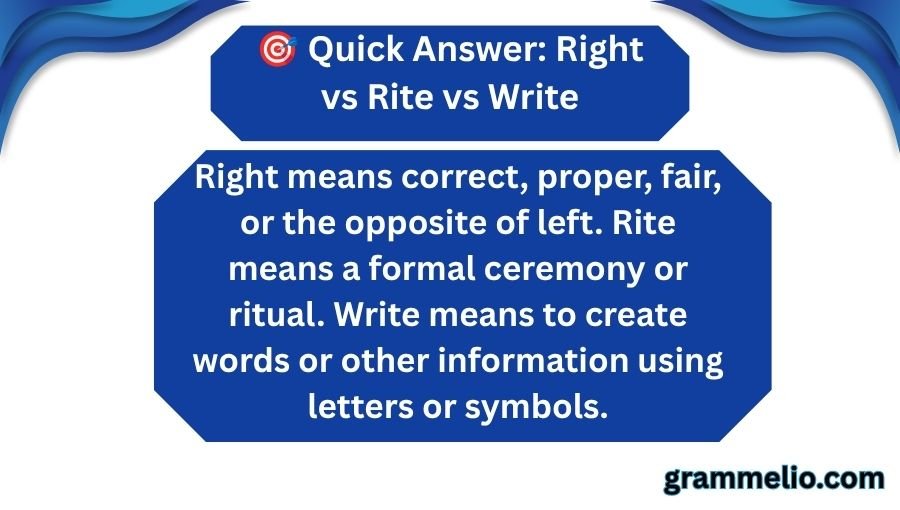
Right means correct, proper, fair, or the opposite of left. Rite means a formal ceremony or ritual. Write means to create words or other information using letters or symbols.
| Word | Main Meaning | Example |
|---|---|---|
| Right | Correct, proper, fair, or opposite of left | You chose the right answer. |
| Rite | A formal ceremony or ritual | The wedding rite was traditional. |
| Write | To form words or record information | Please write your name here. |
A simple memory trick is this: right = correct, rite = ceremony, write = words.
What Is the Difference Between Right, Rite, and Write?
The biggest difference between these three words is their meaning and grammatical role. They are homophones, which means they can sound alike while having different spellings and meanings.
I teach students to focus on the sentence rather than the sound. Ask what the word is doing.
- If you mean correct, proper, fair, or the opposite of left, choose right.
- If you mean a ceremony or formal ritual, choose rite.
- If you mean putting words or information into written form, choose write.
Right: Meaning and Correct Use
Right has several common meanings. It can be an adjective, adverb, noun, or verb.
As an adjective, right can mean correct or proper:
You gave the right answer.
It can also describe direction:
Turn right at the next street.
It may describe something fair or morally proper:
Everyone has the right to speak.
As an adverb, it can mean directly or correctly:
You guessed right.
As a noun, it can refer to a legal or moral entitlement:
Every child has the right to learn.
So, when you see right, think about correctness, direction, fairness, or entitlement.
Rite: Meaning and Correct Use
Rite is a noun. It refers to a formal act, ceremony, or ritual.
For example:
The ceremony included an ancient rite.
The word often appears when people talk about religious, cultural, or traditional ceremonies. It can also appear in the phrase rite of passage, which describes an event or experience that marks an important stage in someone’s life.
Examples include ceremonies connected with marriage, adulthood, burial, or religious practice.
Write: Meaning and Correct Use
Write is a verb. It means to form letters and words or to create written information.
For example:
I need to write an email.
It can also mean creating a longer work:
She writes children’s books.
Or recording information:
Write your phone number on the form.
The key clue is action. If someone is putting words on paper, typing them, or creating written content, write is usually the correct choice.
Quick Comparison of the Three Words
| Word | Part of Speech | Core Meaning | Example Sentence |
|---|---|---|---|
| Right | Adjective, adverb, noun, verb | Correct, fair, proper, or opposite of left | That is the right choice. |
| Rite | Noun | Ceremony or ritual | The rite lasted an hour. |
| Write | Verb | Create written words or information | I will write a note. |
Is Right the Same as Rite or Write?
No. Right, rite, and write are not interchangeable. They may sound alike in many varieties of English, but each word has its own meaning and grammatical use.
Consider these three sentences:
- ✅ I made the right choice.
- ❌ I made the rite choice.
Here, the speaker means a correct choice, so right is needed.
- ✅ The ceremony was an important rite.
- ❌ The ceremony was an important write.
Here, the word means a formal ceremony, so rite is correct.
- ✅ Please write your answer below.
- ❌ Please rite your answer below.
Here, the sentence asks someone to create written words, so write is correct.
The sound can trick you, but the meaning gives you the answer.
Why Do People Confuse Right, Rite, and Write?
People confuse these words mainly because they sound alike. When we hear a word, we do not see its spelling. Our brains must use the context to decide which word belongs on the page.
I once reviewed a student’s short story in which the student wrote, “The knight knew he had the write to enter.” The sentence sounded fine when read aloud, but the intended meaning was a legal or personal entitlement. We changed write to right. The mistake was not a lack of understanding of the story. It was simply a spelling mix-up caused by similar sounds.
Other reasons include:
- Fast typing
- Autocorrect
- Spell-check errors
- Limited vocabulary knowledge
- Writing from memory
- Reading words more often than writing them
- Confusing homophones
Common Homophone Confusions
| Confusing Words | Correct Difference |
|---|---|
| right / rite / write | Correct or direction / ceremony / create words |
| your / you’re | Possession / you are |
| there / their / they’re | Place / possession / they are |
| its / it’s | Possession / it is |
| to / too / two | Direction or infinitive / also / number |
| your / yore | Possession / long ago |
The good news is that homophone errors are easy to reduce once you learn a quick meaning test.
💡 How Can You Remember Right, Rite, and Write?
Use the first letters as memory clues.
Right → correct or direction
Think:
“I got it right.”
Rite → ritual
Both rite and ritual relate to formal ceremonies.
Write → words
Think:
“I write words.”
Another useful trick is to look for the type of word you need.
If you need a verb that describes putting information into written form, use write.
If you need a noun referring to a ceremony, use rite.
If you need a word meaning correct, proper, fair, or opposite of left, use right.
A Three-Word Memory Table
| Question to Ask | Answer | Word |
|---|---|---|
| Do I mean correct or proper? | Yes | Right |
| Do I mean a ceremony or ritual? | Yes | Rite |
| Do I mean creating written words? | Yes | Write |
💡 Test Tip
Remove the confusing word from the sentence and explain what you mean in simpler words.
For example:
“Please ___ your name.”
You mean put your name on the form. Therefore, use write.
“She received the ___ to vote.”
You mean entitlement or legal permission. Therefore, use right.
“The wedding included a traditional ___.”
You mean ceremony or ritual. Therefore, use rite.
If you can explain the meaning, you can usually choose the correct spelling.
📝 Case Study: A Simple Workplace Example
Imagine that a manager sends this message:
“Please rite the correct address on the form.”
The employee may understand the request, but the spelling is wrong. The manager should write:
“Please write the correct address on the form.”
Now imagine a different message:
“Please turn to the write after the bank.”
That is also incorrect if the manager means the direction. The correct sentence is:
“Please turn to the right after the bank.”
Finally:
“The ceremony included an important right.”
That may be incorrect if the intended meaning is a formal ritual. In that case, rite would be the appropriate word.
This example shows why context matters. The same sound can represent three completely different ideas.
What Are the Grammar Rules for Right, Rite, and Write?
The basic grammar rule is simple: choose the spelling based on meaning and grammatical function.
Right can work in several grammatical roles. It can describe a noun, modify a verb, name an entitlement, or appear in other established expressions.
Rite is normally a noun. It names a formal ceremony, ritual, or traditional observance.
Write is a verb. It describes the act of creating written material.
Standard English references consistently distinguish these words by meaning even though their pronunciation may be similar.
Correct vs Incorrect at a Glance
| Sentence | Correct/Incorrect | Why |
|---|---|---|
| ✅ She gave me the right answer. | Correct | Right means correct. |
| ❌ She gave me the rite answer. | Incorrect | A ceremony is not meant here. |
| ✅ Please write your name. | Correct | Write means record words. |
| ❌ Please right your name. | Incorrect | The sentence needs a writing verb. |
| ✅ The ceremony was an ancient rite. | Correct | Rite means ritual or ceremony. |
Right Can Have Several Meanings
One reason right deserves extra attention is that it has many uses.
| Meaning | Example |
|---|---|
| Correct | Your answer is right. |
| Opposite of left | Turn right. |
| Fair or proper | That was the right thing to do. |
| Entitlement | Everyone has the right to speak. |
| Exactly | The store is right across the street. |
This flexibility makes right much more common than rite or write in many types of writing.
⚠️ Common Mistakes With Right, Rite, and Write
Most errors happen when writers choose the spelling by sound instead of meaning.
For example, someone may know exactly what they want to say but type the wrong homophone. A spell-checker may not catch it because all three spellings are legitimate English words.
I once caught myself typing rite when I meant write in a quick note. I had been typing fast and reading the sentence in my head by sound. Once I slowed down and looked at the meaning, the error was obvious.
Why These Mistakes Happen
Fast typing: When people type quickly, they often choose the spelling that appears first in memory.
Autocorrect: A device may select a valid word that does not match the intended meaning.
Lack of knowledge: Some learners know how the words sound but have not learned the spelling difference.
Weak proofreading: Reading too quickly makes homophone errors easy to miss.
Specific Wrong Forms and Their Corrections
| Wrong Form or Use | What’s Wrong | Correct Form |
|---|---|---|
| I will rite an email. | Rite means a ceremony. | I will write an email. |
| Turn write at the corner. | Write means create words. | Turn right at the corner. |
| It was a religious right. | If meaning a ceremony, the spelling is wrong. | It was a religious rite. |
| You are rite about that. | Rite does not mean correct. | You are right about that. |
| Please right your name. | Right does not normally mean create written text. | Please write your name. |
| The marriage write was traditional. | Write is a verb, not the ceremony noun. | The marriage rite was traditional. |
What Is the History Behind Right, Rite, and Write?
The three words have different histories even though modern pronunciation brings them close together. Their spellings developed separately, and their meanings remained distinct.
The important point for modern writers is that their shared sound does not mean they share a meaning.
| Word | Historical Development | Modern Idea |
|---|---|---|
| Right | Developed through older forms connected with ideas of correctness and proper conduct | Correct, fair, proper, or direction |
| Rite | Developed through older language associated with religious or ceremonial practice | Ceremony or ritual |
| Write | Developed through older forms connected with forming or recording written marks | Create written language |
You do not need to memorize their entire history to use them correctly. Their modern meanings are the most useful guide.
How Are Right, Rite, and Write Used in Different Contexts?
The correct word depends on the context, but all three appear in everyday and professional English.
Everyday Conversation
Right is very common:
“You’re right.”
Write is also common:
“Can you write that down?”
Rite is less common in casual conversation. It usually appears when people are discussing ceremonies, traditions, or rituals.
Professional Writing
In business writing, right and write appear frequently.
Examples include:
“Please write your comments below.”
“We need the right information before making a decision.”
Rite may appear in writing about religion, history, culture, or formal ceremonies.
Creative Writing
Authors may use all three words depending on the story.
A character might:
“Turn right at the old bridge.”
Another character might:
“Write a letter before you leave.”
A historical scene might describe:
“The ancient rite took place at sunrise.”
Social Media and Texting
Homophone errors are especially common in quick messages.
| Context | Which Term to Use | Example |
|---|---|---|
| Everyday conversation | Right | You’re right about that. |
| Everyday conversation | Write | Write it down for me. |
| Professional writing | Right | We chose the right option. |
| Professional writing | Write | Please write a short report. |
| Creative writing | Rite | The story describes an ancient rite. |
| Social media/texting | Any, depending on meaning | I think you’re right. |
What Common Phrases Use Right, Rite, and Write?
These words appear in many common phrases. Learning the phrases can make the spelling easier to remember.
| Phrase | Meaning |
|---|---|
| You’re right | You are correct. |
| Right away | Immediately. |
| Right now | At this moment. |
| Rite of passage | A ceremony or event marking an important stage in life. |
| Write down | Record something in written form. |
| Write about | Create written content on a topic. |
The phrase rite of passage is especially useful because it gives rite a strong memory connection with ceremony and life stages.
Which Alternatives Can Replace Right, Rite, or Write?
Sometimes another word can replace one of these terms, but the replacement must preserve the intended meaning.
| Alternative | Works When | Does Not Work When |
|---|---|---|
| Correct | You mean accurate or free from error | You mean a direction |
| Proper | You mean suitable or appropriate | You mean a ceremony |
| Record | You mean store information in written form | You mean physical handwriting specifically |
| Ceremony | You mean a formal event | You mean correct or fair |
| Compose | You mean create written work | You simply mean the physical act of writing |
For example, correct can often replace right in “the right answer,” but it cannot replace right in “turn right.”
Likewise, ceremony can replace rite in many contexts, but it cannot replace write in “write an email.”
Why Does Correct Spelling Matter?
Correct spelling helps readers understand your meaning without stopping to guess. This is especially important when several valid English words sound the same.
Clarity in Communication
The wrong homophone can change the meaning of a sentence.
Compare:
“Please write your name.”
with:
“Please right your name.”
The first sentence clearly asks someone to record their name. The second sentence may confuse the reader because right does not normally carry that meaning.
Professionalism
Errors in emails, resumes, reports, and business documents can make your writing look rushed.
A single homophone error does not define your writing ability. Still, careful word choice creates a stronger impression.
Digital Communication
Text messages and social media posts are often written quickly. That makes homophone mistakes easy to overlook.
A useful rule is:
Clear writing begins with choosing the word that matches your meaning.
| Situation | Why Getting It Right Matters |
|---|---|
| Resume | Shows attention to detail |
| Client email | Prevents confusion |
| Published content | Protects clarity and credibility |
| Social post | Makes your message easier to understand |
🧠 How Can You Master Right, Rite, and Write?
The fastest way to master these words is to practice meaning, not spelling alone.
Try this three-step method:
- Read the sentence.
- Ask what the word means.
- Choose the spelling that carries that meaning.
For example:
“I need to ___ a report.”
What is the action? Creating a report in written form.
Answer: write.
Next:
“That is the ___ decision.”
What does the word mean? Correct or proper.
Answer: right.
Finally:
“The ceremony was an important ___.”
What does the word mean? A formal ritual.
Answer: rite.
Practice Examples
- ✅ I need to write a letter.
- ❌ I need to rite a letter.
- ✅ You are right about the answer.
- ❌ You are write about the answer.
- ✅ The ceremony was a sacred rite.
- ❌ The ceremony was a sacred right.
Practice these patterns until the meaning comes to you automatically.
Can Right Be Used as a Verb?
Yes. Right can be used as a verb in certain contexts. It can mean to correct something or return something to a proper position.
For example:
The worker tried to right the overturned boat.
This use is different from write.
Compare:
- write = create words
- right = correct or set straight
- rite = ceremony
The spelling matters because changing one letter can completely change the word’s function and meaning.
Is Rite Always Related to Religion?
No. Rite is strongly associated with ceremonies and rituals, including religious ceremonies, but it is not limited to religion.
The common phrase rite of passage can describe a ceremony or significant event marking a stage of life.
For example:
Graduation can feel like a rite of passage.
Here, rite points to a meaningful formal or traditional event. The word does not mean “correct,” and it does not mean “write.”
Does Write Have Different Forms?
Yes. Write changes form depending on tense and grammar.
| Form | Use | Example |
|---|---|---|
| Write | Base form | I write every day. |
| Writes | Third-person singular present | She writes clearly. |
| Writing | Present participle/gerund | He is writing a letter. |
| Wrote | Simple past | I wrote the email yesterday. |
| Written | Past participle | She has written three pages. |
These forms are related to write, not right or rite.
This is another reason context matters. If you are describing the act of creating written language, think about the write word family.
FAQs About Right vs Rite vs Write
These frequently asked questions about right vs rite vs write cover the most common spelling and usage problems.
What is the difference between right, rite, and write?
Right means correct, proper, fair, or opposite of left. Rite means a ceremony or ritual. Write means to create or record words and information.
Is “write” the correct word for putting words on paper?
Yes. Write is the correct verb when you mean forming or recording words.
Please write your answer.
Does “rite” mean correct?
No. Rite refers to a formal ceremony or ritual. The word meaning correct is right.
Is “right” always about direction?
No. Right has several meanings. It can mean correct, fair, proper, or opposite of left. It can also refer to an entitlement.
What is a rite of passage?
A rite of passage is a ceremony, event, or experience that marks an important stage or change in someone’s life.
Why do right, rite, and write sound the same?
They are homophones in many varieties of English. Their spellings and meanings are different even though their pronunciation can be the same.
Which word should I use in “Please ___ your name”?
Use write:
Please write your name.
The sentence asks someone to put their name into written form.
Which word should I use in “You are ___”?
If you mean “you are correct,” use right:
You are right.
Which word belongs in “The ceremony was an important ___”?
Use rite if you mean a formal ceremony or ritual:
The ceremony was an important rite.
How can I remember the difference between the three words?
Use this simple pattern:
Right = correct.
Rite = ritual.
Write = words.
If you remember those three meanings, you can usually select the correct spelling quickly.
✅ Quick Recap Checklist
Before choosing among these three words, ask yourself what you mean.
| Question | If Yes → Use |
|---|---|
| Do I mean correct, proper, fair, or opposite of left? | Right |
| Do I mean a ceremony or ritual? | Rite |
| Do I mean creating written words? | Write |
| Am I describing the action of putting words on a page or screen? | Write |
| Am I describing something that is correct? | Right |
| Am I naming a formal traditional ceremony? | Rite |
Final Practice
- “Please ___ the answer in your notebook.”
Answer: write - “Take a ___ turn at the next street.”
Answer: right - “The ceremony was an important cultural ___.”
Answer: rite
A useful final memory line is:
Right is correct, rite is ceremonial, and write creates words.
What Should You Remember About These Three Words?
The easiest way to avoid errors is to stop thinking about sound and start thinking about meaning. Right is the word for correctness, fairness, proper action, direction, and several related ideas. Rite is a noun for a formal ceremony or ritual. Write is a verb for creating or recording written language.
When you proofread, do not simply ask, “Does this word sound right?” Ask, “What do I mean here?” That small change in your proofreading habit can prevent many homophone errors. ✨
Once you connect right with correctness, rite with ceremony, and write with words, the difference becomes much easier to remember. Good grammar is not about memorizing every rule at once. It is about learning useful patterns and applying them with care. Right vs rite vs write may look tricky at first, but three simple meaning clues can make the choice clear every time.


[…] you will know exactly when to choose each word. Let’s make ring vs wring easy to remember. ✍️ Right vs Rite vs Write | Respectably vs Respectfully vs Respectively | Rational vs […]
[…] and practical sentences so you can choose the right word with confidence. ✍️ Ring vs Wring | Right vs Rite vs Write | Respectably vs Respectfully vs […]
[…] By the end, you should be able to choose the right word with confidence. Road vs Rode vs Rowed | Ring vs Wring | Right vs Rite vs Write […]