Have you ever typed a sentence and stopped because you were unsure whether to use ring vs wring? I see this confusion often when helping students, writers, and professionals improve their English. The two words look and sound alike, but they have very different meanings.
One is connected with making a sound, calling someone, or forming a circle. The other means squeezing, twisting, or forcing something to release liquid. 😊
If you are learning English or simply want your writing to look polished, knowing the difference can save you from easy mistakes. In this guide, I will explain the meanings, grammar rules, common phrases, examples, and memory tricks in simple US English.
By the end, you will know exactly when to choose each word. Let’s make ring vs wring easy to remember. ✍️ Right vs Rite vs Write | Respectably vs Respectfully vs Respectively | Rational vs Rationale
🎯 Quick Answer: Ring vs Wring
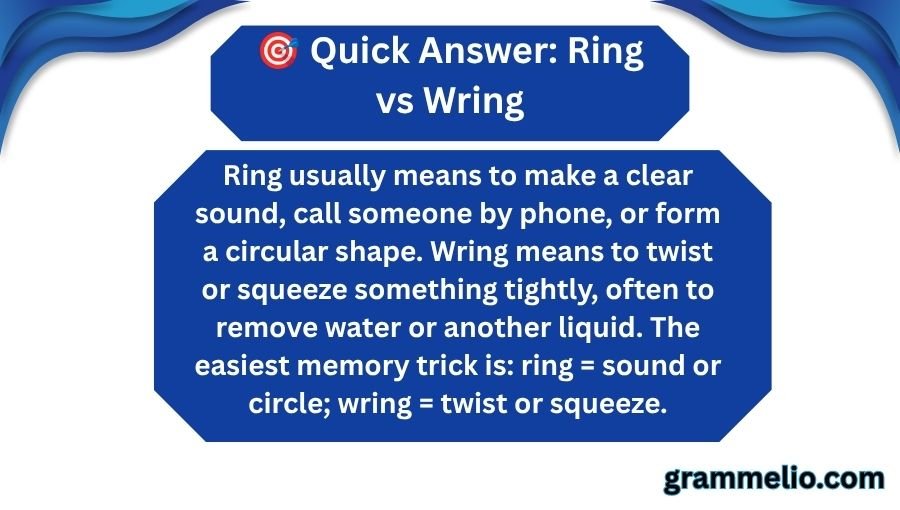
Ring usually means to make a clear sound, call someone by phone, or form a circular shape. Wring means to twist or squeeze something tightly, often to remove water or another liquid. The easiest memory trick is: ring = sound or circle; wring = twist or squeeze.
| Word | Main Meaning | Simple Example |
|---|---|---|
| ring | Make a sound or call someone | Please ring the bell. |
| wring | Twist or squeeze | Wring the water from the towel. |
| ring | A circular object | She wore a gold ring. |
| wring | Force liquid out | Wring out the wet cloth. |
Ring vs Wring: Meaning and Correct Use
The basic difference between ring vs wring is simple. Ring is commonly related to sound, phones, bells, circles, and jewelry. Wring is related to twisting or squeezing something with force.
Although both words can be pronounced alike in many forms of English, their meanings are not alike.
Ring: What Does It Mean?
Ring can be a noun or a verb.
As a noun, it can describe:
- A circular piece of jewelry
- A circular shape
- A sound made by a bell or phone
- A group or circle of people in certain contexts
As a verb, ring can mean:
- To make a clear sound
- To cause a bell to sound
- To call someone by telephone
- To make a sound that continues or echoes
For example:
The doorbell will ring when someone presses the button.
Here, ring is a verb because it describes an action.
Another example is:
She bought a silver ring.
Here, ring is a noun because it names an object.
Wring: What Does It Mean?
Wring is a verb. It means to twist or squeeze something tightly.
It is often used when removing water from cloth.
Wring the towel before you hang it outside.
You can also use wring in a figurative way.
For example:
The stressful situation seemed to wring every bit of energy from him.
The action is not necessarily physical in this sentence. It suggests that something is taking away or draining energy.
Ring vs Wring Comparison Table
| Form | Type | Meaning | Example | Correct/Incorrect |
|---|---|---|---|---|
| ring | Verb | Make a sound | The bell will ring soon. | ✅ Correct |
| ring | Noun | Circular jewelry | She wore a wedding ring. | ✅ Correct |
| wring | Verb | Twist or squeeze | Wring out the towel. | ✅ Correct |
| wring | Verb | Drain or extract by force | The work seemed to wring out his energy. | ✅ Correct |
| wring | Verb | Make a bell sound | Please wring the bell. | ❌ Incorrect |
💡 How Can You Remember Ring and Wring?
A simple memory trick can make this pair much easier.
Think of ring as something connected with a sound or a circle.
- A bell rings.
- A phone rings.
- A wedding ring is circular.
Think of wring as something that involves twisting.
- You wring out a towel.
- You wring water from a cloth.
- You can figuratively wring information from someone.
The extra w in wring can remind you of water. This is not a spelling rule, but it is a useful memory trick.
Ring and Wring at a Glance
| Word | Think Of | Common Use |
|---|---|---|
| ring | Sound | Ring the bell |
| ring | Phone | Ring my number |
| ring | Circle | A gold ring |
| wring | Twist | Wring the cloth |
| wring | Water | Wring out the towel |
| wring | Force | Wring information from someone |
Is Ring the Same as Wring?
No. Ring and wring are different words with different meanings. They may sound the same in many situations, but they should not be substituted for each other.
This is a classic example of a homophone pair. Homophones are words that sound alike but have different meanings and often different spellings.
For example:
The phone will ring at noon.
The sentence describes a sound.
Wring the water out of the shirt.
The sentence describes squeezing.
Changing one word to the other changes the meaning completely.
Why Do People Confuse Ring and Wring?
People often confuse these words because they sound alike. When we hear a word instead of seeing it, the spelling does not give us much help.
I once reviewed a short student paragraph about doing laundry. The student wrote that she would “ring the water out of the towel.” She clearly meant wring. Her idea was correct, but the spelling changed the word. We fixed the sentence by replacing ring with wring.
Fast typing can also cause the mistake. If you know the meaning but type quickly, your fingers may choose the shorter and more familiar spelling.
Other common causes include:
- Autocorrect
- Spell-check suggestions
- Limited vocabulary practice
- Confusing pronunciation with spelling
- Learning English mainly through conversation
- Forgetting which word relates to squeezing
Similar English Word Confusions
| Confusing Pair | Correct Difference |
|---|---|
| it’s / its | it’s = it is; its = belonging to it |
| your / you’re | your = belonging to you; you’re = you are |
| there / their / they’re | Different uses for place, possession, and “they are” |
| to / too / two | Direction, also, and the number 2 |
| hear / here | Sound vs. place |
| right / write | Correct vs. putting words on paper |
| ring / wring | Sound or circle vs. twist or squeeze |
Ring vs Wring in Everyday Sentences
The fastest way to understand these words is to see them in natural sentences.
Examples With Ring
- Please ring the bell when you arrive.
- My phone began to ring.
- I bought a simple silver ring.
- The church bells rang at noon.
- She gave me a quick ring after work.
Examples With Wring
- Please wring out the towel.
- He wrung the water from his shirt.
- She wrung the cloth with both hands.
- Try to wring as much water as possible from it.
- The difficult experience wrung tears from her eyes.
Notice something important: wring has irregular past forms.
The present form is wring.
The past tense is wrung.
The past participle is also commonly wrung.
Related Word Forms
| Base Form | Past Form | Past Participle | Example |
|---|---|---|---|
| ring | rang | rung | The phone rang. |
| wring | wrung | wrung | She wrung out the cloth. |
These forms are worth learning together because ring and wring do not follow exactly the same pattern.
For example:
The bell rang loudly.
But:
She wrung the towel.
And:
The phone has rung several times.
The difference between rang and rung is especially useful when writing about past actions.
💡 Test Tip: Check the Action
When I teach this distinction, I suggest asking one quick question:
“Am I talking about a sound, phone call, or circle?”
If yes, choose ring.
If you are talking about twisting or squeezing, choose wring.
| Question | Choose |
|---|---|
| Is something making a sound? | ring |
| Is a phone making a sound? | ring |
| Is the word about circular jewelry? | ring |
| Am I squeezing cloth? | wring |
| Am I twisting something to remove liquid? | wring |
| Am I draining something through pressure? | wring |
📝 Case Study: A Simple Workplace Example
Imagine that an employee sends this message:
“Please ring the wet cloth before putting it away.”
The reader may understand the general idea, but ring is not the correct verb. The employee means that the cloth should be twisted to remove water.
The improved sentence is:
“Please wring the wet cloth before putting it away.”
Now imagine a different workplace message:
“Please ring the customer after lunch.”
Here, ring means call the customer by telephone. In American English, “call” is more common in many professional settings, but ring can still be understood as a phone-related verb, especially in some varieties of English.
The context tells us which word belongs.
Grammar Rules for Ring and Wring
The grammar rule is straightforward: ring and wring are separate verbs, and their meanings determine which one belongs in a sentence.
Ring can describe an action involving sound or a telephone call. It can also function as a noun for a circular object.
Wring describes twisting or squeezing something. It is normally used as a verb.
Most standard English references treat these as distinct words despite their similar sound.
Do not choose the spelling based only on pronunciation. Instead, identify the action or object in the sentence.
Verb Forms of Ring
| Tense/Form | Example |
|---|---|
| Base | I ring the bell. |
| Third-person singular | She rings the bell. |
| Past | The bell rang. |
| Past participle | The bell has rung. |
| Present participle | The bell is ringing. |
Verb Forms of Wring
| Tense/Form | Example |
|---|---|
| Base | I wring the towel. |
| Third-person singular | She wrings the towel. |
| Past | She wrung the towel. |
| Past participle | She has wrung the towel. |
| Present participle | She is wringing the towel. |
Ring vs Wring at a Glance: Correct and Incorrect Examples
| Sentence | Correct/Incorrect | Why |
|---|---|---|
| Please ring the doorbell. | ✅ Correct | Ring refers to the sound. |
| Please wring the doorbell. | ❌ Incorrect | A doorbell is not being squeezed. |
| Wring the water from the towel. | ✅ Correct | Wring means squeeze or twist. |
| Ring the water from the towel. | ❌ Incorrect | Ring does not mean squeeze. |
| My phone began to ring. | ✅ Correct | A phone makes a ringing sound. |
⚠️ Common Mistakes With Ring and Wring
The most common mistake is choosing the word that sounds right instead of the word that means the right thing.
Another problem is typing too quickly. If you are writing a message about laundry, for example, your brain may know that you mean “twist,” but your fingers may automatically type ring.
Autocorrect can also make things confusing. Spell-check programs often focus on whether a word exists, not whether it makes sense in the sentence.
I once caught myself typing ring while writing instructions for cleaning a reusable cloth. I knew immediately that I meant wring, but the similar sound had influenced my first spelling choice. That small mistake reminded me why context matters more than sound.
Common Wrong Uses
| Wrong Form | What’s Wrong | Correct Form |
|---|---|---|
| Ring out the towel. | Wrong word for squeezing in standard usage | Wring out the towel |
| Wring the bell. | Wrong word for making a bell sound | Ring the bell |
| Ring the water from the cloth. | Ring does not mean squeeze | Wring the water from the cloth |
| Wring the phone. | A phone makes a sound; it is not being squeezed | Ring the phone |
| She ringed the bell. | Wrong past form in standard English | She rang the bell |
| She wringed the towel. | Incorrect past form | She wrung the towel |
Is “Ring Out” or “Wring Out” Correct?
Wring out is the correct phrase when you mean to squeeze liquid from something.
For example:
Wring out the towel before placing it in the basket.
Ring out is generally not the phrase you want for removing water from cloth.
However, ring out can appear in other contexts where ring has its sound-related meaning.
The key is to look at the action. If you are removing water by twisting or squeezing, use wring out.
What Does “Wring Out” Mean?
Wring out means to squeeze or twist something so that liquid comes out.
It is especially common with:
- Towels
- Clothes
- Sponges
- Washcloths
- Wet fabric
Example:
She wrung out the sponge before cleaning the table.
It can also be used figuratively.
The long meeting wrung out all my patience.
In that sentence, the phrase means that the meeting drained or exhausted the speaker’s patience.
What Does “Ring” Mean in Different Contexts?
The word ring has several common uses. Context is what tells us which meaning is intended.
Everyday Conversation
In everyday speech, ring can refer to a phone, bell, sound, or circular object.
I heard the phone ring.
Professional Writing
In professional writing, ring can appear in instructions or descriptions.
Please ring the bell at the reception desk.
In American business writing, call may be more natural when referring to contacting someone by phone.
Creative Writing
Writers often use ring to describe sound.
The quiet room filled with the ring of a distant bell.
They can also use wring to create a strong image of physical or emotional pressure.
She wrung her hands as she waited.
Social Media and Texting
Text messages often use simple forms.
Ring me when you’re free.
I need to wring out this shirt first.
Usage Across Contexts
| Context | Which Term to Use | Example |
|---|---|---|
| Everyday conversation | ring or wring | Ring the bell. |
| Professional writing | ring or wring | Wring out the cloth first. |
| Creative writing | Both | Bells ring; hands wring. |
| Social media/texting | Both | Ring me later. |
| Cleaning instructions | wring | Wring out the towel. |
| Phone instructions | ring | Let the phone ring. |
Common Phrases With Ring
Understanding ring vs wring also helps you recognize common phrases with ring, especially when sound or phone calls are involved.
Ring appears in many familiar expressions.
| Phrase | Meaning |
|---|---|
| ring a bell | Sound familiar or make a bell sound |
| ring the doorbell | Press or activate a doorbell |
| ring someone | Call someone by phone |
| ring true | Seem honest or believable |
| ring in the new year | Celebrate the start of a new year |
| give someone a ring | Call someone |
Some phrases depend on regional usage. For example, give me a ring is understood as “call me,” but “give me a call” is often more natural in American English.
Common Phrases With Wring
Wring has fewer everyday fixed expressions, but several useful phrases are common.
| Phrase | Meaning |
|---|---|
| wring out | Squeeze liquid from something |
| wring one’s hands | Twist or clasp the hands because of worry |
| wring tears from | Cause someone to cry or produce tears |
| wring every last drop | Extract as much as possible |
| wring information from someone | Force or pressure someone to reveal information |
The phrase wring one’s hands is especially useful in writing.
She wrung her hands while waiting for the results.
It can describe worry, distress, or nervousness.
How Are Ring and Wring Different in Meaning?
The difference comes down to the action or object involved.
Ring connects to sound, calls, and circles.
Wring connects to twisting, squeezing, and extracting.
| Feature | Ring | Wring |
|---|---|---|
| Main word type | Noun and verb | Verb |
| Sound-related | Yes | No |
| Phone-related | Yes | No |
| Circular object | Yes | No |
| Squeezing | No | Yes |
| Twisting | No | Yes |
| Removing liquid | No | Yes |
| Common past form | rang | wrung |
Synonyms and Alternatives
Sometimes you can replace these words with clearer alternatives. The best replacement depends on the sentence.
| Alternative | Works When | Does Not Work When |
|---|---|---|
| call | You mean contact someone by phone | You mean a circular object |
| sound | You mean producing a noise | You mean squeezing fabric |
| squeeze | You mean pressing something | You mean making a bell sound |
| twist | You mean turning something tightly | You mean calling someone |
| extract | You mean removing something | You mean a phone or bell making noise |
For example, instead of:
Ring me tonight.
You could write:
Call me tonight.
But you cannot replace:
Wring out the towel.
with:
Call out the towel.
The meaning would be completely different.
Why Does Getting Ring vs Wring Right Matter?
Correct word choice makes your writing easier to understand. A reader should not have to stop and guess what action you mean.
This matters especially in instructions. If you tell someone to “ring out a towel,” they may wonder whether you mean making a sound or squeezing it.
It also matters in professional writing. Small spelling mistakes can make otherwise strong writing look careless.
I use a simple rule when editing: meaning comes before sound. If two words sound alike, I first ask what the sentence is trying to say. That usually makes the correct spelling obvious.
“The right word makes the intended action clear.”
Situations Where Accuracy Matters
| Situation | Why Getting It Right Matters |
|---|---|
| Resume | Shows attention to detail |
| Client email | Prevents confusion |
| Published content | Builds reader trust |
| Social post | Makes the message clear |
| Instructions | Helps readers follow the correct action |
Is There a Special Exception for Ring or Wring?
There is no major spelling exception that makes ring and wring interchangeable. Their meanings remain distinct.
However, ring has many meanings because it can be both a noun and a verb. It can refer to jewelry, a circle, sound, a telephone call, or other related ideas.
Wring is much more focused on twisting, squeezing, and extracting.
That difference actually makes the pair easier to learn once you connect each word with its main image.
How Can You Learn the Difference Faster?
Use mental pictures instead of trying to memorize two spellings in isolation.
Picture a phone:
📞 Ring
Picture a wet towel:
🧺 Wring
Picture a wedding band:
💍 Ring
Picture someone twisting a cloth:
💧 Wring
You can also write two short sentences several times:
The phone will ring.
Wring out the towel.
These sentences create a strong connection between each spelling and its meaning.
What Are the Most Common Errors With These Words?
The most common errors involve using ring when the writer means wring, especially in the phrase wring out.
Another mistake is creating incorrect verb forms such as ringed for the ordinary past tense of the verb meaning “make a sound.” The usual past form is rang.
Likewise, wringed is not the standard past form. Use wrung.
Verb Form Check
| Meaning | Present | Past | Past Participle |
|---|---|---|---|
| Make a sound/call | ring | rang | rung |
| Twist or squeeze | wring | wrung | wrung |
💡 Quick Practice: Choose the Correct Word
Try these sentences before looking at the answers.
- Please ___ the bell.
- ___ out the wet shirt.
- My phone started to ___.
- She ___ the cloth with both hands.
- He wore a gold ___.
Answers
| Sentence | Answer | Reason |
|---|---|---|
| Please ___ the bell. | ring | A bell makes a sound. |
| ___ out the wet shirt. | wring | You squeeze the shirt. |
| My phone started to ___. | ring | A phone makes a ringing sound. |
| She ___ the cloth with both hands. | wrung | This is the past form of wring. |
| He wore a gold ___. | ring | A ring is circular jewelry. |
✅ Quick Recap Checklist
Use this checklist whenever you are unsure.
| Question | If Yes → Use |
|---|---|
| Does it make a sound? | ring |
| Is it a phone call? | ring |
| Is it circular jewelry? | ring |
| Are you twisting something? | wring |
| Are you squeezing liquid out? | wring |
| Are you using “out” after the verb to remove liquid? | wring out |
Practice Examples
1. The telephone began to ___.
Answer: ring.
2. Please ___ out the towel.
Answer: wring.
3. She wore a beautiful gold ___.
Answer: ring.
A quick picture in your mind can often solve the problem before you even think about spelling.
Is Ring or Wring Used for Squeezing Water?
Wring is the correct word for squeezing or twisting water out of fabric. Use wring out when you specifically mean removing liquid.
✅ Correct: Wring out the wet towel.
❌ Incorrect: Ring out the wet towel.
This is one of the most useful distinctions to remember because wring out is a common phrase.
Is Ring or Wring Used for a Bell?
Ring is correct when talking about a bell making a sound.
✅ Correct: Ring the bell before entering.
❌ Incorrect: Wring the bell before entering.
The action is producing sound, so ring is the right choice.
Is Ring or Wring Used for a Phone?
Ring is the word connected with a phone producing a ringing sound.
✅ Correct: I heard my phone ring.
❌ Incorrect: I heard my phone wring.
In American English, call is often more natural when you mean contacting someone.
I will call you after dinner.
Still, ring is perfectly useful when describing the phone’s sound.
FAQs About Ring vs Wring
What is the difference between ring and wring?
Ring refers mainly to sound, phone calls, or circular objects. Wring means to twist or squeeze something, often to remove liquid.
Is it ring out or wring out?
Wring out is correct when you mean squeezing liquid from something.
Wring out the towel before hanging it up.
Is it ring the towel or wring the towel?
Use wring when you mean twisting or squeezing the towel.
Wring the towel to remove the water.
Is “wring” a verb?
Yes. Wring is a verb meaning to twist or squeeze something tightly. It can also be used figuratively to describe extracting something through pressure.
What is the past tense of ring?
The past tense of ring is rang.
The bell rang at noon.
The past participle is rung.
The bell has rung three times.
What is the past tense of wring?
The past tense of wring is wrung.
She wrung the water from the towel.
The past participle is also wrung.
She has wrung out the cloth.
Can ring and wring sound the same?
Yes. In many forms of English, they are pronounced alike. Their different spellings and meanings are what separate them in writing.
How can I remember ring vs wring?
Think ring = sound or circle and wring = twist or squeeze. You can also remember that wring is often connected with water because you wring water out of cloth.
Is “ring a bell” correct?
Yes. Ring a bell is a standard phrase. It can mean making a bell sound, and figuratively it can mean that something seems familiar.
What does “wring one’s hands” mean?
Wring one’s hands means to twist or clasp the hands, often as a sign of worry, fear, or distress. It is also commonly used figuratively.
Final Thoughts on Ring vs Wring
Ring vs wring becomes much easier once you connect each word with its main meaning. Ring is used for sounds, phone calls, circles, and jewelry. Wring is used for twisting, squeezing, and removing liquid. The two words may sound alike, but their jobs in a sentence are very different. ✨
When you are unsure, stop and picture the action. Is something making a sound? Choose ring. Are you twisting or squeezing something? Choose wring. If you remember those two ideas, most sentences become easy to solve.
The best way to master confusing word pairs is not to memorize spelling alone. Learn the meaning, see the word in real sentences, and practice using it. With a little repetition, these two words will stop competing for your attention.
Remember: sounds can match, but meanings choose the spelling.

[…] common mistakes, and practical sentences so you can choose the right word with confidence. ✍️ Ring vs Wring | Right vs Rite vs Write | Respectably vs Respectfully vs […]
[…] the end, you should be able to choose the right word with confidence. Road vs Rode vs Rowed | Ring vs Wring | Right vs Rite vs […]