Have you ever typed a sentence and suddenly wondered whether you need road vs rode vs rowed? I have seen this mix-up many times, especially when people write quickly or rely on how a word sounds. These three words look and sound similar, but they have very different meanings and jobs in a sentence.
One is mainly a noun, one is the past tense of a common verb, and one is the past tense of another verb. 🚗 If you are learning English, writing emails, creating content, or helping a student with grammar, knowing the difference can save you from confusing mistakes. In this guide, I’ll explain each word in simple US English.
You’ll see clear rules, examples, memory tricks, common mistakes, and practical sentences so you can choose the right word with confidence. ✍️ Ring vs Wring | Right vs Rite vs Write | Respectably vs Respectfully vs Respectively
🎯 Quick Answer: Road vs Rode vs Rowed
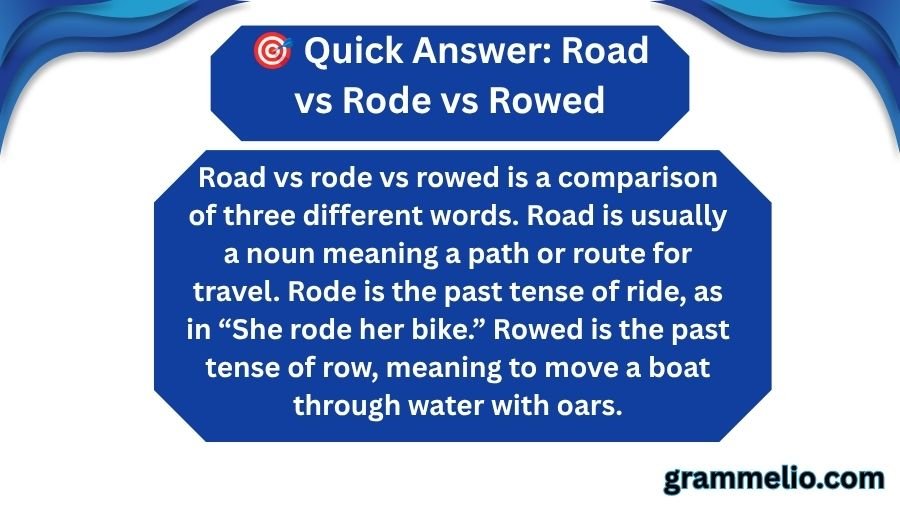
Road vs rode vs rowed is a comparison of three different words. Road is usually a noun meaning a path or route for travel. Rode is the past tense of ride, as in “She rode her bike.” Rowed is the past tense of row, meaning to move a boat through water with oars.
A simple way to remember them is:
- Road = a route 🚗
- Rode = traveled by riding 🐎
- Rowed = moved a boat with oars 🚣
Understanding Road vs Rode vs Rowed
The easiest way to understand road vs rode vs rowed is to look at what each word does in a sentence. They may sound close, but they belong to different word groups and describe different actions or things.
| Form | Type | Meaning | Example | Correct/Incorrect |
|---|---|---|---|---|
| road | Noun | A path or route for vehicles or people | We drove down the road. | ✅ Correct |
| rode | Verb | Past tense of ride | I rode my bike yesterday. | ✅ Correct |
| rowed | Verb | Past tense of row | They rowed across the lake. | ✅ Correct |
| rode | Noun | A standard noun in this comparison | We drove down the rode. | ❌ Incorrect |
| rowed | Noun | A standard noun for a roadway | We drove down the rowed. | ❌ Incorrect |
The key is to focus on meaning, not just sound.
If you can drive, walk, or travel along it, you probably mean road.
If someone traveled on a horse, bicycle, motorcycle, or another rideable thing, you probably need rode.
If someone moved a boat by pulling oars through water, you need rowed.
Road: The Route You Travel On
Road is a noun. It refers to a route or surface used for travel.
For example:
The road to the beach was crowded.
Here, road names the route leading to the beach.
You can use road for many kinds of routes:
- a city road
- a country road
- a mountain road
- a busy road
- a dirt road
- a highway road, although highway is often the more natural word
The word does not describe the act of traveling. It names the place or route where travel happens.
Rode: The Past of Ride
Rode is the simple past tense of ride.
If someone rides something now, we say:
I ride my bike every morning.
If that action happened in the past, we say:
I rode my bike yesterday.
This rule applies to many kinds of riding:
- rode a bicycle
- rode a horse
- rode a motorcycle
- rode a bus
- rode a train
- rode a scooter
The important point is that rode describes an action that happened in the past.
Rowed: The Past of Row
Rowed is the simple past tense of row.
To row means to move a boat through water using oars.
For example:
We rowed across the lake.
The action happened in the past, so rowed is correct.
You might also say:
She rowed the boat toward the dock.
Here, rowed tells us what she did to move the boat.
🧠 A Fast Meaning Test
When I teach these words, I tell learners to ask one simple question: What am I talking about?
| If You Mean… | Use | Example |
|---|---|---|
| A route or street | road | The road is closed. |
| Past travel by riding | rode | He rode his horse home. |
| Past movement of a boat with oars | rowed | They rowed to shore. |
This quick test makes the road vs rode vs rowed difference much easier.
What Is the Difference Between Road and Rode?
Road names a route, while rode describes past riding. They are not interchangeable.
Consider these two sentences:
We drove along the road.
We rode our bikes along the road.
In the first sentence, road is the route.
In the second sentence, rode tells us what we did on that route.
| Word | Main Question | Example |
|---|---|---|
| road | Where did you travel? | We traveled along the road. |
| rode | What did you do? | We rode our bikes. |
✅ Correct vs ❌ Incorrect
- ✅ We drove down the road.
- ❌ We drove down the rode.
Why? The sentence needs a noun for the route, so road is correct.
- ✅ She rode her horse home.
- ❌ She road her horse home.
Why? The sentence needs the past tense of ride, so rode is correct.
Is Road the Same as Rode?
No. Road and rode have different meanings and different grammatical roles.
Road is a noun. Rode is a verb and is the past tense of ride.
| Sentence | Word | Reason |
|---|---|---|
| The road was narrow. | road | Names a route |
| We rode our bikes. | rode | Describes past riding |
| The road was wet. | road | Names a surface or route |
| She rode a horse. | rode | Describes a past action |
A useful memory trick is to connect rode with ride:
ride → rode
That relationship is much stronger than trying to remember the spelling by sound.
How Does Rowed Differ From Rode?
Rowed and rode are both past-tense verbs, but they describe completely different actions.
- Rode comes from ride.
- Rowed comes from row.
Compare:
We rode horses along the trail.
versus:
We rowed the boat across the lake.
The first sentence involves riding. The second involves moving a boat with oars.
| Present Verb | Past Verb | Example |
|---|---|---|
| ride | rode | I rode a horse. |
| row | rowed | I rowed a boat. |
| drive | drove | I drove a car. |
| walk | walked | I walked home. |
The pattern is especially useful because rode is irregular, while rowed follows the regular -ed pattern.
Why Do People Confuse Road, Rode, and Rowed?
People often confuse these words because they can sound similar in casual speech. The problem becomes even greater when someone is writing quickly.
I once reviewed a short message from a student who wrote, “We road our bikes to school.” The student knew exactly what they wanted to say. The problem was simply that they connected the sound of rode with the spelling of road. Once we linked rode directly to ride, the mistake disappeared.
Other reasons include:
- Fast typing — People often type what they hear in their heads.
- Autocorrect — Software may choose a different word than the writer intended.
- Sound confusion — Similar sounds can hide spelling differences.
- Lack of practice — Learners may know the meanings but forget the forms.
- Irregular verbs — The change from ride to rode is not the usual “add -ed” pattern.
The solution is to connect each word with its meaning.
Grammar Rules Explanation
The grammar behind road vs rode vs rowed is straightforward.
Road functions mainly as a noun. It identifies a route, street, or path.
Rode is the simple past form of ride. It describes an action completed in the past.
Rowed is the simple past form of row. It describes an action involving moving a boat with oars.
Standard English references agree on these basic distinctions. The most useful approach is not to memorize the words as isolated spellings. Instead, connect each word to its base form and meaning.
Think of the relationships this way:
road → route
ride → rode
row → rowed
That small three-part system makes the spelling much easier to remember.
Correct vs Incorrect at a Glance
| Sentence | Correct/Incorrect | Why |
|---|---|---|
| We drove along the road. | ✅ Correct | Road is the route. |
| We drove along the rode. | ❌ Incorrect | Rode is not the word for a route. |
| Maria rode her bike to work. | ✅ Correct | Rode is past tense of ride. |
| Maria road her bike to work. | ❌ Incorrect | Road is a noun, not the past tense of ride. |
| They rowed across the lake. | ✅ Correct | Rowed is past tense of row. |
💡 Test Tip: Connect Each Word to a Base Word
Here is one of the easiest tests for road vs rode vs rowed.
Ask yourself whether the word connects to one of these three ideas:
| Word | Connect It With | Memory Clue |
|---|---|---|
| road | route | A road takes you somewhere. |
| rode | ride | I rode yesterday. |
| rowed | row | I rowed a boat. |
If you can replace the word with ride in the present tense, the past form is probably rode.
For example:
Today I ride my bike.
Yesterday I rode my bike.
If the sentence is about a street or route, use road.
If it is about moving a boat with oars, use rowed.
📝 Case Study: A Simple Workplace Message
Imagine that an employee sends this message:
“I road my bike to the office because traffic was heavy.”
The reader can probably understand the meaning. However, the spelling is incorrect.
The corrected version is:
“I rode my bike to the office because traffic was heavy.”
Now imagine a different message:
“The road near our office is closed.”
Here, road is correct because the sentence refers to a street or route.
A third example:
“The team rowed across the lake during the company retreat.”
Here, rowed is correct because the team moved a boat using oars.
The lesson is simple: context tells you which spelling belongs in the sentence.
Common Mistakes With Road, Rode, and Rowed
The most common errors happen when writers choose a word based on sound rather than meaning.
| Mistake | Why It Happens | Better Strategy |
|---|---|---|
| road instead of rode | The words sound similar | Connect rode with ride |
| rode instead of road | The writer hears the word rather than sees its role | Ask whether it means a route |
| rode instead of rowed | Both describe past actions | Ask whether the action involved riding or rowing |
| rowed instead of rode | The spelling looks like another past-tense verb | Check the base verb |
| road instead of rowed | The writer focuses on sound | Focus on the action |
Fast typing makes these errors more likely. Autocorrect can also make them harder to notice. A person may know the rule but still select the wrong spelling while writing quickly.
A Specific List of Wrong Forms
| Wrong Form | What’s Wrong | Correct Form |
|---|---|---|
| I road my bike. | Road is not the past tense of ride. | I rode my bike. |
| We rode down the street. | If you mean the route, road may be needed. | We drove down the road. |
| They rode the boat with oars. | The action is rowing, not riding. | They rowed the boat. |
| The rode was blocked. | Rode does not mean a street. | The road was blocked. |
| She road a horse. | Road cannot replace the past tense of ride. | She rode a horse. |
| We rode across the lake with oars. | The intended action is rowing. | We rowed across the lake. |
I once caught myself typing road when I meant rode in a quick note. I knew the rule, but my fingers followed the sound. That small mistake reminded me why proofreading matters even when the grammar seems easy.
How Should You Use These Words in Everyday Conversation?
In everyday speech and writing, the context usually makes the difference clear.
| Context | Which Term to Use | Example |
|---|---|---|
| Talking about streets | road | The road is busy today. |
| Talking about past bike travel | rode | I rode my bike this morning. |
| Talking about past horse travel | rode | She rode a horse as a child. |
| Talking about moving a boat | rowed | We rowed to the other side. |
| Talking about a travel route | road | This road leads to the park. |
In conversation, pronunciation can sometimes make these words difficult to distinguish. In writing, however, the spelling gives the reader the exact meaning.
How Do These Words Work in Professional Writing?
Professional writing needs clear word choice because readers may not have the context to guess what you mean.
Suppose a report says:
“The driver road the vehicle to the warehouse.”
That sentence contains a spelling error. The correct sentence is:
“The driver rode to the warehouse.”
However, if the report says:
“The road to the warehouse was closed.”
then road is correct.
For workplace writing, always check whether the word is naming a thing or describing an action.
| Professional Situation | Correct Word | Example |
|---|---|---|
| Travel route | road | The road was closed. |
| Past riding | rode | The employee rode the shuttle. |
| Boat activity | rowed | The group rowed across the river. |
Road, Rode, and Rowed in Creative Writing
Creative writers also need to choose carefully. A single spelling can change the meaning of a scene.
Consider:
“He rode into town.”
This creates an image of someone traveling by horse, bicycle, motorcycle, or another rideable vehicle.
Now compare:
“He followed the road into town.”
This focuses on the route.
And:
“They rowed toward the island.”
This creates a water scene.
| Sentence | Main Image |
|---|---|
| He rode into town. | A person traveling by riding |
| He followed the road into town. | A route leading toward town |
| They rowed toward the island. | A boat moving across water |
Good word choice helps readers see the scene without confusion.
Road vs Rode vs Rowed in Texting and Social Media
Short messages often create more spelling mistakes because people type quickly.
You might see:
“I road my bike here.”
The intended word is rode.
Texting shortcuts are common, but basic word choice still matters when the message needs to be clear. This is especially true in public posts, captions, school assignments, or professional social media.
| Digital Context | Best Choice | Example |
|---|---|---|
| Casual text about biking | rode | I rode my bike today. |
| Travel post | road | This road has amazing views. |
| Boating post | rowed | We rowed across the lake. |
| Work message | Depends on meaning | I rode the bus to work. |
Common Phrases With Road
Road appears in many familiar phrases and expressions.
| Phrase | Meaning |
|---|---|
| on the road | Traveling |
| road trip | A trip made by road |
| road ahead | The route in front of you |
| main road | A major route |
| side road | A smaller road branching from a larger one |
| hit the road | Leave or begin traveling |
These expressions make road easy to recognize when you read it.
For example:
We are going on a road trip this weekend.
Here, road clearly relates to travel by route.
Common Phrases With Rode and Rowed
Unlike road, the words rode and rowed are usually understood through their verb meanings rather than through a large set of fixed phrases.
| Word | Common Pattern | Example |
|---|---|---|
| rode | rode a bike | She rode a bike. |
| rode | rode a horse | He rode a horse. |
| rode | rode a bus | We rode the bus. |
| rowed | rowed a boat | They rowed a boat. |
| rowed | rowed across | We rowed across the river. |
The base verbs make the meaning easier to remember.
Synonyms and Alternatives
Sometimes you can replace one of these words with another expression. However, the replacement must keep the same meaning.
| Alternative | Works When | Does Not Work When |
|---|---|---|
| street | You mean an urban road | You mean riding an animal |
| route | You mean a path or direction | You mean the action of riding |
| traveled by bike | You mean past bike travel | You are naming a road |
| traveled by horse | You mean past horse travel | You mean a water activity |
| paddled | You mean moving a boat, depending on the method | You specifically mean using oars |
For example, route can sometimes replace road:
We took a different route.
But you cannot replace rode with route:
❌ I route my bike yesterday.
The meaning and grammar do not match.
Why Does Correct Word Choice Matter?
Getting road vs rode vs rowed right may seem like a small detail, but small details affect the quality of writing.
Clear word choice helps with:
- Clarity — Readers understand your meaning immediately.
- Professionalism — Correct spelling makes writing look polished.
- School writing — Teachers expect accurate word forms.
- Digital communication — A wrong word can make a short message confusing.
- Content writing — Accurate grammar builds trust with readers.
A useful rule is:
“Choose the word that matches the meaning, not just the sound.”
That simple habit can prevent many homophone and near-homophone mistakes.
| Situation | Why Getting It Right Matters |
|---|---|
| Resume | Errors can make writing look careless. |
| Client email | Clear wording prevents confusion. |
| Published article | Readers expect accurate grammar. |
| Social post | Correct spelling improves readability. |
Is There a Special Exception?
There is no major grammar exception that changes the basic distinction among these three words. The main challenge is that road, rode, and rowed can be confused because their sounds or spellings are close.
One useful edge case is the word road in compound expressions.
For example:
road trip
roadway
roadside
roadwork
In these words, road keeps its connection to a route or travel surface.
Meanwhile, rode remains tied to ride, and rowed remains tied to row.
How Can You Remember Road, Rode, and Rowed?
A three-word memory trick can make the rule stick.
Think:
ROAD = ROUTE
RODE = RIDE
ROWED = ROW
You can also imagine three pictures:
🚗 Road → a street
🐎 Rode → someone riding
🚣 Rowed → someone using oars
| Word | Picture | Question |
|---|---|---|
| road | 🚗 Street | Where? |
| rode | 🐎 Rider | Did what? |
| rowed | 🚣 Boat | Did what in a boat? |
If you remember those three images, the spelling becomes much easier.
Which Word Should You Use in a Sentence?
Use road when the sentence needs a noun for a route or roadway.
Use rode when the sentence describes past riding.
Use rowed when the sentence describes past rowing.
Here are three side-by-side examples:
| Meaning | Sentence |
|---|---|
| Route | The road was covered with snow. |
| Past riding | I rode my bicycle home. |
| Past rowing | We rowed across the lake. |
This is the core rule behind the entire comparison.
Can Road, Rode, and Rowed Be Used Together?
Yes. A single sentence or short story can naturally use all three words because they have different meanings.
For example:
We rode our bikes along the old road before we stopped at the lake, where we rowed across the water.
Each word has a separate job:
- rode = past riding
- road = route
- rowed = past rowing
This is a great practice sentence because it shows the complete difference in context.
Quick Recap Checklist
Use this checklist whenever you are unsure.
| Question | If Yes → Use |
|---|---|
| Am I talking about a street, route, or path? | road |
| Am I talking about past riding? | rode |
| Am I talking about moving a boat with oars? | rowed |
| Is the base verb “ride”? | rode for the past |
| Is the base verb “row”? | rowed for the past |
Practice Examples
- Yesterday, I ___ my bike to school.
Answer: rode ✅ - The ___ was closed because of flooding.
Answer: road ✅ - We ___ the boat across the lake.
Answer: rowed ✅
Try saying the base form before choosing the past form. If you mean ride, think rode. If you mean row, think rowed.
FAQs About Road vs Rode vs Rowed
What is the difference between road and rode?
Road is usually a noun meaning a route or roadway. Rode is the past tense of ride. For example, “The road was long” and “She rode her bike.”
Is “I road my bike” correct?
No. The correct sentence is “I rode my bike.” The verb ride changes to rode in the simple past.
Is road the past tense of ride?
No. Road is not a verb form of ride. The past tense of ride is rode.
What does rowed mean?
Rowed is the past tense of row. It means that someone moved a boat through water using oars.
Is “we rowed across the lake” correct?
Yes. Rowed is correct because the sentence describes moving across the lake by rowing.
How can I remember road vs rode?
Connect road with route and rode with ride. If you mean a street or path, use road. If you mean past riding, use rode.
Is “rode” the same as “rowed”?
No. Rode comes from ride, while rowed comes from row. Riding and rowing are different actions.
Which is correct: “She road a horse” or “She rode a horse”?
“She rode a horse” is correct. Rode is the simple past tense of ride.
Which is correct: “The road was blocked” or “The rode was blocked”?
“The road was blocked” is correct. Road is the noun for the route or roadway.
Can all three words appear in one sentence?
Yes. For example: “We rode along the road before we rowed across the lake.” Each word has a different meaning and grammatical role.
Final Thoughts on Road vs Rode vs Rowed
Road vs rode vs rowed becomes much easier once you stop judging the words by sound and focus on their meanings. Road is a route or roadway. Rode is the past tense of ride. Rowed is the past tense of row, usually describing movement through water with oars. 🚗🚣
I recommend using the simple three-part memory trick: road = route, rode = ride, rowed = row. When you are proofreading, ask what the word means before checking how it sounds. That one habit can prevent most mistakes.
Whether you are writing a school assignment, a work email, a social post, or a story, accurate word choice makes your message easier to understand. ✍️ Once these three words become linked to their meanings, choosing the correct spelling should feel almost automatic.
Remember: a road is a route, rode comes from ride, and rowed comes from row. Keep that rule in mind, and these three tricky words will no longer slow down your writing.


[…] the end, you should be able to choose the right word with confidence. Road vs Rode vs Rowed | Ring vs Wring | Right vs Rite vs […]
[…] Once you know the simple rule, choosing the right word becomes almost automatic. Rye vs Wry | Root vs Route vs Rout | Road vs Rode vs Rowed […]