Have you ever written a sentence and stopped because you could not decide between imminent vs eminent? I have seen this mix-up many times in student essays, emails, and online posts. The two words look almost the same, and they sound similar when spoken quickly. However, they describe very different ideas.
Imminent means something is about to happen very soon, while eminent describes someone or something that is famous, respected, or important. Knowing this simple difference can make your writing much clearer.
Whether you are a student, teacher, job seeker, blogger, or professional writer, learning imminent vs eminent can help you avoid an easy spelling and word-choice mistake. 😊 Once you know what each word points to, choosing the right one becomes much easier. Idle vs Idol vs Idyll | Homogeneous vs Homogenous | Grisly vs Gristly
🎯 Quick Answer: Imminent vs Eminent
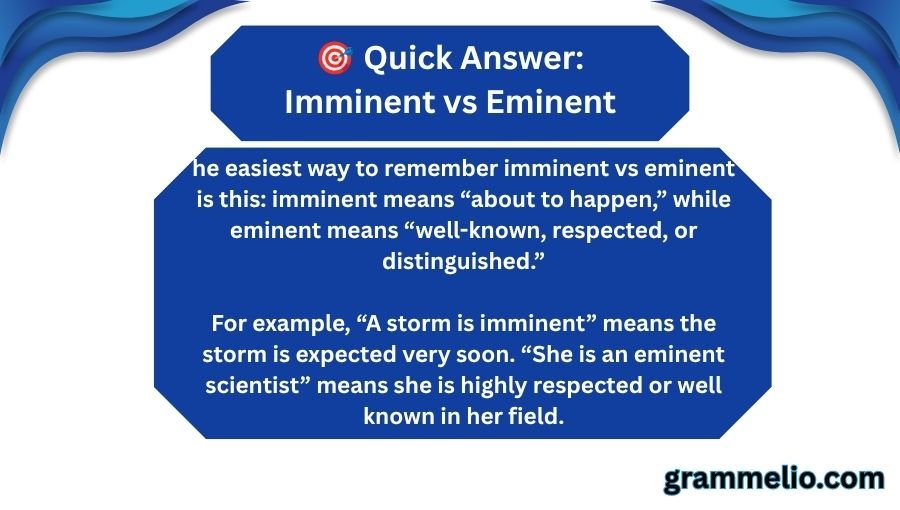
The easiest way to remember imminent vs eminent is this: imminent means “about to happen,” while eminent means “well-known, respected, or distinguished.”
For example, “A storm is imminent” means the storm is expected very soon. “She is an eminent scientist” means she is highly respected or well known in her field.
| Word | Basic Meaning | Typical Use | Example |
|---|---|---|---|
| Imminent | About to happen soon | Events, danger, change | A storm is imminent. |
| Eminent | Famous or highly respected | People, experts, leaders | He is an eminent historian. |
| Immanence | Presence or existence within something | Formal or philosophical writing | The idea concerns immanence. |
| Eminence | Fame, high rank, or distinction | Status or achievement | Her eminence was widely recognized. |
Is Imminent the Same as Eminent?
No. Imminent and eminent are not interchangeable. They differ in both meaning and use.
Imminent describes something that is likely to happen very soon. Eminent usually describes a person who is respected, famous, or important because of achievement or status.
Think about the difference this way:
- Imminent = near in time
- Eminent = high in status or reputation
Imminent
Use imminent when an event is close to happening.
Examples:
- The arrival of the train is imminent.
- The company warned that layoffs were imminent.
- Dark clouds suggested that heavy rain was imminent.
In each sentence, something is expected to happen soon.
Eminent
Use eminent when talking about someone who has earned great respect or recognition.
Examples:
- She is an eminent surgeon.
- The university invited an eminent author to speak.
- He became an eminent figure in the field of physics.
Here, the word describes reputation or importance rather than time.
🔍 Imminent vs Eminent at a Glance
The central difference is simple: imminent concerns time, while eminent concerns distinction or reputation.
| Form | Type | Meaning | Example | Correct/Incorrect |
|---|---|---|---|---|
| Imminent | Adjective | About to happen | A decision is imminent. | ✅ Correct |
| Eminent | Adjective | Famous or respected | She is an eminent doctor. | ✅ Correct |
| Imminent | Adjective | Famous or respected | He is an imminent professor. | ❌ Incorrect |
| Eminent | Adjective | About to happen | The storm is eminent. | ❌ Incorrect |
| Imminent | Adjective | Near in time | An imminent deadline is approaching. | ✅ Correct |
A useful mental picture is a clock for imminent and a trophy for eminent. ⏰🏆
The clock reminds you that something is coming soon. The trophy reminds you that someone has achieved a high level of respect.
What Does Imminent Mean?
Imminent means that something is about to happen or is likely to happen very soon.
The word normally describes an event, situation, change, threat, or action. It does not mean that the event is already happening. Instead, it is close enough that you expect it soon.
Consider these examples:
The storm is imminent.
This means the storm is expected shortly.
The deadline is imminent.
This means the deadline is very close.
An announcement is imminent.
This means an announcement is expected soon.
Common situations with imminent
You may use imminent with:
- danger
- death
- arrival
- change
- departure
- danger
- disaster
- storm
- deadline
- announcement
- decision
- attack
- threat
| Meaning | Word Type | Example Sentence |
|---|---|---|
| About to happen | Adjective | The launch is imminent. |
| Very near in time | Adjective | The deadline is imminent. |
| Likely to happen soon | Adjective | Officials warned of an imminent threat. |
💡 Test Tip
Ask yourself:
“Is this something that is about to happen?”
If the answer is yes, imminent is probably the word you need.
For example:
A major storm is about to arrive.
So:
A major storm is imminent.
This test works because the core idea behind the word is closeness in time.
What Does Eminent Mean?
Eminent means famous, respected, distinguished, or important because of achievement, ability, position, or reputation.
It most often describes people.
For example:
She is an eminent scientist.
This means she is a highly respected or distinguished scientist.
You can also use eminent for people in professional or academic fields:
- an eminent scholar
- an eminent lawyer
- an eminent physician
- an eminent historian
- an eminent professor
- an eminent artist
- an eminent leader
The word focuses on a person’s high standing rather than something happening soon.
| Meaning | Word Type | Example Sentence |
|---|---|---|
| Highly respected | Adjective | He is an eminent professor. |
| Distinguished | Adjective | She became an eminent researcher. |
| Famous in a field | Adjective | The eminent author received an award. |
A simple substitution test
Try replacing eminent with respected or distinguished.
If the sentence still makes sense, eminent may be correct.
She is an eminent historian.
Becomes:
She is a distinguished historian.
The meaning remains close.
Now try:
The storm is eminent.
Replacing it with “distinguished” produces nonsense.
That tells you eminent is the wrong choice.
Why Do People Confuse Imminent and Eminent?
People confuse these words because their spellings are nearly identical. Both begin with emin- or immin-, and both are often used in formal writing.
The main visual difference is the extra m in imminent.
I once reviewed a short school essay in which a student wrote that “an eminent storm was approaching.” The student clearly meant that the storm was about to arrive. We changed the word to imminent, and the sentence immediately became clear.
The mistake was understandable. The two words look almost like twins. Their meanings, however, are very different.
Other reasons include:
- fast typing
- autocorrect
- relying only on sound
- unfamiliarity with formal vocabulary
- confusing spelling patterns
- reading the words less often than hearing them
| Confusing Pair | Correct Difference |
|---|---|
| imminent / eminent | soon to happen / highly respected |
| affect / effect | influence / result |
| accept / except | receive or agree / excluding |
| advice / advise | recommendation / give guidance |
| principal / principle | leader or main / rule or belief |
| stationary / stationery | not moving / writing materials |
These pairs show why checking the meaning is often better than checking the spelling alone.
📝 Case Study: A Workplace Email
Imagine that a manager needs to warn employees that a major system update will happen that evening.
A poor sentence might say:
“The system change is eminent, so please save your files.”
❌ This suggests that the system change is famous or distinguished, which makes no sense.
The correct version is:
“The system change is imminent, so please save your files.”
✅ Now the meaning is clear. The change is about to happen.
Here is another workplace example:
“We invited an eminent technology expert to lead the training.”
✅ This sentence works because the expert is highly respected in the field.
Notice how the two words can appear in similar professional settings while serving completely different purposes.
📚 Grammar Rules Explanation: How the Two Words Work
The key grammar rule is based on meaning, not sentence position. Both imminent and eminent are adjectives, but they describe different qualities.
Imminent describes an event or situation that is close in time.
Eminent describes a person or figure that has high status, recognition, or respect.
Both can appear after a linking verb:
- The danger is imminent.
- The professor is eminent.
Both can also appear before nouns:
- an imminent danger
- an eminent professor
The noun that follows often gives you a strong clue.
If the noun is something that can happen, imminent may fit.
If the noun is a person with a notable reputation, eminent may fit.
Standard English reference works and dictionaries consistently distinguish the two meanings. The safest approach is to focus on the idea each word expresses rather than trying to memorize the spelling alone.
Correct vs Incorrect at a Glance
| Sentence | Correct/Incorrect | Why |
|---|---|---|
| A severe storm is imminent. | ✅ Correct | The storm is about to happen. |
| She is an eminent scientist. | ✅ Correct | She is highly respected. |
| The eminent storm could arrive tonight. | ❌ Incorrect | A storm is not “distinguished.” |
| He is an imminent scholar. | ❌ Incorrect | A scholar is not being described as something about to happen. |
| The announcement is imminent. | ✅ Correct | The announcement is expected soon. |
The easiest rule is:
If you mean “soon,” choose imminent. If you mean “respected,” choose eminent.
⚠️ Common Mistakes With Imminent and Eminent
Most mistakes happen because writers recognize the general shape of the word but do not stop to check its meaning.
Mistake 1: Using eminent for an approaching event
❌ The deadline is eminent.
The deadline is not famous or distinguished.
✅ The deadline is imminent.
The deadline is close.
Mistake 2: Using imminent for a respected person
❌ She is an imminent author.
This suggests that the author is about to happen, which does not make sense.
✅ She is an eminent author.
This means she is a respected or distinguished author.
Mistake 3: Choosing based on sound alone
The words can sound similar, especially in fast speech. That can make them easy to mix up.
When you are unsure, stop and ask what you actually mean.
| Common Problem | Why It Happens | Better Habit |
|---|---|---|
| Fast typing | Fingers follow familiar patterns | Read the sentence again |
| Autocorrect | Software may not know your intended meaning | Check unusual word choices |
| Lack of knowledge | The words look similar | Learn the core meanings |
| Listening only | Similar sounds cause confusion | Focus on context |
| Rushing | Writer skips proofreading | Read important writing aloud |
Specific Wrong Forms and Uses
| Wrong Form or Use | What’s Wrong | Correct Form |
|---|---|---|
| eminent danger | Danger is not respected | imminent danger |
| imminent professor | A professor is not “about to happen” | eminent professor |
| eminent deadline | A deadline is not distinguished | imminent deadline |
| imminent expert | An expert is not an approaching event | eminent expert |
| eminent arrival | An arrival is an event | imminent arrival |
| imminent scholar | The word does not describe the scholar’s reputation | eminent scholar |
I once caught myself typing the wrong word in an editing note because I was moving quickly. I stopped before sending it and asked the same question I recommend to students: “Am I talking about time or status?” The answer was time, so imminent was the clear choice.
🕰️ Word Origin and History
The history of these words helps explain why they look so similar.
Both are connected to older Latin-based word families, but they developed with different meanings. Imminent became associated with something hanging over or approaching closely. Eminent developed around the idea of rising above or standing out.
You do not need to memorize the full history to use them correctly. The modern meanings are much easier to remember.
| Period | Form or Development | General Note |
|---|---|---|
| Latin period | Related Latin word families | The two families had different senses |
| Medieval English | Latin-based forms entered English use | Formal vocabulary expanded |
| Early Modern English | Related spellings became established | Meanings became more familiar in English |
| Modern English | imminent / eminent | The words remain distinct in meaning |
The important lesson is that similar spelling does not mean identical meaning.
Where Should You Use Imminent vs Eminent?
The correct word depends on the context. Imminent is useful when discussing upcoming events, while eminent is useful when describing respected people.
Everyday Conversation
In everyday speech, imminent is useful for things that are about to happen.
“Rain looks imminent.”
Eminent is less common in casual conversation because “famous,” “respected,” or “well known” may sound more natural.
Professional Writing
Both words can be useful in professional writing.
“The policy change is imminent.”
“The panel includes several eminent researchers.”
These sentences are concise and formal.
Creative Writing
Writers can use imminent to create tension.
“She heard the footsteps and knew danger was imminent.”
Eminent can establish a character’s reputation.
“An eminent historian entered the quiet library.”
Social Media and Texting
You are less likely to need eminent in casual posts, but imminent can appear when discussing upcoming events.
“The weekend is imminent! 🎉”
| Context | Which Term to Use | Example |
|---|---|---|
| Everyday conversation | Usually imminent | The storm is imminent. |
| Professional writing | Either, depending on meaning | The change is imminent. |
| Creative writing | Either, depending on meaning | An eminent scholar arrived. |
| Social media/texting | Usually imminent | Vacation is imminent! |
How Can You Remember the Difference?
A strong memory trick can make this distinction almost automatic.
Think:
IMMINENT = IMMEDIATE
The two words begin differently, but both ideas point toward something happening soon.
Think:
EMINENT = ELEVATED
An eminent person has a high level of respect or standing.
Another simple trick is to connect each word with a question.
| Question | Answer | Word |
|---|---|---|
| Is it about to happen? | Yes | Imminent |
| Is someone highly respected? | Yes | Eminent |
| Is the event approaching? | Yes | Imminent |
| Is the person distinguished? | Yes | Eminent |
| Does it describe timing? | Yes | Imminent |
| Does it describe reputation? | Yes | Eminent |
If you remember only one thing, remember this:
Imminent is about time. Eminent is about status.
Common Phrases With Imminent
There are several natural combinations with imminent. These usually describe events, threats, or changes that are expected soon.
| Phrase | Meaning |
|---|---|
| imminent danger | Danger that is about to occur |
| imminent threat | A threat expected very soon |
| imminent arrival | An arrival that will happen shortly |
| imminent change | A change expected soon |
| imminent deadline | A deadline that is very close |
| imminent decision | A decision expected shortly |
For example:
The firefighters prepared for imminent danger.
Her imminent arrival caused everyone to hurry.
These combinations are useful in news reports, workplace writing, essays, and formal communication.
Common Phrases With Eminent
Eminent often appears with words connected to professions, achievement, and reputation.
| Phrase | Meaning |
|---|---|
| eminent scholar | A highly respected scholar |
| eminent scientist | A distinguished scientist |
| eminent professor | A respected professor |
| eminent author | A well-regarded author |
| eminent leader | A highly respected leader |
| eminent expert | A recognized expert |
For example:
The conference attracted several eminent scientists.
The word emphasizes their standing in their field.
Can Synonyms Help You Choose the Right Word?
Yes. Substituting a simpler word is one of the fastest ways to test your choice.
For imminent, try words such as “approaching,” “near,” or “about to happen.”
For eminent, try “distinguished,” “respected,” or “prominent.”
| Alternative | Works When | Does Not Work When |
|---|---|---|
| approaching | Something is coming soon | Describing someone’s reputation |
| upcoming | An event will happen soon | Describing a respected person |
| near | Something is close in time | You need to describe achievement |
| distinguished | Describing a respected person | Describing an approaching event |
| prominent | Describing someone or something notable | Simply meaning “about to happen” |
For example:
An imminent deadline
can become:
An approaching deadline.
But:
An eminent professor
can become:
A distinguished professor.
The substitutions reveal the difference.
Why Does Getting This Difference Right Matter?
Correct word choice makes your writing clearer. A single wrong adjective can change the meaning of a sentence or make it sound strange.
This matters especially in professional and academic writing. Readers should not have to guess what you mean.
“The eminent threat requires action.”
❌ The sentence sounds wrong because “eminent” does not describe an approaching threat.
“The imminent threat requires action.”
✅ Now the meaning is clear.
A useful writing principle is:
Clear words create clear ideas.
| Situation | Why Getting It Right Matters |
|---|---|
| Resume | Shows careful writing and word choice |
| Client email | Prevents confusion |
| Published content | Builds reader trust |
| Social post | Makes your message easier to understand |
Good grammar is not just about passing a test. It helps your reader understand you the first time.
Is There a Special Exception?
There is no major spelling exception that changes the basic distinction between these two words. The safest approach is to learn their core meanings and apply them according to context.
One useful point is that eminent is normally used for people or things that have a high level of distinction or importance. Imminent normally describes something expected to happen soon.
Do not treat them as alternate spellings of the same word.
🎯 Quick Recap Checklist
Before you choose between these words, ask yourself what your sentence is really saying.
| Question | If Yes → Use |
|---|---|
| Is something about to happen? | Imminent |
| Is an event very close in time? | Imminent |
| Is there an approaching threat? | Imminent |
| Is a person highly respected? | Eminent |
| Is someone distinguished in a field? | Eminent |
| Are you describing professional status? | Eminent |
Practice Examples
- The arrival of the guests is ______.
- imminent ✅
- The university honored an ______ professor.
- eminent ✅
- Officials warned that an ______ storm could cause flooding.
- imminent ✅
If you can connect the sentence to soon, choose imminent. If you can connect it to respected, choose eminent.
What Are the Key Differences Between Imminent and Eminent?
The most important difference is the idea each adjective expresses.
Imminent tells us about time. Eminent tells us about reputation, importance, or distinction.
| Feature | Imminent | Eminent |
|---|---|---|
| Main idea | Soon to happen | Highly respected |
| Focus | Time | Status |
| Common noun | Threat, event, arrival, deadline | Person, expert, scholar |
| Easy synonym | Approaching | Distinguished |
| Memory clue | Immediate | Elevated |
| Example | Danger is imminent. | She is eminent in her field. |
This table gives you the entire rule in one place.
Why Is Imminent Used for Events?
The word imminent is used for events because its meaning centers on something being very close in time.
Consider:
The election is imminent.
The sentence tells us that the election is coming soon.
Likewise:
The baby’s arrival is imminent.
The arrival has not happened yet, but it is expected shortly.
This makes imminent especially useful when a writer wants to create a sense of urgency.
Why Is Eminent Used for People?
Eminent describes people because it points to their high standing or reputation.
For example:
She is an eminent lawyer.
This tells us that she is highly respected in the legal field.
The sentence does not tell us when she will do something. It tells us how she is regarded.
That difference is the heart of the entire comparison.
How Can Writers Avoid This Mistake?
The best method is to pause for one second before choosing the word.
Ask:
“Am I talking about when something will happen, or how important someone is?”
If you are talking about when, use imminent.
If you are talking about importance or reputation, use eminent.
I recommend this method because it is faster than trying to remember the spelling every time.
You can also proofread by replacing the word:
- imminent → about to happen
- eminent → highly respected
If the replacement sounds right, your original choice is probably right too.
FAQs About Imminent vs Eminent
What is the difference between imminent and eminent?
Imminent means something is about to happen soon. Eminent means someone or something is famous, respected, or distinguished.
Is imminent used for people?
Usually, no. Imminent normally describes an event, situation, threat, or change that is expected soon. For a highly respected person, use eminent.
Is eminent used for events?
Generally, no. If an event is about to happen, imminent is the correct word.
Which is correct: imminent danger or eminent danger?
Imminent danger is correct. It means danger that is about to occur or is very close.
Which is correct: eminent scientist or imminent scientist?
Eminent scientist is correct when you mean a highly respected or distinguished scientist.
Does imminent mean immediate?
They are closely related, but they are not always exact substitutes. Imminent means something is very close to happening, while immediate can also mean happening or needing attention without delay.
Does eminent mean famous?
It can. Eminent often means highly respected, distinguished, or important. Fame may be part of that status, but the word usually carries a stronger sense of achievement or distinction.
How can I remember imminent vs eminent?
Use the memory rule “imminent = soon” and “eminent = respected.” You can also remember that imminent is connected with an approaching event, while eminent describes someone who stands out because of achievement or status.
Is “the deadline is eminent” correct?
No. The correct sentence is “The deadline is imminent.” A deadline can be close in time, but it cannot be “distinguished.”
Is “an eminent professor” correct?
Yes. An eminent professor is a professor who is highly respected, distinguished, or well known for achievement.
Final Thoughts on Imminent vs Eminent
Imminent vs eminent becomes easy once you connect each word to its main idea. Imminent means that something is about to happen, while eminent describes someone or something that is highly respected, distinguished, or important. ⏰🏆
When you see imminent, think about time. A storm, deadline, arrival, announcement, or threat can be imminent because it is close to happening. When you see eminent, think about status. A scientist, author, professor, expert, or leader can be eminent because of achievement and respect.
I find that the quickest test is also the most useful: replace imminent with “about to happen” and replace eminent with “highly respected.” If the sentence still makes sense, you have probably chosen the right word.
Master that one distinction, and this common spelling mix-up becomes much easier to avoid. ✨


[…] the end, you should feel confident using both words without stopping to second-guess yourself. Imminent vs Eminent | Idle vs Idol vs Idyll | Homogeneous vs […]
[…] the end, you will be able to use both forms with confidence. ✨ Loath vs Loathe | Imminent vs Eminent | Idle vs Idol vs […]