Have you ever stopped while writing and wondered whether you should use liable vs libel? I see this mix-up often because the two words look and sound alike, but they have very different meanings. One word is usually connected to legal responsibility, while the other refers to a harmful false statement that is published about someone. 😅
If you are a student, writer, editor, business owner, or professional who wants clear US English, knowing this difference can save you from an embarrassing mistake. I use a simple meaning test whenever I need to choose between these words. Once you connect each word with its main idea, the confusion becomes much easier to handle.
In this guide, I will explain the difference with simple definitions, examples, memory tricks, tables, common mistakes, and real-world situations. By the end, you should feel confident choosing the right word. Levee vs Levy | Lessen vs Lesson | Lean vs Lien
🎯 Quick Answer: Liable vs Libel
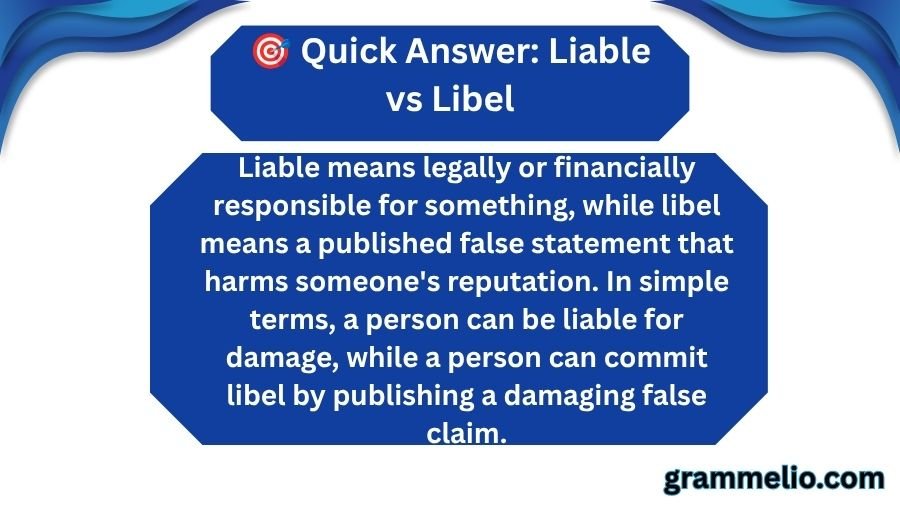
Liable means legally or financially responsible for something, while libel means a published false statement that harms someone’s reputation. In simple terms, a person can be liable for damage, while a person can commit libel by publishing a damaging false claim.
Think of the two words this way:
- Liable = responsible ⚖️
- Libel = published false statement 📰
Here are two quick examples:
✅ The company may be liable for the damage.
❌ The company may be libel for the damage.
The first sentence works because liable describes responsibility.
✅ The newspaper was accused of libel.
❌ The newspaper was accused of liable.
The second sentence works because libel refers to the act or offense involving a false published statement.
Is Liable the Same as Libel?
No, liable and libel are not the same. Liable generally describes responsibility for an action, loss, debt, injury, or other obligation. Libel refers to a false written or otherwise published statement that damages someone’s reputation.
The easiest way to separate them is to focus on the idea behind each word.
Liable answers a question such as:
Who is responsible?
Libel answers a question such as:
What harmful false statement was published?
For example:
✅ The driver was liable for the cost of the repairs.
Here, liable means responsible for paying or covering the cost.
✅ The website removed the statement after facing a libel complaint.
Here, libel refers to the harmful published statement.
A simple side-by-side comparison
| Form | Type | Meaning | Example | Correct/Incorrect |
|---|---|---|---|---|
| Liable | Adjective | Responsible for something | The owner was liable for the loss. | ✅ Correct |
| Libel | Noun | A harmful false published statement | The article led to a libel claim. | ✅ Correct |
| Libel | Verb | To publish a harmful false statement | The paper could libel someone. | ✅ Correct |
| Liable | Verb | A verb meaning “to publish a false statement” | The newspaper liabled the actor. | ❌ Incorrect |
The last example shows an important point: liable is an adjective. Libel can be a noun or a verb.
🧩 Liable: Meaning and Correct Use
Liable is an adjective that describes someone or something that has legal, financial, or other responsibility for an action or result.
For example:
✅ The business is liable for the customer’s medical expenses.
The word liable tells us that the business has responsibility for the expenses.
Liable for something
One common pattern is:
liable + for + noun
Examples include:
- liable for damages
- liable for a debt
- liable for the costs
- liable for an injury
- liable for the loss
Consider this sentence:
✅ The contractor may be liable for the repair costs.
The contractor is the person who may have responsibility. The repair costs are the thing connected to that responsibility.
Liable to do something
Liable can also appear in a different pattern:
liable + to + verb
In this structure, it can mean that something is likely to happen, often in a negative or unwanted situation.
For example:
✅ If you ignore the warning, you are liable to make the same mistake again.
Here, liable to make does not mean legal responsibility. It means the person is likely to make the mistake.
That second use is worth remembering because context matters.
Meaning summary
| Meaning | Word Type | Example Sentence |
|---|---|---|
| Legally responsible | Adjective | The company is liable for the damage. |
| Financially responsible | Adjective | He is liable for the unpaid debt. |
| Likely to experience something | Adjective | You are liable to miss the train if you leave late. |
📰 Libel: Meaning and Correct Use
Libel is commonly used as a noun for a false published statement that harms someone’s reputation. It can also be used as a verb meaning to publish such a statement. Understanding liable vs libel also means knowing that libel can function as both a noun and a verb.
The key idea is publication plus harm to reputation.
For example:
✅ The actor filed a claim involving libel.
Here, libel is a noun.
As a verb:
✅ The magazine was accused of libeling the politician.
Here, libeling is the action of publishing the harmful false statement.
Libel as a noun
When libel acts as a noun, it can refer to the harmful publication or the legal matter involving such a publication.
Examples:
- The writer faced a libel claim.
- The newspaper apologized after the libel dispute.
- The company threatened legal action over alleged libel.
Libel as a verb
When libel acts as a verb, it describes the act of publishing a false statement that harms someone’s reputation.
Examples:
- The article could libel the business owner.
- The publisher was accused of libeling the athlete.
The grammar changes when the word changes from noun to verb.
| Use | Part of Speech | Example |
|---|---|---|
| Libel | Noun | The company filed a libel claim. |
| Libel | Verb | The article could libel the company. |
| Libeling | Verb form | The publisher was accused of libeling him. |
| Libeled | Past-tense verb | The paper was accused of having libeled the actor. |
🔍 What Is the Main Difference Between Liable and Libel?
The main difference is that liable describes responsibility, while libel describes a harmful false publication.
A useful mental picture is this:
Liable → responsibility → who must answer for something
Libel → reputation → harmful false publication
Compare these sentences:
✅ The company was liable for the damage caused by its employee.
❌ The company was libel for the damage caused by its employee.
And:
✅ The company was accused of libel after publishing a false claim.
❌ The company was accused of liable after publishing a false claim.
The two words are close in spelling, but they belong to different grammatical categories and express different ideas.
The core distinction
| Feature | Liable | Libel |
|---|---|---|
| Main idea | Responsibility | Harmful false publication |
| Usual part of speech | Adjective | Noun or verb |
| Common pattern | liable for | accused of libel |
| Connected idea | Duty or responsibility | Reputation |
| Example | liable for damages | libel claim |
💡 Why Do People Confuse Liable and Libel?
People confuse liable and libel mainly because they look similar and both can appear in legal or professional writing.
The spelling can create a mental trap. The words begin with similar letters, contain similar sounds, and often appear in serious contexts. That makes it easy to type one when you mean the other.
I once edited a short business report in which the writer used libel when they clearly meant liable. The sentence was about paying for property damage, so the intended meaning was responsibility. A quick meaning check fixed the problem.
Another reason is that people often associate both words with lawsuits. That association is understandable, but it is too broad. Legal writing contains many different concepts. A person may be liable for an injury without any libel being involved. A publication may involve libel without the word liable appearing at all.
Three reasons the mix-up happens
| Reason | What Happens | Helpful Fix |
|---|---|---|
| Similar spelling | The eye sees similar letter patterns | Focus on meaning |
| Legal context | Both can appear around disputes | Ask what the sentence describes |
| Fast typing | Your brain chooses a familiar-looking word | Proofread legal terms carefully |
| Autocorrect | Software may suggest the wrong word | Read the whole sentence |
| Limited exposure | A writer may know one word better | Learn each word with examples |
📝 Case Study: A Workplace Email
Imagine that a manager sends this email:
“The company may be libel for the repair costs.”
The manager probably means that the company may be responsible for paying the repair costs.
The correct sentence is:
✅ The company may be liable for the repair costs.
Now imagine a different email:
“The company may face a libel complaint after publishing the false statement.”
Here, libel is correct because the sentence concerns a published false statement that may harm someone’s reputation.
The difference becomes obvious when we ask what the sentence is really about.
| Workplace Situation | Correct Word | Example |
|---|---|---|
| Paying for damage | Liable | The company may be liable for the damage. |
| Responsibility for a debt | Liable | The borrower is liable for the unpaid amount. |
| False published claim | Libel | The article led to a libel complaint. |
| Publishing a harmful false statement | Libel | The publisher could libel the business. |
This is a useful lesson for emails, reports, contracts, articles, and workplace messages. Choose the word based on meaning rather than spelling.
📚 Grammar Rules Explanation
Liable functions primarily as an adjective. It describes a person, organization, or thing that is responsible for something or that is likely to experience something.
Libel functions as both a noun and a verb. As a noun, it refers to a harmful false published statement or the related legal matter. As a verb, it means to publish such a statement.
Most standard English reference sources make the same basic distinction: these are separate words with separate meanings.
The grammar also gives you a useful clue.
A sentence such as:
✅ The manufacturer is liable for the defective product.
uses an adjective after the linking verb is.
By contrast:
✅ The publisher faced a libel claim.
uses libel as a noun.
And:
✅ The publisher could libel the company.
uses libel as a verb.
Correct vs Incorrect at a Glance
| Sentence | Correct/Incorrect | Why |
|---|---|---|
| The company is liable for the damages. | ✅ Correct | Liable describes responsibility. |
| The company is libel for the damages. | ❌ Incorrect | Libel does not work as the adjective here. |
| The newspaper faced a libel claim. | ✅ Correct | Libel is a noun referring to the issue. |
| The newspaper faced a liable claim. | ❌ Incorrect | Liable describes responsibility, not the claim itself. |
| The article could libel the business owner. | ✅ Correct | Libel is used as a verb. |
⚠️ Common Mistakes With Liable and Libel
The biggest mistake is choosing a word because it looks right instead of choosing it because it has the right meaning. A quick meaning check is one of the easiest ways to avoid mistakes with liable vs libel.
I once caught myself typing a similar-looking word while proofreading a legal-style sentence late in the afternoon. I stopped because the sentence was about financial responsibility, not reputation. That quick pause was enough to catch the error.
Here are some common sources of confusion.
Similar English mix-ups
| Confusing Pair | First Word | Second Word | Basic Difference |
|---|---|---|---|
| Liable / Libel | Liable | Libel | Responsibility vs. harmful false publication |
| Its / It’s | Its | It’s | Possession vs. “it is” |
| Your / You’re | Your | You’re | Possession vs. “you are” |
| Affect / Effect | Affect | Effect | Usually influence vs. result |
| Advice / Advise | Advice | Advise | Noun vs. verb |
| Principal / Principle | Principal | Principle | Person/main item vs. rule or belief |
The lesson is simple: similar-looking words need meaning checks.
Common wrong forms for this topic
| Wrong Form | What’s Wrong | Correct Form |
|---|---|---|
| The company is libel for the debt. | Libel is not the correct adjective here. | The company is liable for the debt. |
| The newspaper is liable for the false article. | If the intended meaning is the published false statement, the noun is wrong. | The newspaper faced a libel claim. |
| He was accused of liable. | Liable is an adjective, not the noun needed here. | He was accused of libel. |
| The article liabled the actor. | Liable is not the verb meaning to publish a harmful false claim. | The article libeled the actor. |
| She is libel to pay the bill. | Libel cannot replace liable in this expression. | She is liable to pay the bill. |
🧠 How Can You Remember Liable vs Libel?
The fastest memory trick is to connect each word with one simple idea. This simple memory trick makes liable vs libel easier to remember when you are writing quickly.
Liable = responsibility.
Libel = reputation.
You can also use the first letters of the key ideas:
Liable → Legal responsibility
Libel → Libelous publication affecting Legend or reputation
A simpler trick is even better:
If someone owes, pays, or is responsible, think liable.
If something is published and harms a reputation, think libel.
The “responsibility test”
Ask:
“Does this sentence say who is responsible for something?”
If yes, liable is probably the word you need.
✅ The landlord may be liable for the repair.
The “publication test”
Ask:
“Does this sentence involve a false published claim that harms someone’s reputation?”
If yes, libel may be the correct term.
✅ The publication faced a libel complaint.
🗣️ Usage in Different Contexts
The difference between liable vs libel becomes especially useful when you are writing for different audiences and situations.
The correct choice depends on what you are trying to say. The words can appear in everyday conversation, professional writing, creative writing, and online communication, but they do not replace each other. The correct choice in liable vs libel always depends on the meaning you want to communicate.
| Context | Which Term to Use | Example |
|---|---|---|
| Everyday conversation | Liable | You could be liable for the damage. |
| Professional writing | Liable | The contractor may be liable for the costs. |
| Professional/legal discussion | Libel | The company denied the libel allegation. |
| Creative writing | Either, depending on meaning | The publisher faced a libel dispute. |
| Social media | Libel | Be careful before making a false published accusation. |
| Financial discussion | Liable | The borrower is liable for the debt. |
Everyday conversation
In normal conversation, liable often appears when people discuss responsibility.
✅ If you break it, you may be liable for the repair.
Libel is less common in casual conversation, but it can appear when people discuss newspapers, online posts, or reputation.
Professional writing
Professional writing demands extra care because a wrong word can change the meaning of a sentence.
For example:
✅ The supplier may be liable for losses caused by the delay.
That sentence clearly assigns responsibility.
Social media and texting
Social media makes libel especially relevant because people can publish statements quickly and widely. However, not every negative statement is automatically libel. The legal question depends on facts and applicable law.
For everyday writing, the main language lesson remains the same: use liable for responsibility and libel for the relevant type of harmful false publication.
🔗 Common Phrases With Liable and Libel
Certain word combinations can make the distinction easier to remember.
| Phrase | Meaning |
|---|---|
| liable for damages | Responsible for paying damages |
| liable for the loss | Responsible for a loss |
| liable for a debt | Responsible for a debt |
| liable to pay | Responsible or required to pay, depending on context |
| libel claim | A claim involving alleged libel |
| libel lawsuit | A lawsuit involving alleged libel |
These phrases are useful because they show how each word naturally fits into a sentence.
For example:
✅ The driver may be liable for damages.
But:
❌ The driver may be libel for damages.
The second sentence fails because libel does not express responsibility.
🔄 Synonyms and Alternatives
Sometimes you can replace liable with another phrase, depending on context. Likewise, libel may be described with a longer phrase when greater clarity is useful. Knowing liable vs libel also helps you choose a clearer alternative when the exact word is not necessary. A clear understanding of liable vs libel also makes it easier to select the right alternative when rewriting a sentence.
| Alternative | Works When | Does Not Work When |
|---|---|---|
| Responsible | You mean someone must answer for something | You specifically mean published false content |
| Accountable | You mean someone has responsibility | You need the specific legal or financial meaning |
| At fault | You mean someone caused a problem | The sentence is specifically about a debt or obligation |
| Defamatory publication | You mean harmful false published content | You simply mean financial responsibility |
| False published statement | You want a plain-English description | You need a concise legal term |
For example:
✅ The company was responsible for the damage.
This can often replace:
✅ The company was liable for the damage.
But you cannot replace libel with responsible in:
The newspaper faced a libel claim.
The two ideas are different.
❓ Can Liable Mean “Likely”?
Yes. Liable can sometimes mean likely to experience something, especially in the structure liable to + verb.
For example:
✅ You are liable to forget if you do not write it down.
Here, liable does not mean legally responsible.
This is an important special use because learners may assume that liable always has a legal meaning.
Compare:
| Sentence | Meaning of Liable |
|---|---|
| The company is liable for the damage. | Responsible |
| He is liable for the unpaid bill. | Responsible |
| You are liable to forget the appointment. | Likely |
| The old system is liable to fail. | Likely |
Context tells you which meaning is intended.
❓ Can Libel Be Used as a Verb?
Yes. Libel can function as a verb.
For example:
✅ The publisher could libel the business owner by printing a false claim.
Its forms can include:
- libel
- libels
- libeled
- libeling
US English commonly uses libeled and libeling with the single l in the middle pattern shown above.
The verb should not be confused with liable.
❓ Which Is Correct: Liable for or Libel for?
Liable for is the correct phrase when you mean responsible for something.
✅ The company is liable for the costs.
❌ The company is libel for the costs.
The phrase liable for is a useful signal. When you see responsibility, debt, damages, costs, or similar obligations, liable is often the word you need.
❓ Is It “Liable to Pay” or “Libel to Pay”?
The correct expression is liable to pay.
✅ The customer is liable to pay the outstanding amount.
❌ The customer is libel to pay the outstanding amount.
Here, liable describes responsibility or an obligation.
Do not let the similar spelling of libel trick you into choosing it.
❓ What Is the Difference Between Libel and Slander?
Both terms concern false statements that can harm someone’s reputation, but the traditional distinction is based on how the statement is communicated.
Libel is generally associated with published or recorded statements.
Slander is generally associated with spoken statements.
| Term | General Idea | Simple Example |
|---|---|---|
| Libel | Harmful false published statement | A false statement printed in an article |
| Slander | Harmful false spoken statement | A false accusation spoken publicly |
The exact legal rules can vary by jurisdiction, so this is a language distinction rather than legal advice.
❓ How Do I Use Liable in a Sentence?
Use liable when you want to describe responsibility or, in another common pattern, likelihood.
Examples:
✅ The company is liable for the damage.
✅ The driver may be liable for the repair bill.
✅ You are liable to forget the password if you never use it.
A common structure is:
subject + be + liable + for + noun
Example:
The contractor is liable for the repairs.
❓ How Do I Use Libel in a Sentence?
Use libel as a noun when referring to the harmful false publication or related legal matter.
✅ The newspaper faced a libel claim.
Use it as a verb when describing the act of publishing the harmful false statement.
✅ The article could libel the business owner.
The surrounding grammar usually makes the role clear.
❓ Why Is Liable Often Used in Legal Writing?
Liable is useful in legal and business writing because it expresses responsibility or an obligation.
For example:
The party may be liable for damages.
This tells the reader that the party may have responsibility for the damages.
The word also appears outside strict legal writing. People can discuss being liable for bills, costs, losses, or repairs in everyday and professional settings.
❓ Why Is Libel Important in Publishing?
Libel matters in publishing because written or recorded statements can affect a person’s or organization’s reputation.
Writers, editors, publishers, and social media users should check claims carefully before presenting serious accusations as facts.
Good writing does not just sound polished. It also uses words carefully and avoids stating uncertain claims as established facts.
❓ What Is an Easy Way to Remember Liable vs Libel?
Remember:
Liable = responsibility.
Libel = reputation and harmful false publication.
Try the one-word replacement test.
If you can replace the word with responsible, choose liable.
If the sentence is about a harmful false statement that was published, think libel.
💬 Why Getting Liable and Libel Right Matters
Correct word choice improves clarity, professionalism, and trust. Learning liable vs libel is especially useful when your writing involves business, publishing, legal matters, or reputation.
A single wrong word can make a sentence sound strange or even change its meaning. This matters especially in emails, reports, articles, contracts, business communication, and online posts.
A useful writing principle is:
“Clear words make clear ideas.”
That simple rule applies well here.
| Situation | Why Getting It Right Matters |
|---|---|
| Resume or application | Shows careful command of English |
| Client email | Prevents confusing professional communication |
| Published content | Helps protect accuracy and credibility |
| Social post | Reduces the chance of misleading readers |
When your writing deals with responsibility or reputation, precision matters even more.
🎯 Quick Recap Checklist
Use this liable vs libel checklist whenever you are unsure which word belongs in your sentence.
Use this checklist whenever you hesitate between the two words.
| Question | If Yes → Use |
|---|---|
| Does the word mean responsible? | Liable |
| Does it describe responsibility for money or damage? | Liable |
| Does it mean likely in “___ to happen”? | Liable |
| Is the sentence about a harmful false published statement? | Libel |
| Is the word being used as a noun for that publication or claim? | Libel |
| Is the word being used as a verb for publishing that statement? | Libel |
Practice examples
- The manufacturer may be liable for the defective product.
- The newspaper faced a libel claim.
- The publisher could libel the company by printing a false accusation.
If you can explain why each word works, you have mastered the basic distinction.
✏️ Three More Practice Sentences
Try choosing the word before checking the answers.
1. The restaurant may be ___ for the customer’s medical costs.
Answer: liable.
Why? The sentence is about responsibility.
2. The magazine was accused of ___.
Answer: libel.
Why? The sentence refers to a harmful false publication.
3. The writer could ___ the business if the false claim were published.
Answer: libel.
Why? Here, the word is functioning as a verb.
| Practice Sentence | Answer | Reason |
|---|---|---|
| The company is ___ for the loss. | Liable | Responsibility |
| The publisher faced a ___ claim. | Libel | Harmful false publication |
| The article could ___ the company. | Libel | Verb meaning to publish the harmful statement |
🧾 Final Comparison Table
This final comparison brings the key points of liable vs libel together in one quick reference.
| Question | Liable | Libel |
|---|---|---|
| Is it mainly an adjective? | Yes | No; commonly noun or verb |
| Does it mean responsible? | Yes | No |
| Can it mean likely? | Yes, in some constructions | No |
| Can it describe a harmful false publication? | No | Yes |
| Can it be a verb? | Not in the relevant sense | Yes |
| Common phrase | liable for | libel claim |
| Main memory word | Responsibility | Reputation |
FAQs About Liable vs Libel
What does liable mean?
Liable usually means responsible for something, especially a cost, debt, loss, injury, or legal obligation. It can also mean likely in the structure liable to + verb.
What does libel mean?
Libel generally refers to a false published statement that harms someone’s reputation. It can be a noun or a verb.
Is liable an adjective?
Yes. Liable is an adjective. For example: The company is liable for the damage.
Is libel a noun or a verb?
It can be both. As a noun, you might say a libel claim. As a verb, you might say the article could libel the business.
Is “liable for” correct?
Yes. Liable for is a standard construction when describing responsibility.
Example:
✅ The contractor is liable for the repair costs.
Is “libel for” correct?
Usually not when you mean responsibility. The correct phrase is liable for.
Can liable mean likely?
Yes. In a sentence such as “You are liable to forget,” the word can mean likely to do or experience something.
What is the difference between libel and slander?
The traditional language distinction is that libel concerns harmful false statements that are published or recorded, while slander concerns harmful false spoken statements. Legal rules can vary by jurisdiction.
How can I remember the difference between liable and libel?
Remember liable = responsibility and libel = harmful false publication affecting reputation. If someone is responsible for a cost, use liable. If the issue is a harmful false published claim, use libel.
Which word should I use for financial responsibility?
Use liable.
✅ The company is liable for the unpaid debt.
Do not use libel to mean financial responsibility.
Conclusion
Liable vs libel becomes much easier when you stop focusing on spelling and focus on meaning. Liable is mainly an adjective that describes responsibility, such as responsibility for damages, costs, debts, or losses. It can also mean likely in expressions such as “liable to happen.” Libel, on the other hand, is a noun or verb connected with harmful false published statements. 🧠
When I proofread these words, I use one simple question: “Am I talking about responsibility, or am I talking about reputation?” If the answer is responsibility, choose liable. If the answer involves a harmful false publication, choose libel.
This small memory trick can help you write clearer emails, articles, reports, social posts, and professional documents. ✨ The words may look similar, but their meanings are far apart. Remember the idea behind the word, and the spelling becomes much easier to choose.

[…] and see it in real sentences, you will have a simple way to choose the right spelling every time. Liable vs Libel | Levee vs Levy | Lessen vs […]
[…] that relationship, the spelling and meaning become much easier to remember. Links vs Lynx | Liable vs Libel | Levee vs […]