I have seen adapt vs adopt confuse students, bloggers, job seekers, and even experienced writers. The two words look and sound similar, but they do different jobs in a sentence. If you are writing an email, polishing a resume, preparing a school paper, or simply trying to sound clear in everyday English, knowing this difference can save you from an easy mistake. 😊
I teach word-choice rules by looking at what each word actually means, not by asking learners to memorize long grammar rules. The simplest idea is this: adapt means to change something so it works in a new situation, while adopt means to accept, choose, or take something as your own.
Once you see that basic difference, the pair becomes much easier. In this guide, I will show you how to use both words correctly, where people go wrong, and how to remember the difference for good. Accept vs Except
🎯 Quick Answer: Adapt vs Adopt
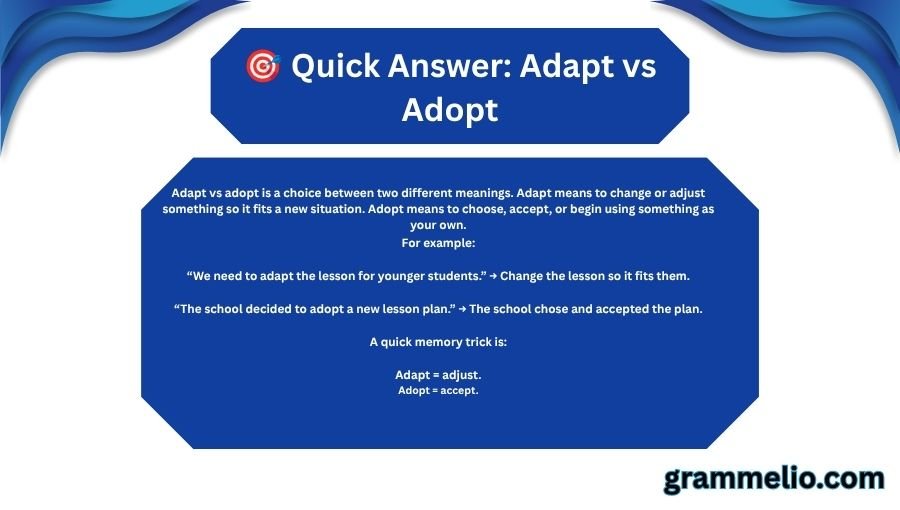
Adapt vs adopt is a choice between two different meanings. Adapt means to change or adjust something so it fits a new situation. Adopt means to choose, accept, or begin using something as your own.
For example:
- “We need to adapt the lesson for younger students.” → Change the lesson so it fits them.
- “The school decided to adopt a new lesson plan.” → The school chose and accepted the plan.
A quick memory trick is:
Adapt = adjust.
Adopt = accept.
Related Word Forms
Both words have several useful forms. Learning them together can make the difference easier to remember.
| Form | Type | Example |
|---|---|---|
| adapt | verb | We must adapt to the change. |
| adapts | present-tense verb | She adapts quickly. |
| adapted | past-tense/past participle | The story was adapted for film. |
| adapting | present participle | They are adapting to the new system. |
| adaptation | noun | The adaptation was successful. |
| adopt | verb | They adopted a new policy. |
| adopts | present-tense verb | The company adopts new tools carefully. |
| adopted | past-tense/past participle | The plan was adopted last year. |
| adopting | present participle | The team is adopting a new method. |
| adoption | noun | The adoption of the rule took time. |
Notice that adaptation usually relates to a change made to fit a new condition, while adoption often refers to accepting or choosing something.
🎯 Understanding the Basics of Adapt vs Adopt
The core difference is simple: adapt focuses on change, while adopt focuses on choice or acceptance.
Think about moving a piece of furniture into a smaller room. You might adapt the furniture by changing its size or shape. If you decide to buy a completely different chair for the room, you might adopt a new style or approach.
Adapt means “change to fit”
We use adapt when a person, object, idea, plan, or system changes because the situation has changed.
Examples:
- A teacher adapts a lesson for students with different needs.
- A company adapts its service to meet customer needs.
- Animals may adapt to changes in their environment.
- I adapted my schedule after my work hours changed.
Adopt means “choose or accept”
We use adopt when someone chooses, accepts, or starts using something.
Examples:
- The company adopted a new policy.
- She adopted a healthier routine.
- The team adopted a new strategy.
- They decided to adopt a different approach.
Adapt vs Adopt at a Glance
| Form | Type | Meaning | Example | Correct/Incorrect |
|---|---|---|---|---|
| adapt | verb | Change to fit | We adapted the plan. | ✅ Correct |
| adopt | verb | Choose or accept | We adopted the plan. | ✅ Correct |
| adapt | verb | Choose something as your own | We adapted the policy last week. | ❌ Incorrect if you mean accepted it |
| adopt | verb | Change something to fit | We adopted the lesson for children. | ❌ Incorrect if you mean changed it |
| adaptation | noun | A change made for a new use or situation | The adaptation worked well. | ✅ Correct |
The easiest question to ask is:
Did something change to fit a new need? Use adapt.
Did someone choose, accept, or take something on? Use adopt.
Is Adapt the Same as Adopt?
No. Adapt and adopt are not interchangeable because they describe different actions.
If I change a plan so it works for a new group, I adapt the plan. If I decide to officially use that plan, I adopt it.
Compare these sentences:
- “The teacher adapted the textbook for younger readers.” ✅
- “The school adopted the textbook for all seventh-grade classes.” ✅
The first sentence describes a change. The second describes a choice.
A useful way to remember this is to connect adapt with adjust. Both words begin with an “a,” and both involve making something fit.
Connect adopt with accept. Both describe taking something on or choosing it.
A quick real-life memory
A student once wrote, “Our teacher adopted the assignment because it was too difficult.” I knew what she meant, but the sentence said the teacher accepted or chose the assignment. She actually meant that the teacher changed it to make it easier. We replaced adopted with adapted, and the meaning became clear immediately.
Why Do People Confuse Adapt and Adopt?
People confuse these words because they look almost identical and both often appear in discussions about change, plans, rules, and ideas.
The main difference is the direction of the action:
- Adapt: change something because circumstances require it.
- Adopt: choose or accept something because you want to use it.
For example, a business might adapt its website for mobile users. The same business might adopt a new customer-service policy.
Both actions can happen during the same project.
| Situation | Correct Word | Reason |
|---|---|---|
| Change a plan to fit new conditions | adapt | The plan is being changed. |
| Choose a new plan | adopt | The plan is being accepted. |
| Change a book for a movie | adapt | The original is changed for a new format. |
| Start using a new rule | adopt | The rule is accepted. |
| Adjust to a new workplace | adapt | A person changes behavior or habits. |
Adapt: Meaning and Correct Use
Adapt is a verb that means to change something or change yourself so that you can deal with a new situation.
It can describe people, plans, objects, stories, systems, and behavior.
Adapting yourself
When a person changes their behavior or habits to fit a new situation, adapt is the right choice.
Examples:
- “I had to adapt to my new work schedule.”
- “She quickly adapted to college life.”
- “The players adapted to the new coach.”
Here, the person is changing in response to new conditions.
Adapting something
You can also adapt an object, plan, story, method, or idea.
Examples:
- “We adapted the presentation for a younger audience.”
- “The director adapted the novel for the screen.”
- “The engineer adapted the design for colder weather.”
The object is changed so it works in a different setting.
Common meanings of adapt
| Meaning | Word Type | Example Sentence |
|---|---|---|
| Change yourself for a new situation | Verb | She adapted to her new job. |
| Change something for a new purpose | Verb | We adapted the guide for beginners. |
| Adjust to new conditions | Verb | The team adapted quickly. |
| Change a story or work for another format | Verb | The novel was adapted for television. |
💡 Test Tip
Replace adapt with adjust.
If adjust makes sense, adapt is probably the correct word.
For example:
“We need to adjust the schedule.”
“We need to adapt the schedule.”
Both can work when the idea is that the schedule must change to fit new needs.
Adopt: Meaning and Correct Use
Adopt is a verb that means to accept, choose, or begin using something.
It can refer to rules, plans, methods, ideas, habits, policies, approaches, or even a child in the legal sense of adoption.
Adopting an idea
When someone accepts an idea and begins supporting or using it, adopt is appropriate.
- “The team adopted her suggestion.”
- “The company adopted a new marketing strategy.”
- “He adopted a positive attitude.”
Adopting a policy or rule
Organizations often adopt policies, procedures, standards, and rules.
- “The city adopted a new safety rule.”
- “The school adopted a new attendance policy.”
- “The company adopted stricter privacy guidelines.”
The key point is that the organization chooses to accept or use the rule.
Adopting a habit or approach
People can also adopt habits, attitudes, lifestyles, and approaches.
- “I adopted a simple morning routine.”
- “She adopted a calmer approach.”
- “They adopted healthier eating habits.”
Common meanings of adopt
| Meaning | Word Type | Example Sentence |
|---|---|---|
| Accept or choose an idea | Verb | We adopted the proposal. |
| Begin using a method | Verb | The team adopted a new system. |
| Take on a habit or attitude | Verb | He adopted a positive mindset. |
| Legally take a child as one’s own | Verb | The couple adopted a child. |
Adapt vs Adopt Examples You Can Copy
Seeing the words in pairs is one of the best ways to understand them.
Plans and strategies
- “We adapted the strategy after the market changed.” ✅
- “We adopted the new strategy after reviewing it.” ✅
The first sentence says the strategy was changed. The second says the strategy was chosen.
Rules and policies
- “The company adapted the policy for remote workers.” ✅
- “The company adopted the policy in January.” ✅
Again, the first focuses on modification. The second focuses on acceptance.
Personal behavior
- “I adapted to my new schedule.” ✅
- “I adopted a new morning routine.” ✅
You adapt to conditions. You adopt a habit or routine.
Books and movies
- “The author adapted the story for children.” ✅
- “The studio adopted the story as part of its development plan.” ✅
A story can be changed for a new audience, which is adaptation. A company can choose a project, which is adoption.
📝 Case Study: A Workplace Example
Imagine that a small company introduces a new customer-support system.
At first, the manager chooses a software platform. The company adopts the platform.
After two weeks, employees discover that some features do not work well for their customers. The manager changes the workflow. The company adapts the system to fit its needs.
So one project can involve both words.
| Step | Action | Correct Word | Example |
|---|---|---|---|
| 1 | Choose a new system | adopt | The company adopted the platform. |
| 2 | Change the workflow | adapt | The team adapted the workflow. |
| 3 | Adjust employee training | adapt | The manager adapted the training. |
| 4 | Accept a new policy | adopt | The company adopted the policy. |
| 5 | Adjust the policy for a special case | adapt | The company adapted the policy. |
I once edited a workplace memo where the writer used adopt four times. In two places, the writer actually meant “change.” Replacing those two words with adapt made the memo much clearer without changing anything else.
Grammar Rules Explanation
The grammar rule is based on meaning rather than spelling.
Adapt is used when the subject changes something or changes itself to fit a new condition, purpose, or environment.
Adopt is used when the subject accepts, chooses, takes on, or begins using something.
Both are verbs, so they can appear in many of the same grammatical positions. That is one reason learners sometimes select the wrong word.
Compare:
- “The teacher adapted the lesson.”
- “The teacher adopted the lesson.”
Both sentences are grammatically possible. Their meanings are different.
In the first, the teacher changed the lesson.
In the second, the teacher chose or accepted the lesson.
Standard English reference works consistently distinguish the words by these meanings. A general dictionary is useful when you need to check a specific sentence, but understanding the core idea is usually faster.
Correct vs Incorrect at a Glance
| Sentence | Correct/Incorrect | Why |
|---|---|---|
| We adapted the plan for younger students. | ✅ Correct | The plan was changed to fit them. |
| We adopted a new company policy. | ✅ Correct | The company accepted the policy. |
| She adopted to her new school quickly. | ❌ Incorrect | The natural phrase is “adapted to.” |
| They adapted the new rule last Monday. | ❌ Incorrect if they mean accepted it | “Adopted” fits the meaning of accepting a rule. |
| He adopted a new routine after moving. | ✅ Correct | He chose to begin using the routine. |
One useful grammar pattern is adapt to:
- adapt to change
- adapt to a new environment
- adapt to new conditions
- adapt to a new schedule
With adopt, you usually identify the thing being chosen:
- adopt a policy
- adopt a plan
- adopt a habit
- adopt an approach
- adopt an idea
⚠️ Common Mistakes With Adapt and Adopt
Most mistakes happen because the words are visually similar. Fast typing and autocorrect can make the problem worse. A writer may also know both words but not know the exact difference.
Here are some common word pairs that create similar problems:
| Confusing Pair | Correct Difference |
|---|---|
| adapt / adopt | adjust / accept or choose |
| affect / effect | influence / result |
| advice / advise | noun / verb |
| accept / except | receive or agree / exclude |
| its / it’s | possessive / “it is” |
| your / you’re | possessive / “you are” |
Specific wrong uses
| Wrong Form | What’s Wrong | Correct Form |
|---|---|---|
| adopt to change | “Adopt to” is not the normal phrase for adjusting | adapt to change |
| adapt a new policy | Wrong if the meaning is “accept” | adopt a new policy |
| adopted to the climate | Wrong verb for adjusting | adapted to the climate |
| adapt a habit | Wrong if the meaning is “begin using” | adopt a habit |
| adopted the lesson for children | Wrong if the lesson was changed | adapted the lesson |
| adapt the company rule | Wrong if the company simply accepted it | adopt the company rule |
Why these errors happen
Fast typing: The fingers may produce the familiar-looking word first.
Autocorrect: A writing app may not understand the intended meaning because both words are correctly spelled.
Lack of knowledge: Writers may know that the words are related but not know what separates them.
Sound and appearance: The similar spelling makes the pair easy to mix up.
I once caught myself typing adopt when I meant adapt in a short work note. I was writing quickly and saw the mistake only after rereading the sentence. That small check reminded me why proofreading for meaning matters, not just spelling.
Word Origin and History
The two words have long histories in English, but you do not need detailed history to use them correctly. Their modern meanings are the part that matters most for everyday writing.
The forms have developed into separate English verbs with related-looking spellings but different uses.
| Period | Form | Note |
|---|---|---|
| Earlier English use | adapt-related forms | The idea centered on making something fit. |
| Earlier English use | adopt-related forms | The idea centered on taking or accepting something. |
| Later English use | adapt | Commonly used for adjustment and change. |
| Later English use | adopt | Commonly used for acceptance, choice, and taking on. |
The spelling similarity is one reason the pair remains easy to confuse.
Usage in Different Contexts
The correct word depends on what you are trying to say. Understanding adapt vs adopt in different contexts makes it easier to choose the correct word.
Everyday conversation
Use adapt when talking about getting used to change.
- “It took me a week to adapt to the new schedule.”
Use adopt when talking about choosing a new habit or approach.
- “I adopted a better sleep routine.”
Professional writing
Professional documents often use both words.
- “The team adapted the process.”
- “The company adopted the process.”
These sentences can both be correct because they describe different actions.
Creative writing
Writers often use adapt when describing characters, stories, or settings that change.
- “She adapted to life in the mountains.”
Adopt can describe a character taking on an idea, style, attitude, or habit.
- “He adopted a quiet and careful manner.”
Social media and texting
Short messages still need the right word.
- “I finally adapted to working nights.”
- “I adopted a new workout routine.”
| Context | Which Term to Use | Example |
|---|---|---|
| Everyday conversation | adapt or adopt, depending on meaning | I adapted to the change. |
| Professional writing | adapt or adopt, depending on meaning | We adopted the new policy. |
| Creative writing | adapt or adopt, depending on meaning | The character adapted quickly. |
| Social media/texting | adapt or adopt, depending on meaning | I adopted a new habit. |
Common Phrases With Adapt
There are several natural phrases that can help you recognize adapt. These phrases also make the adapt vs adopt difference easier to recognize in everyday writing.
| Phrase | Meaning |
|---|---|
| adapt to change | adjust to changing conditions |
| adapt to a new environment | become able to function in a new setting |
| adapt to new circumstances | adjust to new conditions |
| adapt a plan | change a plan to fit a need |
| adapt a story | change a story for another purpose or format |
You can often spot adapt when the sentence involves words such as change, adjust, fit, modify, environment, conditions, or circumstances.
Common Phrases With Adopt
Adopt also appears in many common phrases.
| Phrase | Meaning |
|---|---|
| adopt a policy | officially accept or begin using a policy |
| adopt a plan | choose or accept a plan |
| adopt an approach | choose an approach |
| adopt a habit | begin using or practicing a habit |
| adopt an idea | accept or take on an idea |
| adopt a child | legally take a child into one’s family |
These phrases usually involve a choice or decision.
How to Remember the Difference
The fastest memory trick is:
Adapt = Adjust.
Adopt = Accept.
Both words start with A, but you can connect the second part to a simple idea.
Think:
Adapt → Adjust
You change something so it fits.
Adopt → Accept
You choose or take something on.
Another trick is to ask two questions:
- Am I changing something to make it fit? → Adapt
- Am I choosing or accepting something? → Adopt
This method works better than memorizing isolated example sentences because you can apply it to new situations.
Synonyms and Alternatives
Sometimes you can replace these words with simpler alternatives. The best replacement depends on the exact sentence. Knowing these alternatives can also help you remember the basic adapt vs adopt rule.
| Alternative | Works When | Does Not Work When |
|---|---|---|
| adjust | Something changes to fit a situation | You mean formally accepting a policy |
| modify | You change part of something | You mean choosing an existing plan |
| accept | You agree to or receive something | You mean changing something |
| choose | You select something | You mean adjusting to conditions |
| embrace | You willingly accept an idea or change | You mean physically modifying something |
For example, “The company adjusted the schedule” can often replace “The company adapted the schedule.”
But “The company accepted the schedule” has a different meaning from “The company adapted the schedule.”
Why It Matters 🎯
Using the right word makes your meaning clear. A single word can tell readers whether something was changed or chosen. The adapt vs adopt distinction matters because each word communicates a different action.
That matters in school, work, business, and online communication.
| Situation | Why Getting It Right Matters |
|---|---|
| Resume | Shows careful and professional word choice |
| Client email | Prevents confusion about plans or decisions |
| Published content | Improves grammar and reader trust |
| Social post | Makes short messages easier to understand |
Consider this simple idea:
Clear writing helps readers understand the action without having to guess.
If you write, “We adopted the schedule,” readers may think your group accepted it.
If you write, “We adapted the schedule,” readers will understand that your group changed it.
That difference can matter in a business memo, project report, or classroom assignment.
Adapt vs Adopt in Formal and Informal Writing
Both words are acceptable in formal and informal English. The important issue is meaning.
In formal writing, adopt often appears with policies, standards, plans, methods, and recommendations.
Examples:
- “The board adopted the recommendation.”
- “The organization adopted a new policy.”
Adapt often appears with plans, systems, materials, strategies, and people.
Examples:
- “The team adapted the strategy.”
- “Employees adapted to the new system.”
In informal writing, the same rule applies.
- “I had to adapt to my new schedule.”
- “I adopted a new routine.”
The setting does not change the basic difference.
Can You Use Both Words in One Sentence?
Yes. In fact, using both words in one sentence can make their difference very clear.
For example:
“The company adopted a new training program and adapted it for remote employees.”
The company adopted the program because it chose to use it.
Then it adapted the program because it changed it to fit remote employees.
Here are more examples:
- “The school adopted the textbook but adapted several lessons.”
- “We adopted the new process and adapted it to our team.”
- “She adopted the idea and adapted it to her own needs.”
This is a useful way to see that the words are not opposites. They describe different actions that can happen together.
When Should You Use Adapt Instead of Adopt?
Use adapt when the sentence is about changing, adjusting, or fitting something to a new situation. This is the key idea to remember when deciding between adapt vs adopt.
Look for clues such as:
- change
- adjust
- fit
- modify
- new conditions
- new environment
- different audience
- new purpose
For example:
“We need to adapt the instructions for beginners.”
The instructions are being changed so beginners can understand them.
When Should You Use Adopt Instead of Adapt?
Use adopt when the sentence is about choosing, accepting, or beginning to use something.
Look for clues such as:
- choose
- accept
- approve
- begin using
- take on
- policy
- plan
- habit
- approach
- idea
For example:
“We decided to adopt the new instructions.”
The instructions are being accepted or chosen.
Quick Recap Checklist ✅
Use these questions whenever you are unsure.
| Question | If Yes → Use |
|---|---|
| Am I changing something so it fits? | adapt |
| Am I adjusting to a new situation? | adapt |
| Am I changing a story for another format? | adapt |
| Am I accepting a policy? | adopt |
| Am I choosing a plan? | adopt |
| Am I beginning a new habit? | adopt |
| Am I taking on an idea or approach? | adopt |
Practice Examples
- “I had to ___ to my new schedule.”
Answer: adapt - “The company decided to ___ a new policy.”
Answer: adopt - “She ___ the lesson for younger students.”
Answer: adapted
The first asks about adjusting. The second asks about accepting. The third asks about changing something to fit a new audience.
FAQs About Adapt vs Adopt
What is the difference between adapt and adopt?
Adapt means to change or adjust something so it fits a new situation. Adopt means to choose, accept, or begin using something.
Is it adapt to or adopt to?
The normal phrase is adapt to when you mean “adjust to.” For example, “She adapted to her new job.”
Adopt to is not normally used with this meaning.
Is it adapt a policy or adopt a policy?
Usually, use adopt a policy when you mean accept or officially begin using it. Use adapt a policy when you mean change the policy so it fits a particular situation.
Can you adapt a person?
Yes. A person can adapt to new conditions, environments, schedules, or situations. For example, “He adapted quickly to his new school.”
Can you adopt a habit?
Yes. Adopt a habit means to begin using or practicing a habit.
For example, “She adopted the habit of taking a short walk after lunch.”
Can a company adapt and adopt at the same time?
Yes. A company can adopt a new system and then adapt that system for its own needs.
For example, “The company adopted new software and adapted it for its workflow.”
Is “adapted to” correct?
Yes. Adapted to is correct when you mean adjusted to a new situation.
Example: “I adapted to the new schedule.”
Is “adopted to” ever correct?
It can appear in unusual grammatical structures where adopted has another role, but it is not the normal replacement for adapted to. If you mean “adjusted to,” use adapted to.
What is the easiest way to remember adapt vs adopt?
Remember:
Adapt = adjust.
Adopt = accept or choose.
If something changes to fit, use adapt. If someone chooses or accepts something, use adopt.
Which word should I use for a new strategy?
Use adopt if you mean that you chose or accepted the strategy. Use adapt if you mean that you changed the strategy to fit new needs.
Final Takeaway
Adapt vs adopt becomes much easier when you focus on the action behind the word. Adapt means to change, adjust, or make something fit a new situation. Adopt means to accept, choose, or begin using something. 😊 When I edit writing, I often tell learners to ask one simple question: “Am I changing it, or am I choosing it?” If you are changing it to fit, choose adapt. If you are choosing or accepting it, choose adopt. Remember the short pair: adapt = adjust, adopt = accept. Once that link becomes automatic, you will be able to choose the right word quickly in emails, schoolwork, business writing, and everyday conversation. Clear word choice does not need to be complicated. Change to fit? Adapt. Choose to use? Adopt. That simple rule will keep these two look-alike verbs from getting in the way of clear, confident writing. ✨


[…] By the end, you should feel much more confident choosing the right word. 😊 Adapt vs Adopt […]
[…] By the end, you should feel confident choosing the right word whether you are writing about a grocery store, an airplane, a wedding, a beach, or a beautiful island. 🌴 Adapt vs Adopt […]