Have you ever written a sentence and stopped because you were not sure whether you meant allude vs elude? I have seen this mix-up many times in student essays, work emails, and online posts. The words look and sound somewhat alike, but they do very different jobs. One word is about making an indirect reference. The other is about escaping, avoiding, or failing to be caught or understood.
That small difference can change the meaning of an entire sentence. If you are learning English, editing your writing, or trying to sound more polished at work, knowing the difference will help you communicate with confidence. 😊
In this guide, I will break the two words down into simple rules, examples, memory tricks, and real-world situations so you can choose the right word every time. All Ready vs Already | Aisle vs Isle | Adapt vs Adopt
🎯 Quick Answer: Allude vs Elude
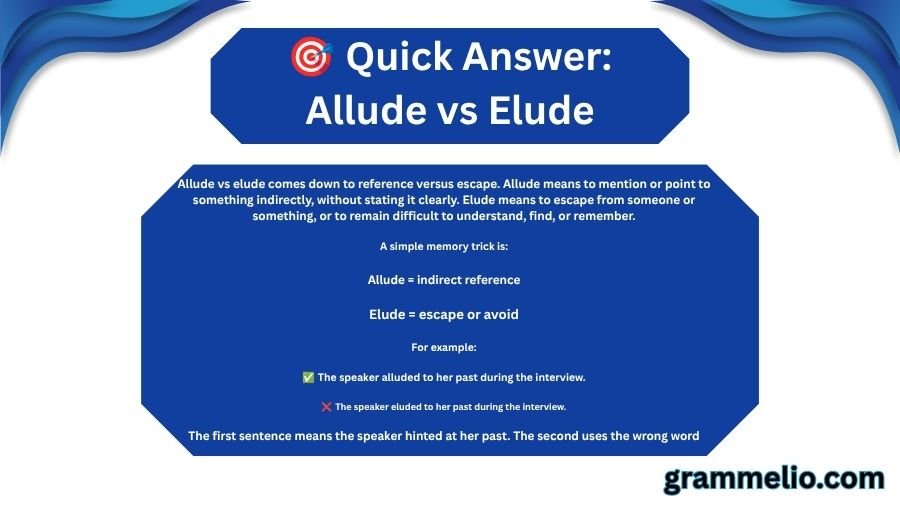
Allude vs elude comes down to reference versus escape. Allude means to mention or point to something indirectly, without stating it clearly. Elude means to escape from someone or something, or to remain difficult to understand, find, or remember.
A simple memory trick is:
- Allude = indirect reference
- Elude = escape or avoid
For example:
- ✅ The speaker alluded to her past during the interview.
- ❌ The speaker eluded to her past during the interview.
The first sentence means the speaker hinted at her past. The second uses the wrong word.
Is Allude the Same as Elude?
No, allude and elude are not the same. Allude is connected with an indirect mention, while elude is connected with escaping or staying out of reach.
Think of two different actions:
Allude → point toward an idea
Elude → slip away from something
If I say, “The author alluded to a famous historical event,” I mean the author hinted at that event.
If I say, “The suspect eluded the police,” I mean the suspect escaped or avoided being caught.
Here is the difference at a glance:
| Form | Type | Meaning | Example | Correct/Incorrect |
|---|---|---|---|---|
| Allude | Verb | Refer to something indirectly | The poem alludes to war. | ✅ Correct |
| Elude | Verb | Escape or avoid | The runner eluded the guards. | ✅ Correct |
| Allude | Verb | Escape | The suspect alluded the police. | ❌ Incorrect |
| Elude | Verb | Indirectly mention | The writer eluded to the book. | ❌ Incorrect |
The easiest way to avoid confusion is to ask yourself what action is happening. Is someone hinting at something? Use allude. Is something escaping or staying out of reach? Use elude.
🧠 Understanding Allude vs Elude
The main difference between these words is their meaning, not their spelling. Both are verbs, but they describe very different actions.
What Does Allude Mean?
Allude means to refer to something indirectly. The speaker does not explain the subject fully. Instead, the speaker gives a hint that allows the listener or reader to understand what is meant.
For example:
The teacher alluded to a change in the exam schedule.
The teacher did not directly announce the change. The teacher only hinted at it.
You can often replace allude with phrases such as:
- refer to indirectly
- hint at
- suggest
- mention indirectly
- point toward
Here are some examples:
- ✅ The article alludes to a problem with the current system.
- ❌ The article eludes to a problem with the current system.
The second sentence is wrong because the article is not escaping the problem. It is indirectly referring to it.
What Does Elude Mean?
Elude means to escape from someone or something. It can also describe something that is difficult to find, understand, remember, or achieve.
For example:
The thief managed to elude the police.
The thief escaped being caught.
But elude is not limited to physical escape. You can also say:
The answer eluded me.
That means I could not understand or find the answer.
You might also say:
Her name eluded me.
That means I could not remember her name.
So elude can involve something staying out of your reach.
Why Do People Confuse Allude and Elude?
People confuse these words because they have similar spellings and sounds. They also appear in similar kinds of formal writing.
I once edited a short business report in which the writer used elude several times when they clearly meant allude. The writer knew both words but had connected them with the general idea of “mentioning something.” Once we changed the sentences to allude, the meaning became clear.
The mistake is easy to make when you focus on how a word sounds instead of what it means.
| Word | Core Idea | Mental Picture |
|---|---|---|
| Allude | Hint or indirect reference | 👉 Pointing toward an idea |
| Elude | Escape or remain out of reach | 🏃 Slipping away |
| Allusion | An indirect reference | 💭 A hidden hint |
| Elusive | Hard to catch, find, or understand | 🔍 Something out of reach |
What Are the Correct Meanings and Uses?
The best way to learn these words is to see them in several settings. I recommend learning the meaning first and then connecting it to real sentences. Understanding allude vs elude starts with knowing whether the sentence describes a hint or an escape.
Allude: Indirectly Refer to Something
Use allude when someone refers to something without clearly saying it.
- The president alluded to future changes.
- The novel alludes to several famous myths.
- She alluded to an argument she had with her friend.
In each sentence, the person is pointing toward an idea rather than directly explaining it.
Elude: Escape From Someone
Use elude when a person or animal escapes from someone trying to catch it.
- The fox eluded the hunters.
- The driver eluded the police.
- The suspect eluded capture.
Here, elude describes avoiding capture.
Elude: Remain Difficult to Find or Understand
You can also use elude when something seems impossible to find, remember, understand, or achieve.
- The solution eluded the scientists.
- The word eluded my memory.
- Success continued to elude him.
The thing being described is out of reach.
| Meaning | Word Type | Example Sentence |
|---|---|---|
| Refer indirectly | Verb | The speaker alluded to the issue. |
| Escape capture | Verb | The suspect eluded the officers. |
| Be difficult to remember | Verb | Her name eluded me. |
| Be difficult to understand | Verb | The meaning eluded the reader. |
| Be difficult to achieve | Verb | Victory eluded the team. |
💡 Test Tip: Try the “Hint or Escape?” Test
When you are unsure, ask:
Is the sentence about a hint?
If yes, choose allude.
Is the sentence about escape or something being out of reach?
If yes, choose elude.
For example:
The speaker ___ to an old disagreement.
Is the speaker hinting at something? Yes.
So:
The speaker alluded to an old disagreement.
Now try:
The criminal ___ the police.
Is the criminal escaping? Yes.
So:
The criminal eluded the police.
This simple test works in most everyday situations.
📝 Case Study: Allude vs Elude in the Workplace
Imagine that a manager sends an email after a difficult team meeting. This workplace example shows how allude vs elude can change the meaning of a sentence.
The manager writes:
“I want to allude to the concerns raised during yesterday’s meeting.”
That sentence means the manager wants to refer to those concerns without discussing every detail.
Now imagine a different situation. A worker has repeatedly avoided answering questions about a missing report.
You might write:
“The employee managed to elude direct questions about the missing report.”
Here, elude means the employee avoided something.
I once caught myself typing elude in a note when I meant allude. I stopped because the sentence was about a speaker referring indirectly to an earlier discussion. Replacing the word with allude fixed the meaning immediately. That small pause is often enough to prevent the error.
| Workplace Situation | Correct Word | Example |
|---|---|---|
| Hinting at a problem | Allude | The manager alluded to budget concerns. |
| Referring indirectly to a report | Allude | The email alluded to the earlier report. |
| Avoiding a question | Elude | The employee eluded the question. |
| Avoiding capture | Elude | The suspect eluded security. |
📚 Grammar Rules Explanation
The grammar rule is simple: allude takes the idea of indirect reference, while elude takes the idea of escape, avoidance, or something remaining out of reach. The basic rule for allude vs elude is simple: allude means indirect reference, while elude means escape or remain out of reach.
Both words function as verbs.
When you use allude, the object is usually an idea, event, person, topic, or work that someone refers to indirectly.
Examples include:
- The speaker alluded to the scandal.
- The book alludes to ancient traditions.
- She alluded to her earlier comment.
The common pattern is:
subject + allude + to + subject
The preposition to is important in common constructions.
When you use elude, the word can describe escaping a person, avoiding capture, or something remaining difficult to grasp.
Examples include:
- The suspect eluded the police.
- The answer eluded me.
- The meaning eluded the reader.
Notice that elude does not mean “refer indirectly.”
Standard English reference works agree on this basic distinction. The key is to focus on the action described by the sentence rather than the similarity between the spellings.
Correct vs Incorrect at a Glance
| Sentence | Correct/Incorrect | Why |
|---|---|---|
| The writer alluded to the problem. | ✅ Correct | The writer referred to it indirectly. |
| The writer eluded to the problem. | ❌ Incorrect | Elude does not mean hint at. |
| The suspect eluded the police. | ✅ Correct | The suspect escaped them. |
| The suspect alluded the police. | ❌ Incorrect | Allude does not mean escape. |
| The answer eluded me. | ✅ Correct | The answer remained out of reach. |
⚠️ Common Mistakes With Allude and Elude
These mistakes usually happen because the two words look so similar. Most mistakes with allude vs elude happen because the two words look and sound similar.
Three common causes are:
- Fast typing: You know the difference but type the wrong word quickly.
- Autocorrect: Your device may not catch a correctly spelled but incorrectly chosen word.
- Lack of knowledge: You may have seen both words but never learned the meaning difference.
Context matters more than spelling.
A sentence can be grammatically perfect on the surface and still use the wrong word. That is why spell-check programs do not always catch this mistake.
Similar Word Confusions
| Confusing Pair | Correct Difference |
|---|---|
| It’s / Its | It’s = it is; its = possessive |
| Your / You’re | Your = belonging to you; you’re = you are |
| Their / There / They’re | Possession, place, and they are |
| Affect / Effect | Usually verb versus noun |
| Allude / Elude | Indirect reference versus escape |
Specific Wrong Forms to Avoid
| Wrong Form | What’s Wrong | Correct Form |
|---|---|---|
| elude to an idea | Uses escape word for a reference | allude to an idea |
| allude the police | Uses reference word for escape | elude the police |
| eluded to the topic | Wrong verb for indirect reference | alluded to the topic |
| alluded the guards | Wrong verb for escaping | eluded the guards |
| elude to a reference | Incorrect construction and meaning | allude to a reference |
How Can You Remember the Difference?
The fastest memory trick is to connect each word with one simple image. Knowing allude vs elude helps you choose the right word in everyday, professional, and creative writing.
Allude = Allude to an Idea
The word allude commonly appears with to when someone refers indirectly to something.
Think:
Allude → “add a hint.”
You do not fully explain the idea. You point toward it.
Elude = Escape
Think of elude as something slipping away.
A runner can elude a guard.
A suspect can elude police.
An answer can elude you.
A name can elude your memory.
| Memory Clue | Word | Meaning |
|---|---|---|
| Hint | Allude | Refer indirectly |
| Point toward an idea | Allude | Mention indirectly |
| Escape | Elude | Avoid being caught |
| Slip away | Elude | Stay out of reach |
| Hard to remember | Elude | Remain outside memory |
Is There a Simple Way to Use Allude and Elude in Conversation?
Yes. Replace the word with a simpler phrase before choosing it.
If you can replace it with “hint at” or “refer to indirectly,” use allude.
If you can replace it with “escape,” “avoid,” or “stay out of reach,” use elude.
For example:
The author alluded to a secret.
Replace it:
The author hinted at a secret.
The meaning still works.
Now:
The prisoner eluded the guards.
Replace it:
The prisoner escaped the guards.
Again, the meaning works.
This replacement method is especially useful when writing quickly.
Allude vs Elude in Different Contexts
Both words can appear in everyday writing, but the situations in which they are natural are different.
| Context | Which Term to Use | Example |
|---|---|---|
| Everyday conversation | Allude | She alluded to an old family story. |
| Professional writing | Allude | The report alludes to several concerns. |
| Creative writing | Both | The poem alludes to loss; the truth eludes the character. |
| Social media/texting | Both | He alluded to the news; the answer eluded me. |
Everyday Conversation
In casual speech, allude may sound slightly formal, but it is still correct.
“Are you alluding to what happened last week?”
Elude is also natural:
“The name is completely eluding me.”
Professional Writing
Professional writing often uses allude when discussing reports, policies, events, or ideas.
“The report alludes to several risks.”
Elude may appear when discussing problems that remain unsolved.
“The cause of the error has eluded the team.”
Creative Writing
Writers often use allude when making indirect references to history, literature, culture, or personal events.
“The character alludes to a painful childhood.”
Elude can describe mystery or something difficult to grasp.
“The truth continued to elude him.”
Social Media and Texting
Both words can appear online, but simpler words are often clearer.
Instead of:
“She alluded to the announcement.”
You could say:
“She hinted at the announcement.”
Still, allude is perfectly correct.
Common Phrases With Allude and Elude
These words do not have many fixed idioms, but they appear in useful patterns.
| Phrase | Meaning |
|---|---|
| Allude to something | Refer to something indirectly |
| Allude to an idea | Hint at an idea |
| Allude to the past | Refer indirectly to past events |
| Elude capture | Escape being caught |
| Elude the police | Avoid being caught by police |
| Elude understanding | Remain difficult to understand |
These phrases can help you recognize the words faster when reading.
For example:
The article alludes to the earlier debate.
The phrase tells you that the article is making an indirect reference.
By contrast:
The suspect eluded capture.
The phrase clearly describes escape.
What Are Good Alternatives to Allude and Elude?
Sometimes you can replace these words with simpler terms. The best replacement depends on the sentence.
| Alternative | Works When | Does Not Work When |
|---|---|---|
| Hint | Someone refers indirectly to something | Someone physically escapes |
| Refer to | Someone mentions something | Something escapes capture |
| Suggest | An idea is presented indirectly | A person is running away |
| Escape | Someone gets away | Someone is only making a reference |
| Avoid | Someone stays away from something | Someone simply mentions a topic |
For example, hint can replace allude:
The speaker hinted at a possible change.
But you cannot replace allude with escape.
Likewise, escape can replace elude in many physical situations:
The prisoner escaped the guards.
However, escape does not always work when elude describes something abstract.
The answer eluded me.
You could say:
I could not find the answer.
That is clearer than trying to force the word “escape” into the sentence.
Why Does Getting This Difference Right Matter?
Using the correct word improves clarity. It also makes your writing sound more careful and professional.
A reader should not have to stop and guess what you mean.
This matters in:
- school essays
- workplace emails
- resumes
- published articles
- reports
- social media posts
- creative writing
A simple rule captures the goal:
Clear words make clear ideas.
| Situation | Why Getting It Right Matters |
|---|---|
| Resume | Shows strong language control |
| Client email | Prevents confusion |
| Published content | Builds reader trust |
| Social post | Keeps the message easy to understand |
Imagine writing:
“The suspect alluded the police.”
A reader may understand what you intended, but the sentence is still wrong.
Now compare:
“The suspect eluded the police.”
The meaning is clear immediately.
Good writing is not about using the fanciest word. It is about choosing the word that says exactly what you mean.
Can Allude and Elude Be Used in the Same Sentence?
Yes. In fact, using both in one sentence can make the difference very clear.
Consider:
The author alluded to a hidden truth, but the truth continued to elude the main character.
This sentence works because the two words perform different jobs.
Alluded means the author hinted at the truth.
Elude means the truth remained difficult for the character to understand or discover.
Another example:
The speaker alluded to the missing evidence, while the suspect continued to elude investigators.
Again, the first word is about a reference. The second is about avoidance.
| Sentence | Allude Meaning | Elude Meaning |
|---|---|---|
| The writer alluded to a mystery that eluded the detective. | Hinted at the mystery | Remained unsolved |
| She alluded to the issue while the answer eluded her. | Referred indirectly | Stayed beyond her understanding |
| The article alluded to a problem that had long eluded researchers. | Mentioned indirectly | Remained difficult to solve |
What About Allusion and Elusive?
Two related words can make the distinction easier to understand.
Allusion is the noun form connected to an indirect reference.
Example:
The poem contains an allusion to a famous story.
The poem is making an indirect reference.
Elusive is an adjective connected to elude.
It describes something difficult to catch, find, understand, or achieve.
Example:
The answer remained elusive.
You can remember the family groups this way:
- Allude → allusion
- Elude → elusive
| Word | Part of Speech | Meaning | Example |
|---|---|---|---|
| Allude | Verb | Refer indirectly | She alluded to the event. |
| Allusion | Noun | Indirect reference | The book contains an allusion. |
| Elude | Verb | Escape or remain out of reach | The suspect eluded capture. |
| Elusive | Adjective | Difficult to catch, find, or understand | The answer was elusive. |
Does Allude Always Need “To”?
In common usage, allude to is the standard construction when you mean “refer indirectly to something.”
For example:
The speaker alluded to the disagreement.
Not:
The speaker alluded the disagreement.
This is a useful pattern to memorize.
Allude + to + topic
Examples:
- allude to a problem
- allude to an event
- allude to the past
- allude to a person
- allude to a possible change
This pattern gives you a strong clue when editing your own writing.
Does Elude Mean Only Physical Escape?
No. Elude can describe physical escape, but it can also describe something that remains difficult to find, understand, remember, or achieve.
Compare these examples:
The criminal eluded the police.
Physical or practical escape.
The answer eluded me.
The answer was difficult for me to find or understand.
Her name eluded my memory.
I could not remember her name.
Victory eluded the team.
The team failed to achieve victory.
| Use of Elude | Example | Meaning |
|---|---|---|
| Physical escape | The thief eluded the guards. | Escaped |
| Avoiding capture | The suspect eluded capture. | Was not caught |
| Memory | Her name eluded me. | I could not remember it |
| Understanding | The meaning eluded him. | He could not understand it |
| Achievement | Success eluded her. | She could not achieve it |
💡 How Can I Choose the Right Word Quickly?
Use this three-step method. When checking allude vs elude, ask yourself whether the sentence describes a hint or something escaping.
Step 1: Find the action.
Ask what the subject is doing.
Step 2: Test “hint.”
If “hint at” makes sense, choose allude.
Step 3: Test “escape.”
If “escape,” “avoid,” or “remain out of reach” makes sense, choose elude.
Here are three quick practice examples:
- The speaker ___ to an earlier disagreement.
- Hint? Yes.
- Alluded is correct.
- The suspect ___ the police.
- Escape? Yes.
- Eluded is correct.
- The answer ___ me.
- Stay out of reach? Yes.
- Eluded is correct.
| Question to Ask | If Yes → Use |
|---|---|
| Is someone hinting at something? | Allude |
| Is someone referring indirectly to something? | Allude |
| Is someone escaping? | Elude |
| Is something hard to find or understand? | Elude |
| Is something hard to remember or achieve? | Elude |
Are There Any Special Exceptions?
There is no major spelling exception that changes the basic rule. The important edge case is that elude can be used for abstract things, not just people escaping.
That is why sentences such as these are correct:
- The answer eluded me.
- The meaning eluded the audience.
- Success eluded the athlete.
These examples may seem unusual if you learned elude only as “escape.” But the central idea remains the same: something is staying beyond reach.
Likewise, allude remains tied to indirect reference.
Can You Test Yourself With These Examples?
Absolutely. Try choosing the correct word before reading the answers.
Practice 1
The journalist ___ to a possible change in policy.
Answer: alluded
The journalist hinted at the change.
Practice 2
The escaped prisoner ___ the authorities for several days.
Answer: eluded
The prisoner avoided being caught.
Practice 3
The exact reason for the failure ___ the engineers.
Answer: eluded
The reason remained difficult for them to discover.
Practice 4
The novelist ___ to a famous historical event.
Answer: alluded
The novelist referred to it indirectly.
| Practice Sentence | Answer | Reason |
|---|---|---|
| The speaker ___ to the problem. | Alluded | Indirect reference |
| The suspect ___ the officers. | Eluded | Escape |
| The answer ___ me. | Eluded | Difficult to find |
| The writer ___ to a famous book. | Alluded | Indirect reference |
✅ Quick Recap Checklist
Before you finish writing, ask yourself these questions:
| Question | If Yes → Use |
|---|---|
| Does the sentence mean “hint at”? | Allude |
| Does it mean “refer indirectly”? | Allude |
| Does it mean “escape”? | Elude |
| Does it mean “avoid capture”? | Elude |
| Does something remain difficult to understand or find? | Elude |
Remember:
Allude = hint or indirect reference.
Elude = escape or remain out of reach.
Final Practice
- The author alluded to the famous event.
- The suspect eluded the police.
- The answer eluded me.
If you can identify whether the sentence involves a hint or an escape, you can usually make the right choice quickly.
FAQs About Allude vs Elude
What is the difference between allude and elude?
Allude means to refer to something indirectly. Elude means to escape, avoid, or remain difficult to find, understand, remember, or achieve.
Is it allude to or elude to?
The correct phrase for an indirect reference is allude to.
Example:
She alluded to the problem.
Elude to is not the standard expression for “refer indirectly.”
What does allude mean in a sentence?
Allude means to hint at or refer to something without directly explaining it.
Example:
The speaker alluded to an earlier disagreement.
The speaker referred to the disagreement indirectly.
What does elude mean in a sentence?
Elude means to escape or stay beyond someone’s reach.
Example:
The suspect eluded the police.
It can also describe something difficult to understand or remember:
The answer eluded me.
Is “eluded to” correct?
Usually, no, when you mean “hinted at” or “referred to.” The correct expression is alluded to.
Correct:
The writer alluded to the issue.
Incorrect:
The writer eluded to the issue.
Is “alluded the police” correct?
No. If you mean that someone escaped the police, use eluded.
Correct:
The suspect eluded the police.
Can allude and elude be used in the same sentence?
Yes. They can describe two different actions in the same sentence.
The writer alluded to a mystery that continued to elude the detective.
The writer hinted at the mystery, while the mystery remained difficult for the detective to solve.
What is the noun form of allude?
The related noun is allusion. An allusion is an indirect reference to something.
Example:
The poem contains an allusion to a famous story.
What is the adjective related to elude?
The related adjective is elusive. It describes something difficult to catch, find, understand, remember, or achieve.
Example:
The answer remained elusive.
How can I remember allude vs elude?
Use the hint or escape trick.
Allude = hint.
Elude = escape.
If someone is pointing toward an idea without saying it directly, use allude. If someone or something is getting away or staying out of reach, use elude.
Conclusion
Allude vs elude becomes much easier once you connect each word to its core action. Allude means to hint at or refer to something indirectly. Elude means to escape, avoid, or remain difficult to find, understand, remember, or achieve. I recommend using the simple “hint or escape” test whenever you hesitate. If the sentence is about an indirect reference, choose allude. If something is slipping away or staying beyond reach, choose elude. 😊 With a little practice, these similar-looking words will stop feeling confusing. The goal is not to memorize a long grammar rule. It is to understand the meaning behind the sentence and choose the word that matches it. Keep this rule in mind: allude points toward an idea, while elude slips away from reach. Once that picture is clear, you can use both words with confidence. ✨


[…] to use it, common mistakes to avoid, and easy memory tricks that make the difference stick. ✨ Allude vs Elude | All Ready vs Already | Aisle vs […]
[…] person, action, decision, or situation is amoral or immoral with confidence. 👍 Alter vs Altar | Allude vs Elude | All Ready vs […]
[…] By the end, you should be able to choose the right word quickly and confidently. ✨ Amoral vs Immoral | Alter vs Altar | Allude vs Elude […]