Have you ever typed a sentence and stopped because you could not remember whether alter vs altar was the right choice? I have seen this mix-up many times, and I understand why it happens. The two words look almost the same, sound similar in many accents, and differ by only one letter. Yet their meanings are completely different.
One word is about changing something, while the other names a special table or structure used in religious worship. 🔍 If you are a student, writer, teacher, blogger, or professional who wants clean US English, learning this small difference can save you from embarrassing spelling mistakes.
In this guide, I will explain the difference in simple language. You will learn what each word means, when to use it, common mistakes to avoid, and easy memory tricks that make the difference stick. ✨ Allude vs Elude | All Ready vs Already | Aisle vs Isle
🎯 Quick Answer: What Is the Difference Between Alter and Altar?
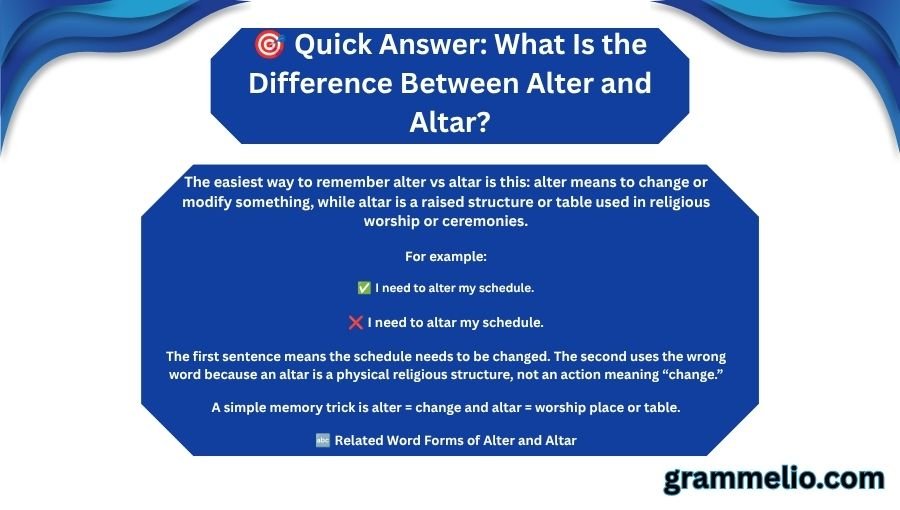
The easiest way to remember alter vs altar is this: alter means to change or modify something, while altar is a raised structure or table used in religious worship or ceremonies.
For example:
- ✅ I need to alter my schedule.
- ❌ I need to altar my schedule.
The first sentence means the schedule needs to be changed. The second uses the wrong word because an altar is a physical religious structure, not an action meaning “change.”
A simple memory trick is alter = change and altar = worship place or table.
🔤 Related Word Forms of Alter and Altar
The two words have different related forms because they belong to different word families. Alter can appear as a verb and can form words such as altered, altering, and alteration. Altar is normally used as a noun, with altars as its plural form.
| Form | Type | Example |
|---|---|---|
| alter | Verb | We may alter the plan. |
| altered | Past participle/adjective | The altered design looks better. |
| altering | Present participle | She is altering the dress. |
| alteration | Noun | The alteration took an hour. |
| altar | Noun | Flowers stood beside the altar. |
| altars | Plural noun | The church has several altars. |
The spelling difference becomes easier once you connect each word to its word family. If you can replace the word with change, you probably need alter. If you are talking about a religious structure, you probably need altar.
🧠 Understanding the Basics of Alter vs Altar
The core difference between alter vs altar is meaning and word type. Alter is usually a verb that describes an action. Altar is a noun that names a thing or place.
| Form | Type | Meaning | Example | Correct/Incorrect |
|---|---|---|---|---|
| alter | Verb | To change something | We need to alter the design. | ✅ Correct |
| altar | Noun | A religious table or structure | Candles were placed on the altar. | ✅ Correct |
| altar | Verb meaning “change” | No standard meaning | We need to altar the design. | ❌ Incorrect |
| alter | Noun for religious structure | Not the standard word | The priest stood near the alter. | ❌ Incorrect |
Think about the role of the word in the sentence.
If someone changes a plan, dress, rule, schedule, or design, use alter.
If someone stands beside, approaches, decorates, builds, or cleans a religious structure, use altar.
What Does Alter Mean?
Alter means to make a change to something without necessarily replacing it completely.
You can alter:
- a plan
- a schedule
- a dress
- a building
- a document
- a recipe
- a design
- a decision
- a habit
- a system
For example:
“I altered the recipe by using less sugar.”
The recipe still exists. A change was simply made to it.
Another example is:
“The tailor altered my jacket.”
The tailor changed the jacket so it would fit better.
What Does Altar Mean?
Altar is a noun. It refers to a raised table, platform, or structure used during religious worship or ceremonies.
For example:
“The couple stood near the altar during the ceremony.”
Here, altar names a physical place or structure.
You might also see sentences such as:
- “The flowers were arranged around the altar.”
- “The priest stood at the altar.”
- “Candles were placed on the altar.”
- “The family gathered near the altar.”
The key point is simple: altar is a thing, while alter describes an action.
💡 Test Tip: Replace the Word With “Change”
When I am unsure about the spelling, I use a fast test.
Replace the word with change.
If the sentence still makes sense, choose alter.
- “Can we change the schedule?” → “Can we alter the schedule?” ✅
- “Flowers covered the change.” → This makes no sense. The sentence probably needs altar if it refers to a religious structure.
This test works because alter and change are closely related in meaning.
✏️ Correct Meanings and Uses of Alter
Alter has several everyday uses, but they all connect to the idea of making something different.
Altering Plans
You can alter a plan when you change some part of it.
“We had to alter our travel plans because of the weather.”
The plan was not necessarily thrown away. It was changed.
Altering Clothing
This is common in everyday American English.
“The tailor altered the pants to fit me.”
Here, alter means to adjust the clothing.
Altering Documents
A person may alter a document by changing its words, numbers, or information.
“Do not alter the official record without permission.”
This use can carry a serious meaning because changing an official record may be improper or illegal.
Altering a Design
Designers often alter their work after receiving feedback.
“The designer altered the logo before publication.”
The original design was modified.
Meaning Summary
| Meaning | Word Type | Example Sentence |
|---|---|---|
| Change a plan | Verb | We altered our plan. |
| Adjust clothing | Verb | She altered the dress. |
| Modify a document | Verb | He altered the report. |
| Change a design | Verb | They altered the layout. |
| Modify a system | Verb | Engineers altered the system. |
⛪ Correct Meanings and Uses of Altar
Altar has a much narrower meaning than alter. It is a noun connected mainly with worship, religious ceremonies, or ceremonial settings.
Religious Worship
An altar may be a central place where religious ceremonies take place.
“The priest stood beside the altar.”
Weddings
The word is also commonly used when discussing wedding ceremonies.
“They exchanged vows near the altar.”
The word does not mean “wedding.” It names the structure or place associated with the ceremony.
Decorations
An altar may be decorated with flowers, candles, cloth, or other objects.
“White flowers decorated the altar.”
Symbolic or Figurative Use
The word can sometimes appear in figurative expressions.
For example:
“He placed his career on the altar of ambition.”
This does not necessarily describe a literal religious altar. It creates an image of sacrificing something for another goal.
| Use | Meaning | Example |
|---|---|---|
| Religious | Worship structure | The candles were near the altar. |
| Wedding | Ceremony structure/place | They stood before the altar. |
| Decorative | Structure decorated for worship | Flowers covered the altar. |
| Figurative | Symbol of sacrifice | She placed fame on the altar of success. |
📝 Case Study: A Small Mistake in a Real-World Message
I once edited a short event announcement that said, “The couple will meet at the alter at 4 p.m.” The writer meant the wedding structure, so the correct word was altar. The mistake was easy to understand because the writer had been typing quickly.
Here is the corrected announcement:
- ❌ The couple will meet at the alter at 4 p.m.
- ✅ The couple will meet at the altar at 4 p.m.
Now consider a completely different sentence:
- ❌ We need to altar the wedding schedule.
- ✅ We need to alter the wedding schedule.
The context gives us the answer.
The first sentence refers to a physical structure. The second describes an action.
| Situation | Correct Word | Why |
|---|---|---|
| Changing a wedding schedule | alter | It means change. |
| Standing near a wedding structure | altar | It is a noun. |
| Adjusting a wedding dress | alter | The dress is being changed. |
| Decorating a wedding structure | altar | It names the structure. |
📚 Grammar Rules Explanation
The grammar rule behind alter vs altar is straightforward. Alter functions mainly as a verb meaning “to change.” Altar is a noun referring to a religious or ceremonial structure.
The words cannot normally be exchanged simply because they look or sound alike.
Consider the grammar role:
“We will alter the plan.”
The subject performs an action. Alter is the verb.
“The plan was discussed near the altar.”
Altar names a thing. It is a noun.
Standard English references and dictionaries consistently distinguish these words by meaning and spelling. You do not need a complicated rule to remember the difference. Focus on the meaning first.
Correct vs Incorrect at a Glance
| Sentence | Correct/Incorrect | Why |
|---|---|---|
| We need to alter the schedule. | ✅ Correct | Alter means change. |
| We need to altar the schedule. | ❌ Incorrect | Altar is not the verb meaning change. |
| Flowers were placed on the altar. | ✅ Correct | Altar is a religious structure. |
| Flowers were placed on the alter. | ❌ Incorrect | Alter does not name the structure. |
| The tailor will alter the jacket. | ✅ Correct | The jacket will be changed. |
A useful rule is:
If you mean “change,” use alter. If you mean a religious structure, use altar.
⚠️ Common Mistakes With Alter and Altar
People confuse these words for several simple reasons. Their spellings are almost identical. They can sound alike in casual speech. Autocorrect may also fail to catch the mistake because both words are valid English words.
Why Do People Confuse Alter and Altar?
The biggest problem is that spell-check software often cannot understand what you mean.
If you type:
“We need to altar the plan.”
The spelling of altar is technically valid. A spell checker may not mark it as wrong. The problem is the meaning.
Other common causes include:
- fast typing
- autocorrect
- weak knowledge of the difference
- similar pronunciation
- writing without rereading
- relying completely on spell-check tools
I once caught myself typing altar when I meant alter in a quick note about a project schedule. I noticed it only because I reread the sentence before sending it. That small pause showed me how easily context can expose a word-choice mistake.
Similar Grammar Confusions
| Confusing Pair | Correct Meaning 1 | Correct Meaning 2 |
|---|---|---|
| its / it’s | its = belonging to it | it’s = it is |
| your / you’re | your = belonging to you | you’re = you are |
| there / their / they’re | there = place | their = belonging to them; they’re = they are |
| affect / effect | affect = usually influence | effect = usually result |
| then / than | then = time/order | than = comparison |
| accept / except | accept = receive/agrees | except = leaving out |
These pairs share one major problem: a spell checker may not know which valid word fits the sentence.
Common Wrong Spellings and Uses
| Wrong Form | What’s Wrong | Correct Form |
|---|---|---|
| altar the plan | Uses the noun as a verb | alter the plan |
| alter the church table | Uses the verb for a structure | altar the church table |
| alter at the wedding | Wrong word for the structure | altar at the wedding |
| altar my schedule | Wrong word for changing | alter my schedule |
| altar the dress | Wrong word for adjusting clothing | alter the dress |
The best solution is not to memorize every sentence. Learn the core meanings.
📜 Word History and Why the Spellings Differ
The histories of alter and altar developed separately, even though their modern spellings look very similar. Their different histories help explain why they have unrelated meanings despite their close appearance.
Alter is connected with the idea of making something different or changing it. Altar has a long history connected with religious worship and sacred ceremonies.
You do not need to memorize old spellings to use the modern words correctly. The important lesson is that similar spelling does not mean similar meaning.
| Period | Form/Idea | General Note |
|---|---|---|
| Earlier English | Forms related to changing | The word family behind alter developed around the idea of making something different. |
| Earlier English | Forms related to worship | Altar developed in religious language. |
| Later English | alter | The modern verb became established for changing something. |
| Later English | altar | The modern noun remained connected with worship. |
The two words eventually became visually similar in modern English, which helps explain today’s spelling confusion.
🌎 Usage in Different Contexts
Context is one of the strongest clues when choosing between alter vs altar.
Everyday Conversation
Use alter when discussing changes.
“Can you alter the settings?”
Use altar when discussing a religious or ceremonial structure.
“The flowers are beside the altar.”
Professional Writing
Professional writing often uses alter when discussing plans, policies, designs, or documents.
“The team decided to alter the original proposal.”
A professional or event document may use altar when describing a religious ceremony.
“The ceremony will begin at the altar.”
Creative Writing
Writers can use both words, but their meanings remain separate.
“She altered her plan.”
versus:
“She walked slowly toward the altar.”
Social Media and Texting
Fast digital writing creates more opportunities for mistakes. Before posting, check whether you mean change or a religious structure.
| Context | Which Term to Use | Example |
|---|---|---|
| Everyday conversation | alter for change | I need to alter my plans. |
| Professional writing | alter for modification | We altered the contract. |
| Creative writing | Either, depending on meaning | He approached the altar. |
| Social media/texting | Either, depending on meaning | I had to alter my plans. |
💬 Common Phrases With Alter and Altar
There are several useful expressions involving these words. Most common phrases with alter focus on changing something. Phrases with altar usually involve worship, marriage, or sacrifice.
| Phrase | Meaning |
|---|---|
| alter the plan | Change the plan |
| alter the design | Modify the design |
| alter the course | Change the direction or path |
| alter the schedule | Change the planned time |
| at the altar | At or near a religious structure |
| lead someone to the altar | Lead someone toward marriage |
One useful point is that alter can appear in many ordinary situations. Altar is much more limited because it refers to a specific kind of noun.
🔄 Synonyms and Alternatives
Using synonyms can help you check whether alter is the word you need. If you can replace it with change, modify, or adjust, then alter probably fits.
For altar, alternatives are more limited because it names a specific structure.
| Alternative | Works When | Does Not Work When |
|---|---|---|
| change | You mean make different | You mean a religious structure |
| modify | You mean make a small or planned change | You mean a physical altar |
| adjust | You mean make a small correction | You mean a worship structure |
| revise | You mean improve or change written material | You mean a religious table |
| religious table | You need to explain altar in simple terms | The exact word altar is expected |
For example:
“We need to modify the schedule.”
This has almost the same basic meaning as:
“We need to alter the schedule.”
But you cannot replace altar with modify in:
“The flowers were placed on the altar.”
That would completely change the grammar and meaning.
🎯 Why Does Getting Alter and Altar Right Matter?
Getting these words right matters because readers depend on context to understand your meaning. A single wrong word can make an otherwise polished sentence look careless.
Clarity in Communication
A reader may understand your meaning from context, but the wrong word still creates confusion.
Professionalism
A spelling mistake in a client email, report, or formal announcement can reduce confidence in your writing.
Digital Communication
Posts, captions, messages, and emails move quickly. Since both words are real English words, spell-check software may not catch the error.
Writing Accuracy
Correct word choice shows that you understand not only spelling but also meaning.
| Situation | Why Getting It Right Matters |
|---|---|
| Resume | Shows careful writing |
| Client email | Builds professional trust |
| Published content | Protects clarity and quality |
| Social post | Prevents distracting mistakes |
A simple writing principle is worth remembering:
The right word makes the meaning clear before the reader has to guess.
🧩 How To Remember the Difference
A strong memory trick can make this pair much easier. Understanding alter vs altar becomes much easier when you connect each word with its meaning.
Alter = Change
Notice that alter contains “alt”, which can remind you of making an alternative or changing something.
Think:
alter → change
Examples:
- alter a plan
- alter a dress
- alter a schedule
- alter a design
Altar = Religious Structure
Think of altar as a physical place or structure.
Examples:
- stand at the altar
- decorate the altar
- kneel at the altar
- approach the altar
The One-Question Method
Ask yourself:
“Am I talking about changing something?”
If yes → alter.
If not, ask:
“Am I talking about a religious or ceremonial structure?”
If yes → altar.
This simple two-question method can prevent most mistakes.
🤔 Is Alter the Same as Altar?
No. Alter and altar are different words with different meanings.
Alter is mainly a verb meaning to change or modify something. Altar is a noun for a structure or table used in religious worship or ceremonies.
Compare:
- ✅ She altered the dress.
- ❌ She altared the dress.
And:
- ✅ She stood near the altar.
- ❌ She stood near the alter.
The words look similar, but they cannot normally replace each other.
🔍 Why Do People Confuse Alter and Altar?
People confuse them because they look nearly identical and may sound similar. Both are also valid English words, so spell-check programs may not identify the mistake.
The solution is to focus on meaning rather than appearance.
If the sentence describes an action of changing something, choose alter. If it names a religious structure, choose altar.
✍️ How Do You Use Alter Correctly?
Use alter when you mean to change, modify, or adjust something.
Examples include:
- “We need to alter the schedule.”
- “She altered the design.”
- “The tailor altered my coat.”
- “They altered the agreement.”
A quick replacement test works well:
alter = change
If “change” fits the sentence, alter is likely correct.
⛪ How Do You Use Altar Correctly?
Use altar as a noun when referring to a religious or ceremonial structure.
Examples include:
- “The flowers are on the altar.”
- “They stood before the altar.”
- “Candles surrounded the altar.”
- “The priest approached the altar.”
A useful clue is that altar usually refers to a place or thing rather than an action.
💡 Can Alter Be Used as a Noun?
In standard modern English, alter is primarily used as a verb meaning “to change.” It is not the standard noun for the religious structure.
For example:
- ❌ The bride stood beside the alter.
- ✅ The bride stood beside the altar.
When you see a sentence about a religious structure, do not let the spelling of alter fool you.
🏛️ Can Altar Be Used as a Verb?
In standard English, altar is not the normal verb meaning “to change.”
So:
- ❌ We need to altar the design.
- ✅ We need to alter the design.
This is one of the most important rules to remember.
🧠 What Is an Easy Trick for Remembering Alter vs Altar?
The easiest trick is:
ALTER = CHANGE
ALTAR = WORSHIP STRUCTURE
If you can connect alter with “change,” you will usually make the right choice.
You can also remember the sentence:
“I alter a plan, but I stand at an altar.”
That single sentence captures the entire difference.
📝 Which Word Should You Use in a Sentence?
Choose alter when the sentence needs a verb that means “change.”
Choose altar when the sentence needs a noun referring to a religious or ceremonial structure.
| Question | If Yes → Use |
|---|---|
| Do I mean “change”? | alter |
| Am I changing a plan? | alter |
| Am I adjusting clothing? | alter |
| Am I modifying a document? | alter |
| Am I talking about a religious structure? | altar |
| Am I describing a wedding ceremony location? | altar |
Practice Examples
- We may need to alter the meeting time. → Change → alter ✅
- The couple stood before the altar. → Religious structure → altar ✅
- The designer altered the original plan. → Modified → alter ✅
❓ FAQs About Alter vs Altar
What is the main difference between alter and altar?
Alter means to change or modify something. Altar is a noun referring to a religious or ceremonial structure.
Is “alter” the correct word for changing something?
Yes. Alter is the correct word when you mean to change, modify, or adjust something.
Example: “We need to alter the schedule.”
Is an altar only used in religious settings?
The word is most strongly associated with religious worship and ceremonies. It can also appear in figurative writing, where it represents sacrifice or devotion.
Is “altar” a verb?
No, not in standard usage when you mean “change.” The correct verb is alter.
How can I remember alter vs altar?
Remember:
Alter = change.
Altar = religious structure.
You can also use the sentence: “I alter a plan, but I stand at an altar.”
Which is correct: “alter the plan” or “altar the plan”?
“Alter the plan” is correct because the sentence means “change the plan.”
Which is correct: “at the alter” or “at the altar”?
“At the altar” is correct when referring to a religious or ceremonial structure.
Can autocorrect catch alter and altar mistakes?
Not always. Both words are correctly spelled English words. Autocorrect may therefore accept the wrong word even when it does not fit the sentence.
Is “altar” related to “alter”?
They look and sound similar in modern English, but they have different meanings and developed as separate words. Their similarity is a major reason writers confuse them.
What is the fastest way to choose between alter and altar?
Ask whether you mean change. If you do, choose alter. If you mean a religious or ceremonial structure, choose altar.
✅ Quick Recap Checklist
The difference between these words is small in spelling but large in meaning. Use this checklist whenever you hesitate. If you remember the basic rule behind alter vs altar, you can avoid this common spelling mistake in everyday and professional writing.
| Question | If Yes → Use |
|---|---|
| Does the sentence mean “change”? | alter |
| Am I modifying a plan? | alter |
| Am I adjusting clothing? | alter |
| Am I changing a document? | alter |
| Am I naming a religious structure? | altar |
| Am I talking about a wedding structure? | altar |
| Can I replace the word with “change”? | alter |
Final Practice
- I need to alter my travel plans. → Change = alter ✅
- The bride walked toward the altar. → Religious ceremony structure = altar ✅
- The tailor will alter the jacket. → Adjust = alter ✅
🌟 Conclusion: Remember the Difference for Good
Alter vs altar becomes easy once you stop focusing on the spelling and start focusing on the meaning. Alter is the verb you need when something is changed, modified, or adjusted. Altar is the noun you need when you are talking about a religious or ceremonial structure.
I recommend using the simplest memory rule: alter means change, while altar is a place or structure connected with worship. 🧠 If you are writing about a schedule, plan, dress, design, document, or system, think alter. If you are writing about a wedding ceremony, religious service, candles, flowers, or a sacred structure, think altar.
Once you learn that difference, you can spot the correct word quickly, even when typing fast. ✨
Remember one sentence and you will rarely mix them up again: I alter a plan, but I stand at an altar. That is the whole rule in one clear line.

[…] to tell whether a person, action, decision, or situation is amoral or immoral with confidence. 👍 Alter vs Altar | Allude vs Elude | All Ready vs […]