If you have ever seen colonel vs kernel written side by side, you may have wondered how two words that look so different can sound almost exactly alike. I have seen this confusion show up in student papers, emails, online comments, and even careful professional writing. The tricky part is that these words do not mean the same thing at all.
One is a military rank, while the other usually refers to the inner part of a seed or a grain. 🌽 Once you learn the meaning behind each spelling, the difference becomes much easier to remember. In this guide, I will break down colonel vs kernel in simple US English, explain why they sound alike, show you correct and incorrect examples, and give you easy memory tricks you can use whenever you are unsure. Cereal vs Serial | Censor vs Censure vs Sensor | Carat vs Caret vs Carrot vs Karat
🎯 Quick Answer: Colonel vs Kernel
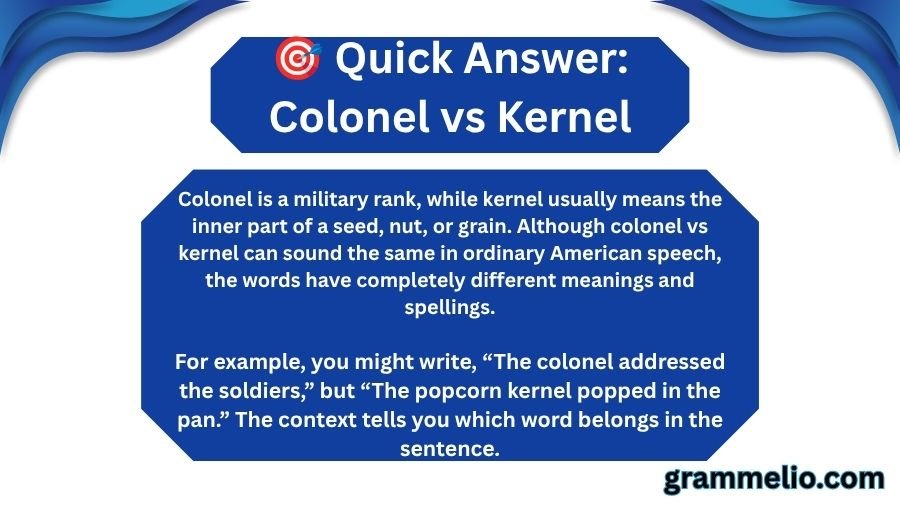
Colonel is a military rank, while kernel usually means the inner part of a seed, nut, or grain. Although colonel vs kernel can sound the same in ordinary American speech, the words have completely different meanings and spellings.
For example, you might write, “The colonel addressed the soldiers,” but “The popcorn kernel popped in the pan.” The context tells you which word belongs in the sentence.
Related Word Forms
The two words have several related forms, although their uses remain very different. Colonel can become colonels when you mean more than one military officer. It can also appear in possessive forms such as colonel’s and colonels’. Kernel can become kernels for the plural and kernel’s or kernels’ for possessive forms.
| Form | Type | Example |
|---|---|---|
| colonel | Singular noun | The colonel gave the order. |
| colonels | Plural noun | Several colonels attended the meeting. |
| colonel’s | Singular possessive | The colonel’s uniform was neatly pressed. |
| colonels’ | Plural possessive | The colonels’ meeting lasted two hours. |
| kernel | Singular noun | The kernel was inside the shell. |
| kernels | Plural noun | The corn had many kernels. |
| kernel’s | Singular possessive | The kernel’s outer layer was removed. |
| kernels’ | Plural possessive | The kernels’ texture was soft. |
The key point is simple: changing the number or possessive form does not change the basic meaning of either word.
Understanding the Basics of Colonel vs Kernel
The main difference between colonel vs kernel is meaning. Colonel describes a military rank. Kernel normally describes a small inner part of something, especially a seed, nut, or grain.
Here is the basic comparison:
| Form | Type | Meaning | Example | Correct/Incorrect |
|---|---|---|---|---|
| colonel | Noun | A military rank | The colonel spoke to the troops. | ✅ Correct |
| kernel | Noun | Inner part of a seed or grain | The corn kernel was yellow. | ✅ Correct |
| colonel | Noun | A corn seed | I ate a colonel of popcorn. | ❌ Incorrect |
| kernel | Noun | A military officer’s rank | She was promoted to kernel. | ❌ Incorrect |
| colonel | Noun | Military rank | He became a colonel. | ✅ Correct |
| kernel | Noun | Small inner part | A kernel fell from the cob. | ✅ Correct |
Colonel: Meaning and Correct Use
A colonel is a military officer who holds the rank of colonel. The word is used in military settings and can also appear when discussing military history, fiction, biographies, movies, or news reports.
For example:
The colonel inspected the training area.
Here, colonel is a noun. It identifies the officer who inspected the area.
Another example:
The colonel spoke with the new recruits.
Again, the word refers to a military officer.
The word can be used with a person’s name or title:
Colonel Davis addressed the group.
When a military title comes directly before a person’s name, it is commonly capitalized.
When the word is used as a general noun, lowercase is normally appropriate:
The colonel arrived at noon.
This distinction is similar to other titles. The exact capitalization can depend on how the title is used in a sentence.
Kernel: Meaning and Correct Use
A kernel is the inner part of a seed, nut, or grain. It is also commonly used for a single piece of corn.
For example:
One kernel of corn was stuck between my teeth.
The word can also be used in a broader sense. A kernel may mean the central or essential part of an idea.
For example:
There was a kernel of truth in his story.
Here, nobody is talking about food. The phrase means that the story contained a small but real element of truth.
Another example is:
The article contains a kernel of a good idea.
The word kernel therefore has both a physical and a figurative use.
A Small Meaning Guide
| Meaning | Word Type | Example Sentence |
|---|---|---|
| Military rank | Noun | The colonel entered the room. |
| Military officer holding that rank | Noun | The colonel reviewed the report. |
| Inner part of a seed or grain | Noun | The kernel was removed from the shell. |
| Piece of corn | Noun | A popcorn kernel landed on the table. |
| Central part of an idea | Noun | There is a kernel of truth in the claim. |
💡 Test Tip: Use the Meaning Test
When I am editing writing and see colonel vs kernel, I first ignore the spelling and ask one question:
Is the sentence about the military or about a seed, grain, food, or central idea?
- Military → colonel
- Seed, grain, corn, or central part → kernel
This quick test works in most everyday situations.
Why Do People Confuse Colonel and Kernel?
People confuse colonel vs kernel mainly because the two words are pronounced alike in standard American English even though their spellings are very different.
This makes them a type of homophone pair. Homophones are words that sound alike but have different meanings and spellings.
Other familiar examples include:
- two / too / to
- right / write
- flower / flour
- pair / pear
- sea / see
The same basic problem happens with colonel and kernel. If you only hear the word, you may not know which spelling the speaker intends.
I once worked through a writing exercise with a student who had written “kernel” when describing a military officer. The student knew the word when reading it but had never connected its spelling to the military meaning. Once we separated sound from meaning, the mistake disappeared almost immediately.
The Sound Creates the Confusion
When spoken aloud, colonel and kernel can sound very similar. That means a listener cannot always determine the spelling from sound alone.
Consider this sentence:
The colonel ate popcorn.
If you hear the sentence without seeing it, you have to use context to understand the intended meaning.
The military rank is colonel.
The pieces of popcorn are kernels.
| Spoken Idea | Correct Written Word | Meaning |
|---|---|---|
| Military officer | colonel | Military rank |
| Piece of corn | kernel | Inner part of corn |
| Military officers | colonels | More than one colonel |
| Pieces of corn | kernels | More than one kernel |
| Central part of an idea | kernel | Essential part |
Colonel vs Kernel at a Glance
The easiest way to understand colonel vs kernel is to compare their meanings directly.
| Feature | Colonel | Kernel |
|---|---|---|
| Main meaning | Military rank | Inner part of a seed, grain, or nut |
| Word type | Noun | Noun |
| Common setting | Military | Food, science, writing, technology |
| Refers to a person | Yes | Usually no |
| Refers to corn | No | Yes |
| Can have a figurative meaning | Less common | Yes |
| Sounds like the other word | Yes | Yes |
The spelling gives you an important visual clue. Colonel contains letters that do not make its pronunciation obvious. Kernel looks much closer to the sound you hear.
📝 Case Study: A Mistake in a Workplace Email
Imagine a manager writing:
“The kernel will meet with the team at 2 p.m.”
If the writer means a military officer, the sentence contains the wrong word.
The corrected version is:
“The colonel will meet with the team at 2 p.m.” ✅
Now imagine a food report:
“Each colonel of corn was removed from the cob.”
That does not make sense if the writer means a single piece of corn.
The correct sentence is:
“Each kernel of corn was removed from the cob.” ✅
The mistake can look small, but the meaning changes completely.
Here is how I would correct both examples:
| Original Sentence | Correct Version | Reason |
|---|---|---|
| The kernel met the soldiers. | The colonel met the soldiers. | Military context requires colonel. |
| A colonel of corn fell on the floor. | A kernel of corn fell on the floor. | Food context requires kernel. |
| The colonel inspected the unit. | The colonel inspected the unit. | Correct military use. |
| The kernel popped in the pan. | The kernel popped in the pan. | Correct food use. |
Grammar Rules Explanation
The grammar rule behind colonel vs kernel is straightforward: choose the word based on its meaning, not on how it sounds.
Colonel is a noun used for a military rank or for a person who holds that rank.
Kernel is a noun used for the inner part of a seed, nut, or grain. It can also describe a small central part of an idea or subject.
Neither word is a general replacement for the other.
The spelling cannot be changed simply because the words sound alike. Standard English treats them as separate words with separate meanings.
Most major English dictionaries agree on this basic distinction, and standard writing practice follows the same rule.
Correct vs Incorrect at a Glance
| Sentence | Correct/Incorrect | Why |
|---|---|---|
| The colonel addressed the soldiers. | ✅ Correct | A colonel is a military officer. |
| The kernel addressed the soldiers. | ❌ Incorrect | Kernel does not mean military officer. |
| The popcorn kernel was still unpopped. | ✅ Correct | Kernel can mean a piece of corn. |
| The popcorn colonel was still unpopped. | ❌ Incorrect | Colonel has no food meaning. |
| She spoke with the colonel yesterday. | ✅ Correct | The sentence refers to a military officer. |
⚠️ Common Mistakes With Colonel vs Kernel
Most mistakes happen because people hear the words before they see them.
There are several reasons this happens:
- Fast typing can cause a writer to choose the familiar-looking word.
- Autocorrect may not understand the intended meaning.
- Lack of knowledge about the words can make the spelling seem random.
- Listening without context makes the two words difficult to separate.
- Speech-to-text tools can select the wrong spelling.
I once caught myself reading a sentence twice because a speech-to-text program had chosen the wrong homophone. The sentence sounded fine when spoken, but the written version made the meaning unclear. That is why I always check the surrounding context when a homophone appears.
Similar Grammar Confusions
| Confusing Pair | Correct Difference |
|---|---|
| it’s / its | It’s = it is; its = possessive |
| your / you’re | Your = possessive; you’re = you are |
| their / they’re | Their = possessive; they’re = they are |
| to / too / two | Different meanings and grammatical roles |
| affect / effect | Usually affect = influence; effect = result |
| colonel / kernel | Colonel = military rank; kernel = inner part |
Specific Wrong Spellings and Uses
| Wrong Form | What’s Wrong | Correct Form |
|---|---|---|
| kernal | Common misspelling of kernel | kernel |
| kernell | Extra letter | kernel |
| kernel officer | Wrong meaning | colonel |
| corn colonel | Wrong word for a corn piece | corn kernel |
| colonal | Misspelling | colonel |
| colonel of corn | Wrong word choice | kernel of corn |
The spelling kernal is especially common. The correct spelling is kernel, with the letters -nel at the end.
Word Origin and History
The history of colonel helps explain why its spelling and pronunciation seem unusual. The word entered English through European military language and developed a spelling influenced by forms used in French and Italian. Over time, English pronunciation changed while the spelling retained older features.
Kernel has a different history. It developed from an older English word connected with the idea of a small seed or inner part.
The two words therefore came from different paths. Their similar modern pronunciation is not because they have the same meaning.
| Period | Form | Note |
|---|---|---|
| Earlier English period | Early forms related to kernel | Connected with a seed or inner part |
| Medieval period | Military forms related to colonel | Used for a military rank |
| Later English | Colonel | Spelling became established in English |
| Later English | Kernel | Meaning expanded beyond seeds and grains |
| Modern English | Colonel / kernel | Different spellings and meanings, similar pronunciation |
The unusual spelling of colonel is one reason this pair continues to surprise English learners.
How To Remember the Difference
A good memory trick can make colonel vs kernel much easier.
Try this:
Colonel = command.
Both words begin with a strong C when you think about the military role. Imagine a colonel commanding soldiers.
Then remember:
Kernel = corn.
Think of a popcorn kernel sitting in a bowl.
This gives you a simple mental picture:
🎖️ Colonel → military
🌽 Kernel → corn
Another trick is to connect kernel with the phrase kernel of corn. If you can picture the word beside corn, you are less likely to confuse it with the military term.
| Memory Word | Think About | Correct Term |
|---|---|---|
| Command | Military | colonel |
| Corn | Food | kernel |
| Officer | Army or military | colonel |
| Popcorn | Snack | kernel |
| Central idea | Main point | kernel |
Is Colonel the Same as Kernel?
No. Colonel and kernel are different words with different meanings, even though they can sound alike.
A colonel is connected with the military. A kernel is usually connected with a seed, grain, nut, or corn. Kernel can also mean the central part of an idea.
The important lesson is that pronunciation does not determine spelling.
Can Colonel and Kernel Be Used Interchangeably?
No. Colonel and kernel cannot normally replace each other because they refer to completely different things.
You cannot call a military officer a kernel.
You also cannot call a piece of corn a colonel.
The only reason they are discussed together is that their spoken forms are alike or nearly alike for many American English speakers.
Usage in Different Contexts
The context usually makes the correct choice obvious.
| Context | Which Term to Use | Example |
|---|---|---|
| Everyday conversation | Either, depending on meaning | The kernel got stuck in my teeth. |
| Professional writing | colonel for military; kernel for food or central idea | The colonel reviewed the report. |
| Creative writing | Either, depending on the scene | The colonel watched the soldiers leave. |
| Social media/texting | Either, depending on meaning | I just burned the popcorn kernels! |
Everyday Conversation
In normal conversation, kernel often appears when people talk about corn, popcorn, seeds, or ideas.
Example:
I found one unpopped kernel at the bottom of the bowl.
Colonel is more likely to appear when someone is talking about military service, history, or fiction.
The colonel ordered the troops to move.
Professional Writing
Professional writing requires extra care because the wrong word can change the meaning of a sentence.
If you are writing a military report, use colonel when referring to that rank.
If you are writing a food article, use kernel for an individual piece of corn.
Creative Writing
Writers may use either word depending on the story.
A historical novel might contain:
The colonel stood beside the map.
A food-themed story might say:
A tiny kernel rolled across the kitchen floor.
Social Media and Texting
Informal writing does not remove the need for correct spelling. Readers may understand the sentence from context, but a wrong homophone can still look careless.
For example:
“The colonel popcorn is ready.”
This is confusing.
Better:
“The popcorn kernels are ready.” ✅
Common Phrases With Kernel
Kernel appears in several useful phrases, especially when talking about food or the central part of an idea.
| Phrase | Meaning |
|---|---|
| kernel of corn | One individual piece of corn |
| popcorn kernel | A piece of corn used to make popcorn |
| kernel of truth | A small amount of truth within a larger claim |
| kernel of an idea | The central or early part of an idea |
| kernel of wisdom | A small but useful piece of knowledge |
There are fewer common fixed expressions built around colonel because it is mainly the name of a military rank.
What Are Good Alternatives to Colonel and Kernel?
Sometimes another word can make a sentence clearer, but alternatives depend on context.
| Alternative | Works When | Does Not Work When |
|---|---|---|
| military officer | You want a broad description | You specifically mean the rank colonel |
| officer | The exact rank is not important | Precision about rank matters |
| corn | You mean the crop or food generally | You mean one individual kernel |
| seed | You are describing a seed generally | You specifically mean a corn kernel |
| central part | You mean the figurative sense of kernel | You mean the physical part of a seed |
For example, “military officer” can describe a colonel, but it is less precise. Likewise, “corn” is broader than “kernel.”
Why Does Getting Colonel vs Kernel Right Matter?
Getting colonel vs kernel right matters because correct spelling helps readers understand your exact meaning.
This is especially important in professional writing. A spelling error may make a sentence funny, confusing, or unintentionally distracting.
Imagine seeing this on a military website:
“The kernel spoke to the soldiers.”
A reader may understand that the writer meant colonel, but the mistake still weakens the credibility of the text.
Now imagine a food article saying:
“Remove the colonels from the cob.”
That error changes a simple cooking instruction into something strange.
A useful writing rule is:
Clear words create clear meaning.
| Situation | Why Getting It Right Matters |
|---|---|
| Resume | Shows careful writing |
| Client email | Prevents confusion |
| Published content | Protects accuracy and credibility |
| Social post | Makes the intended meaning clear |
Special Exception: Technology and the Word Kernel
There is one important broader use of kernel that you may see in technology.
In computing, a kernel is the central part of an operating system. It manages important communication between software and computer hardware.
So you may see phrases such as:
- operating system kernel
- kernel update
- kernel process
- kernel development
This has nothing to do with corn, but the basic idea is related: a kernel is something central or core.
The word colonel does not have this computer meaning.
| Field | Word | Example |
|---|---|---|
| Military | colonel | The colonel inspected the base. |
| Food | kernel | The kernel popped. |
| Ideas | kernel | There was a kernel of truth. |
| Computing | kernel | The operating system kernel manages core tasks. |
How Can You Spot the Correct Word Quickly?
When you see colonel vs kernel, look at the nouns and verbs around the word.
Words such as these strongly suggest colonel:
- soldiers
- troops
- army
- military
- officer
- commander
- base
- uniform
- rank
Words such as these strongly suggest kernel:
- corn
- popcorn
- seed
- grain
- nut
- shell
- idea
- truth
- computer
| Nearby Word | Likely Choice |
|---|---|
| soldiers | colonel |
| military | colonel |
| officer | colonel |
| troops | colonel |
| popcorn | kernel |
| corn | kernel |
| seed | kernel |
| truth | kernel |
| idea | kernel |
| operating system | kernel |
💡 A Simple Three-Second Test
When I need to check colonel vs kernel, I use a three-second test:
Step 1: Read the whole sentence.
Step 2: Ask what the word refers to.
Step 3: Choose the spelling based on meaning.
For example:
The _____ gave orders to the soldiers.
Military? Use colonel.
The _____ popped in the microwave.
Food? Use kernel.
This works because the problem is usually not grammar. It is word choice.
Practice Examples
Try choosing the correct word before reading the answers.
Example 1
The _____ inspected the military base.
Answer: colonel ✅
The sentence refers to a military officer.
Example 2
I found an unpopped _____ in my bowl.
Answer: kernel ✅
The sentence refers to a piece of popcorn.
Example 3
The _____ spoke during the ceremony.
Answer: colonel ✅
The military context identifies the correct word.
Example 4
There was a _____ of truth in the rumor.
Answer: kernel ✅
Here, kernel is used figuratively to mean a small central element of truth.
| Practice Sentence | Answer | Reason |
|---|---|---|
| The _____ commanded the unit. | colonel | Military |
| The popcorn _____ was hard. | kernel | Food |
| The _____ wore a military uniform. | colonel | Military officer |
| A _____ of an idea appeared in the discussion. | kernel | Central idea |
Quick Recap Checklist
| Question | If Yes → Use |
|---|---|
| Does the word refer to a military rank? | colonel |
| Does it refer to a military officer holding that rank? | colonel |
| Does it refer to corn? | kernel |
| Does it refer to a seed or grain’s inner part? | kernel |
| Does it mean the central part of an idea? | kernel |
| Does it refer to the core of an operating system? | kernel |
Three More Practice Examples
- The colonel met with the officers. → ✅ colonel
- The popcorn kernel refused to pop. → ✅ kernel
- The article contained a kernel of truth. → ✅ kernel
If you remember only one rule, remember this:
Colonel = military. Kernel = inner part or core.
FAQs About Colonel vs Kernel
What is the difference between colonel and kernel?
Colonel is a military rank, while kernel usually means the inner part of a seed, grain, nut, or piece of corn. Kernel can also describe the central part of an idea or a computer system.
Why do colonel and kernel sound the same?
They can sound the same because English pronunciation does not always match spelling. The two words developed from different histories, but their modern spoken forms are very similar in standard American English.
Is colonel pronounced like kernel?
Yes. In standard American English, colonel and kernel are commonly pronounced alike or nearly alike. Their spellings, however, remain completely different.
Is kernel the correct spelling for corn?
Yes. A single piece of corn is a kernel. For example, “One kernel fell from the cob” is correct.
Is colonel a military title?
Yes. Colonel is a military rank. It is used for an officer who holds that rank.
What is the plural of colonel?
The plural is colonels. For example: “Several colonels attended the ceremony.”
What is the plural of kernel?
The plural is kernels. For example: “The popcorn had several unpopped kernels.”
What does kernel of truth mean?
A kernel of truth means a small or central element of truth within something that may otherwise be exaggerated, incomplete, or false.
Can kernel refer to a computer?
Yes. In computing, a kernel is the core part of an operating system. It helps manage communication between software and computer hardware.
How can I remember colonel vs kernel?
Use the memory pair colonel = command and kernel = corn. If the sentence is about a military officer, choose colonel. If it is about corn, a seed, an inner part, or a core idea, choose kernel.
What is the easiest way to avoid this spelling mistake?
Do not rely on pronunciation. Read the sentence and identify the meaning first. Military context points to colonel, while food, seeds, ideas, or computing usually point to kernel.
Is Colonel vs Kernel a Grammar Problem or a Spelling Problem?
Colonel vs kernel is mainly a word-choice and spelling problem caused by similar pronunciation. Both are nouns, but they carry different meanings.
Grammar tells you how the noun fits into the sentence. Meaning tells you which noun you need.
For example:
The colonel arrived.
The grammar is fine, and the meaning is military.
The kernel arrived.
The grammar is also fine, but the meaning is completely different.
This is why context matters more than sound.
Final Examples of Colonel vs Kernel
Before finishing, compare these pairs:
| Correct Sentence | Why |
|---|---|
| The colonel addressed the soldiers. | Military rank |
| The colonel signed the report. | Military officer |
| The kernel popped in the pan. | Piece of corn |
| The kernel remained inside the shell. | Inner part |
| There was a kernel of truth in the story. | Central element of truth |
| The operating system kernel was updated. | Core computer component |
The sentences may sound confusing when spoken, but they become easy once you focus on meaning.
Conclusion
Colonel vs kernel becomes much easier once you stop judging the words by their sound and start judging them by their meaning. Colonel refers to a military rank or the officer who holds that rank. Kernel usually refers to the inner part of a seed, grain, nut, or piece of corn. It can also describe the central part of an idea or a computer system.
I recommend using one simple memory trick: 🎖️ colonel means military, while 🌽 kernel makes you think of corn or something central. When you are unsure, read the full sentence and ask what the word describes. If it involves soldiers, ranks, or military command, choose colonel. If it involves popcorn, seeds, ideas, or computing, choose kernel.
The spellings may look surprising, and their pronunciation may sound identical, but their meanings are easy to separate. Hear the sound, check the meaning, and then choose the spelling. That simple habit will help you get this tricky pair right every time. ✨



[…] word means, when to use it, what mistakes to avoid, and how to remember the difference with ease. Colonel vs Kernel | Cereal vs Serial | Censor vs Censure vs […]
[…] or everyday writer, this guide will help you use both words correctly. Complacent vs Complaisant | Colonel vs Kernel | Cereal vs […]