Have you ever stopped while writing because you could not remember whether you needed conscience vs conscious? I have seen this mix-up many times, and I understand why it happens. The two words look and sound alike, but they do very different jobs in a sentence. One relates to your inner sense of right and wrong. The other describes being awake, aware, or able to notice something. 😅
If you learn one simple idea for each word, the difference becomes much easier to remember. In this guide, I will break down conscience vs conscious with clear definitions, examples, memory tricks, common mistakes, and practical situations.
My goal is to make these words feel easy enough that you can choose the right one without stopping to think twice. Whether you are a student, professional, blogger, or everyday writer, this guide will help you use both words correctly. Complacent vs Complaisant | Colonel vs Kernel | Cereal vs Serial
🎯 Quick Answer: Conscience vs Conscious
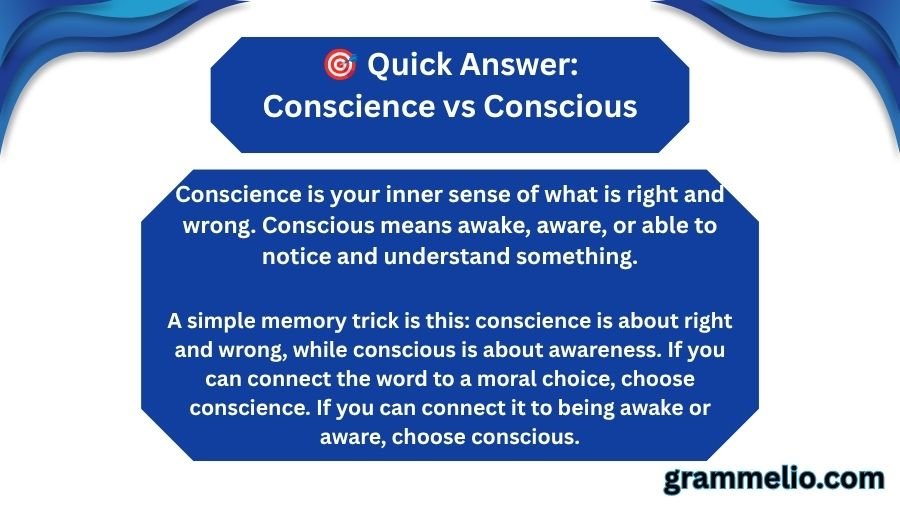
Conscience is your inner sense of what is right and wrong. Conscious means awake, aware, or able to notice and understand something.
A simple memory trick is this: conscience is about right and wrong, while conscious is about awareness. If you can connect the word to a moral choice, choose conscience. If you can connect it to being awake or aware, choose conscious.
| Word | Part of Speech | Basic Meaning | Simple Example |
|---|---|---|---|
| Conscience | Noun | Inner sense of right and wrong | My conscience would not let me lie. |
| Conscious | Adjective | Awake or aware | She was conscious of the noise. |
🔤 Related Word Forms You Should Know
The words in conscience vs conscious have several related forms. Knowing them can help you recognize the correct word even when the sentence looks different.
| Form | Type | Example |
|---|---|---|
| Conscience | Noun | His conscience bothered him. |
| Conscientious | Adjective | She is a conscientious worker. |
| Conscientiously | Adverb | He completed the task conscientiously. |
| Conscious | Adjective | I was conscious of the mistake. |
| Consciously | Adverb | She consciously chose to wait. |
| Consciousness | Noun | He slowly regained consciousness. |
| Unconscious | Adjective | The injured player was unconscious. |
Notice something useful: conscientious comes from the same word family as conscience, but it does not simply mean “having a conscience.” It usually describes someone who is careful, responsible, and serious about doing things properly.
Likewise, consciousness belongs to the conscious family. It relates to awareness or the state of being awake.
🧠 Understanding the Basics of Conscience vs Conscious
The easiest way to understand conscience vs conscious is to separate morality from awareness.
Conscience is a noun. It refers to the inner feeling or judgment that tells you whether something feels morally right or wrong.
Conscious is an adjective. It describes someone or something that is awake, aware, or noticed by the mind.
| Form | Type | Meaning | Example | Correct/Incorrect |
|---|---|---|---|---|
| Conscience | Noun | Moral sense | My conscience told me to return the wallet. | ✅ Correct |
| Conscious | Adjective | Aware | I was conscious of the problem. | ✅ Correct |
| Conscience | Noun | Awake | I was conscience after the accident. | ❌ Incorrect |
| Conscious | Adjective | Moral sense | My conscious would not let me lie. | ❌ Incorrect |
| Conscience | Noun | Inner moral judgment | Her conscience bothered her. | ✅ Correct |
| Conscious | Adjective | Awake | The patient was conscious. | ✅ Correct |
What Does Conscience Mean?
Conscience is your inner sense of right and wrong. It can make you feel good when you make a moral choice and uncomfortable when you do something you believe is wrong.
For example:
My conscience would not let me keep the money.
Here, the speaker feels that keeping the money would be wrong. The word conscience is a noun because it names an inner moral sense.
Another example:
She felt guilty because her conscience told her she had made the wrong choice.
The conscience acts almost like an inner guide. It does not mean that everyone has exactly the same moral views. Instead, it refers to a person’s inner judgment about right and wrong.
What Does Conscious Mean?
Conscious means awake or aware.
For example:
After the accident, the driver remained conscious.
Here, conscious means the driver was awake and able to respond.
It can also mean aware of something:
I was conscious of the people watching me.
In this sentence, the speaker was aware of the people.
So, when you see conscious, think awake or aware.
| Meaning | Word Type | Example Sentence |
|---|---|---|
| Inner sense of right and wrong | Noun | My conscience would not let me cheat. |
| Awake | Adjective | The patient is conscious. |
| Aware of something | Adjective | She was conscious of the time. |
| Careful moral behavior | Adjective family | He is conscientious about his work. |
💡 Test Tip: Ask Yourself One Question
When you are unsure about conscience vs conscious, ask:
“Am I talking about right and wrong, or am I talking about awareness?”
- Right and wrong → conscience
- Awake or aware → conscious
Try these:
I felt guilty because my ______ bothered me.
The answer is conscience because the sentence is about moral guilt.
I was ______ that everyone was looking at me.
The answer is conscious because the sentence is about awareness.
This quick test works in most everyday situations.
❓ Is Conscience the Same as Conscious?
No. Conscience and conscious are different words with different meanings and grammatical roles.
Conscience is a noun connected to moral judgment. Conscious is an adjective connected to awareness or being awake.
Think of this pair:
My conscience told me not to cheat.
I was conscious that the teacher was watching.
The first sentence is about right and wrong. The second is about awareness.
| Question | Answer |
|---|---|
| Is the sentence about morality? | Use conscience. |
| Is the sentence about being awake? | Use conscious. |
| Is the sentence about awareness? | Use conscious. |
| Is the word naming an inner moral guide? | Use conscience. |
| Is the word describing someone? | Conscious may be the right choice. |
❓ Why Do People Confuse Conscience and Conscious?
People confuse these words because their spellings are very similar. Both begin with consc-, and both contain sounds that can make them difficult to separate when spoken quickly.
I once reviewed a student’s short essay about honesty. The student repeatedly wrote “my conscious” when they meant “my conscience.” The student clearly understood the idea but had connected the wrong spelling to the meaning. Once we changed the memory trick to “conscience = moral sense,” the error disappeared.
Another reason is that English spelling does not always give learners an obvious clue about meaning. When two words look alike, writers may rely on sound instead of meaning. That can lead to mistakes.
Fast typing makes the problem worse. Autocorrect may not catch it because both conscience and conscious are legitimate English words.
| Common Confusion | Correct Choice | Main Difference |
|---|---|---|
| It’s / its | Depends on meaning | Contraction vs possession |
| Your / you’re | Depends on meaning | Possession vs “you are” |
| Their / there / they’re | Depends on meaning | Possession, place, contraction |
| Affect / effect | Depends on sentence | Verb/noun uses vary |
| Conscience / conscious | Depends on meaning | Morality vs awareness |
| Advice / advise | Depends on grammar | Noun vs verb |
The key lesson is simple: do not rely only on how a word looks or sounds. Check what the sentence means.
📝 Case Study: A Workplace Email
Imagine that an employee sends this message to a manager:
“I couldn’t keep the extra payment because my conscious would not allow it.”
The intended meaning is clear. The employee feels that keeping money that does not belong to them would be wrong.
But the spelling is incorrect.
The better sentence is:
“I couldn’t keep the extra payment because my conscience would not allow it.”
Now imagine a different message:
“I was conscience that the client was waiting.”
That sentence needs conscious:
“I was conscious that the client was waiting.”
Here, the writer means that they were aware of the client.
This example shows why the difference matters. The surrounding words can tell you which word belongs there.
| Workplace Sentence | Correct Word | Reason |
|---|---|---|
| My ___ would not let me hide the mistake. | Conscience | Moral judgment |
| I was ___ of the deadline. | Conscious | Awareness |
| She felt guilty because her ___ bothered her. | Conscience | Moral feeling |
| He remained ___ during the meeting. | Conscious | Awake |
| We became ___ of the growing cost. | Conscious | Aware |
📏 Grammar Rules Explanation
The main grammar rule behind conscience vs conscious is that the words have different meanings and different grammatical roles.
Conscience is normally used as a noun. It names an inner moral sense.
Conscious is an adjective. It describes a person or state related to awareness or wakefulness.
You can often identify the correct word by looking at its job in the sentence.
For example:
Her conscience bothered her.
The noun conscience is the thing that bothered her.
She was conscious of her mistake.
The adjective conscious describes her state of awareness.
You can also use conscience with common phrases such as “clear conscience” and “guilty conscience.” By contrast, conscious commonly appears with phrases involving awareness, such as “conscious of” or “conscious that.”
Standard English reference works agree on the basic distinction: these are separate words with separate meanings. The safest approach is always to match the word to the idea you want to express.
Correct vs Incorrect at a Glance
| Sentence | Correct/Incorrect | Why |
|---|---|---|
| My conscience would not let me lie. | ✅ Correct | The sentence concerns moral judgment. |
| I was conscious of the loud music. | ✅ Correct | The sentence concerns awareness. |
| My conscious would not let me cheat. | ❌ Incorrect | The moral sense is a conscience. |
| She remained conscience after surgery. | ❌ Incorrect | Being awake is being conscious. |
| He had a clear conscience. | ✅ Correct | “Clear conscience” is a common expression about moral guilt. |
⚠️ Common Mistakes With Conscience and Conscious
Most mistakes happen because writers remember the sound but forget the meaning.
Here are some common reasons:
- Fast typing: Your fingers may choose the familiar spelling before you think about the meaning.
- Autocorrect: Both words are valid, so software may not recognize the mistake.
- Lack of knowledge: New English learners may not know that the words have different meanings.
- Similar spelling: The beginning of both words looks almost the same.
- Speech-based writing: If you learned the word mainly by hearing it, the spelling may be harder to remember.
I once caught myself typing conscious in a sentence about guilt. I knew what I meant, but my fingers had chosen the more familiar spelling. That reminded me that even experienced writers benefit from a quick meaning check.
Similar Grammar Confusions
| Confusing Pair | Word 1 | Word 2 |
|---|---|---|
| Conscience / conscious | Moral sense | Awareness |
| Your / you’re | Possessive | You are |
| Its / it’s | Possessive | It is / it has |
| Then / than | Time or result | Comparison |
| Lose / loose | Fail to keep | Not tight |
| Principal / principle | Person or main item | Rule or belief |
Common Wrong Forms for This Specific Pair
| Wrong Form | What’s Wrong | Correct Form |
|---|---|---|
| My conscious bothers me. | Uses the awareness word for moral judgment. | My conscience bothers me. |
| I was conscience of the noise. | Uses the noun where an adjective is needed. | I was conscious of the noise. |
| A clear conscious | Wrong spelling for the moral expression. | A clear conscience |
| He lost conscious. | Missing the noun form needed here. | He lost consciousness. |
| She is conscience of the risk. | Incorrect form for awareness. | She is conscious of the risk. |
| His conscious felt guilty. | Moral sense is being described. | His conscience felt guilty. |
🕰️ Word History and How the Meanings Became Different
The two words have a shared history, which helps explain why they look so similar today. Both are connected to older word forms associated with knowing or being aware. Over time, English developed separate uses and spellings for the moral sense and the state of awareness.
That shared background is one reason conscience vs conscious can feel confusing. The words are related, but modern English gives them different jobs.
| Period | Form | General Development |
|---|---|---|
| Earlier English use | Related forms | Ideas of knowing and awareness were connected. |
| Middle English period | Developing forms | Different uses began to become clearer. |
| Later English | Conscience | Strongly linked with moral judgment. |
| Later English | Conscious | Linked with awareness and wakefulness. |
| Modern English | Both forms | Separate meanings and grammatical uses are standard. |
You do not need to memorize the history to use the words correctly. The practical distinction is much more useful.
❓ How Can You Remember Conscience vs Conscious?
Use the moral vs awareness trick.
Conscience = moral choice.
Conscious = awareness.
You can also remember the ending:
- Conscience has science in its spelling: think of an inner “sense” that helps judge your actions.
- Conscious ends with -ous, like many adjectives.
This is not a grammar rule. It is simply a memory aid.
Try this:
I cannot lie because my ______ will bother me.
Think: moral choice → conscience.
I am ______ of the noise outside.
Think: awareness → conscious.
| Memory Question | Answer |
|---|---|
| Am I talking about right and wrong? | Conscience |
| Am I talking about being awake? | Conscious |
| Am I talking about awareness? | Conscious |
| Am I talking about guilt over an action? | Conscience |
| Am I describing a person as aware? | Conscious |
💬 Usage in Different Contexts
The difference between conscience vs conscious stays the same across writing styles. What changes is how often you may use each word.
Everyday Conversation
In everyday speech, conscious often appears when someone talks about awareness or sleep.
“I was conscious of the noise.”
Conscience often appears when someone talks about guilt or moral choices.
“My conscience would not let me do that.”
Professional Writing
Both words are useful in professional writing. Conscious may describe awareness of costs, deadlines, risks, or customer needs.
“The team is conscious of the budget.”
Conscience may appear when discussing ethical choices.
“The manager acted according to her conscience.”
Creative Writing
Writers may use conscience to explore guilt, conflict, and personal choices.
“His conscience kept him awake all night.”
They may use conscious to describe awareness or a person’s state.
“She became conscious of footsteps behind her.”
Social Media and Texting
Both words can appear in casual posts and messages. Because texting is fast, this is also a place where spelling mistakes are common.
| Context | Which Term to Use | Example |
|---|---|---|
| Everyday conversation | Either, depending on meaning | My conscience is bothering me. |
| Professional writing | Either, depending on meaning | We are conscious of the deadline. |
| Creative writing | Either, depending on meaning | His conscience would not rest. |
| Social media/texting | Either, depending on meaning | I was conscious of the awkward silence. |
🗣️ Common Phrases With Conscience
Conscience appears in several familiar expressions. Learning these phrases can make the correct spelling easier to remember.
| Phrase | Meaning |
|---|---|
| Clear conscience | Feeling that you have done nothing morally wrong |
| Guilty conscience | Feeling guilty about something |
| Conscience-stricken | Deeply troubled by guilt |
| Conscience of the matter | A moral judgment about an issue |
| Follow your conscience | Act according to your sense of right and wrong |
| Ease your conscience | Reduce guilt or moral worry |
Some phrases with conscious are also common:
| Phrase | Meaning |
|---|---|
| Conscious of | Aware of something |
| Conscious that | Aware that something is true |
| Regain consciousness | Become awake again |
| Lose consciousness | Become unconscious |
| Conscious effort | An intentional effort |
| Conscious decision | A decision made intentionally |
The phrases themselves provide useful clues. If you see clear, guilty, or follow your, you may be dealing with conscience. If you see of, effort, or decision, conscious may fit better.
🔄 Synonyms and Alternatives
Sometimes you can replace one of these words with a simpler word. Doing this can help if you are unsure which form belongs in your sentence.
For conscience, possible alternatives include moral sense, inner judgment, and sense of right and wrong.
For conscious, alternatives include aware, awake, alert, and mindful, depending on the context.
| Alternative | Works When | Does Not Work When |
|---|---|---|
| Moral sense | Talking about right and wrong | Talking about being awake |
| Aware | Talking about noticing something | Talking about guilt itself |
| Awake | Talking about someone’s state | Talking about moral judgment |
| Alert | Talking about being awake and attentive | Talking about ethics |
| Mindful | Talking about deliberate awareness | Talking about a guilty moral feeling |
Be careful with synonyms. Aware can replace conscious in many sentences, but it cannot replace conscience.
For example:
I was conscious of the problem.
You can write:
I was aware of the problem.
But:
My conscience bothered me.
Cannot naturally become:
My awareness bothered me.
The meaning changes.
❓ When Should You Use Conscience Instead of Conscious?
Use conscience when the sentence involves a person’s inner moral sense. It often appears when someone feels guilt, responsibility, or a need to do what they believe is right.
Examples include:
I could not steal the money because of my conscience.
She has a clear conscience.
His guilty conscience kept bothering him.
If the sentence is about moral choice, conscience is usually the correct word.
❓ When Should You Use Conscious Instead of Conscience?
Use conscious when the sentence describes awareness or being awake.
Examples include:
I was conscious of the mistake.
The patient is conscious.
She became conscious of the sound.
He made a conscious decision to leave.
If you could replace the word with aware, awake, or intentional, conscious may be the right choice.
| Replacement Test | Likely Word |
|---|---|
| Could I say “moral sense”? | Conscience |
| Could I say “aware”? | Conscious |
| Could I say “awake”? | Conscious |
| Could I say “inner sense of right and wrong”? | Conscience |
| Could I say “intentional”? | Conscious |
❓ Can Conscious Mean Morally Aware?
Yes, but the context matters. Conscious can describe awareness of something, including an awareness of social, moral, or personal issues.
For example:
She is conscious of her responsibility.
This means she is aware of her responsibility.
It does not mean that the word itself means “conscience.”
Likewise:
He made a conscious choice to tell the truth.
This means he intentionally chose to tell the truth. It does not mean that conscious means an inner moral guide.
That distinction is important because the two ideas can appear in the same sentence.
He was conscious of his mistake, and his conscience bothered him.
Here, both words are correct. He was aware of the mistake, and his moral sense made him feel bad about it.
❓ Can You Use Conscience as an Adjective?
No. Conscience is normally a noun. It names the inner moral sense.
You should not write:
“She is conscience of the problem.”
Instead, write:
“She is conscious of the problem.”
Similarly, do not write:
“He made a conscience decision.”
If you mean an intentional decision, use:
“He made a conscious decision.”
If you mean a decision based on moral judgment, you may need a different phrase, such as:
“He made the decision according to his conscience.”
This is one of the most useful grammar points in the entire topic.
❓ What Is the Difference Between Conscience and Consciousness?
Conscience refers to a moral sense. Consciousness refers to awareness or the state of being awake.
The endings matter here:
- conscience → moral sense
- conscious → awake or aware
- consciousness → state of being aware or awake
For example:
Her conscience bothered her.
She regained consciousness.
The first sentence is about morality. The second is about awareness or wakefulness.
| Word | Meaning | Example |
|---|---|---|
| Conscience | Moral sense | My conscience bothered me. |
| Conscious | Awake or aware | I am conscious of the problem. |
| Consciousness | State of awareness | He regained consciousness. |
| Unconscious | Not awake or aware | The player was unconscious. |
❓ Why Does Getting Conscience vs Conscious Right Matter?
Correct word choice makes your meaning clear. A reader should not have to guess whether you mean moral judgment or awareness.
This matters in school essays, workplace emails, resumes, websites, articles, and social posts. A spelling error between these words can change the meaning of your sentence.
A useful writing rule is:
Clear words make clear thoughts easier to understand.
| Situation | Why Getting It Right Matters |
|---|---|
| Resume | Shows attention to detail |
| Client email | Prevents confusion and protects professionalism |
| Published content | Builds reader trust |
| Social post | Makes your meaning easier to understand |
In professional writing, small errors can affect how readers judge the quality of the entire document. One mistake will not always matter, but repeated mistakes can distract from your message.
🧩 Special Exception: Conscious and Conscience in the Same Sentence
There is no special spelling exception that changes the basic rule. However, the two words can correctly appear together.
Consider:
I was conscious of what I had done, and my conscience would not let me forget it.
This sentence is a perfect demonstration of the difference.
The speaker was conscious of the action because they were aware of it.
Their conscience bothered them because they believed the action was morally troubling.
When both ideas appear together, the contrast becomes especially clear.
❓ Can Conscience and Conscious Appear Together?
Yes. They can appear in the same sentence because they express different ideas.
For example:
She was conscious of the mistake, but her conscience told her to admit it.
The first word means aware. The second means inner moral sense.
This is a useful practice sentence because it lets you compare both meanings at once.
| Sentence | First Word | Second Word |
|---|---|---|
| He was conscious of his mistake, and his conscience bothered him. | Awareness | Moral sense |
| She became conscious of the problem and listened to her conscience. | Awareness | Moral judgment |
| I was conscious of the risk, but my conscience made me speak up. | Awareness | Moral judgment |
📝 More Practice Examples
Try to choose the correct word before reading the answer.
Example 1
I could not lie to my parents because my ______ would bother me.
Answer: conscience ✅
The sentence is about right and wrong.
Example 2
I became ______ of how loudly I was speaking.
Answer: conscious ✅
The sentence is about awareness.
Example 3
The patient was still ______ after the procedure.
Answer: conscious ✅
The sentence is about being awake.
Example 4
She had a clear ______ after telling the truth.
Answer: conscience ✅
“Clear conscience” refers to freedom from moral guilt.
Example 5
He was ______ that his decision might upset the team.
Answer: conscious ✅
He was aware of the possible result.
| Practice Sentence | Answer | Reason |
|---|---|---|
| My ___ would not let me cheat. | Conscience | Moral judgment |
| I was ___ of the danger. | Conscious | Awareness |
| She remained ___ after the fall. | Conscious | Awake |
| He had a guilty ___. | Conscience | Moral guilt |
| We are ___ of the cost. | Conscious | Awareness |
✅ Quick Recap Checklist
Use this checklist whenever you are unsure about the difference.
| Question | If Yes → Use |
|---|---|
| Is the sentence about right and wrong? | Conscience |
| Is it about guilt? | Conscience |
| Is it about a moral choice? | Conscience |
| Is it about being awake? | Conscious |
| Is it about awareness? | Conscious |
| Is it describing an intentional choice? | Conscious |
| Can you replace the word with “aware”? | Conscious |
| Can you replace the word with “moral sense”? | Conscience |
Three Final Practice Examples
- My conscience told me to return the wallet. ✅
Moral sense → conscience. - I was conscious of the noise. ✅
Awareness → conscious. - She was conscious of her mistake, and her conscience made her apologize. ✅
Awareness → conscious; moral feeling → conscience.
❓ What Is the Easiest Trick for Conscience vs Conscious?
The easiest trick is to remember:
Conscience = right and wrong.
Conscious = awake and aware.
If you are talking about guilt, morality, or an inner moral guide, choose conscience.
If you are talking about awareness, attention, being awake, or an intentional action, choose conscious.
❓ Is “My Conscious Is Bothering Me” Correct?
No. The correct sentence is:
My conscience is bothering me. ✅
The sentence is about an inner moral feeling, so conscience is required.
You could use conscious in a sentence such as:
I am conscious of my mistake. ✅
Here, the meaning is awareness.
❓ Is “I Am Conscience of It” Correct?
No. The correct sentence is:
I am conscious of it. ✅
The phrase conscious of means aware of.
Conscience is a noun and does not work in this structure.
❓ What Is the Difference Between a Clear Conscience and Being Conscious?
A clear conscience means you do not feel that you have done something morally wrong. Being conscious means you are awake or aware.
For example:
I have a clear conscience because I told the truth.
This is about morality.
I was conscious during the entire conversation.
This is about being awake.
The two ideas are completely different even though the words look similar.
❓ How Do You Spell the Word for Moral Judgment?
The word is conscience.
A useful phrase to remember is:
a clear conscience
Another is:
a guilty conscience
If you are talking about your inner sense of right and wrong, spell it conscience.
❓ How Do You Spell the Word for Being Awake or Aware?
The word is conscious.
Useful examples include:
I am conscious of the problem.
The patient is conscious.
She made a conscious choice.
If the idea is awareness or wakefulness, use conscious.
❓ Can You Give Me a One-Sentence Rule?
Yes:
Use conscience for your inner sense of right and wrong, and use conscious for being awake, aware, or intentional.
That single rule solves most conscience vs conscious questions.
❓ Which Word Should I Use in Professional Writing?
Use the word that matches your intended meaning. Use conscience for moral judgment and conscious for awareness or intentional action.
For example:
The manager followed her conscience.
The manager was conscious of the company’s budget.
Both sentences are professional and correct. They simply communicate different ideas.
🎯 Final Takeaway
Conscience vs conscious becomes much easier once you stop focusing on their similar spelling and focus on their meanings. Conscience is a noun that refers to your inner sense of right and wrong. Conscious is an adjective that describes being awake, aware, or intentional.
When you see a sentence, ask yourself one quick question: Is this about morality or awareness? If it is about morality, choose conscience. If it is about awareness or being awake, choose conscious. 🧠
I recommend practicing the words in pairs because the contrast makes the difference stick. Write one sentence about your conscience and another about being conscious. After a few repetitions, the correct spelling will feel much more natural.
Remember the simplest rule: conscience judges your choices; conscious notices what is happening. Keep that line in mind, and you will be able to choose the right word with confidence every time. ✨

[…] should feel confident using both words in school, work, conversation, and online writing. ✍️ Conscience vs Conscious | Complacent vs Complaisant | Colonel vs […]
[…] that basic difference, choosing the right word becomes much easier. Continual vs Continuous | Conscience vs Conscious | Complacent vs […]