Have you ever paused while writing because you could not remember whether you meant flounder vs founder? I have seen this mix-up many times in student papers, emails, and even polished business writing. The two words look almost the same, but they have very different meanings. One usually describes struggling, while the other can mean starting something or sinking.
That small spelling difference can change an entire sentence. 📝 If you are a student, teacher, writer, job seeker, or simply someone who wants clearer English, learning this pair is worth your time. In this guide, I will break down the meanings, grammar rules, examples, common mistakes, and memory tricks in simple US English.
By the end, you should be able to choose the right word quickly and confidently. 😊 Flew vs Flu vs Flue | Finale vs Finally | Ferment vs Foment
🎯 Quick Answer: What Is the Difference Between Flounder vs Founder?
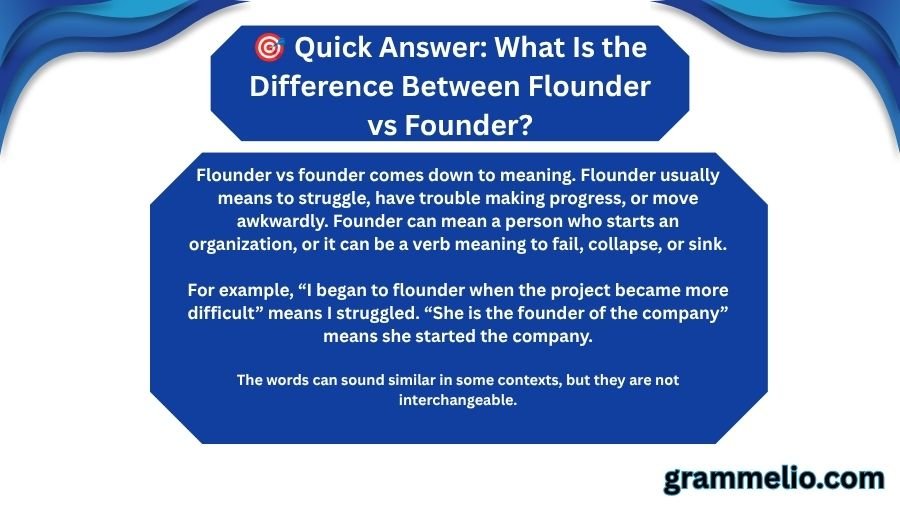
Flounder vs founder comes down to meaning. Flounder usually means to struggle, have trouble making progress, or move awkwardly. Founder can mean a person who starts an organization, or it can be a verb meaning to fail, collapse, or sink.
For example, “I began to flounder when the project became more difficult” means I struggled. “She is the founder of the company” means she started the company.
The words can sound similar in some contexts, but they are not interchangeable.
Related Word Forms of Flounder and Founder
Both words have several useful forms. Knowing these forms can make the difference easier to spot when you see them in real writing.
| Form | Type | Example |
|---|---|---|
| flounder | Verb | I began to flounder under pressure. |
| floundering | Present participle | The team is floundering without a plan. |
| floundered | Past tense | We floundered during the first week. |
| founder | Noun | The founder launched the business. |
| founded | Past tense/adjective form | She founded the nonprofit in 2018. |
| founding | Noun/adjective/participle | He attended the founding meeting. |
| foundering | Present participle | The company is foundering financially. |
| foundered | Past tense | The plan foundered after several delays. |
Notice something important: floundering and foundering look almost identical. Their meanings are still different.
🔍 Understanding the Basics of Flounder vs Founder
The easiest way to understand flounder vs founder is to separate their main meanings.
Flounder is mainly about struggling.
Founder has two important uses. As a noun, it means a person who starts something, such as a company or organization. As a verb, it can mean to fail, collapse, or sink.
Here is the basic difference:
| Form | Type | Meaning | Example | Correct/Incorrect |
|---|---|---|---|---|
| flounder | Verb | Struggle or have difficulty | I floundered during the interview. | ✅ Correct |
| founder | Noun | Person who starts something | Maria is the founder of the company. | ✅ Correct |
| founder | Verb | Fail, collapse, or sink | The plan foundered after months of delays. | ✅ Correct |
| flounder | Verb | Be the person who started a company | Maria floundered the company. | ❌ Incorrect |
| founder | Noun | A person who is struggling | He is a founder with the difficult task. | ❌ Incorrect |
Flounder Means to Struggle
When flounder is used as a verb, it describes a person or group that is having trouble.
You might flounder when:
- You do not know what to do.
- You cannot make progress.
- You are trying to solve a difficult problem.
- You are unsure how to respond.
- You are struggling to stay in control.
For example:
✅ “I started to flounder when the interviewer asked a technical question.”
The sentence says that the speaker struggled to answer.
❌ “I started to founder when the interviewer asked a technical question.”
This is not the normal word if you simply mean that you struggled.
Founder as a Person
As a noun, founder means someone who starts or establishes something.
That something could be:
- a company
- a nonprofit
- a school
- a movement
- a club
- a website
- a project
- an organization
For example:
✅ “The founder of the company spoke at the event.”
Here, founder is a person.
It does not mean “someone who is struggling.”
Founder as a Verb
Founder can also be a verb. In this use, it means to fail, collapse, or stop making progress.
For example:
✅ “The negotiations foundered after both sides rejected the proposal.”
The negotiations did not simply experience a small problem. They failed to move forward.
This use is less common in casual conversation than “founder” as a noun, but it is useful in formal writing.
💡 Test Tip: How Can You Test the Difference?
Here is my favorite quick test.
Ask yourself:
Am I talking about struggling?
If yes, flounder is usually the word you want.
Am I talking about the person who started something?
Use founder.
Am I talking about a plan, effort, or organization failing?
Founder may be correct when used as a verb.
| Question | Word to Choose |
|---|---|
| Is someone struggling? | Flounder |
| Is someone starting a company? | Founder |
| Did a plan fail? | Founder |
| Is someone having trouble making progress? | Flounder |
| Is the sentence about the creator of an organization? | Founder |
A simple memory trick is:
Flounder = flail and struggle.
Founder = founder of a company or something that fails.
📝 Correct Meanings and Uses of Flounder
Flounder in Everyday Situations
People often use flounder when someone is having difficulty.
For example:
✅ “Without clear instructions, I began to flounder.”
The person does not know how to proceed.
Another example:
✅ “The new employee floundered during her first week.”
This does not necessarily mean she was a bad employee. It means she had difficulty adjusting.
Flounder in School
Students can flounder when they face a subject they do not understand.
For example:
✅ “I floundered in chemistry until I found a better study method.”
The speaker struggled with the subject.
Flounder in Business
A business or team can also flounder when it struggles to make progress.
For example:
✅ “The team began to flounder after its manager resigned.”
The team lost direction.
Flounder as a Physical Action
Flounder can also describe awkward physical movement, especially when someone is trying to regain balance or control.
For example:
✅ “He floundered in the water before reaching the side of the pool.”
This meaning connects nicely to the idea of struggling.
| Meaning | Word Type | Example Sentence |
|---|---|---|
| Struggle mentally | Verb | She floundered under pressure. |
| Have difficulty making progress | Verb | The project floundered without funding. |
| Move awkwardly | Verb | He floundered in the shallow water. |
| Struggle with a task | Verb | I floundered during the presentation. |
👤 Correct Meanings and Uses of Founder
Founder as a Noun
The most common meaning of founder is a person who establishes something.
For example:
✅ “He is the founder of a successful technology company.”
Here, founder is a noun.
The word often appears with of:
- founder of a company
- founder of a nonprofit
- founder of a movement
- founder of a school
- founder of a website
Founder as a Verb
As a verb, founder has a very different meaning.
It can describe something that fails or collapses.
For example:
✅ “The project foundered because the team lacked funding.”
The project failed to move forward.
This use often appears in formal writing, news reports, and discussions about plans or negotiations.
Founder and Failure
When founder is used as a verb, it often suggests that something has run into serious trouble.
| Use | Meaning | Example |
|---|---|---|
| Founder as noun | Person who starts something | The founder opened the school. |
| Founder as verb | Fail or collapse | The plan foundered. |
| Founder as verb | Stop progressing | Talks foundered over money. |
| Founder in past tense | Failed or collapsed | The agreement foundered quickly. |
🤔 Is Flounder the Same as Founder?
No. Flounder and founder are not the same word.
Flounder normally describes struggling or moving awkwardly. Founder can describe a person who starts something or an effort that fails.
The confusion comes from their similar spelling and sound.
Compare these:
✅ “The student floundered during the difficult exam.”
The student struggled.
✅ “The student’s project foundered after the main sponsor left.”
The project failed.
The two words can appear in similar situations, especially when talking about difficulty, but they express different ideas.
🧠 Why Do People Confuse Flounder and Founder?
People confuse these words because they share several letters and can both appear in sentences about difficult situations.
There is another problem: the verb founder can mean that something fails. That meaning overlaps with the general idea of struggling.
I once edited a short business report where the writer used “founder” when describing a team that was having trouble. The writer clearly meant “struggling,” so floundering was the better choice. The sentence looked almost right at first glance, but the meaning changed because of one letter.
Common causes of confusion include:
- Similar spelling
- Similar pronunciation
- Overlapping ideas about difficulty
- Fast typing
- Autocorrect
- Limited vocabulary knowledge
- Not checking the sentence meaning
Flounder vs Founder in Similar Sentences
| Sentence | Meaning |
|---|---|
| The team is floundering. | The team is struggling. |
| The plan is foundering. | The plan is failing. |
| The founder joined the meeting. | The person who started the organization joined. |
| The student floundered on the test. | The student struggled on the test. |
📚 Grammar Rules Explanation
The grammar rule is simple: choose the word based on its meaning and grammatical role.
Flounder is primarily a verb when it means to struggle or move awkwardly.
Founder can be a noun or a verb.
As a noun:
“The founder spoke to the employees.”
As a verb:
“The negotiations foundered.”
The noun founder identifies a person who establishes something. The verb founder describes failure, collapse, or a loss of progress.
Do not choose between these words based only on how they look. Read the entire sentence and ask what idea you need to express.
Most standard English reference sources distinguish these words clearly, so the safest approach is to focus on meaning rather than spelling.
Correct vs Incorrect at a Glance
| Sentence | Correct/Incorrect | Why |
|---|---|---|
| I began to flounder when the lesson became harder. | ✅ Correct | Flounder means struggle. |
| She is the founder of the nonprofit. | ✅ Correct | Founder means the person who started it. |
| The negotiations foundered over money. | ✅ Correct | Founder means failed or stopped progressing. |
| She floundered the nonprofit in 2020. | ❌ Incorrect | A person who starts it is the founder. |
| The student was the founder during the exam. | ❌ Incorrect | The intended meaning is struggling, so use flounder. |
⚠️ Common Mistakes With Flounder and Founder
The biggest mistake is treating these words as simple spelling variants.
They are different words with different jobs.
Common English Word Confusions
| Confusion | Correct Difference |
|---|---|
| its / it’s | Possession vs. “it is” |
| your / you’re | Possession vs. “you are” |
| their / there / they’re | Possession, place, or “they are” |
| affect / effect | Usually verb vs. noun |
| advice / advise | Noun vs. verb |
| flounder / founder | Struggle vs. starter/failure |
Fast typing makes these mistakes even more likely. Autocorrect can also make things worse because a spelling checker may accept a real word even when it is the wrong word for the sentence.
I once caught myself typing “founder” in a sentence where I clearly meant “flounder.” Nothing looked wrong at the spelling level. The problem only became obvious when I read the sentence for meaning.
Specific Wrong Forms and Uses
| Wrong Form | What’s Wrong | Correct Form |
|---|---|---|
| I founder when I get nervous. | Wrong if you mean “struggle.” | I flounder when I get nervous. |
| She floundered the company. | Wrong verb for starting a company. | She founded the company. |
| He is the flounder of the business. | Wrong noun. | He is the founder of the business. |
| The negotiations floundered after the dispute. | Possible only if you mean struggled; often “foundered” better expresses failure. | The negotiations foundered after the dispute. |
| The founder student could not answer. | Wrong meaning. | The struggling student could not answer. |
🕰️ Word History and How the Meanings Developed
The histories of these words are different, even though their modern forms look similar. The histories of these words are different, even though their modern forms look similar.
Flounder developed with meanings connected to struggling and awkward movement. The word has long been used for the idea of having difficulty getting forward.
Founder, when used as a noun for the person who establishes something, is connected to the idea of founding or establishing. The verb founder, meaning to fail or collapse, developed separately in English usage and is associated with the idea of something failing to continue successfully.
The key lesson is that similar spelling does not mean two words share the same modern meaning.
| Period | Form | General Note |
|---|---|---|
| Earlier English use | flounder | Connected with struggling or awkward movement |
| Later English use | flounder | Expanded naturally into figurative struggle |
| Earlier English use | founder | Used in connection with establishing or founding |
| Modern English | founder | Common noun for someone who starts an organization |
| Modern English | founder | Also used as a verb for failing or collapsing |
You do not need to memorize this history to use the words correctly. Meaning is the more useful tool.
🌎 Usage in Different Contexts
Context can make the difference much easier to see.
Everyday Conversation
Use flounder when talking about someone who is struggling.
“I totally floundered when she asked me that question.”
Use founder when identifying someone who started something.
“He is the founder of that local business.”
Professional Writing
Both words can appear in professional writing.
“The team continued to flounder without clear leadership.”
“The founder announced a new company policy.”
“The negotiations foundered after the two sides disagreed.”
Creative Writing
Writers can use flounder to describe emotional or physical struggle.
“She floundered for words.”
Founder can create a stronger sense of failure.
“Their carefully planned mission foundered before it began.”
Social Media and Texting
In casual writing, flounder is useful when describing confusion or difficulty.
“I completely floundered during that interview 😂.”
Founder is common when discussing entrepreneurs.
“The founder just announced a new product.”
| Context | Which Term to Use | Example |
|---|---|---|
| Everyday conversation | Flounder for struggle | I floundered when I had to explain it. |
| Professional writing | Either, depending on meaning | The negotiations foundered. |
| Creative writing | Flounder for struggle | He floundered for an answer. |
| Social media/texting | Founder for business creator | The founder shared the news. |
💬 Common Phrases With Flounder
There are several natural expressions built around flounder.
| Phrase | Meaning |
|---|---|
| flounder for words | Struggle to find something to say |
| flounder around | Struggle without a clear plan |
| flounder under pressure | Have trouble because of stress |
| flounder without guidance | Struggle because help is missing |
| begin to flounder | Start having difficulty |
For example:
“Without a clear plan, the team began to flounder.”
This sentence gives a strong picture of a group that is losing direction.
Common Phrases With Founder
Founder as a noun commonly appears in phrases about organizations.
| Phrase | Meaning |
|---|---|
| company founder | Person who started a company |
| nonprofit founder | Person who established a nonprofit |
| startup founder | Person who started a startup |
| founding founder | Usually unnecessary repetition; avoid it |
| founder of the organization | Person who established the organization |
As a verb, founder often appears with words describing plans or efforts:
- negotiations foundered
- talks foundered
- plans foundered
- efforts foundered
- the project foundered
🔄 Synonyms and Alternatives
Sometimes you can replace these words with simpler alternatives. Choosing alternatives can also help you understand flounder vs founder and the specific meaning you want to express.
For flounder, you might use struggle, stray, or have difficulty, depending on context.
For founder as a noun, you might use creator, establisher, or person who started the organization. However, “founder” is usually the most natural choice for an organization or company.
| Alternative | Works When | Does Not Work When |
|---|---|---|
| struggle | You mean having difficulty | You mean a company founder |
| have difficulty | You want very simple wording | You need the idea of awkward movement |
| creator | Someone made or developed something | The exact role is founder |
| started | You need a simple verb | You need a noun for the person |
| collapse | Something failed | Someone merely struggled |
🎯 How to Remember the Difference
A good memory trick can save you from repeated mistakes.
Think:
FLOUNDER = FIGHTING TO GET THROUGH SOMETHING.
The word contains “fl”, which can remind you of flailing around.
FOUNDER = FOUND + ER.
A founder is the person who founds or starts something.
Then remember the second verb meaning:
A plan can founder when it fails.
This gives you three simple ideas:
- Flounder = struggle
- Founder = person who starts something
- Founder = fail or collapse
| Memory Question | Answer |
|---|---|
| Am I struggling? | Flounder |
| Am I talking about the person who started it? | Founder |
| Did a plan or effort fail? | Founder |
| Am I describing awkward movement? | Flounder |
🏢 📝 Case Study: A Workplace Example
Imagine that a small company launches a new project.
At first, the project has no clear manager. Team members are unsure about their tasks. Meetings become confusing.
You could say:
“The team began to flounder without clear leadership.”
This means the team struggled.
A few months later, the project loses funding and stops moving forward.
You could say:
“The project foundered after its funding disappeared.”
Now the meaning is stronger. The project did not merely struggle. It failed to continue.
Finally, the person who originally created the company can be described as:
“The company’s founder attended the final meeting.”
These three sentences show why context matters.
| Workplace Situation | Correct Word | Reason |
|---|---|---|
| Team struggles | Flounder | Describes difficulty |
| Project fails | Founder | Verb meaning fails |
| Person who started company | Founder | Noun meaning starter |
| Employee struggles with a task | Flounder | Describes difficulty |
❓ Can a Person Flounder?
Yes. A person can flounder when they struggle with a task, decision, conversation, or situation.
Examples include:
- “I floundered during the interview.”
- “She floundered when asked to explain the process.”
- “He began to flounder without proper training.”
The word does not automatically mean someone is incompetent. It simply shows that the person is having difficulty.
❓ Can a Business Flounder?
Yes. A business can flounder when it struggles to succeed or make progress.
For example:
“The company began to flounder after losing its biggest customer.”
This focuses on ongoing difficulty.
You can also use founder as a verb when you want to emphasize failure:
“The company’s expansion plan foundered after costs increased.”
The first sentence focuses on struggle. The second focuses more strongly on failure.
❓ Can Founder Be a Verb?
Yes. Founder can be a verb meaning to fail, collapse, or stop making progress.
For example:
“The negotiations foundered after the two sides rejected the proposal.”
This is grammatically correct.
Do not confuse this with found, which means established or discovered.
For example:
“They founded the organization in 2015.”
That sentence means they established it.
❓ What Is the Difference Between Floundering and Foundering?
Floundering usually means struggling or having difficulty. Foundering can mean failing, collapsing, or losing the ability to move forward.
Compare:
“The team is floundering without a leader.”
The team is struggling.
“The project is foundering because of repeated delays.”
The project is failing.
Both can describe difficult situations, but foundering usually gives a stronger sense of failure.
❓ Should I Say “I Am Floundering” or “I Am Foundering”?
If you mean “I am struggling,” say:
“I am floundering.”
If you mean that something is failing or collapsing, “foundering” may fit, but it is much less common for describing a person in ordinary conversation.
For everyday speech, “I am struggling” is often clearer.
❓ Is “Founder” the Opposite of “Flounder”?
No. They are not opposites.
Flounder means struggle.
Founder can mean the person who starts something, or it can mean fail.
Because “founder” can mean failure, it may seem related to “flounder,” but the words are still distinct.
❓ How Do You Use Flounder in a Sentence?
Use flounder when you want to say that someone or something is struggling.
Examples:
- “I floundered during the presentation.”
- “The team is floundering without a clear goal.”
- “She floundered for an answer.”
- “The new business began to flounder.”
❓ How Do You Use Founder in a Sentence?
Use founder as a noun when you mean the person who started something.
Example:
“The founder of the company gave a speech.”
Use it as a verb when something fails or collapses.
Example:
“The plan foundered after the budget was cut.”
❓ What Is an Easy Way to Remember Flounder vs Founder?
Remember three words:
Flounder = struggle.
Founder = starter.
Founder = fail.
If you can replace the word with struggle, choose flounder.
If you mean the person who started a company or organization, choose founder.
If you mean that a plan or effort failed, founder may be the right verb.
❓ Which Word Is Better for Formal Writing?
Both words are correct in formal writing, but they must be used for the right meaning.
Flounder works well when describing difficulty or lack of progress.
Founder works well when identifying the person who established an organization. Its verb form also works when describing a serious failure.
For maximum clarity, always check what the sentence actually means before choosing the word.
❓ Can Autocorrect Help Me Choose the Right Word?
Not always. Both flounder and founder are correctly spelled English words, so a spelling checker may not recognize a meaning error.
That is why proofreading for meaning matters.
A sentence can have perfect spelling and still use the wrong word.
✅ Quick Recap Checklist
Use this checklist whenever you hesitate.
| Question | If Yes → Use |
|---|---|
| Does the word mean “struggle”? | Flounder |
| Does it describe awkward movement? | Flounder |
| Does it name someone who started a company? | Founder |
| Does it describe a plan that failed? | Founder |
| Is the sentence about a business creator? | Founder |
Practice Examples
Try these before checking the answers:
- “I began to ______ when the teacher asked a difficult question.”
- “She is the ______ of the nonprofit.”
- “The negotiations ______ after both sides rejected the deal.”
Answers:
- flounder
- founder
- foundered
If you got all three right, you have the main rule down.
🚨 A Final Look at Flounder vs Founder
Here is the difference in its simplest form:
| Word | Main Meaning | Example |
|---|---|---|
| Flounder | Struggle or move awkwardly | I floundered during the interview. |
| Founder | Person who starts something | She is the founder of the company. |
| Founder | Fail or collapse | The plan foundered after funding ended. |
The most common mistake is using founder when you mean flounder.
If someone is having trouble, use flounder.
If someone created an organization, use founder.
If a plan, negotiation, or effort fails, founder can work as a verb.
FAQs About Flounder vs Founder
These common questions about flounder vs founder can help you review the main differences quickly.
What does flounder mean?
Flounder means to struggle, have difficulty making progress, or move awkwardly. For example, “The student floundered during the difficult exam.”
What does founder mean?
Founder can mean a person who starts or establishes something. It can also be a verb meaning to fail, collapse, or stop making progress.
Is flounder a verb?
Yes. Flounder is commonly used as a verb. It can describe struggling with a task or situation, or moving awkwardly.
Is founder a noun?
Yes. Founder is a noun when it means the person who established or started an organization, business, or other project.
Is founder also a verb?
Yes. As a verb, founder can mean to fail, collapse, or stop progressing. For example, “The negotiations foundered.”
Is “flounder” the same as “struggle”?
They can be close in meaning when flounder describes difficulty. However, flounder can also suggest awkward movement or a lack of direction.
Is “founder” the same as “fail”?
Sometimes. When founder is used as a verb, it can mean to fail or collapse. But founder as a noun means the person who starts something, so context matters.
Should I use “flounder” for a person who starts a company?
No. The correct noun is founder.
Correct:
“She is the founder of the company.”
Not:
“She is the flounder of the company.”
Which word means “struggle”: flounder or founder?
Flounder is the usual choice when you mean struggle.
How can I quickly remember the difference?
Think of flounder as “struggle” and founder as “starter” or “failure.” That three-part memory trick covers the main uses.
🎯 Conclusion: Mastering Flounder vs Founder
Flounder vs founder becomes much easier when you focus on meaning instead of spelling. Flounder usually means to struggle, have trouble making progress, or move awkwardly. Founder can mean the person who starts an organization. It can also work as a verb when a plan, effort, or negotiation fails or collapses. 🧠
When I proofread these words, I always ask one simple question: What does the sentence actually mean? If the answer is “struggle,” choose flounder. If you are naming the person who started something, choose founder. If something failed to continue successfully, founder may work as a verb.
Once you connect each word to its main meaning, the spelling becomes much easier to remember. You do not need a complicated grammar rule. You only need to pause, identify the intended meaning, and choose the word that fits. ✨
When in doubt, remember: flounder means struggle, founder means starter or failure. Meaning first, spelling second.

[…] memory tricks. By the end, you should feel confident choosing the right word every time. ✍️ Flounder vs Founder | Flew vs Flu vs Flue | Finale vs […]
[…] you should be able to choose the right word quickly and confidently. ✍️ Formally vs Formerly | Flounder vs Founder | Flew vs Flu vs […]