Have you ever written a sentence and stopped because you could not decide between ferment vs foment? I have seen this mix-up many times in editing and grammar work. The two words look and sound somewhat alike, but they describe very different ideas. Ferment is mainly connected with a process of change, especially when food or drink changes through a natural process. It can also describe feelings or unrest that are slowly growing.
Foment, on the other hand, means to encourage or stir up trouble, anger, conflict, or unrest. That small spelling difference can change the whole meaning of a sentence. 😊 Once you understand the key idea behind each word, choosing the right one becomes much easier.
In this guide, I will show you how to tell them apart, give you clear examples, and share simple memory tricks you can use in school, work, and everyday writing. Faun vs Fawn | Fate vs Fete | Fair vs Fare
🎯 Quick Answer: What Is the Difference Between Ferment vs Foment?
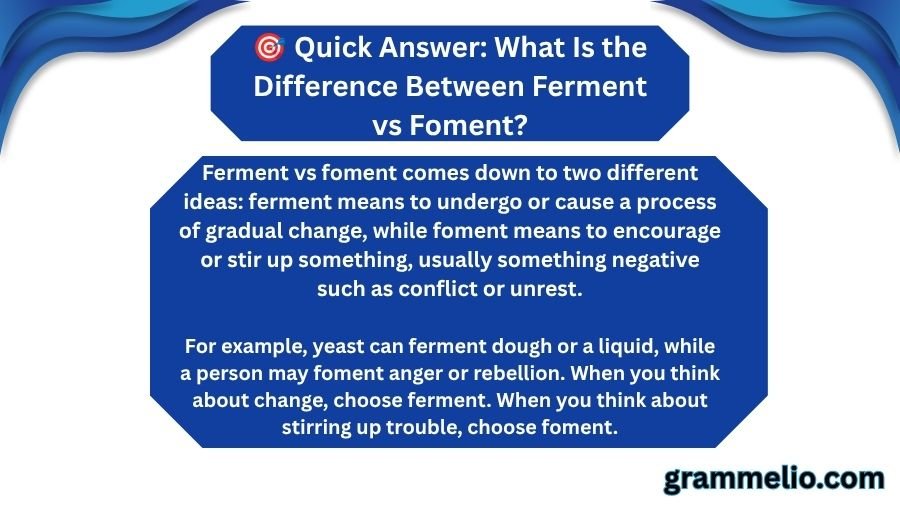
Ferment vs foment comes down to two different ideas: ferment means to undergo or cause a process of gradual change, while foment means to encourage or stir up something, usually something negative such as conflict or unrest.
For example, yeast can ferment dough or a liquid, while a person may foment anger or rebellion. When you think about change, choose ferment. When you think about stirring up trouble, choose foment.
Related Word Forms
Both words have several useful forms. Knowing them can make the difference easier to recognize in longer sentences.
| Form | Type | Example |
|---|---|---|
| ferment | Verb / noun | The fruit will ferment naturally. |
| ferments | Verb | The mixture ferments quickly. |
| fermented | Past participle / adjective | We used fermented vegetables. |
| fermenting | Present participle | The juice is fermenting. |
| foment | Verb | The speech could foment anger. |
| fomented | Past tense / past participle | The rumors fomented unrest. |
| fomenting | Present participle | They were accused of fomenting conflict. |
| fomenter | Noun | He was described as a fomenter of unrest. |
The forms of ferment usually describe a process or a growing state. Forms of foment usually describe an action in which someone encourages or stirs up a feeling, dispute, or movement.
Is Ferment the Same as Foment?
No. Ferment and foment are not interchangeable. They have different meanings and usually appear in different kinds of sentences.
| Form | Type | Meaning | Example | Correct/Incorrect |
|---|---|---|---|---|
| ferment | Verb | To undergo or cause gradual change | The grapes ferment in the barrel. | ✅ Correct |
| ferment | Noun | A state of excitement or unrest | The country was in political ferment. | ✅ Correct |
| foment | Verb | To encourage or stir up trouble | The speech fomented anger. | ✅ Correct |
| foment | Verb | To promote unrest or conflict | The group tried to foment rebellion. | ✅ Correct |
| foment | Food process | To change food through fermentation | The dough will foment overnight. | ❌ Incorrect |
The easiest starting point is this:
Ferment = change or develop.
Foment = stir up or encourage.
Ferment: The Basic Meaning
As a verb, ferment can mean to undergo a chemical or natural process that changes a substance. Yeast is often involved when foods or drinks are fermented.
For example:
The yeast helps the dough ferment.
Here, the dough is going through a process of change.
Ferment can also describe emotions, ideas, or social conditions that are developing beneath the surface.
Anger began to ferment among the workers.
The sentence does not mean someone directly encouraged the anger. Instead, the anger was slowly developing.
Foment: The Basic Meaning
Foment is a verb. It means to encourage, promote, or stir up something, especially trouble, anger, disagreement, rebellion, or unrest.
For example:
The rumor fomented panic among the crowd.
The rumor helped cause or increase panic.
A person can foment something. That is a useful clue. The word often focuses on an active effort to make a problem or strong feeling grow.
| Word | Core Idea | Common Objects |
|---|---|---|
| ferment | Gradual change or growth | dough, grapes, ideas, feelings, unrest |
| foment | Stirring up or encouraging | anger, conflict, rebellion, unrest |
| fermenting | Something is changing | food, drink, emotions |
| fomenting | Someone is encouraging something | conflict, disorder, anger |
💡 How Does Ferment Work in a Sentence?
Ferment works as both a verb and a noun. Its meaning depends on the context. In ferment vs foment, this is the key point to remember: ferment can describe gradual development, while foment describes active encouragement.
As a verb, it often describes a process:
The juice will ferment over several days.
As a noun, it can describe a state of strong excitement, change, or unrest:
The organization was in a period of political ferment.
This second meaning is less common in everyday speech, but it appears often in formal writing, history, politics, and journalism.
Ferment in Food and Drink
One of the most familiar uses is related to food and beverages.
Examples include:
- Bread dough can ferment.
- Grapes can ferment.
- Milk can ferment.
- Vegetables can be fermented.
- Some drinks are made through fermentation.
The key idea is transformation through a process.
Ferment for Feelings and Ideas
The word can also be used figuratively.
A new idea began to ferment in the team.
The idea was developing gradually.
Resentment had been fermenting for months.
The resentment was growing over time.
That does not mean someone necessarily caused it on purpose.
Test Tip 💡
Ask yourself:
“Is something changing or developing over time?”
If the answer is yes, ferment is likely the word you need.
| Meaning | Word Type | Example Sentence |
|---|---|---|
| Change through fermentation | Verb | The mixture will ferment overnight. |
| Develop gradually | Verb | The idea continued to ferment. |
| A state of unrest or excitement | Noun | The city was in political ferment. |
How Does Foment Work in a Sentence?
Foment is used when someone or something encourages a strong reaction or helps create conflict, unrest, or trouble. In ferment vs foment, this is the key point to remember: ferment can describe gradual development, while foment describes active encouragement.
It is usually followed by a noun that describes what is being encouraged. In ferment vs foment, this is the key point to remember: ferment can describe gradual development, while foment describes active encouragement.
Common examples include:
- foment anger
- foment conflict
- foment unrest
- foment rebellion
- foment violence
- foment resistance
- foment opposition
For example:
The leader was accused of fomenting unrest.
The leader was accused of encouraging unrest.
Foment Is Usually About Action
This is one of the best ways to separate the two words.
If a person foments something, that person is actively encouraging it.
The campaign was designed to foment opposition.
Someone is actively trying to increase opposition.
Compare that with:
Opposition began to ferment within the organization.
Here, the opposition is developing. The sentence does not necessarily say that someone intentionally caused it.
| Sentence | Main Idea |
|---|---|
| Anger began to ferment. | Anger developed gradually. |
| The speaker fomented anger. | The speaker encouraged anger. |
| Unrest was fermenting in the city. | Unrest was growing. |
| The group fomented unrest. | The group encouraged unrest. |
Ferment vs Foment at a Glance
The spelling difference is small, but the meaning difference is large.
| Feature | Ferment | Foment |
|---|---|---|
| Main meaning | Develop or undergo change | Encourage or stir up |
| Common role | Verb and noun | Verb |
| Food use | Very common | Incorrect |
| Emotional use | Feelings develop | Feelings are encouraged |
| Political use | A state of unrest | Encourage unrest |
| Typical idea | Process | Action |
| Example | The mixture will ferment. | The speech may foment anger. |
A simple rule I teach is:
Ferment describes something growing or changing. Foment describes someone stirring something up.
Why Do People Confuse Ferment and Foment?
People confuse these words because they are close in spelling and both can appear in discussions about emotions, social change, and unrest. People confuse these words because they are close in spelling and both can appear in discussions about emotions, social change, and unrest.
A sentence such as “anger began to ___” can make the choice difficult. Both words can appear near the idea of growing anger, but the meaning changes depending on the writer’s intention.
I once edited a short opinion piece in which the writer used foment to describe anger that had been slowly building for months. The writer was not trying to say anyone had encouraged the anger. They meant that the feeling had developed over time. Changing the word to ferment made the sentence much clearer.
Here are some reasons the confusion happens:
- The words have similar spellings.
- Both can appear in serious or formal writing.
- Both can relate to unrest or strong emotions.
- Spell-check tools may not catch the mistake.
- Writers may remember the sound but forget the meaning.
Similar Grammar Confusions
| Confused Words | Correct Distinction |
|---|---|
| ferment / foment | develop or change / stir up |
| affect / effect | influence / result |
| advice / advise | recommendation / give guidance |
| accept / except | receive or agree / excluding |
| loose / lose | not tight / misplace or fail to win |
| your / you’re | belonging to you / you are |
| its / it’s | belonging to it / it is |
These pairs show why spelling alone is not enough. You must check the meaning of the sentence.
Grammar Rules Explanation
The main grammar rule is based on meaning and sentence function.
Ferment can function as a verb meaning to undergo or cause fermentation. It can also describe something that gradually develops. As a noun, it can refer to a state of unrest, excitement, or change.
Foment functions as a verb meaning to encourage or stir up a feeling, condition, or action. It is especially common with words related to conflict and unrest.
Standard English reference sources agree on this basic distinction, even though the words can appear in similar contexts.
Consider the difference:
Anger was fermenting among the workers.
The anger was developing.
The manager’s comments fomented anger among the workers.
The comments helped encourage the anger.
The first sentence focuses on growth. The second focuses on cause or encouragement.
Correct vs Incorrect at a Glance
| Sentence | Correct/Incorrect | Why |
|---|---|---|
| The dough will ferment overnight. | ✅ Correct | Ferment describes the food process. |
| The speech fomented anger. | ✅ Correct | Foment means to stir up anger. |
| The grapes will foment in the barrel. | ❌ Incorrect | Ferment is the correct word for the process. |
| The group tried to foment rebellion. | ✅ Correct | Foment means to encourage rebellion. |
| Resentment began to ferment among the employees. | ✅ Correct | The resentment was gradually developing. |
Can Ferment Describe Emotions?
Yes. Ferment can describe emotions, ideas, or social conditions that slowly develop.
For example:
Suspicion began to ferment among the team members.
This means suspicion was gradually growing.
You can think of it as something that is not fully visible at first but becomes stronger over time.
Other examples include:
Doubt was fermenting in her mind.
Frustration had been fermenting for weeks.
A new political idea was fermenting among young voters.
The word works because all of these situations involve gradual development.
Can Foment Describe Emotions?
Yes. Foment can describe emotions when someone actively encourages or stirs them up.
For example:
The false report fomented fear.
The report helped create or increase fear.
The speaker’s comments fomented resentment.
The comments encouraged resentment.
The difference is subtle but important:
Ferment = the emotion develops.
Foment = something or someone encourages the emotion.
| Situation | Best Word | Example |
|---|---|---|
| Feelings slowly grow | ferment | Fear began to ferment. |
| Someone encourages fear | foment | The rumor fomented fear. |
| An idea develops | ferment | A new plan began to ferment. |
| Someone encourages opposition | foment | The campaign fomented opposition. |
📝 Case Study: A Workplace Example
Imagine a company where employees have been unhappy about a new schedule.
At first, only a few workers complain. Over several weeks, more people become frustrated.
A manager might write:
Frustration began to ferment among the staff.
That sentence describes a feeling that developed gradually.
Now imagine someone intentionally spreads false claims about the schedule to make workers angry.
A report might say:
The false claims fomented anger among the staff.
That sentence says the claims helped stir up the anger.
I once caught myself typing foment when I meant that an idea was slowly developing during a planning meeting. I stopped because I remembered that foment suggests active encouragement. I changed it to ferment, and the sentence matched what I actually meant.
| Workplace Situation | Correct Word | Example |
|---|---|---|
| Complaints slowly develop | ferment | Complaints began to ferment. |
| A manager encourages conflict | foment | The manager’s remarks fomented conflict. |
| A new plan develops | ferment | The proposal continued to ferment. |
| A rumor creates anger | foment | The rumor fomented anger. |
⚠️ Common Mistakes With Ferment and Foment
The biggest mistake is choosing based on spelling rather than meaning.
Another problem is assuming that foment is simply a fancy version of ferment. It is not.
Here are common causes of errors:
- Fast typing: Writers type the familiar-looking word without checking its meaning.
- Autocorrect: Spell-check may accept both words because both are real English words.
- Lack of knowledge: A writer may know the words but not understand their difference.
- Memory errors: Similar spellings can blur together.
- Formal writing pressure: People sometimes choose the word that sounds more sophisticated.
Common Wrong Forms and Uses
| Wrong Form | What’s Wrong | Correct Form |
|---|---|---|
| The grapes will foment. | Foment is not the food process. | The grapes will ferment. |
| The speech fermented anger. | The sentence means the speech stirred up anger. | The speech fomented anger. |
| The dough is fomenting. | The food is undergoing fermentation. | The dough is fermenting. |
| They tried to ferment rebellion. | The intended meaning is to encourage rebellion. | They tried to foment rebellion. |
| Fear was fomenting for months. | If fear was simply growing, ferment is better. | Fear was fermenting for months. |
| The group fermented unrest. | The intended meaning is active encouragement. | The group fomented unrest. |
How Can You Remember the Difference?
The fastest memory trick is to connect each word with its main idea.
Ferment = Change
Think about food changing through fermentation.
Ferment → food changes.
Then extend the idea:
Feelings can ferment → feelings develop.
Foment = Fuel Trouble
Think of foment as actively adding fuel to a problem.
Foment → fuel a conflict.
For example:
The rumor fomented anger.
Someone or something helped make the anger stronger.
| Memory Word | Meaning | Example |
|---|---|---|
| Ferment = change | Develop gradually | Ideas ferment. |
| Foment = fuel | Encourage or stir up | Rumors foment anger. |
Usage in Different Contexts
The choice between ferment vs foment also depends on the context and the action you want to describe.
The correct choice depends on what you want to say.
| Context | Which Term to Use | Example |
|---|---|---|
| Everyday conversation | Usually ferment for food/processes | The dough needs time to ferment. |
| Professional writing | Either, depending on meaning | The dispute began to ferment. |
| Creative writing | Either, depending on meaning | Suspicion fermented beneath the calm surface. |
| Social media/texting | Usually simpler alternatives are clearer | The rumor stirred up anger. |
In casual writing, ferment is especially common when discussing food and drinks.
Foment tends to appear more often in formal discussions about conflict, politics, protests, unrest, or strong public reactions.
Common Phrases With Ferment
Although ferment does not have as many fixed phrases as some common English verbs, several natural combinations appear often.
| Phrase | Meaning |
|---|---|
| ferment dough | Allow dough to undergo fermentation |
| ferment fruit | Allow fruit or its juice to undergo fermentation |
| ferment naturally | Change through a natural fermentation process |
| ferment an idea | Allow an idea to develop |
| political ferment | A state of political unrest or change |
| fermenting feelings | Feelings that are gradually growing |
These phrases show why context matters. Ferment can describe physical change or gradual emotional and social development.
Common Phrases With Foment
Foment often appears with words related to conflict, anger, or unrest.
| Phrase | Meaning |
|---|---|
| foment unrest | Encourage unrest |
| foment anger | Stir up anger |
| foment conflict | Encourage conflict |
| foment rebellion | Encourage rebellion |
| foment opposition | Encourage opposition |
| foment violence | Encourage violence |
These combinations are useful clues. If you see anger, conflict, rebellion, unrest, or opposition, foment may be the intended word when the meaning is “encourage” or “stir up.”
Synonyms and Alternatives
Sometimes a simpler word is better than either term.
| Alternative | Works When | Does Not Work When |
|---|---|---|
| develop | Something grows over time | You mean active encouragement |
| grow | A feeling becomes stronger | You need a formal word for stirring conflict |
| stir up | Someone causes a reaction | You are describing food fermentation |
| encourage | Someone promotes an action or feeling | You mean a natural process |
| ferment | Something changes or develops | Someone is clearly encouraging conflict |
For example, instead of:
The rumor fomented anger.
You could say:
The rumor stirred up anger.
The second version is often easier for general readers.
But if you are writing formal content, foment can be precise and appropriate.
Is Foment Always Negative?
Usually, foment has a negative or troubling sense because it commonly refers to encouraging conflict, anger, unrest, or disorder.
It is possible to find broader uses in formal language, but learners should remember the common pattern:
foment + trouble or unrest
For everyday writing, this is the safest association.
By contrast, ferment can be neutral or positive when it refers to food, creativity, ideas, or growth.
| Word | Common Tone | Example |
|---|---|---|
| ferment | Neutral or sometimes positive | The idea began to ferment. |
| ferment | Neutral in food | The vegetables will ferment. |
| foment | Usually negative | The rumor fomented conflict. |
| foment | Often linked to unrest | The speech fomented unrest. |
Why Does Getting Ferment vs Foment Right Matter?
Using the right word makes your writing easier to understand. It also shows that you understand the exact meaning of the words you choose. Knowing ferment vs foment helps you express whether something is gradually developing or being deliberately stirred up.
In professional writing, one wrong word can change the message.
Consider:
The employees’ anger fermented after the announcement.
This suggests the anger developed gradually.
Now compare:
The announcement fomented the employees’ anger.
This suggests the announcement helped stir up the anger.
Both sentences can be grammatical, but they tell different stories.
A useful writing principle is:
The best word is the one that tells the reader exactly what happened.
| Situation | Why Getting It Right Matters |
|---|---|
| Resume or application | Precise word choice supports professionalism. |
| Client email | Clear wording reduces confusion. |
| Published content | Accurate language builds reader trust. |
| Social post | The right word prevents unintended meaning. |
Can You Use Ferment and Foment in the Same Sentence?
Yes, you can use both in the same sentence when they describe different actions or stages.
For example:
Anger began to ferment among the workers after the company announced the change, while several online posts fomented even more hostility.
Here, ferment describes anger developing. Foment describes posts actively encouraging greater hostility.
This contrast is useful because it shows the core difference very clearly.
| Word | Role in the Sentence |
|---|---|
| ferment | Describes gradual development |
| foment | Describes active encouragement |
How Are Ferment and Foment Different in Formal Writing?
In formal writing, ferment often describes a condition that is developing, while foment often identifies an action that contributes to that condition.
For example:
Political unrest was fermenting across the region.
The unrest was developing.
Several groups were accused of fomenting political unrest.
The groups were accused of encouraging it.
This distinction is especially useful in news writing, history, politics, academic writing, and professional reports.
How Can You Tell Which Word Is Correct?
When you are unsure about ferment vs foment, focus on whether something is developing or being actively stirred up.
Use a three-question test.
Question 1: Is something changing or developing?
If yes, consider ferment.
Resentment was fermenting.
Question 2: Is someone encouraging or stirring something up?
If yes, consider foment.
The campaign fomented resentment.
Question 3: Are you talking about food or drink changing through fermentation?
If yes, use ferment.
The vegetables are fermenting.
This simple test handles most common cases.
Quick Recap Checklist
Use this checklist whenever you are unsure.
| Question | If Yes → Use |
|---|---|
| Is something undergoing fermentation? | ferment |
| Is an idea slowly developing? | ferment |
| Is a feeling gradually growing? | ferment |
| Is someone encouraging anger? | foment |
| Is someone stirring up conflict? | foment |
| Is someone promoting unrest or rebellion? | foment |
Practice Examples
1. The grapes will ___ in the container.
Answer: ferment ✅
2. The false story was designed to ___ anger.
Answer: foment ✅
3. Resentment began to ___ among the workers.
Answer: ferment ✅
Try to explain why each answer works. Understanding the meaning is much more powerful than memorizing the spelling.
FAQs About Ferment vs Foment
What is the difference between ferment and foment?
Ferment means to undergo or cause a process of change, or to develop gradually. Foment means to encourage or stir up something, especially anger, conflict, unrest, or rebellion.
Is it ferment or foment anger?
Both can be correct, but they mean different things. Anger can ferment when it gradually develops. Someone can foment anger when they actively encourage or stir it up.
Is it ferment or foment rebellion?
Use foment when you mean “encourage rebellion” or “stir up rebellion.” For example: “The group attempted to foment rebellion.”
Can food foment?
No. When food undergoes the natural process of fermentation, the correct word is ferment.
For example:
The vegetables will ferment in the jar.
Can feelings ferment?
Yes. Ferment can describe feelings that slowly develop or become stronger.
Resentment had been fermenting for months.
Can feelings foment?
Yes, when something or someone actively encourages those feelings.
The rumor fomented fear.
The rumor helped stir up the fear.
Is ferment a noun or a verb?
Ferment can be both a noun and a verb. As a verb, it can describe a process of change. As a noun, it can describe a state of excitement, unrest, or change.
Is foment a noun or a verb?
Foment is primarily used as a verb. Related forms include fomented, fomenting, and fomenter.
What is an easy way to remember ferment vs foment?
The easiest way to remember ferment vs foment is to connect ferment with change and foment with stirring up trouble.
Remember:
Ferment = change.
Foment = fuel trouble.
If something is gradually developing, think ferment. If someone is stirring up a problem, think foment.
Which word is more common in everyday English?
Ferment is common when people discuss food and fermentation. Foment is less common in casual speech and appears more often in formal writing about conflict, unrest, or strong reactions.
Conclusion
Ferment vs foment becomes much easier once you focus on the action behind each word. Ferment is about change, development, or a process that happens over time. It can describe food, drinks, ideas, emotions, and social conditions. Foment is about actively encouraging or stirring up something, most often anger, conflict, unrest, rebellion, or opposition. 🧠
When I am editing a sentence, I use one simple test: Is something developing, or is something being stirred up? If it is developing, choose ferment. If someone or something is encouraging a reaction, choose foment. That quick question can prevent most mistakes.
Remember the shortcut: ferment means change; foment means fuel. ✨ Once that distinction becomes familiar, these two similar-looking words stop being confusing and become easy, precise choices in your writing.




[…] typed one word when you meant the other, you are not alone. Let’s make the choice clear and easy. Ferment vs Foment | Faun vs Fawn | Fate vs […]