Have you ever written an email, essay, or social post and stopped because you were unsure whether to use formally vs formerly? 😅 You are not alone. These two words look almost the same, and both are common in everyday English. However, they have completely different meanings. Formally usually relates to rules, official actions, proper behavior, or a formal style. Formerly means “in the past” or “previously.”
As an English teacher and editor, I often see this small spelling difference create a big change in meaning. Once you understand the key idea behind each word, the choice becomes much easier.
In this guide, I’ll show you exactly when to use each one, give you clear examples, and share simple memory tricks. By the end, you should feel confident choosing the right word every time. ✍️ Flounder vs Founder | Flew vs Flu vs Flue | Finale vs Finally
🎯 Quick Answer: Formally vs Formerly
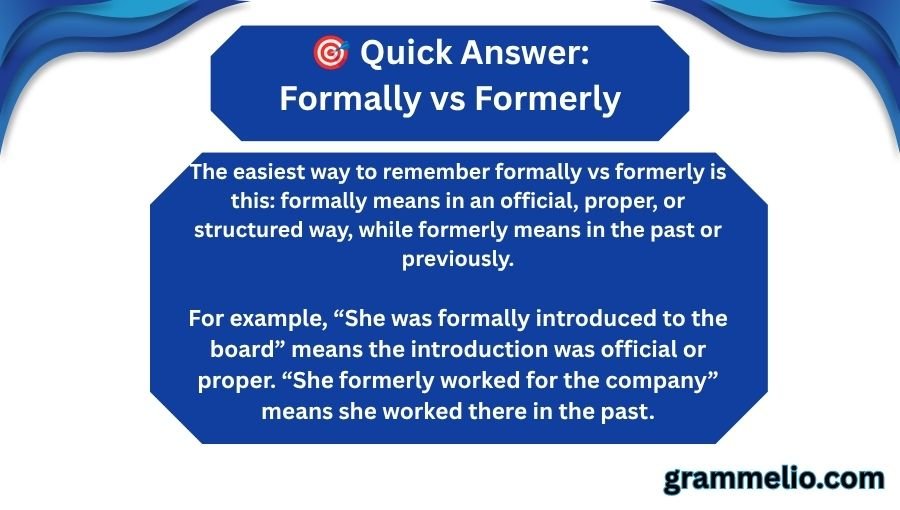
The easiest way to remember formally vs formerly is this: formally means in an official, proper, or structured way, while formerly means in the past or previously.
For example, “She was formally introduced to the board” means the introduction was official or proper. “She formerly worked for the company” means she worked there in the past.
What Does Formally Mean?
Formally is an adverb. It describes something done in an official, proper, serious, or established way. Understanding formally vs formerly starts with knowing that these words describe different ideas.
The word often appears when talking about:
- Official announcements
- Rules and procedures
- Professional behavior
- Ceremonies
- Formal language
- Official recognition
- Proper dress
- Structured events
Consider this sentence:
The company formally announced the new policy.
The action was an official announcement. The word formally tells us how the company made the announcement.
Another example is:
Please formally submit your application by Friday.
Here, formally suggests that the application must be submitted through the proper or official process.
What Does Formerly Mean?
The formally vs formerly distinction is easy to remember once you connect each word with its main meaning.
Formerly is also an adverb, but its meaning is very different. It means in the past, previously, or at an earlier time.
It often describes something that was true before but is no longer true.
For example:
The building was formerly a school.
This means the building used to be a school. It is not necessarily a school now.
Another example:
Maria, formerly the department manager, now works as a consultant.
The word formerly tells us about Maria’s past position.
The Simple Difference
The easiest question to ask is:
Am I talking about how something is done, or when something was true?
- If you mean how something is done in an official or proper way, use formally.
- If you mean something that happened or was true in the past, use formerly.
That single question solves most cases.
📊 Formally vs Formerly at a Glance
| Form | Type | Meaning | Example | Correct/Incorrect |
|---|---|---|---|---|
| Formally | Adverb | In an official or proper way | The team formally accepted the offer. | ✅ Correct |
| Formerly | Adverb | Previously or in the past | He formerly lived in Boston. | ✅ Correct |
| Formally | Adverb | In the past | She formally worked here. | ❌ Incorrect for this meaning |
| Formerly | Adverb | In an official way | They formerly approved the plan. | ❌ Incorrect for this meaning |
The spelling is close, but the meaning is not. Formally connects with the idea of being formal. Formerly connects with the idea of being former, or something from the past.
🔑 Formally: Meaning and Correct Use
Formally has several closely related uses. The main idea is that something happens in an official, proper, serious, or structured manner.
Formally Means “Officially”
This is one of the most common uses.
The president formally approved the proposal.
The approval was official. It was not just a casual comment.
The two companies formally signed the agreement.
The signing was an official act.
Formally Means “In a Proper or Conventional Way”
The word can also describe behavior or presentation.
He formally introduced himself to the guests.
The introduction followed a polite or proper style.
She was formally dressed for the ceremony.
Her clothing matched the serious or official nature of the event.
Formally Can Describe Official Recognition
You may also see it when someone or something receives official status.
The organization was formally recognized by the city.
The recognition was official rather than informal.
Meaning Summary for Formally
| Meaning | Word Type | Example Sentence |
|---|---|---|
| Officially | Adverb | The board formally approved the plan. |
| In a proper way | Adverb | He formally introduced his colleague. |
| In a serious or conventional style | Adverb | Everyone was formally dressed. |
| Through an official process | Adverb | She formally submitted the complaint. |
💡 Test Tip
Replace formally with officially.
If the sentence still makes sense, formally is probably the right choice.
The committee formally accepted the proposal.
Try:
The committee officially accepted the proposal.
The meaning remains close, so formally works.
⏳ Formerly: Meaning and Correct Use
Formerly is used when you want to point to an earlier time.
It tells readers that something was true before.
Formerly Means “Previously”
The restaurant was formerly called The Green House.
This means the restaurant had that name in the past.
He formerly worked as a teacher.
This means he worked as a teacher before.
Formerly Shows a Past Role or Position
You will often see formerly in professional writing.
Linda, formerly the company’s director, now runs her own business.
The word makes it clear that Linda held the director position in the past.
Formerly Can Describe a Previous Name
The city was formerly known by a different name.
The current name is different from the old one.
Meaning Summary for Formerly
| Meaning | Word Type | Example Sentence |
|---|---|---|
| Previously | Adverb | I formerly lived in Texas. |
| In the past | Adverb | The store was formerly a bakery. |
| At an earlier time | Adverb | She formerly served as chairperson. |
| Under an earlier name | Adverb | The company was formerly known by another name. |
❓ Is Formally the Same as Formerly?
No. Formally and formerly are not interchangeable. Formally describes the way something happens, while formerly refers to an earlier time.
Compare these sentences:
The manager formally announced the change. ✅
The announcement was official.
The manager formerly announced the change. ❌
This does not normally express the intended idea. It sounds as if “formerly” is being used to describe how the announcement happened, which is not its normal meaning.
Now consider:
She formerly worked at the bank. ✅
This means she worked there in the past.
She formally worked at the bank. ❌
This would not normally mean “she used to work there.”
❓ Why Do People Confuse Formally and Formerly?
People confuse these words because their spelling and sound are very similar. Both begin with form-, and both function as adverbs.
I once edited a short business report in which a writer used “formally” when they meant “previously.” The sentence was easy to fix, but the meaning changed completely. The writer knew both words but had connected the wrong one to the idea of the past.
Another reason is fast reading. When we see a word that looks familiar, we may read it without noticing the middle letters. Learning formally vs formerly as a meaning-based difference is more effective than focusing only on their similar spelling.
The difference becomes easier when you connect each word with a simple root idea:
- Formal → formally → official/proper
- Former → formerly → previous/past
That connection is more useful than trying to memorize two complicated definitions.
❓ How Can You Remember Formally vs Formerly?
Use this simple memory trick:
Formal = formally = official.
Former = formerly = past.
Think about the word former. A former employee is someone who worked somewhere before. Therefore, formerly points backward in time.
Think about formal clothing. Formal clothing is associated with proper or official situations. Therefore, formally can describe the way something is done.
🧠 A One-Second Memory Test
Ask:
Does the sentence answer “How?”
Use formally.
How did they announce it?
They announced it formally.
Ask:
Does the sentence answer “When before?”
Use formerly.
When was she the manager?
She was formerly the manager.
This method works especially well when you are writing quickly.
📝 Case Study: A Workplace Email
Imagine that a company has hired a new director.
An employee writes:
Please formally welcome David, our new director.
Here, formally works because the writer is describing the proper or official nature of the welcome.
Now imagine David’s biography says:
David formerly worked as a regional manager.
Here, formerly works because the sentence describes David’s previous job.
I once saw a similar mix-up in a workplace profile. The writer wanted to say that an employee had previously held a position, but the wrong adverb made the sentence sound as though the employee had performed that job in an official manner. The correction took one word, but it restored the intended meaning.
📚 Grammar Rules Explanation
The grammar rule is straightforward because the two words perform different jobs of meaning.
Formally is the adverb form connected to formal. It describes the manner or nature of an action. It can suggest an official, proper, serious, or conventional way of doing something.
Formerly is the adverb form connected to former. It describes something that existed, happened, or was true at an earlier time.
Most standard English reference sources make this same basic distinction.
A useful grammar test is to identify the idea in the sentence:
- Official or proper action → formally
- Past or previous situation → formerly
Notice how the words answer different questions.
Formally often answers:
How?
Formerly often answers:
When was this true?
For example:
The company formally accepted the contract.
“How did it accept the contract?”
It accepted it in an official way.
Now:
The company was formerly called Bright Star LLC.
“When was it called Bright Star LLC?”
It had that name in the past.
Correct vs Incorrect at a Glance
| Sentence | Correct/Incorrect | Why |
|---|---|---|
| The committee formally approved the request. | ✅ Correct | The approval was official. |
| She formerly worked for the agency. | ✅ Correct | The job belonged to her past. |
| He formerly introduced the guest. | ❌ Incorrect | The intended meaning is probably “in an official way.” |
| The company was formally known as Westline. | ⚠️ Context-dependent | “Formally” can work if the meaning is official; “formerly” is better when simply referring to an old name. |
| They formerly signed the agreement. | ❌ Incorrect | “Formally” is needed for an official signing. |
⚠️ Common Mistakes With Formally and Formerly
Most mistakes happen because the words look so similar. Many writing errors involving formally vs formerly happen because the two words look almost identical at a quick glance.
Mistake 1: Using Formally for the Past
Incorrect:
I formally worked there for five years. ❌
If you mean you worked there in the past, say:
I formerly worked there for five years. ✅
Mistake 2: Using Formerly for Official Actions
Incorrect:
The board formerly approved the budget. ❌
If you mean the board gave official approval, write:
The board formally approved the budget. ✅
Mistake 3: Confusing Them While Typing
Fast typing can make the problem worse. Autocorrect may not catch the error because both words are valid English words.
A sentence can therefore be grammatically acceptable on the surface while still expressing the wrong meaning.
Common Grammar Confusions
| Confusion | Correct Choice | Basic Difference |
|---|---|---|
| Its / It’s | Depends on meaning | Possession vs. “it is” |
| Your / You’re | Depends on meaning | Possession vs. “you are” |
| Their / There / They’re | Depends on meaning | Possession, place, or “they are” |
| Then / Than | Depends on meaning | Time/order vs. comparison |
| Affect / Effect | Depends on context | Usually verb vs. noun |
| Formally / Formerly | Depends on meaning | Official manner vs. past |
Why These Mistakes Happen
Three common causes are:
- Fast typing — We focus on the message rather than each word.
- Autocorrect — Both words are correctly spelled, so software may not flag the mistake.
- Lack of knowledge — A writer may know the words but not the difference between their meanings.
Specific Wrong Forms and Uses
| Wrong Form or Use | What’s Wrong | Correct Form |
|---|---|---|
| Formally = previously | The meaning is incorrect | Formerly |
| Formerly = officially | The meaning is incorrect | Formally |
| Formally worked there | Usually does not mean “used to work there” | Formerly worked there |
| Formerly approved | Usually does not mean “officially approved” | Formally approved |
| Formerly introduced the speaker | “Formerly” does not normally describe manner | Formally introduced |
| Formally lived there | Usually does not mean “used to live there” | Formerly lived there |
📜 Word History and the Link Between the Two Words
The easiest way to understand the history of these words is through their related base words.
Formal relates to established form, proper procedure, or an official style. Former relates to something earlier or previous. Adding -ly turns each adjective into an adverb.
So the meaning can be seen clearly:
formal + ly → formally
former + ly → formerly
This is useful because the spelling itself gives you a memory clue.
| Stage | Form | Meaning Idea |
|---|---|---|
| Base adjective | Formal | Official, proper, structured |
| Adverb | Formally | In an official or proper way |
| Base adjective | Former | Previous, earlier |
| Adverb | Formerly | Previously, in the past |
You do not need to memorize a long history lesson. The relationship between formal/formally and former/formerly is enough to guide your everyday writing.
❓ How Are Formally and Formerly Used in Different Contexts?
The formally vs formerly difference can remain clear even when the same words appear in very different types of writing.
The context can make the difference especially clear. Keeping the formally vs formerly rule in mind will help you choose the right word in each context.
Everyday Conversation
In normal conversation, formerly often appears when talking about an old job, home, name, or situation.
I formerly lived in Chicago.
Formally may appear when discussing official actions.
We formally agreed to the plan.
Professional Writing
Both words are common in business and workplace writing.
The company formally announced the merger.
She formerly served as the company’s chief accountant.
Professional writing benefits from choosing the exact word because small errors can make a message sound careless.
Creative Writing
Authors may use formerly to reveal a character’s past.
The quiet man was formerly a famous actor.
Formally can describe a character’s behavior.
She formally greeted the visitors before taking her seat.
Social Media and Texting
Informal posts may use either word, although formerly is especially useful when talking about past identities or roles.
Formerly known as the Blue Room!
Formally may appear in posts about official announcements.
We are formally announcing our new project today.
Usage Table
| Context | Which Term to Use | Example |
|---|---|---|
| Everyday conversation | Either, depending on meaning | I formerly lived there. |
| Professional writing | Either, depending on meaning | The company formally announced the change. |
| Creative writing | Either, depending on meaning | He was formerly a soldier. |
| Social media/texting | Either, depending on meaning | Formerly known as The Corner Cafe. |
❓ Can You Use Formally and Formerly in the Same Sentence?
Yes, you can use both words in one sentence if each has its own meaning.
For example:
The company, formerly called GreenTech, was formally recognized by the state.
Here, formerly tells us about the company’s old name. Formally tells us that the recognition was official.
This is a useful example because it shows that the words are not competing versions of the same word. They can describe two different parts of the same situation.
Common Phrases With Formally
Some combinations occur often in standard writing.
| Phrase | Meaning |
|---|---|
| Formally announced | Announced officially |
| Formally approved | Approved through an official process |
| Formally introduced | Introduced in an official or proper way |
| Formally recognized | Given official recognition |
| Formally accepted | Accepted officially |
| Formally submitted | Sent through the required official process |
These phrases are especially common in business, government, education, and professional communication.
Common Phrases With Formerly
Formerly also appears in several useful patterns.
| Phrase | Meaning |
|---|---|
| Formerly known as | Had a different name before |
| Formerly called | Had another name in the past |
| Formerly worked as | Had a previous job or role |
| Formerly served as | Held a position before |
| Formerly owned by | Belonged to someone in the past |
| Formerly lived in | Had a previous home in a place |
The phrase formerly known as is particularly common when an organization, product, place, or person has changed names.
❓ What Are Good Alternatives to Formally?
Sometimes you can replace formally with another word, but the exact replacement depends on the sentence.
| Alternative | Works When | Does Not Work When |
|---|---|---|
| Officially | You mean through an official process | You only mean “in a serious style” |
| Properly | You mean in the correct way | You need to stress official status |
| Politely | You mean respectful behavior | The action is official rather than polite |
| Professionally | You mean suitable workplace behavior | The action is legally or officially recognized |
| Publicly | You mean openly or before others | You mean proper or official procedure |
For example:
The company formally announced the change.
You could write:
The company officially announced the change.
But replacing formally with “politely” would change the meaning.
❓ What Are Good Alternatives to Formerly?
Because formerly is closely connected to time, its alternatives are often simple.
| Alternative | Works When | Does Not Work When |
|---|---|---|
| Previously | You mean before now | You need to describe official behavior |
| Once | You mean at an earlier time | The sentence needs a clear formal tone |
| In the past | You want a very clear time reference | You need a compact adverb |
| Earlier | You mean at an earlier point | You mean official procedure |
| Before | The sentence naturally supports a time reference | You are describing manner |
For example:
She formerly worked here.
can become:
She previously worked here.
The basic meaning remains the same.
💼 Why Getting Formally and Formerly Right Matters
Choosing the right word matters because a single letter can change the meaning of a sentence.
Clarity in Communication
Readers should not have to guess whether you mean “officially” or “in the past.”
Clear word choice makes your message easier to understand.
Professionalism
In a resume, cover letter, business email, or report, incorrect word choice can make your writing look less polished.
Digital Communication
Online writing moves quickly. A typo may remain visible in an email, post, profile, or published article for a long time.
I once caught myself typing the wrong one while editing a short professional bio. I had written “formally” when the sentence was clearly talking about a previous position. The mistake was easy to miss because the word itself was spelled correctly.
A useful writing principle is:
“Choose the word that matches the meaning, not just the spelling.”
| Situation | Why Getting It Right Matters |
|---|---|
| Resume | Shows accurate information about past roles |
| Client email | Prevents confusion about official actions |
| Published content | Protects clarity and credibility |
| Social post | Helps readers understand the intended message |
❓ Is “Formerly Known As” Correct?
Yes. Formerly known as is a standard phrase used to identify an earlier name or identity.
For example:
The restaurant, formerly known as The Garden Cafe, has reopened.
This means the restaurant had a different name before.
Do not use formally simply because the situation sounds official. The phrase is about the past name, so formerly is the natural choice.
❓ Is “Formally Known As” Ever Possible?
Yes, but it can communicate a different idea. Formally known as can suggest that a name is officially recognized or used in an official setting.
Compare:
The company was formerly known as North Star Media.
This focuses on its old name.
The company is formally known as North Star Media Group, Inc.
This focuses on its official name.
The difference is subtle but useful. Formerly points backward in time. Formally points toward official status or proper designation.
❓ Which Is Correct: Formally or Formerly Worked?
If you mean someone worked somewhere in the past, use formerly.
She formerly worked at the hospital. ✅
If you write:
She formally worked at the hospital. ❌
the reader may not understand the intended meaning.
A simple replacement test helps:
Formerly = previously.
She previously worked at the hospital.
If that is your meaning, use formerly.
❓ Which Is Correct: Formally or Formerly Approved?
If you mean an official approval happened, use formally.
The board formally approved the proposal. ✅
Here, “officially approved” has nearly the same meaning.
Formerly approved would suggest a past situation, not the normal idea of official approval.
❓ Can Formally Describe Clothing and Behavior?
Yes. Formally can describe clothing, behavior, speech, or actions when they follow a formal or proper style.
Examples:
Guests were formally dressed for the event.
She formally addressed the committee.
He formally introduced the speaker.
In each sentence, formally tells us something about the manner or style of the action.
❓ Can Formerly Describe a Person’s Previous Job?
Yes. This is one of its most common uses.
He formerly served as mayor.
She formerly worked as a nurse.
I formerly managed the department.
In each case, formerly tells us that the role belonged to an earlier period.
❓ What Is the Easiest Way to Tell Them Apart?
Remember this two-word rule:
FORMALLY = OFFICIALLY
FORMERLY = PREVIOUSLY
If you can replace the word with officially, choose formally.
If you can replace it with previously, choose formerly.
This is one of the fastest ways to solve the problem while writing.
🧩 Quick Recap Checklist
Before you finish, review formally vs formerly one more time: formally relates to an official or proper manner, while formerly refers to the past.
| Question | If Yes → Use |
|---|---|
| Does the sentence mean “officially”? | Formally |
| Does it mean “properly”? | Formally |
| Does it describe formal behavior or style? | Formally |
| Does it mean “previously”? | Formerly |
| Does it describe a past job? | Formerly |
| Does it describe an old name? | Formerly |
| Does it refer to something that used to be true? | Formerly |
Practice Examples
- The board ______ approved the new policy.
Answer: formally ✅ - She ______ worked for the company.
Answer: formerly ✅ - The store was ______ known as Miller’s Market.
Answer: formerly ✅
The more you connect each word with its core idea, the faster the choice becomes.
FAQs About Formally vs Formerly
What is the difference between formally and formerly?
Formally means in an official, proper, or formal way. Formerly means previously or in the past.
Is formally the same as officially?
Often, yes. Formally can mean officially, especially when describing an official action or process.
The agreement was formally approved.
Is formerly the same as previously?
Yes, in many sentences. Formerly commonly means previously or at an earlier time.
She formerly lived in Denver.
This means she previously lived in Denver.
Should I say “formerly worked” or “formally worked”?
Use formerly worked when you mean someone worked somewhere in the past.
He formerly worked for the company.
Should I say “formally approved” or “formerly approved”?
Use formally approved when you mean the approval was official.
The board formally approved the plan.
Is “formerly known as” correct?
Yes. Formerly known as means that a person, company, place, product, or organization had a different name in the past.
Can formally and formerly appear together?
Yes. They can appear in the same sentence when they express different ideas.
The company was formerly called Oak Systems and was formally recognized last year.
Does formally mean “in a formal way”?
Yes. Formally can describe something done in a formal, proper, serious, or official way.
Does formerly always mean something is no longer true?
Usually, formerly introduces a past state, role, name, or situation. It normally suggests that the situation has changed or is being viewed as belonging to an earlier period.
What is the easiest trick for remembering formally and formerly?
Think:
Formal → formally → official.
Former → formerly → past.
If you remember those two connections, you can solve most usage questions quickly.
Final Takeaway
Formally vs formerly becomes much easier once you focus on meaning instead of spelling. Use formally when you mean officially, properly, or in a formal way. Use formerly when you mean previously, in the past, or under an earlier name or role. ✨
When I teach this distinction, I encourage writers to use the replacement test. If officially fits, choose formally. If previously fits, choose formerly. This quick test works in emails, essays, reports, resumes, social media posts, and everyday writing. Once you understand formally vs formerly, you can quickly identify whether a sentence refers to an official action or something from the past.
Remember the simplest version: formal → formally → official; former → formerly → past. Once that pattern becomes familiar, these two similar-looking words stop being confusing. Good writing is often about small choices, and choosing the right word can make your meaning clear at once. Keep that one simple rule in mind, and you will rarely mix them up again. 📝

[…] the end, you should be able to choose the right word quickly and confidently. ✍️ Formally vs Formerly | Flounder vs Founder | Flew vs Flu vs […]
[…] be able to choose the correct word without stopping to second-guess yourself. Fort vs Forte | Formally vs Formerly | Flounder vs […]