Have you ever typed a sentence and stopped because you were not sure whether you needed foul vs fowl? I have seen this mix-up many times in student essays, emails, text messages, and even polished online articles. The two words sound exactly the same, but they have very different meanings. 📝 One usually describes something unpleasant, unfair, or against a rule.
The other is connected with birds, especially domestic birds such as chickens, ducks, and turkeys. 🐔 In this guide, I will explain the difference in simple terms, show you how each word works, and give you easy ways to remember which spelling belongs in each sentence.
By the end, you should be able to choose the right word quickly and confidently. Forth vs Fourth | Fort vs Forte | Formally vs Formerly
🎯 Quick Answer: Foul vs Fowl
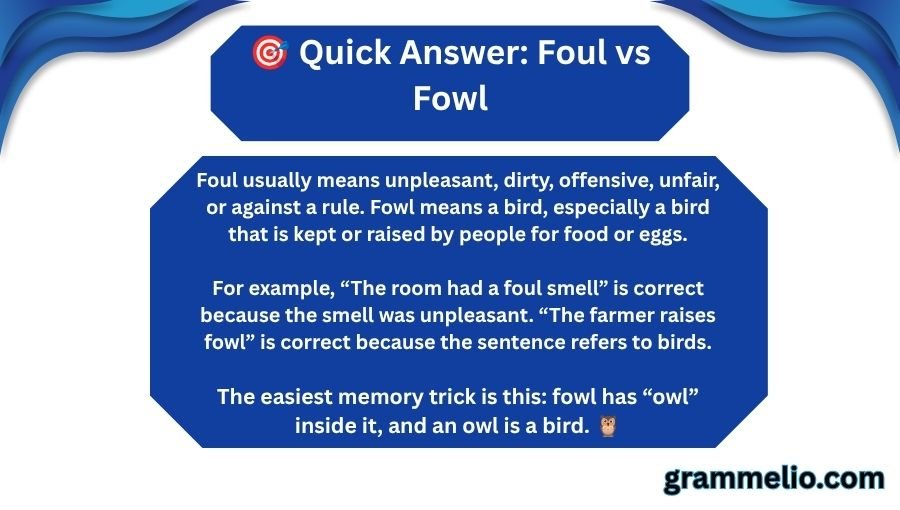
Foul usually means unpleasant, dirty, offensive, unfair, or against a rule. Fowl means a bird, especially a bird that is kept or raised by people for food or eggs.
For example, “The room had a foul smell” is correct because the smell was unpleasant. “The farmer raises fowl” is correct because the sentence refers to birds.
The easiest memory trick is this: fowl has “owl” inside it, and an owl is a bird. 🦉
Related Word Forms
Both words have useful related forms, although their forms behave differently in normal writing.
| Form | Type | Example |
|---|---|---|
| foul | Adjective, verb, noun | The garbage had a foul odor. |
| fouled | Past-tense verb | The player fouled his opponent. |
| fouling | Present participle | The machine is fouling the water. |
| foully | Adverb | The rule was foully broken. |
| fowl | Noun | The farmer keeps fowl. |
| fowls | Plural noun | Several fowls crossed the yard. |
| fowler | Noun | The fowler hunted birds. |
The most important distinction remains simple. Foul describes something unpleasant or a rule-breaking action in many common uses. Fowl refers to birds.
🔎 Understanding the Basics of Foul vs Fowl
The core difference is meaning, not pronunciation. In standard American English, these words are pronounced alike, so you cannot depend on how they sound when choosing the spelling.
Foul can be an adjective, verb, or noun. It can describe a bad smell, dirty conditions, unfair behavior, or a rule violation in sports.
Fowl is mainly a noun. It refers to birds, especially birds that are raised for food or kept on farms.
| Form | Type | Meaning | Example | Correct/Incorrect |
|---|---|---|---|---|
| foul | Adjective | Unpleasant or offensive | The kitchen had a foul odor. | ✅ Correct |
| foul | Verb | To break a rule or make dirty | The player fouled his opponent. | ✅ Correct |
| foul | Noun | A rule violation | The referee called a foul. | ✅ Correct |
| fowl | Noun | A bird | The farmer raised fowl. | ✅ Correct |
| fowl | Adjective | Not normally used this way in modern everyday English | The room was fowl. | ❌ Incorrect |
| foul | Bird | Does not mean a bird | We bought three foul. | ❌ Incorrect |
What Does Foul Mean?
Foul has several common meanings, but they all have a general idea of something bad, improper, dirty, or unpleasant.
Here are the most useful meanings:
- Unpleasant or disgusting
- The trash had a foul smell.
- The drain released a foul odor.
- Dirty or polluted
- The factory was accused of fouling the river.
- The water became foul after the spill.
- Unfair or wrong
- The team was accused of foul play.
- He used foul methods to win.
- Against the rules in sports
- The basketball player committed a foul.
- The referee called a foul.
- Offensive language
- The movie contained foul language.
- The teacher asked students not to use foul words.
What Does Fowl Mean?
Fowl refers to birds. The word is often used for birds kept by people, especially for meat or eggs.
Examples include:
- Chickens
- Turkeys
- Ducks
- Geese
- Other farm-raised birds
For example:
The farmer keeps several kinds of fowl.
Here, fowl refers to birds.
The word can also appear in cooking and farming discussions. You might see phrases such as “domestic fowl” or “wild fowl.”
| Meaning | Word Type | Example Sentence |
|---|---|---|
| Bad smell | Adjective | A foul odor filled the room. |
| Dirty or polluted | Adjective | The pond had foul water. |
| Break a sports rule | Verb | The defender fouled the striker. |
| Sports rule violation | Noun | The referee called a foul. |
| Offensive language | Adjective | The show included foul language. |
| Bird | Noun | The farmer raises fowl. |
Is Foul the Same as Fowl?
No. Foul and fowl are different words with different meanings, even though they sound the same.
This is a classic homophone problem. A homophone is a word that sounds like another word but has a different meaning or spelling.
Think of the difference this way:
- Foul = bad, dirty, unfair, or a rule violation
- Fowl = bird
The spelling gives you a useful clue. Fowl contains “owl,” which is a bird. 🦉
I once helped a student edit a short story about a farm. She wrote, “The farmer sold his foul at the market.” The sentence sounded fine when read aloud, but the spelling changed the meaning. Once we replaced foul with fowl, the sentence made sense immediately.
Why Do People Confuse Foul and Fowl?
People confuse these words because they are pronounced the same. When we hear a sentence, our brains do not receive the spelling. We have to choose the spelling based on context. Foul vs fowl is confusing because both words are pronounced the same.
This is especially difficult when someone is typing quickly.
For example:
- “The chicken was a foul.”
- “The chicken was a fowl.”
Only one spelling fits the intended meaning. If the writer means the chicken is a bird, fowl is the correct choice.
The problem becomes even easier to understand when you compare other common homophones:
| Confusing Words | Correct Meaning |
|---|---|
| foul / fowl | bad or dirty / bird |
| right / write | correct / put words on paper |
| flower / flour | plant bloom / baking ingredient |
| pair / pear | two things / fruit |
| hear / here | receive sound / location |
| sea / see | ocean / use your eyes |
The lesson is simple: sound alone cannot tell you which spelling to use. Context does.
💡 How Can You Remember the Difference?
Use a simple visual trick: fowl has “owl” inside it. Learning the foul vs fowl difference becomes much easier when you use a simple visual trick.
An owl is a bird. Therefore:
FOWL → OWL → BIRD 🦉
For foul, think about something that is “bad.”
FOUL → BAD, DIRTY, UNFAIR, OR AGAINST THE RULES
You can also use this quick test:
If you could replace the word with “bird,” choose fowl.
If you could replace it with “bad,” “dirty,” “unpleasant,” or “rule violation,” choose foul.
Test Tip
Read the sentence without the confusing word.
- “The farmer raises ___.”
- “The referee called a ___.”
- “There was a ___ smell.”
- “Several ___ were in the yard.”
Now fill in the obvious meaning:
- The farmer raises birds → fowl
- The referee called a rule violation → foul
- There was a bad smell → foul
- Several birds were in the yard → fowl
This method works because it focuses on meaning rather than sound.
📝 Foul vs Fowl in a Real-Life Case Study
Imagine that you are writing an email to a local food supplier. This real-life example shows how the foul vs fowl difference can affect professional writing.
You want to say that the company delivers farm-raised birds. You type:
“We are interested in purchasing locally raised foul.”
The reader may understand what you mean, but the spelling is wrong. Fowl is the appropriate word when you mean birds.
A clearer sentence would be:
“We are interested in purchasing locally raised fowl.”
Now imagine a completely different email:
“The warehouse had a foul odor.”
Here, foul is correct because you are describing an unpleasant smell.
The context changes the spelling.
| Situation | Intended Meaning | Correct Word |
|---|---|---|
| Farm-raised birds | Birds | fowl |
| Bad smell | Unpleasant | foul |
| Basketball rule violation | Rule violation | foul |
| Offensive language | Bad/offensive | foul |
| Chickens and turkeys | Birds | fowl |
| Polluted water | Dirty/contaminated | foul |
📚 Grammar Rules Explanation
The grammar rule is based on meaning and word function. The grammar rules behind foul vs fowl are simple once you focus on meaning and word function.
Foul can serve several grammatical roles.
As an adjective:
The room had a foul smell.
Here, foul describes the noun “smell.”
As a verb:
The player fouled his opponent.
Here, fouled describes an action.
As a noun:
The referee called a foul.
Here, foul names the rule violation.
Fowl, by contrast, is normally used as a noun referring to birds.
The farmer sells fowl.
The word “fowl” is the object of the verb “sells.”
Standard English reference works treat these as separate words despite their identical pronunciation. The key is not to memorize every possible meaning. Instead, connect each spelling with its main idea.
Foul = bad, dirty, offensive, unfair, or a violation.
Fowl = bird.
Correct vs Incorrect at a Glance
| Sentence | Correct/Incorrect | Why |
|---|---|---|
| The garbage produced a foul smell. | ✅ Correct | “Foul” means unpleasant. |
| The farmer raises fowl. | ✅ Correct | “Fowl” means birds. |
| The referee called a fowl. | ❌ Incorrect | A sports violation is a “foul.” |
| The barn contained several fowl. | ✅ Correct | The word refers to birds. |
| The room had a fowl odor. | ❌ Incorrect | An unpleasant odor is “foul.” |
⚠️ Common Mistakes With Foul and Fowl
These mistakes usually happen because the two words sound identical. Most foul vs fowl mistakes happen because the two words sound exactly alike.
There are three common causes:
Fast Typing
When people type quickly, they often choose the first spelling that comes to mind. They may know the difference but fail to stop and check.
Autocorrect
Autocorrect can make the problem worse. If you type the wrong word but the sentence still looks grammatically possible, your device may not flag it.
Lack of Knowledge
Some writers have heard both words but have never learned their separate meanings. They may assume the spellings are interchangeable.
I once caught myself typing “fowl” when I meant “foul” in a sentence about a sports game. I had been writing quickly and was thinking about the sound instead of the meaning. A quick reread fixed it.
| Confusing Pair | Common Problem | Quick Reminder |
|---|---|---|
| foul / fowl | Same sound | fowl = bird |
| it’s / its | Apostrophe confusion | it’s = it is |
| your / you’re | Sound alike | you’re = you are |
| their / there / they’re | Similar sounds | they’re = they are |
| to / too / two | Same pronunciation | two = number |
| weather / whether | Similar sound | whether = choice |
Specific Wrong Uses to Avoid
| Wrong Form | What’s Wrong | Correct Form |
|---|---|---|
| The bird was a foul. | “Foul” does not mean bird. | The bird was a fowl. |
| The referee called a fowl. | A sports violation is a foul. | The referee called a foul. |
| The room had a fowl smell. | The smell is unpleasant. | The room had a foul smell. |
| We bought several foul. | The writer means birds. | We bought several fowl. |
| The player made a fowl. | The sports term is foul. | The player committed a foul. |
| The farmer raises foul. | The word for birds is fowl. | The farmer raises fowl. |
Why Does Context Matter So Much?
Context tells your reader which meaning you intend.
Consider this sentence:
The farmer noticed something strange near the chickens.
The word itself is not enough to tell us whether you mean an unpleasant smell or birds. But the surrounding words can make the intended meaning obvious.
Now compare:
The farmer noticed a foul smell near the chickens.
The word smell clearly points toward foul.
Compare that with:
The farmer sold several fowl at the market.
The word sold and the farm setting point toward birds.
| Context Clue | Likely Word |
|---|---|
| smell | foul |
| odor | foul |
| referee | foul |
| basketball | foul |
| unfair play | foul |
| chicken | fowl |
| turkey | fowl |
| farm | fowl |
| bird | fowl |
| eggs | often fowl in a farming context |
Context is your strongest tool when two words sound the same.
How Is Foul Used in Everyday English?
Foul is common in everyday speech and writing.
You may hear:
- foul smell
- foul odor
- foul language
- foul weather
- foul play
- foul mood
- commit a foul
- foul up
The exact meaning changes with the phrase.
For example, “foul weather” means unpleasant weather. “Foul language” means offensive language. “Foul play” can refer to unfair or dishonest behavior.
Foul in Sports
Sports provide one of the most common uses of foul.
In basketball, soccer, baseball, and other sports, a foul is an action that breaks a rule.
Examples:
The referee called a foul.
The defender fouled the player.
The team committed too many fouls.
Notice that the word can be both a noun and a verb.
| Sports Use | Word Form | Example |
|---|---|---|
| Rule violation | Noun | The referee called a foul. |
| Break a rule | Verb | The defender fouled him. |
| Multiple violations | Plural noun | The team had six fouls. |
| Illegal action | Adjective phrase | The player was warned about foul play. |
What Are the Common Uses of Fowl?
Fowl is less common in casual conversation than foul, but it remains a useful word.
It often appears in farming, food, hunting, cooking, and nature-related writing.
For example:
The farm keeps domestic fowl.
The market sells fresh fowl.
The pond attracted wild fowl.
The word is useful when you want a general term for birds rather than naming one specific type.
If you know the exact bird, however, the specific word is often clearer:
- chicken
- turkey
- duck
- goose
So you might say “three chickens” in casual speech instead of “three fowl.”
Usage in Different Contexts
The choice depends on what you are trying to say. Understanding foul vs fowl in different contexts helps you choose the correct spelling every time.
| Context | Which Term to Use | Example |
|---|---|---|
| Everyday conversation | foul or fowl, depending on meaning | The milk smells foul. |
| Professional writing | foul or fowl, depending on meaning | The farm raises fowl. |
| Creative writing | Either, depending on meaning | A foul wind moved through the valley. |
| Social media/texting | Either, depending on meaning | That was a foul in the game! |
The spelling does not change just because the setting changes. Meaning always controls the choice.
Common Phrases With Foul
Several familiar expressions use foul. Several common phrases can help you understand the foul vs fowl difference more clearly.
| Phrase | Meaning |
|---|---|
| foul smell | Very unpleasant smell |
| foul language | Offensive or rude language |
| foul play | Unfair or dishonest behavior |
| foul weather | Bad or unpleasant weather |
| foul mood | An angry or unpleasant mood |
| commit a foul | Break a sports rule |
These expressions are worth learning as complete phrases. When you recognize them, choosing the spelling becomes automatic.
What Are Some Useful Alternatives?
Sometimes you can replace the word with a synonym. This can help you check whether you have selected the correct spelling.
| Alternative | Works When | Does Not Work When |
|---|---|---|
| unpleasant | You mean something that feels or smells bad | You mean a bird |
| offensive | You mean rude or insulting | You mean farm birds |
| dirty | You mean unclean | You mean a sports violation |
| violation | You mean a sports rule break | You mean an unpleasant smell |
| bird | You mean an animal such as a chicken or duck | You mean something disgusting |
A synonym test can be useful. If bird fits the sentence, consider fowl. If unpleasant, dirty, or violation fits, consider foul.
Why Does Getting Foul vs Fowl Right Matter?
Correct spelling makes your meaning clear. That matters even when the two words sound exactly alike.
A reader cannot hear your written sentence. They only see the spelling.
If you write “foul” when you mean “fowl,” your reader may pause and wonder what you mean. In a casual text, that may only cause a small moment of confusion. In professional writing, it can make your work look less polished.
“The right word makes the intended meaning easier to see.”
| Situation | Why Getting It Right Matters |
|---|---|
| Resume | Shows attention to detail |
| Client email | Prevents confusion |
| Published content | Builds trust with readers |
| Social post | Makes your message easier to understand |
Spelling is not only about rules. It is also about communication.
Is Fowl Only Used for Chickens?
No. Fowl can refer to several types of birds, especially birds kept or raised by people.
Depending on context, it can include chickens, ducks, turkeys, geese, and similar birds.
However, “fowl” is a broad word. If you know the exact bird, using the specific name may give your reader more information.
For example:
The farm raises chickens.
is more specific than:
The farm raises fowl.
Both can be correct when the meaning fits.
Can Foul Be Used as a Verb?
Yes. Foul can be a verb.
In sports:
The defender fouled the player.
It can also describe making something dirty or polluted:
The chemicals fouled the water.
The past tense is fouled, and the present participle is fouling.
This is another reason foul has more grammatical flexibility than fowl.
| Form | Example |
|---|---|
| foul | The player may foul him. |
| fouls | He often fouls opponents. |
| fouled | She fouled another player. |
| fouling | The company was fouling the river. |
Does Fowl Have a Plural Form?
Yes. The plural form is fowls.
For example:
Several fowls were walking around the farm.
However, in everyday English, people often use the names of specific birds instead.
You might naturally say:
The farmer has chickens and ducks.
rather than:
The farmer has several fowls.
Both can work, but the first is more specific.
How Do Foul and Fowl Work in Creative Writing?
Creative writers often use foul to create a strong mood.
For example:
A foul wind swept across the empty field.
Here, foul creates a feeling of something unpleasant or threatening.
Fowl, on the other hand, can help create a farm, nature, or historical setting.
The old farmer scattered grain for the fowl.
The two words can therefore create very different images.
| Writing Goal | Better Choice | Example |
|---|---|---|
| Show disgust | foul | A foul odor filled the room. |
| Show danger | foul | Foul weather approached. |
| Describe unfair action | foul | The hero accused him of foul play. |
| Describe birds | fowl | The fowl gathered near the barn. |
How Can You Avoid This Mistake While Typing?
You do not need a complicated grammar trick. Just pause for one second and ask what the word means.
Use these three steps:
- Read the whole sentence.
- Replace the word with “bird” or “bad.”
- Choose the spelling that matches the meaning.
For example:
The referee called a ___.
Replace it with “bird”:
The referee called a bird.
That makes no sense.
Replace it with “rule violation”:
The referee called a rule violation.
That works.
Therefore, the answer is foul.
This tiny check can prevent most mistakes.
🎯 Foul vs Fowl at a Glance
Here is the entire rule in one table.
| Feature | Foul | Fowl |
|---|---|---|
| Main idea | Bad, dirty, unfair, offensive, or a violation | Bird |
| Main word type | Adjective, verb, noun | Noun |
| Sounds like the other word? | Yes | Yes |
| Used in sports? | Yes | No |
| Used for birds? | No | Yes |
| Example | That was a foul. | The farmer keeps fowl. |
| Memory clue | Think “bad” | Think “owl” |
What Is the Fastest Way to Choose the Right Word?
Ask one question:
Am I talking about a bird?
- If yes → fowl
- If no → foul may be correct, depending on the sentence.
Then check the exact meaning.
Mini Practice
1. The garbage smelled ___.
Answer: foul ✅
Why? The smell was unpleasant.
2. The farmer raised several ___.
Answer: fowl ✅
Why? The farmer raised birds.
3. The referee called a ___.
Answer: foul ✅
Why? A foul is a sports violation.
✅ Quick Recap Checklist
| Question | If Yes → Use |
|---|---|
| Does the word mean a bird? | fowl |
| Does it describe a bad smell? | foul |
| Does it describe offensive language? | foul |
| Does it refer to a sports violation? | foul |
| Does it describe something dirty or unpleasant? | foul |
| Does it refer to farm-raised birds? | fowl |
Practice Examples
- The kitchen had a foul odor.
- The farmer raised several fowl.
- The referee called a foul.
If you remember only one thing, remember this:
FOWL has OWL inside it, and an owl is a bird. 🦉
FAQs About Foul vs Fowl
What is the main difference between foul and fowl?
Foul usually means unpleasant, dirty, offensive, unfair, or a rule violation. Fowl means a bird, especially one kept or raised by people.
Is foul a bird?
No. Foul does not mean bird. If you are talking about chickens, ducks, turkeys, or similar birds, fowl may be the word you need.
Is fowl a type of bird?
Yes. Fowl is a general noun used for certain birds, especially domestic or farm-raised birds.
Are foul and fowl pronounced the same?
Yes. They are homophones, meaning they have the same pronunciation but different spellings and meanings.
How do you use foul in a sentence?
You can use foul to describe something unpleasant or offensive, or to refer to a sports violation. For example, “The room had a foul smell” and “The referee called a foul” are both correct.
How do you use fowl in a sentence?
Use fowl when you mean birds. For example, “The farmer raises fowl” means the farmer raises birds.
Is “fowl smell” correct?
No, not when you mean an unpleasant smell. The correct phrase is “foul smell.”
Is “foul bird” correct?
It can be grammatically possible if foul means something unpleasant or offensive about the bird, but it does not mean “bird.” If you are looking for the general noun meaning bird, use fowl.
What is an easy trick for remembering foul and fowl?
Remember FOWL → OWL → BIRD. If you are talking about something bad, dirty, offensive, or a sports violation, think FOUL.
Which word should I use for chickens?
If you are using a general term for chickens or similar domestic birds, fowl can be correct. In everyday writing, however, chicken is often more specific.
Conclusion
Foul vs fowl becomes easy once you connect each spelling to its meaning. Foul describes something bad, unpleasant, dirty, offensive, unfair, or against a rule. It can also be used as a verb, especially in sports. Fowl is a noun for birds, particularly birds that people keep or raise. 🐔
The best memory trick is simple: FOWL contains OWL, and an owl is a bird. 🦉 When you see a sentence about a bad smell, foul language, foul play, or a sports violation, choose foul. When the sentence is about birds, choose fowl.
I recommend using the meaning test whenever you are unsure. Ask whether you mean “bird” or something “bad, unpleasant, or against a rule.” That one-second check can prevent an embarrassing spelling error.
Once you stop relying on sound and start relying on meaning, these two homophones become easy to separate. Hear the same sound, check the meaning, and let the meaning choose the spelling.

[…] the end, you should feel confident choosing the right word every time. Foul vs Fowl | Forth vs Fourth | Fort vs […]
[…] the end, you should be able to spot the difference instantly. 🧠 Freeze vs Frieze | Foul vs Fowl | Forth vs […]