Have you ever typed a sentence and stopped because two words looked almost the same? I see this often when students and writers deal with grisly vs grizzly. The words differ by only one letter, but they describe very different things. One usually describes something frightening, bloody, or disturbing. The other is most often connected with a type of bear. 🐻
I teach writers to focus on meaning instead of spelling alone, because meaning gives you the best clue. If you are describing a violent scene, you probably need grisly. If you are talking about a large brown bear, you probably need grizzly. Once you understand that simple difference, grisly vs grizzly becomes much easier to remember.
In this guide, I will show you the meanings, correct uses, common mistakes, memory tricks, examples, and practical rules you can use in everyday and professional writing. Gravely vs Gravelly | Grate vs Great | Gibe vs Jibe
🎯 Quick Answer: What Is the Difference Between Grisly and Grizzly?
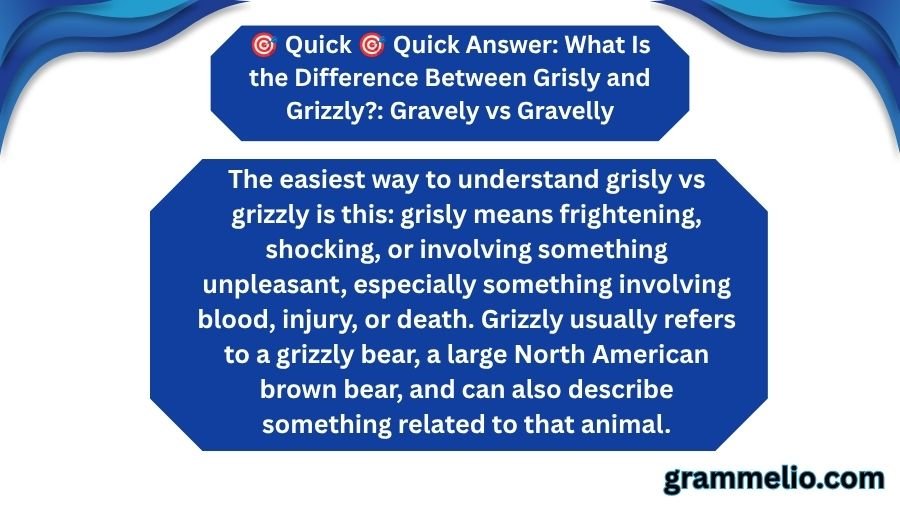
The easiest way to understand grisly vs grizzly is this: grisly means frightening, shocking, or involving something unpleasant, especially something involving blood, injury, or death. Grizzly usually refers to a grizzly bear, a large North American brown bear, and can also describe something related to that animal.
For example:
- The detective described the grisly details of the crime.
- We saw a grizzly bear from a safe distance.
Think grisly = gruesome and grizzly = grizzly bear.
Grisly vs Grizzly: Understanding the Basics
The central difference between grisly vs grizzly is meaning. Although the words look and sound very similar, they belong to different meaning groups.
Grisly is an adjective. It describes something that causes horror, disgust, or fear because it is violent, bloody, or disturbing.
Grizzly is most commonly an adjective or noun connected with the grizzly bear. As a noun, a grizzly means a grizzly bear. As an adjective, it can describe something connected with that bear.
Here is the basic comparison:
| Form | Type | Meaning | Example | Correct/Incorrect |
|---|---|---|---|---|
| Grisly | Adjective | Horrifying, bloody, or disturbing | The police found grisly evidence. | ✅ Correct |
| Grizzly | Noun | A grizzly bear | A grizzly crossed the trail. | ✅ Correct |
| Grizzly | Adjective | Related to a grizzly bear | The ranger studied grizzly behavior. | ✅ Correct |
| Grisly | Adjective | Disturbing or gruesome | The movie contained grisly scenes. | ✅ Correct |
| Grizzly | Adjective for a bloody crime | Incorrect use | The article described a grizzly crime. | ❌ Incorrect |
The key is to ask what you are describing.
If the answer is something horrifying or gruesome, choose grisly.
If the answer is a bear or something related to a grizzly bear, choose grizzly.
Is Grisly the Word for Something Bloody or Horrifying?
Yes. Grisly is the correct word when you want to describe something extremely unpleasant, shocking, bloody, or connected with death or serious injury.
For example:
The newspaper reported the grisly details of the murder.
Here, grisly tells the reader that the details are disturbing and possibly graphic.
Another example:
The detective arrived at a grisly crime scene.
The word does not simply mean “bad.” It suggests something that causes horror, shock, or disgust.
How Grisly Works in a Sentence
Grisly usually comes before a noun.
Common combinations include:
- grisly murder
- grisly discovery
- grisly scene
- grisly details
- grisly accident
- grisly remains
- grisly story
- grisly evidence
For example:
The reporter avoided describing the grisly details.
The noun is details. The adjective grisly tells us what kind of details they were.
💡 Test Tip for Grisly
When you are unsure, replace the word with gruesome.
If the sentence still makes sense, grisly is probably the right choice.
- The movie contained a grisly scene.
- The movie contained a gruesome scene.
Both work.
But:
- We watched a grisly bear near the river. ❌
- We watched a grizzly bear near the river. ✅
You would not normally replace grizzly with gruesome in that sentence.
| Meaning | Word Type | Example Sentence |
|---|---|---|
| Horrifying | Adjective | It was a grisly discovery. |
| Bloody | Adjective | The story described a grisly battle. |
| Disturbing | Adjective | The documentary showed grisly images. |
| Shocking | Adjective | Investigators faced a grisly scene. |
What Does Grizzly Mean?
Grizzly most often refers to a grizzly bear. It can work as either a noun or an adjective.
As a noun:
A grizzly wandered through the forest.
Here, grizzly means a grizzly bear.
As an adjective:
The park has strict rules about grizzly encounters.
Here, grizzly describes encounters involving grizzly bears.
The word is especially common in discussions about wildlife, forests, national parks, conservation, and outdoor safety.
Grizzly as a Noun
When grizzly is a noun, it names the animal.
Examples:
We spotted a grizzly near the mountain.
The guide taught us how to behave around a grizzly.
A grizzly can be dangerous when surprised.
The noun form is easy to remember because you can often add bear after it:
grizzly bear
Grizzly as an Adjective
Grizzly can also modify another noun.
Examples include:
- grizzly bear
- grizzly habitat
- grizzly population
- grizzly territory
- grizzly tracks
- grizzly behavior
- grizzly encounter
In these examples, grizzly is connected to the animal.
| Use | Meaning | Example |
|---|---|---|
| Noun | A grizzly bear | A grizzly appeared on the trail. |
| Adjective | Related to a grizzly bear | The ranger discussed grizzly habitat. |
| Animal reference | A specific type of bear | The grizzly is native to parts of North America. |
Grisly vs Grizzly: Key Differences at a Glance
The simplest rule for grisly vs grizzly is to connect each word with a different idea.
Grisly belongs with horror. Grizzly belongs with bears.
| Feature | Grisly | Grizzly |
|---|---|---|
| Main meaning | Horrifying or gruesome | A type of bear |
| Common part of speech | Adjective | Noun or adjective |
| Common topic | Crime, death, injury, horror | Wildlife and nature |
| Memory word | Gruesome | Bear |
| Example | A grisly discovery | A grizzly bear |
| Spelling clue | No “z” | Contains “zz” |
This distinction makes grisly vs grizzly much easier to handle.
Why Do People Confuse Grisly and Grizzly?
People confuse these words because they look almost identical and are pronounced similarly in many varieties of English. Both begin with gri- and have the same general rhythm.
There is also a spelling trap. The extra z in grizzly is easy to forget, especially when someone is typing quickly.
I once edited a short travel article about wildlife where the writer repeatedly used grisly bear. The writer knew exactly what animal they meant. The problem was simply the spelling. I changed each instance to grizzly bear and explained the meaning connection. That small correction made the article much clearer.
Here are common reasons for the confusion:
| Reason | What Happens |
|---|---|
| Similar spelling | The words look nearly identical. |
| Similar sound | Their pronunciation can make them hard to separate. |
| Fast typing | Writers may leave out a letter. |
| Autocorrect | Software may suggest an unexpected form. |
| Weak word association | The writer has not connected each word with its meaning. |
| Rare usage | Some people see one word much more often than the other. |
The best solution is not simply memorizing the spelling. Build a meaning-based connection.
Grisly → gruesome.
Grizzly → bear.
📝 Case Study: A Small Word Choice Can Change the Meaning
Imagine that you work for a travel company that publishes hiking guides.
You write:
Hikers should know how to react if they encounter a grisly bear.
The sentence sounds like you are saying the bear is gruesome or horrifying. That is probably not what you mean.
The correct version is:
Hikers should know how to react if they encounter a grizzly bear. ✅
Now imagine a crime report:
Police investigated a grizzly discovery.
That sounds as if the discovery involved a bear.
If the intended meaning is something horrifying, write:
Police investigated a grisly discovery. ✅
This case shows why grisly vs grizzly is more than a spelling issue. The wrong word can change the meaning of an entire sentence.
Grammar Rules Explanation: Grisly vs Grizzly
The grammar rule is simple: use the word that matches the meaning you intend.
Grisly is an adjective used to describe something disturbing, horrifying, bloody, or gruesome.
Grizzly is usually a noun referring to a grizzly bear or an adjective describing something related to that bear.
The two words should not be treated as interchangeable spellings.
Most standard English reference sources distinguish the words by meaning. You do not need to memorize a complicated grammar rule. Instead, identify the subject of your sentence.
Ask:
- Am I describing something gruesome or horrifying?
- Am I talking about a grizzly bear?
- Am I describing something connected to a grizzly bear?
If the answer to the first question is yes, use grisly.
If the answer to the second or third question is yes, use grizzly.
Correct vs Incorrect at a Glance
| Sentence | Correct/Incorrect | Why |
|---|---|---|
| The reporter described a grisly scene. | ✅ Correct | The scene was disturbing. |
| We saw a grizzly near the river. | ✅ Correct | A grizzly is a bear. |
| The hikers entered grizzly territory. | ✅ Correct | The territory is connected to grizzly bears. |
| The detective found a grizzly crime scene. | ❌ Incorrect | The intended meaning is probably horrifying, so use grisly. |
| The park protects its grisly bear population. | ❌ Incorrect | The animal is a grizzly bear. |
What Are the Most Common Mistakes With These Words?
The most common mistake in grisly vs grizzly is using the bear word when the writer means something gruesome, or using the horror word when the writer means the animal.
Another mistake is leaving out one of the z letters in grizzly.
⚠️ Common Mistakes and Why They Happen
| Confusion | Wrong Idea | Better Approach |
|---|---|---|
| Grisly/grizzly | Treating them as alternate spellings | Learn their separate meanings. |
| Your/you’re | Mixing possession and contraction | Ask whether you mean “you are.” |
| Its/it’s | Mixing possession and contraction | Ask whether you mean “it is.” |
| Then/than | Mixing time and comparison | Check the sentence relationship. |
| Affect/effect | Mixing related word functions | Identify the role in the sentence. |
| Their/there/they’re | Choosing by sound | Check the meaning before typing. |
These mistakes often happen because English contains many words that sound alike or nearly alike.
Fast typing makes the problem worse. Autocorrect can also create errors when the writer accepts a suggestion without checking the sentence.
I once caught myself typing grisly when I meant grizzly in a note about wildlife. I noticed the error because I stopped and asked myself, “Am I talking about something gruesome or an animal?” That quick question fixed the problem immediately.
Specific Wrong Forms to Watch For
| Wrong Form | What’s Wrong | Correct Form |
|---|---|---|
| grisly bear | Uses the horror adjective for the animal | grizzly bear |
| grizzly murder | Usually means a bear-related murder, not a gruesome murder | grisly murder |
| grizly bear | Missing a “z” | grizzly bear |
| grisley bear | Incorrect spelling | grizzly bear |
| grizzly details of the crime | Wrong meaning in most contexts | grisly details of the crime |
| grisly habitat | Wrong meaning if referring to bear habitat | grizzly habitat |
How Can You Remember Grisly vs Grizzly?
The best memory trick for grisly vs grizzly is extremely short:
Grisly = gruesome
Both words point you toward something unpleasant or horrifying.
Grizzly = grizzly bear
The double z helps you recognize the bear word.
You can also use this sentence:
The grisly scene involved a grizzly bear.
This sentence contains both words and shows their different meanings.
The scene is grisly because it is horrifying.
The bear is grizzly because it belongs to that bear group.
| Memory Trick | Meaning |
|---|---|
| Grisly → gruesome | Horrifying or disturbing |
| Grizzly → bear | Animal or bear-related |
| Double Z → grizzly | Helpful spelling clue |
| Crime scene → grisly | Usually disturbing |
| Wildlife trail → grizzly | Usually the animal |
Is Grisly Used Only for Death and Violence?
No. Although grisly often appears with death, violence, blood, or serious injury, it can describe anything that is deeply disturbing or horrifying.
For example:
The documentary included some grisly images.
The images do not have to show a crime. They could show a disturbing medical condition, accident, historical event, or other unpleasant subject.
You can also use grisly in creative writing:
The old castle had a grisly history.
Here, the word suggests that the history includes disturbing or horrifying events.
The meaning depends on context.
Can Grizzly Be Used Without the Word Bear?
Yes. Grizzly can stand alone as a noun when the context clearly refers to the animal.
For example:
The hikers saw a grizzly.
The reader understands that grizzly means a grizzly bear.
However, when writing for a broad audience, grizzly bear can be clearer, especially the first time the animal appears.
As an adjective, grizzly normally comes before a noun:
grizzly habitat
grizzly tracks
grizzly behavior
grizzly country
This is one reason grisly vs grizzly can be confusing. Grizzly can function as both a noun and an adjective, while grisly is normally an adjective.
Usage in Different Contexts
The correct choice depends on the subject of your writing.
| Context | Which Term to Use | Example |
|---|---|---|
| Everyday conversation | Either, depending on meaning | That was a grisly story. |
| Professional writing | Either, depending on meaning | Researchers studied grizzly habitat. |
| Creative writing | Either, depending on meaning | The novel opened with a grisly discovery. |
| Social media/texting | Either, depending on meaning | We saw a grizzly on our hike! |
Everyday Conversation
In everyday speech, grisly often appears when people describe disturbing movies, news stories, or events.
That was a pretty grisly movie.
Grizzly appears in conversations about wildlife:
We saw a grizzly bear during our trip.
Professional Writing
Professional writers should be especially careful because a wrong word can affect credibility.
A wildlife report might say:
The study examines grizzly populations.
A news article might say:
Investigators released details about the grisly incident.
Creative Writing
Creative writers can use grisly to create a dark mood.
The detective entered the grisly room.
They can use grizzly to create a wildlife setting.
A grizzly appeared between the trees.
Social Media and Texting
Short posts often contain quick spelling errors.
For example:
Saw a grizly today!
A better version is:
Saw a grizzly today! 🐻
The meaning is still easy to understand, but correct spelling makes the post cleaner.
Common Phrases With Grisly
There are several natural combinations with grisly. These phrases usually involve disturbing or horrifying subjects.
| Phrase | Meaning |
|---|---|
| Grisly details | Disturbing details |
| Grisly scene | A horrifying or disturbing scene |
| Grisly discovery | A disturbing thing that was found |
| Grisly murder | A horrifying or bloody murder |
| Grisly accident | A disturbing or serious accident |
| Grisly remains | Disturbing human or animal remains |
These phrases are useful because they make the meaning of grisly easy to recognize.
If you see grisly details, you should immediately think disturbing details, not bears.
Common Phrases With Grizzly
Grizzly commonly appears in phrases related to bears and wildlife.
| Phrase | Meaning |
|---|---|
| Grizzly bear | A type of brown bear |
| Grizzly habitat | Area where grizzly bears live |
| Grizzly territory | Area associated with grizzly bears |
| Grizzly tracks | Tracks left by a grizzly |
| Grizzly encounter | An encounter with a grizzly |
| Grizzly population | The number of grizzly bears in an area |
These phrases give you another practical clue when deciding between the two spellings.
Are Grisly and Grizzly Pronounced the Same?
They are very similar in sound, which is one reason the spelling can cause trouble. However, exact pronunciation can vary by speaker and region.
For writing purposes, pronunciation is not the best way to separate them.
Meaning is much more reliable.
When you hear either word, ask yourself what the speaker is talking about. If the topic is a bear, think grizzly. If the topic is something horrifying, think grisly.
That meaning-first strategy is much safer than trying to rely only on sound.
Can Grisly and Grizzly Ever Be Interchangeable?
No. In standard usage, they are not interchangeable.
Changing one word for the other can change the meaning of the sentence.
Compare:
The reporter described the grisly details. ✅
This means the details were disturbing.
Now:
The reporter described the grizzly details. ❌
This does not naturally communicate the same idea. It may suggest that the details have some connection to a grizzly bear.
Likewise:
We saw a grizzly bear. ✅
But:
We saw a grisly bear. ❌
That second sentence describes the bear as gruesome rather than identifying its type.
Synonyms and Alternatives for Grisly
Several words can sometimes replace grisly, but they do not always have exactly the same strength or tone.
| Alternative | Works When | Does Not Work When |
|---|---|---|
| Gruesome | Something is horrifying or unpleasant | You mean a grizzly bear |
| Horrifying | Something causes strong fear or shock | You specifically need a bloody image |
| Disturbing | Something causes discomfort or concern | You want a very strong horror tone |
| Bloody | Blood is a major part of the description | The disturbing quality has nothing to do with blood |
| Graphic | Details are very explicit | The subject is simply frightening |
For example:
The movie contained gruesome scenes.
This can often replace:
The movie contained grisly scenes.
But none of these alternatives can replace grizzly when you mean the animal.
Why It Matters to Get Grisly vs Grizzly Right
Correct word choice improves clarity. It also makes your writing look more careful and professional.
Imagine reading a wildlife article that repeatedly calls bears “grisly bears.” You might understand the writer’s meaning, but the spelling error can make you question the rest of the article.
Now imagine a news report describing a “grizzly murder.” Readers may wonder whether the murder involved a grizzly bear.
The difference matters because one letter can change the mental picture.
Clear words create clear pictures.
| Situation | Why Getting It Right Matters |
|---|---|
| Resume or application | Shows attention to detail |
| Client email | Prevents confusion |
| Published article | Builds credibility |
| Social post | Makes your message easier to understand |
How Should You Use Grisly vs Grizzly in Digital Writing?
Digital writing moves quickly. People often type on phones, accept autocorrect suggestions, or skim their own work before posting.
That makes grisly vs grizzly an especially useful pair to memorize.
Before publishing, use a quick meaning check:
Is this about horror? → grisly.
Is this about a bear? → grizzly.
You do not need to reread an entire article every time. A two-second check can prevent the error.
For sen writers, this matters even more. Search-focused articles often repeat important terms many times. A spelling mistake can make the page look less polished and can confuse readers.
What Is the Best Way to Proofread These Words?
I recommend a three-step check.
Step 1: Find the Word
Search your document for grisly and grizzly.
Step 2: Read the Whole Sentence
Do not check spelling alone. Read the sentence and identify the meaning.
Step 3: Ask the Bear-or-Horror Question
Ask:
Am I talking about something horrifying?
If yes, use grisly.
Ask:
Am I talking about a grizzly bear or something connected with it?
If yes, use grizzly.
This method works because it checks meaning, grammar, and context at the same time.
How Does the Spelling Help You Remember the Difference?
Spelling can provide a useful memory clue.
Grizzly has two z letters.
That extra visual feature can remind you of the animal word.
You can picture:
GRIZZLY → 🐻
Then connect:
GRISLY → 😨
The emoji trick is not a grammar rule, but it can make the distinction easier to remember.
| Word | Visual Reminder | Meaning |
|---|---|---|
| Grisly | 😨 | Horrifying or gruesome |
| Grizzly | 🐻 | Bear |
| Grisly details | 🩸 | Disturbing details |
| Grizzly tracks | 🐾 | Bear tracks |
Quick Practice: Can You Choose the Right Word?
Try these sentences before looking at the answers.
- The documentary showed a ______ scene.
- We saw a ______ near the river.
- The article described the ______ details of the accident.
- The park is home to a large ______ population.
- The detective discovered a ______ scene.
Answers
- grisly ✅
- grizzly ✅
- grisly ✅
- grizzly ✅
- grisly ✅
The pattern is consistent: horror takes grisly, while bears take grizzly.
How Can You Teach Grisly vs Grizzly to a Student?
If I were teaching this distinction in a classroom, I would avoid giving students a long list of rules first.
I would write two words on the board:
GRISLY → GRUESOME
GRIZZLY → BEAR
Then I would give students mixed sentences.
For example:
The hikers saw a ______ bear.
Students choose grizzly.
Then:
The hikers heard a ______ story about the accident.
Students choose grisly.
This approach works because students learn the meaning difference through context.
A short memory sentence also helps:
A grisly scene can involve a grizzly bear.
The sentence is memorable because both words appear together while performing different jobs.
FAQs About Grisly vs Grizzly
What is the difference between grisly and grizzly?
Grisly means horrifying, gruesome, bloody, or disturbing. Grizzly usually means a grizzly bear or something related to that bear.
Is it grisly bear or grizzly bear?
The standard phrase is grizzly bear. Grizzly identifies the type of bear.
We saw a grizzly bear in the distance. ✅
Is it grisly details or grizzly details?
If you mean disturbing or horrifying details, use grisly details.
The reporter described the grisly details of the crime. ✅
Does grisly mean scary?
It can. Grisly usually describes something that is horrifying, gruesome, bloody, or deeply disturbing. It is stronger and more specific than simply saying something is scary.
Does grizzly always mean a bear?
Most commonly, yes. As a noun, a grizzly refers to a grizzly bear. As an adjective, grizzly can describe something connected with grizzly bears.
Why are grisly and grizzly confused?
They are confused because their spellings and sounds are very similar. They also begin with the same letters. The easiest solution is to remember their meanings separately.
How do you remember the spelling of grizzly?
Connect grizzly with grizzly bear. The double z in grizzly can serve as a visual spelling clue.
Can you use grisly for a crime?
Yes. Grisly is commonly used to describe a disturbing or horrifying crime.
Police investigated a grisly murder. ✅
Can grizzly describe something frightening?
Not in the same sense as grisly. Grizzly normally points to a grizzly bear or something related to one. If you mean horrifying or gruesome, grisly is usually the better choice.
What is an easy sentence that uses both words correctly?
A useful example is:
The grisly story involved a grizzly bear.
Here, grisly describes the disturbing story, while grizzly identifies the bear.
✅ Quick Recap Checklist
Use this checklist whenever you are unsure about grisly vs grizzly.
| Question | If Yes → Use |
|---|---|
| Am I describing something gruesome? | Grisly |
| Am I describing something horrifying? | Grisly |
| Am I describing disturbing details? | Grisly |
| Am I talking about a bear? | Grizzly |
| Am I talking about bear habitat? | Grizzly |
| Am I describing something connected to a grizzly bear? | Grizzly |
Practice Examples
1. The reporter described a ______ discovery.
Answer: grisly ✅
2. A ______ crossed the road.
Answer: grizzly ✅
3. The researchers studied ______ habitat.
Answer: grizzly ✅
Here is the final memory rule:
Grisly = gruesome. Grizzly = bear.
That one line will solve most cases.
Conclusion
Grisly vs grizzly becomes easy once you stop treating the words as spelling variations and connect each one with its meaning. Grisly describes something horrifying, gruesome, bloody, or deeply disturbing. Grizzly usually refers to a grizzly bear or something related to that animal. 🐻
When I teach this distinction, I encourage writers to use a simple mental test. If the sentence makes you think of horror, choose grisly. If it makes you think of a bear, choose grizzly. That quick check is often enough to prevent the mistake.
Remember the two-word memory trick: grisly = gruesome; grizzly = bear. Once that connection becomes automatic, you will be able to choose the correct spelling without stopping to think for long. ✍️
The goal is not just to spell these words correctly. It is to make sure your reader gets the exact picture you intended.
When one letter changes the meaning, choose the word by meaning first.


[…] mistakes, memory tricks, and practical examples so you can choose the right word with confidence. Grisly vs Grizzly | Gravely vs Gravelly | Grate vs […]
[…] By the end, you should be able to choose the right word with confidence. 😊 Groan vs Grown | Grisly vs Grizzly | Gravely vs […]