I have seen even strong English writers pause when they come across holy vs wholly because the two words look and sound very similar. If you are learning English, writing emails, creating content, or simply trying to avoid small spelling mistakes, this pair can be confusing.
I know how easy it is to type one word when you mean the other, especially when you are writing quickly. 😊
The good news is that the difference is simple once you connect each word to its meaning. Holy is mainly an adjective connected with religion, sacred things, or something treated as deeply special.
Wholly is an adverb that means “completely,” “entirely,” or “fully.” In this guide, I will explain holy vs wholly with clear examples, memory tricks, grammar rules, common mistakes, and practical tips.
By the end, you should be able to choose the right word with confidence. ✨ Hangar vs Hanger | Groan vs Grown | Grisly vs Grizzly
🎯 Quick Answer: Holy vs Wholly
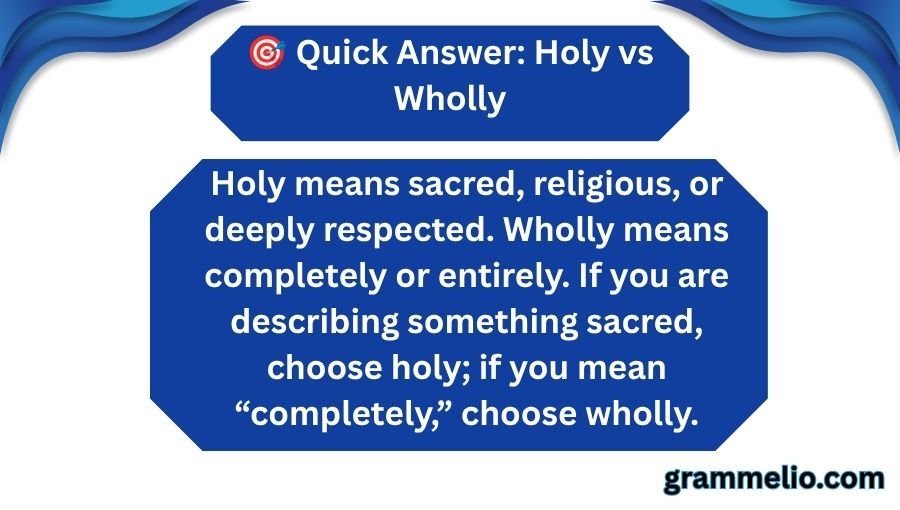
Holy means sacred, religious, or deeply respected. Wholly means completely or entirely. If you are describing something sacred, choose holy; if you mean “completely,” choose wholly.
A quick memory trick is this:
- Holy = sacred 🙏
- Wholly = completely ✅
For example:
- ✅ The church is considered a holy place.
- ❌ The church is considered a wholly place.
But:
- ✅ The decision was wholly unexpected.
- ❌ The decision was holy unexpected.
Holy vs Wholly: The Basic Difference
The easiest way to understand holy vs wholly is to focus on the job each word does in a sentence. Holy normally describes a noun, while wholly usually tells us how completely something happens or how complete something is.
| Word | Type | Meaning | Example | Correct/Incorrect |
|---|---|---|---|---|
| holy | Adjective | Sacred or religious | The temple is a holy place. | ✅ Correct |
| wholly | Adverb | Completely or entirely | I am wholly responsible. | ✅ Correct |
| holy | Adjective | Sacred | She visited a holy site. | ✅ Correct |
| wholly | Adverb | Completely | The claim was wholly false. | ✅ Correct |
Think of the difference this way:
Holy answers: “What kind of thing is it?”
Wholly answers: “To what extent?”
That simple question can solve most cases.
🙏 What Does Holy Mean?
Holy is an adjective. It describes something connected with God, religion, worship, or something considered sacred and worthy of deep respect.
The word can describe places, books, people, objects, days, traditions, or ideas.
Examples include:
- a holy place
- a holy book
- a holy day
- a holy site
- a holy person
- holy ground
Holy in religious contexts
The most common use of holy is religious.
For example:
- The pilgrims visited a holy site.
- The ceremony took place on holy ground.
- They treated the building as a holy place.
Here, holy tells us that the noun has a sacred or religious meaning.
Holy in nonreligious contexts
Holy can also be used more broadly to describe something deeply respected or treated as almost untouchable.
For example:
For some writers, the privacy of a person’s home is almost holy.
This does not necessarily mean the home is officially religious. The word can express a strong sense of respect.
A useful summary
| Meaning of Holy | Word Type | Example Sentence |
|---|---|---|
| Sacred | Adjective | The shrine is a holy place. |
| Religious | Adjective | They observed a holy tradition. |
| Deeply respected | Adjective | Family time was holy to him. |
💡 Test Tip
If you can replace the word with sacred, religious, or deeply respected, holy is probably the correct choice.
🌟 What Does Wholly Mean?
Wholly is an adverb. It means completely, entirely, or fully.
It tells us about the degree or extent of something.
Consider these examples:
- I am wholly committed to the project.
- The plan was wholly successful.
- She was wholly responsible for the decision.
- The statement was wholly inaccurate.
In each sentence, wholly means “completely.”
You could often replace it with completely without changing the basic meaning.
For example:
The plan was wholly successful.
becomes:
The plan was completely successful.
Wholly and complete ideas
| Meaning | Word Type | Example |
|---|---|---|
| Completely | Adverb | I wholly agree. |
| Entirely | Adverb | The idea was wholly rejected. |
| Fully | Adverb | She was wholly prepared. |
A helpful clue is the spelling. Wholly contains whole, which can remind you of something complete.
🔍 Is Holy the Same as Wholly?
No. Holy and wholly are not interchangeable. They have different meanings and usually perform different grammatical jobs.
Holy relates to sacredness or deep respect. Wholly means completely or entirely.
Compare:
- The mountain is holy.
- The mountain is wholly covered in snow.
The first sentence describes the mountain as sacred. The second says that the mountain is completely covered.
Holy vs Wholly at a Glance
| Feature | Holy | Wholly |
|---|---|---|
| Main meaning | Sacred or deeply respected | Completely or entirely |
| Part of speech | Adjective | Adverb |
| Commonly modifies | Nouns | Verbs, adjectives, or other adverbs |
| Related idea | Religion or sacredness | Completeness |
| Memory clue | Holy = sacred | Wholly = whole/completely |
🧠 Why Do People Confuse Holy and Wholly?
People confuse these words because they look and sound very similar. The extra w in wholly is easy to miss during fast reading or typing.
There is also a strong sound connection between the two words in many varieties of English. That makes spelling more difficult because you cannot always depend on pronunciation.
I once edited a short article in which the writer meant “completely different” but wrote “holy different.” The writer knew the difference in meaning but had typed too quickly and never noticed the error. That small mistake changed the sentence from normal English into something unintentionally funny.
Common reasons for confusion include:
- Similar spelling
- Similar pronunciation
- Fast typing
- Autocorrect
- Spell-check limits
- Lack of familiarity with the words
- Reading the sentence too quickly
| Confusing Pair | Correct Difference |
|---|---|
| holy / wholly | sacred / completely |
| accept / except | receive or agree / excluding |
| its / it’s | possessive / it is |
| your / you’re | possessive / you are |
| their / there / they’re | possession / place / they are |
The best solution is not simply to memorize the spelling. Learn the meaning and grammar role of each word.
✍️ How Can You Tell Which Word to Use?
Ask yourself what you are trying to say.
If you mean sacred, use holy.
If you mean completely, use wholly.
Try these examples:
- ✅ The river is considered holy.
- ❌ The river is considered wholly.
Here, “sacred” makes sense.
Now compare:
- ✅ The company is wholly owned by its founder.
- ❌ The company is holy owned by its founder.
Here, “completely” makes sense.
The replacement test
| If You Can Replace the Word With… | Choose |
|---|---|
| sacred | holy |
| religious | holy |
| revered | holy |
| completely | wholly |
| entirely | wholly |
| fully | wholly |
This is one of the fastest ways to solve the problem.
📚 Grammar Rules Explanation
Holy functions as an adjective. It normally modifies or describes a noun.
Examples:
a holy place
a holy book
holy ground
Wholly functions as an adverb. It expresses completeness or totality and can modify a verb, adjective, or another adverb.
Examples:
wholly agree
wholly responsible
wholly unacceptable
The difference is therefore both semantic and grammatical. The words do not simply have different spellings. They have different meanings and different roles in a sentence.
A standard English dictionary can be useful when you need to confirm a word’s meaning or part of speech, but in everyday writing, the sacred-versus-completely test will usually be enough.
Correct vs Incorrect at a Glance
| Sentence | Correct/Incorrect | Why |
|---|---|---|
| The temple is a holy place. | ✅ Correct | “Holy” means sacred. |
| The temple is a wholly place. | ❌ Incorrect | “Wholly” does not mean sacred. |
| I wholly agree with your point. | ✅ Correct | “Wholly” means completely. |
| I holy agree with your point. | ❌ Incorrect | “Holy” cannot mean completely. |
| They stood on holy ground. | ✅ Correct | The ground is described as sacred. |
⚠️ Common Mistakes With Holy vs Wholly
Most mistakes happen when writers focus on sound instead of meaning.
For example, someone may see a sentence such as:
“I ___ support the proposal.”
Because holy and wholly sound similar, the writer may choose the wrong spelling. But “completely support” makes sense, so wholly is required.
Why these mistakes happen
| Cause | What Happens |
|---|---|
| Fast typing | The writer types the familiar-looking form. |
| Autocorrect | Technology may not understand the intended meaning. |
| Weak word knowledge | The writer remembers the sound but not the definition. |
| Similar pronunciation | The difference is hard to hear. |
| Limited proofreading | The error remains unnoticed. |
Specific Wrong Forms and Uses
| Wrong Form | What’s Wrong | Correct Form |
|---|---|---|
| wholly place | “Wholly” does not mean sacred. | holy place |
| holy agree | “Holy” cannot mean completely. | wholly agree |
| wholly book | A sacred book is a holy book. | holy book |
| holy responsible | “Holy” cannot mean completely responsible. | wholly responsible |
| wholly ground | Sacred ground is described as holy. | holy ground |
I once caught myself typing holy when I meant wholly in a note about a project that was “completely unnecessary.” I stopped because the sentence sounded strange when I read it back. That quick reread saved me from sending a silly mistake.
🕰️ Holy and Wholly: A Brief History
The two words have different histories even though their modern spellings are close.
Holy is an old English word associated with sacredness and religious ideas. Wholly developed from whole, with the ending -ly helping form an adverb meaning “in a whole or complete manner.”
The important lesson is that their similar appearance today does not mean they have the same meaning.
| General Period | Form | Main Idea |
|---|---|---|
| Old English period | Early form related to holy | Sacred or religious |
| Middle English period | Holy and related forms | Sacredness and religion |
| Later English | Whole + -ly | In a complete manner |
| Modern English | holy | Sacred or deeply respected |
| Modern English | wholly | Completely or entirely |
You do not need to memorize this history to use the words correctly. The modern meanings are what matter most.
💼 Usage in Different Contexts
The difference becomes especially clear when you look at real writing situations.
Everyday conversation
In everyday speech, holy often appears in religious expressions or emotional phrases.
Examples:
We visited a holy site.
She considers that day holy.
Wholly is less common in casual speech because people often say “completely” instead.
Professional writing
Wholly is useful in formal and professional writing.
Examples:
The project is wholly funded by private donations.
The company is wholly responsible for the final decision.
Holy appears when the subject is religious or treated as sacred.
Creative writing
Writers can use holy to create a strong emotional or spiritual image.
For example:
The old forest felt like holy ground.
Wholly can emphasize total commitment or complete change:
He was wholly transformed by the experience.
Social media and texting
In casual digital writing, holy may appear in religious comments or expressions of surprise. Wholly is less common, but it is still correct when “completely” is intended.
| Context | Which Term to Use | Example |
|---|---|---|
| Everyday conversation | holy | This is a holy site. |
| Professional writing | wholly | The company is wholly responsible. |
| Creative writing | Either, depending on meaning | The forest seemed holy. |
| Social media/texting | Either, depending on meaning | I wholly agree with this post. |
💬 Common Phrases With Holy
Holy appears in many familiar expressions. These phrases can help you remember its connection with sacredness.
| Phrase | Meaning |
|---|---|
| holy place | A place considered sacred |
| holy ground | Ground treated as sacred |
| Holy Week | A Christian religious observance |
| holy day | A day with religious significance |
| holy book | A sacred religious text |
| holy water | Water used in certain religious practices |
These expressions are useful because they give you strong mental links. When you see holy, think about something sacred or deeply respected.
🔄 Can Wholly Be Replaced With Completely?
Yes, in many sentences. Wholly often means the same basic thing as completely, entirely, or fully.
For example:
The statement was wholly inaccurate.
You can write:
The statement was completely inaccurate.
The meaning remains almost the same.
However, holy cannot normally be replaced with “completely.”
The church is holy.
does not mean:
The church is completely.
That sentence is incomplete and changes the meaning.
Alternatives for Wholly
| Alternative | Works When | Does Not Work When |
|---|---|---|
| completely | You mean total extent | You mean sacredness |
| entirely | You mean without exception | You describe a holy object |
| fully | You mean to the full degree | You mean religious |
| totally | Informal contexts needing strong emphasis | You mean sacred |
| absolutely | Strong agreement or total degree | You mean a religious place |
🎯 How to Remember Holy vs Wholly
The easiest memory trick is:
Holy = holy things.
Think of a church, temple, sacred book, religious ceremony, or holy site.
For wholly, think:
Wholly = whole.
The extra w connects it visually to whole. Something whole is complete.
Try this mental pair:
holy → sacred
wholly → whole → completely
This connection is much easier to remember than simply memorizing two spellings.
A five-second test
Before choosing the word, ask:
- Am I describing something sacred?
- Or am I saying something is complete?
If the answer is sacred, choose holy.
If the answer is complete, choose wholly.
📝 Case Study: A Workplace Email
Imagine that a manager writes:
“The new process is wholly owned by the operations team.”
This means the operations team has complete ownership or control.
Now imagine the manager writes:
“The new process is holy owned by the operations team.”
That sentence is incorrect because holy does not mean completely.
Now consider another email:
“The ceremony will be held at a holy site.”
Here, holy is correct because the site has religious or sacred importance.
The key is to read the word in context rather than choosing it by sound.
| Workplace Sentence | Correct Word | Reason |
|---|---|---|
| The department is ___ responsible. | wholly | Completely responsible |
| The event will be held at a ___ site. | holy | Sacred site |
| The project is ___ funded by the charity. | wholly | Entirely funded |
| The team visited a ___ place. | holy | Sacred place |
❓ Why Does Context Matter So Much?
Context matters because pronunciation alone may not tell you which spelling is correct. The surrounding words reveal the intended meaning.
Consider:
She was ___ committed to the plan.
The phrase “completely committed” makes sense. Therefore, wholly is correct.
Now consider:
They entered the ___ temple.
The temple is being described as sacred. Therefore, holy is correct.
The same sound can lead to two very different meanings.
✨ Holy vs Wholly in Sentences
Seeing many examples is one of the best ways to build confidence.
Holy examples
- The pilgrims traveled to a holy city.
- The ceremony took place in a holy building.
- The mountain is regarded as holy.
- They carefully protected the holy object.
- The book is considered holy by many believers.
Wholly examples
- I wholly support the proposal.
- The claim was wholly untrue.
- She was wholly prepared for the challenge.
- The decision was wholly unexpected.
- The company is wholly owned by its parent organization.
Notice the pattern. Holy describes a thing. Wholly tells us the degree to which something is true, complete, supported, owned, or done.
📊 A Simple Comparison You Can Save
| Question | Holy | Wholly |
|---|---|---|
| Does it mean sacred? | ✅ Yes | ❌ No |
| Does it mean completely? | ❌ No | ✅ Yes |
| Is it usually an adjective? | ✅ Yes | ❌ No |
| Is it usually an adverb? | ❌ No | ✅ Yes |
| Can it describe a place? | ✅ Yes | Usually no |
| Can it mean entirely? | ❌ No | ✅ Yes |
🧩 How Does Each Word Work in a Sentence?
Grammar becomes easier when you identify what the word modifies.
Holy normally modifies a noun:
a holy place
a holy tradition
holy ground
Wholly usually modifies an action or description:
wholly agree
wholly owned
wholly responsible
wholly unexpected
This gives you another useful test.
If the word comes before a noun and describes that noun as sacred, holy is likely correct.
If the word means “completely” and explains the degree of an action or description, wholly is likely correct.
🚫 When Should You Never Use Holy?
Do not use holy when your intended meaning is completely, entirely, or fully.
Incorrect:
❌ I holy agree with you.
Correct:
✅ I wholly agree with you.
Incorrect:
❌ The company is holy owned by one person.
Correct:
✅ The company is wholly owned by one person.
Incorrect:
❌ The answer is holy incorrect.
Correct:
✅ The answer is wholly incorrect.
🚫 When Should You Never Use Wholly?
Do not use wholly when you mean sacred or religious.
Incorrect:
❌ We visited a wholly site.
Correct:
✅ We visited a holy site.
Incorrect:
❌ They stood on wholly ground.
Correct:
✅ They stood on holy ground.
Incorrect:
❌ The ceremony took place in a wholly building.
Correct:
✅ The ceremony took place in a holy building.
🛠️ How Can You Improve Your Accuracy?
I recommend three simple habits.
1. Read the entire sentence
Do not choose the word before understanding the sentence.
2. Replace it with a synonym
Try sacred or completely.
3. Read your writing aloud
Hearing the whole sentence can sometimes expose a strange choice.
| Habit | Benefit |
|---|---|
| Read the context | Reveals intended meaning |
| Use a synonym test | Makes the choice obvious |
| Check the word’s grammar role | Prevents adjective/adverb errors |
| Proofread slowly | Catches typing mistakes |
| Learn common phrases | Builds natural word memory |
💡 A Quick Memory Trick for Writers
Here is the shortcut I give students:
Holy has one meaning to remember: sacred.
Wholly contains “whole”: complete.
Imagine a completely whole pie. 🥧
If you mean the pie is complete, think wholly.
If you mean a place is sacred, think holy.
It is a small trick, but simple visual connections often work better than long grammar rules.
⚠️ Three Tricky Sentences to Practice
Try choosing the correct word before checking the answers.
1. The organization is ___ funded by donations.
Answer: wholly
Why? The meaning is “completely funded.”
2. The ancient temple is considered ___.
Answer: holy
Why? The meaning is “sacred.”
3. I ___ agree with your recommendation.
Answer: wholly
Why? The meaning is “completely agree.”
| Practice Sentence | Answer | Meaning |
|---|---|---|
| The site is considered ___. | holy | Sacred |
| The project is ___ complete. | wholly | Completely |
| They entered a ___ building. | holy | Sacred |
| She ___ accepted the decision. | wholly | Completely |
📌 Why Holy vs Wholly Matters
Getting these words right matters because a single letter can change the meaning of a sentence.
Clear writing helps readers understand your exact point. This is especially important in professional emails, school assignments, websites, resumes, and published content.
A sentence such as:
“I wholly support this plan.”
sounds clear and professional.
A sentence such as:
“I holy support this plan.”
looks like a spelling mistake and may distract the reader.
A useful rule is:
Good word choice makes your meaning easy to see.
| Situation | Why Getting It Right Matters |
|---|---|
| Resume | Shows careful writing |
| Client email | Builds professional trust |
| Published content | Improves credibility |
| Social post | Keeps the message clear |
Small errors do not always change a person’s understanding. But repeated errors can make readers question the care behind the writing.
🧠 What Are the Most Important Differences to Remember?
There are three main differences.
First, meaning: holy means sacred; wholly means completely.
Second, grammar: holy is normally an adjective; wholly is an adverb.
Third, spelling clue: wholly contains the idea of “whole.”
| Difference | Holy | Wholly |
|---|---|---|
| Core meaning | Sacred | Completely |
| Grammar | Adjective | Adverb |
| Memory word | Sacred | Whole |
| Example | holy place | wholly agree |
❓ Can Holy Ever Mean Very Important?
Yes. In some contexts, holy can be used more broadly for something treated with deep respect or viewed as extremely important.
For example:
For the artist, the studio was holy ground.
This is figurative. The writer is comparing the studio to a sacred place.
However, this broader use still does not make holy mean “completely.” That meaning belongs to wholly.
❓ Can Wholly Mean Sacred?
No. Wholly means completely, entirely, or fully. It does not mean sacred.
For example:
The building was wholly destroyed.
Here, wholly means completely.
You cannot replace it with holy:
❌ The building was holy destroyed.
That would be incorrect.
❓ Is Wholly a Form of Whole?
Yes. Wholly is closely connected in spelling and meaning to whole. This is a useful memory aid because whole suggests completeness.
For example:
The group was wholly united.
This means the group was completely united.
❓ Is Holy an Adjective?
Yes. Holy is normally an adjective. It describes a noun as sacred, religious, or deeply respected.
Examples include:
- holy place
- holy book
- holy day
- holy site
- holy tradition
❓ Is Wholly an Adverb?
Yes. Wholly is an adverb. It commonly modifies a verb, adjective, or description by showing complete extent.
Examples include:
- wholly agree
- wholly responsible
- wholly unexpected
- wholly unacceptable
❓ How Do I Remember Holy vs Wholly?
Use the sacred vs whole trick.
If you mean sacred, choose holy.
If you mean completely, think whole and choose wholly.
This is one of the fastest ways to remember the difference.
❓ Which Is Correct: “Holy Responsible” or “Wholly Responsible”?
The correct phrase is “wholly responsible.”
For example:
She was wholly responsible for the project.
Here, wholly means completely.
“Holy responsible” is incorrect because holy does not mean completely.
❓ Which Is Correct: “Holy Place” or “Wholly Place”?
The correct phrase is “holy place.”
A holy place is a place considered sacred or religiously significant.
Wholly place is incorrect because wholly does not describe something as sacred.
❓ Can These Words Be Used Figuratively?
Yes. Holy can be used figuratively when something is treated as deeply important or sacred.
Wholly can also appear in figurative or abstract statements because it simply means completely.
For example:
She was wholly devoted to her craft.
The old library felt like holy ground.
Both words can appear in creative writing, but they carry completely different meanings.
❓ What Is the Easiest Rule for Holy and Wholly?
The easiest rule is:
Holy = sacred.
Wholly = completely.
If you remember only those two meanings, you will get most sentences right.
❓ Can I Use Completely Instead of Wholly?
Usually, yes. Completely, entirely, and fully are often good alternatives for wholly.
For example:
I wholly agree.
can become:
I completely agree.
But there are cases where one choice may sound more natural than another. In ordinary conversation, completely is often more common. Wholly can sound more formal or deliberate.
❓ What Is the Biggest Mistake With These Words?
The biggest mistake is choosing based on sound rather than meaning.
When you hear a sentence, both forms may seem possible because they sound close. When you write, stop and ask whether you mean sacred or completely.
That one question solves the problem in most cases.
✅ Quick Recap Checklist
Use this checklist whenever you are unsure.
| Question | If Yes → Use |
|---|---|
| Do I mean sacred? | holy |
| Do I mean religious? | holy |
| Do I mean deeply respected? | holy |
| Do I mean completely? | wholly |
| Do I mean entirely? | wholly |
| Do I mean fully? | wholly |
| Does the word describe a noun as sacred? | holy |
| Does the word show complete extent? | wholly |
Practice Examples
Example 1
The mountain is considered ___.
Answer: holy.
It is being described as sacred.
Example 2
I ___ support the decision.
Answer: wholly.
It means “I completely support the decision.”
Example 3
The company is ___ owned by its founder.
Answer: wholly.
It means “entirely owned.”
🏁 Final Takeaway: Holy vs Wholly Made Simple
Holy vs wholly becomes easy when you stop focusing on how the words sound and focus on what they mean. Holy is an adjective used for something sacred, religious, or deeply respected. Wholly is an adverb that means completely, entirely, or fully.
When I teach this distinction, I encourage writers to use one simple mental shortcut: holy = sacred, wholly = whole or complete. That connection is enough to guide you through most everyday, academic, and professional sentences.
Remember the examples:
- ✅ a holy place
- ✅ holy ground
- ✅ a holy book
- ✅ wholly responsible
- ✅ wholly owned
- ✅ wholly agree
The next time these two words appear in your writing, pause for one second and ask: Am I talking about something sacred, or am I saying something is completely true or complete? That quick question can prevent a surprisingly common mistake. Keep that rule in mind, and this confusing pair will soon feel completely clear. 😊

[…] to live by their own stated standards. That small question can make the difference clear. 😊 Holy vs Wholly | Hangar vs Hanger | Groan vs […]
[…] its meaning, the confusion becomes much easier to avoid. 🧠✨Hypercritical vs Hypocritical | Holy vs Wholly | Hangar vs […]