Have you ever wanted to describe someone who is far too hard on other people, but then stopped because you were unsure whether to call that person hypercritical vs hypocritical? I have seen this mix-up many times in student writing, emails, and everyday conversations.
The two words look and sound similar, so the confusion is easy to understand. Yet they describe two very different problems.
One is about being overly judgmental or finding fault with almost everything. The other is about saying you believe one thing while acting in a way that goes against it.
I use a simple meaning test when I teach this pair: ask whether the person is being too critical or failing to live by their own stated standards. That small question can make the difference clear. 😊 Holy vs Wholly | Hangar vs Hanger | Groan vs Grown
🎯 Quick Answer: Hypercritical vs Hypocritical
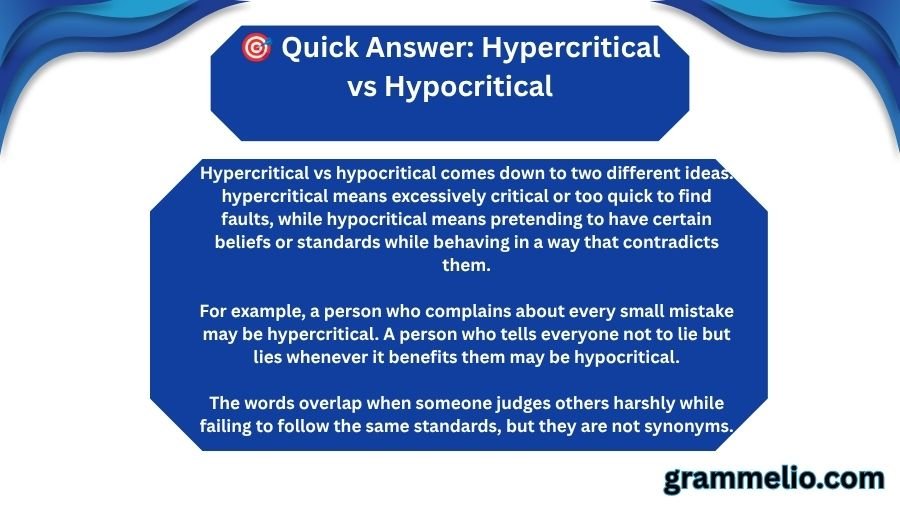
Hypercritical vs hypocritical comes down to two different ideas: hypercritical means excessively critical or too quick to find faults, while hypocritical means pretending to have certain beliefs or standards while behaving in a way that contradicts them.
For example, a person who complains about every small mistake may be hypercritical. A person who tells everyone not to lie but lies whenever it benefits them may be hypocritical.
The words overlap when someone judges others harshly while failing to follow the same standards, but they are not synonyms.
🔎 Understanding the Basics of Hypercritical vs Hypocritical
The easiest way to understand hypercritical vs hypocritical is to focus on the central idea behind each word.
Hypercritical describes a person, attitude, comment, or review that is too critical. The person may constantly point out flaws, mistakes, or weaknesses. They do not necessarily break their own rules.
Hypocritical describes a person who does not practice what they claim to believe. A hypocrite may demand a certain behavior from others while secretly or openly doing the opposite.
Here is the basic difference:
| Form | Type | Meaning | Example | Correct/Incorrect |
|---|---|---|---|---|
| Hypercritical | Adjective | Excessively critical | The editor was hypercritical of every small error. | ✅ Correct |
| Hypocritical | Adjective | Claiming one standard while acting against it | His advice about honesty was hypocritical because he lied himself. | ✅ Correct |
| Hypercritical | Adjective | Acting contrary to one’s stated beliefs | She was hypercritical because she lied about the rules. | ❌ Incorrect use |
| Hypocritical | Adjective | Finding too many faults | The reviewer was hypocritical because he disliked every typo. | ❌ Incorrect unless he also violated his own standard |
Hypercritical: Meaning and Correct Use
The other side of hypercritical vs hypocritical is hypocritical, which focuses on a person’s actions and standards.
Hypercritical means extremely or excessively critical. A hypercritical person tends to notice faults and focus on them more than is reasonable.
The word contains the idea of too much criticism.
Consider these examples:
The coach was hypercritical of the players’ mistakes.
This means the coach criticized the players excessively.
My boss can be hypercritical about grammar.
This means the boss pays too much attention to grammar mistakes and may criticize them more than necessary.
She became hypercritical of her own work.
This means she judged her own work too harshly.
The key point is that hypercritical does not automatically mean dishonest or fake.
A person can be hypercritical while being completely sincere.
Hypocritical: Meaning and Correct Use
Hypocritical means behaving in a way that conflicts with what you claim to believe or what you expect from others.
The key idea is double standards.
For example:
He tells everyone to arrive on time, but he is always late himself.
If he sincerely expects punctuality from others while excusing his own lateness, calling him hypocritical makes sense.
Another example:
It was hypocritical of the manager to criticize employees for using their phones when she spent the whole meeting texting.
The issue is not simply that she criticized people. The issue is that she did the very thing she criticized.
The Fastest Way to Tell Them Apart
This simple test makes the hypercritical vs hypocritical difference easier to recognize when you are writing.
This simple test makes hypercritical vs hypocritical much easier to remember in everyday writing.
I recommend asking two questions:
- Is the person criticizing too much?
If yes, think hypercritical. - Is the person failing to follow the standard they demand from others?
If yes, think hypocritical.
Sometimes the answer is both.
A parent who constantly criticizes a child’s messy room may be hypercritical. If that same parent demands cleanliness while leaving their own room extremely messy, the behavior may also be hypocritical.
💡 Test Tip: Use the “Too Critical or Double Standard?” Test
Replace the adjective mentally.
If you can say “too critical”, use hypercritical.
If you can say “saying one thing and doing another”, use hypocritical.
| Meaning | Word Type | Example Sentence |
|---|---|---|
| Excessively critical | Adjective | The teacher was hypercritical of minor errors. |
| Too focused on faults | Adjective | He has a hypercritical attitude toward new ideas. |
| Failing to follow one’s own standard | Adjective | Her complaint sounded hypocritical because she did the same thing. |
| Showing a double standard | Adjective | It was hypocritical to demand honesty while lying to others. |
❓ Is Hypercritical the Same as Hypocritical?
No. Hypercritical means overly critical, while hypocritical means inconsistent between stated beliefs and actual behavior.
The confusion comes mainly from their similar spelling and sound. Both words begin with “hyp” or “hyper” and contain “critical,” which makes them easy to mix up.
But their meanings are built around different ideas.
Think of hypercritical as:
“Too much criticism.”
Think of hypocritical as:
“Different rules for yourself and everyone else.”
That distinction works in most everyday situations.
❓ Why Do People Confuse Hypercritical and Hypocritical?
People confuse these words because they look alike and both can describe negative behavior.
Another reason is that the behaviors can happen together. A person who is hypocritical may also be hypercritical. For example, someone might constantly criticize other people’s spending while secretly wasting money themselves.
I once reviewed a student’s essay where the writer called a teacher “hypocritical” simply because the teacher corrected every tiny grammar error. The better word was hypercritical. The teacher’s problem was excessive criticism, not necessarily a double standard.
That example shows why meaning matters more than spelling.
| Confusion | What the Writer Means | Better Word |
|---|---|---|
| “She criticizes every detail.” | Too much criticism | Hypercritical |
| “He tells others not to cheat but cheats himself.” | Double standard | Hypocritical |
| “The reviewer finds fault with everything.” | Excessively critical | Hypercritical |
| “The leader demands rules that he ignores.” | Inconsistent behavior | Hypocritical |
| “She judges others by standards she follows herself.” | Strong criticism, but no double standard | Hypercritical |
📌 Hypercritical vs Hypocritical at a Glance
The difference becomes much easier when the words are placed side by side.
| Feature | Hypercritical | Hypocritical |
|---|---|---|
| Main idea | Excessive criticism | Inconsistent beliefs and actions |
| Focus | Fault-finding | Double standards |
| Requires a contradiction? | No | Usually yes |
| Can describe self-criticism? | Yes | Usually no |
| Can describe a review? | Yes | Sometimes, if the reviewer violates their own stated standards |
| Basic memory phrase | “Too critical” | “Do as I say, not as I do” |
Simple Examples
Hypercritical:
The customer was hypercritical of the restaurant.
The customer may have complained about the food, service, lighting, prices, and seating. The focus is excessive criticism.
Hypocritical:
The customer was hypocritical when he complained about slow service after arriving forty minutes late.
Here, the issue is inconsistency. He criticized behavior that he was partly responsible for.
✅ Correct vs Incorrect Examples
Example 1
✅ Correct: The editor was hypercritical of the writer’s word choice.
❌ Incorrect: The editor was hypocritical of the writer’s word choice.
Why? The sentence describes excessive criticism. There is no stated double standard.
Example 2
✅ Correct: It was hypocritical for him to demand honesty after lying to his team.
❌ Incorrect: It was hypercritical for him to demand honesty after lying to his team.
Why? The problem is that his behavior conflicts with the standard he demands.
Example 3
✅ Correct: My sister can be hypercritical about my cooking.
❌ Incorrect: My sister can be hypocritical about my cooking.
Why? The sentence only says that she criticizes the cooking too much.
Example 4
✅ Correct: The politician’s statement sounded hypocritical because he had broken the same rule.
❌ Incorrect: The politician’s statement sounded hypercritical because he had broken the same rule.
Why? The main issue is the mismatch between his words and actions.
Example 5
✅ Correct: The reviewer was hypercritical of the new book.
❌ Incorrect: The reviewer was hypocritical of the new book.
Why? A person is generally described as hypocritical, rather than saying they are “hypocritical of” a book. The sentence also gives no double-standard context.
📝 Case Study: A Workplace Example
Imagine a team leader who reviews every employee report.
She complains about tiny formatting issues. She points out small spelling mistakes. She criticizes sentence length, headings, and even minor spacing problems.
Her employees might reasonably describe her as hypercritical.
Now imagine something else happens. She tells employees that every report must be submitted by 5 p.m. Yet she regularly submits her own reports several days late and becomes angry when anyone questions it.
Now there is a second issue: hypocrisy.
The leader is demanding a standard from others that she does not follow herself.
| Workplace Situation | Best Description | Reason |
|---|---|---|
| Manager notices every tiny error | Hypercritical | Excessive fault-finding |
| Manager demands punctuality but is always late | Hypocritical | Double standard |
| Manager criticizes every report and follows the same high standards herself | Hypercritical | Heavy criticism without hypocrisy |
| Manager demands perfect reports but submits poor reports | Hypocritical | Her actions conflict with her expectations |
⚖️ Grammar Rules Explanation
Both hypercritical and hypocritical are adjectives. They normally describe a person, attitude, comment, behavior, judgment, or action.
The grammar rule is simple: choose the adjective based on the meaning you want to express.
Use hypercritical when the focus is on excessive criticism.
Use hypocritical when the focus is on a mismatch between what someone says, expects, or claims and how they actually behave.
Most standard English reference sources make the same broad distinction between excessive criticism and hypocrisy.
Neither word should be chosen just because it “sounds right.” Look at the behavior described by the sentence.
Correct vs Incorrect at a Glance
| Sentence | Correct/Incorrect | Why |
|---|---|---|
| The teacher was hypercritical of my essay. | ✅ Correct | The teacher criticized it excessively. |
| The teacher was hypocritical because she criticized students for cheating while cheating herself. | ✅ Correct | Her behavior showed a double standard. |
| He is hypercritical because he tells people to be honest but lies himself. | ❌ Usually incorrect | The main idea is hypocrisy. |
| She was hypocritical because she complained about every tiny typo. | ❌ Usually incorrect | Excessive criticism alone does not prove hypocrisy. |
| The reviewer was hypercritical of the movie. | ✅ Correct | The reviewer found excessive faults. |
⚠️ Common Mistakes With Hypercritical and Hypocritical
The hypercritical vs hypocritical confusion often happens because both words look similar and describe negative behavior.
Many errors with hypercritical vs hypocritical happen because the two adjectives look and sound so similar.
The most common mistake is treating these words as interchangeable.
They are not.
Another problem is that writers sometimes choose a word based only on its appearance. This happens especially when writing quickly.
I once caught myself typing “hypocritical” when I meant “hypercritical” in a note about a book review. I had to stop and ask what I actually meant. Once I replaced the word with “too critical,” the answer was obvious.
Why These Mistakes Happen
| Cause | How It Creates Errors | Helpful Fix |
|---|---|---|
| Fast typing | Similar-looking words get mixed up | Pause and check the meaning |
| Autocorrect | Software may accept the wrong real word | Read the full sentence |
| Lack of knowledge | The difference may not have been taught | Learn the “too critical vs double standard” test |
| Similar spelling | Both words contain “critical” | Focus on the first part |
| Context confusion | Both can describe unpleasant behavior | Ask what the person actually did |
Common Wrong Forms and Uses
| Wrong Form | What’s Wrong | Correct Form |
|---|---|---|
| He was hypocritical of every mistake. | “Hypocritical” does not mean excessively critical. | He was hypercritical of every mistake. |
| She was hypercritical because she lied about the rule. | Lying against one’s own stated standard points to hypocrisy. | She was hypocritical because she lied about the rule. |
| He is hypercritical to tell others not to lie while lying himself. | The key issue is a double standard. | He is hypocritical to tell others not to lie while lying himself. |
| The critic was hypocritical of the movie. | The word does not normally mean “very critical of.” | The critic was hypercritical of the movie. |
| Her behavior was hypercritical because she demanded a rule she ignored. | The behavior involves inconsistency, not simply criticism. | Her behavior was hypocritical because she demanded a rule she ignored. |
🧠 How To Remember the Difference
A short memory trick can save you from this mistake.
Hypercritical = hyper + critical = extremely critical.
The word hyper often suggests something excessive or above the usual level. So think:
Hypercritical = too critical.
For hypocritical, think:
Hypocritical = words and actions do not match.
You can also remember a classic idea:
“Do as I say, not as I do.”
That is the kind of behavior associated with hypocrisy.
| Memory Clue | Word | Meaning |
|---|---|---|
| Too much criticism | Hypercritical | Excessively critical |
| Double standard | Hypocritical | Demands one thing but does another |
| Finds faults constantly | Hypercritical | Overly judgmental |
| Says one thing, does another | Hypocritical | Inconsistent behavior |
🌎 Usage in Different Contexts
Understanding hypercritical vs hypocritical in different contexts helps you choose the right adjective for the situation.
Knowing how hypercritical vs hypocritical works in different contexts can help you choose the right word in both casual and formal writing.
The difference between these adjectives stays the same across different types of writing. What changes is the situation in which you use them.
Everyday Conversation
In casual speech, hypercritical works well when someone complains about everything.
“Don’t be so hypercritical. The meal was fine.”
Hypocritical works when someone behaves against their own claims.
“That’s hypocritical. You told me not to gossip, but you just did the same thing.”
Professional Writing
In work settings, both words can be useful, but they should be used carefully.
Calling someone hypercritical says they criticize excessively.
Calling someone hypocritical is stronger because it accuses them of inconsistent behavior.
Creative Writing
Writers may use both words to reveal character.
The hypercritical father corrected every sentence his daughter spoke.
Or:
The hypocritical mayor preached honesty while secretly hiding the truth.
Social Media and Texting
On social media, both words are common because people often comment on public behavior.
Still, the distinction matters. A person who gives a harsh review is not automatically hypocritical.
| Context | Which Term to Use | Example |
|---|---|---|
| Everyday conversation | Hypercritical | You’re being hypercritical about the food. |
| Everyday conversation | Hypocritical | That’s hypocritical because you do the same thing. |
| Professional writing | Hypercritical | The report takes a hypercritical view of minor errors. |
| Professional writing | Hypocritical | The policy appears hypocritical when leaders ignore it themselves. |
| Creative writing | Hypercritical | Her hypercritical aunt found fault with everything. |
| Creative writing | Hypocritical | The hypocritical ruler demanded loyalty he never showed. |
| Social media/texting | Hypercritical | You’re being hypercritical about a tiny mistake. |
| Social media/texting | Hypocritical | That’s hypocritical after what you said yesterday. |
💬 Common Phrases With Hypercritical and Hypocritical
Neither word has a large group of fixed idioms, but several common expressions naturally explain the ideas behind them.
| Phrase | Meaning |
|---|---|
| Hypercritical of others | Too ready to find faults in people |
| Hypercritical attitude | A habit of judging things too harshly |
| Hypercritical review | A review that focuses heavily on faults |
| Hypocritical behavior | Actions that conflict with stated beliefs |
| Hypocritical attitude | A pattern of holding inconsistent standards |
| A double standard | Expecting different behavior from yourself and others |
These expressions can help you recognize the intended meaning even when the exact adjective is not used.
✍️ Synonyms and Alternatives
When comparing hypercritical vs hypocritical, synonyms can also help clarify the exact meaning you want.
Sometimes you can replace these words with simpler language.
For hypercritical, useful alternatives include overly critical, too judgmental, fault-finding, and harsh.
For hypocritical, useful alternatives include inconsistent, two-faced, double-standard, or insincere, depending on the context.
Be careful, though. These alternatives are not always exact matches.
| Alternative | Works When | Does Not Work When |
|---|---|---|
| Overly critical | Someone criticizes too much | Someone breaks their own rules |
| Judgmental | Someone judges others harshly | The main issue is a personal double standard |
| Harsh | Criticism is severe | The person claims one standard and violates it |
| Inconsistent | Words and actions conflict | Someone simply criticizes too much |
| Double standard | Different rules are applied to different people | There is no unequal standard |
❓ Can Someone Be Both Hypercritical and Hypocritical?
The overlap between hypercritical vs hypocritical is worth understanding because one person can sometimes be both.
Yes. A person can be both.
For example, imagine a manager who constantly criticizes employees for arriving late. The manager may be hypercritical if the criticism is excessive.
If the manager also arrives late every morning, the manager may be hypocritical.
The two words describe different parts of the same behavior.
| Behavior | Hypercritical? | Hypocritical? |
|---|---|---|
| Criticizes every tiny mistake | Yes | Not necessarily |
| Demands punctuality while being late | Not necessarily | Yes |
| Criticizes every tiny mistake and breaks the same rules | Yes | Yes |
| Gives fair criticism and follows the same rules | No | No |
❓ Is Being Hypercritical Always a Sign of Hypocrisy?
No. Being hypercritical does not automatically make someone hypocritical.
A person can genuinely believe in high standards and still criticize others too much. For example, an editor might follow every writing rule personally but still be excessively harsh toward writers.
That person may be hypercritical, but there is no clear hypocrisy.
Hypocrisy requires a stronger idea: the person’s behavior conflicts with the standards or beliefs they present.
❓ Is Hypocritical Always About Lying?
No. Hypocrisy can involve lying, but lying is not required.
Someone can be hypocritical by demanding behavior from others that they refuse to follow themselves.
For example:
A manager tells employees never to interrupt meetings but constantly interrupts them.
That behavior may be hypocritical even if the manager says nothing false.
The key is the mismatch between the standard and the behavior.
❓ Which Word Means “Too Critical”?
Hypercritical means too critical or excessively focused on faults.
This is the quickest answer when someone criticizes people, work, ideas, or situations more than seems reasonable.
The reviewer was hypercritical of the restaurant.
The sentence does not suggest that the reviewer violated a personal standard.
❓ Which Word Means “Saying One Thing and Doing Another”?
Hypocritical is the correct word for behavior in which someone’s actions conflict with what they claim, preach, or expect.
It was hypocritical for him to demand honesty while lying to everyone.
The contradiction is the central idea.
❓ Can a Review Be Hypercritical?
Yes. A review can be hypercritical when it focuses excessively on faults or judges something too harshly.
For example:
The film received a hypercritical review.
This suggests that the review was unusually harsh or focused too much on flaws.
A review could be called hypocritical only in a context where the reviewer applies a standard inconsistently.
❓ Is “Hypocritical of” Correct English?
Usually, hypocritical of is not the natural pattern when you mean “too critical of.”
Say:
She was hypercritical of my presentation.
If you mean that her behavior contradicted her own standards, you can say:
Her behavior was hypocritical.
Or:
It was hypocritical of her to criticize me for something she did herself.
The phrase “hypocritical of her” works naturally in structures such as “It was hypocritical of her to…,” but hypocritical does not mean “very critical.”
❓ How Do You Use Hypercritical in a Sentence?
Use hypercritical before a noun or after a linking verb when describing excessive criticism.
Examples include:
He has a hypercritical attitude.
She is hypercritical of her own writing.
The review was hypercritical.
The word often appears with of when identifying the target of criticism.
❓ How Do You Use Hypocritical in a Sentence?
Use hypocritical when someone’s actions conflict with their stated beliefs or standards.
Examples include:
His behavior was hypocritical.
It was hypocritical of her to demand honesty while lying.
The policy seemed hypocritical because the people enforcing it ignored the same rule.
The surrounding context should make the contradiction clear.
❓ What Is an Easy Trick for Remembering Hypercritical vs Hypocritical?
Use this two-part test:
Hypercritical = too critical.
Hypocritical = double standard.
If you remember only those two phrases, you can solve most usage questions quickly.
❓ Which Word Should I Use in Formal Writing?
Use the word that accurately describes the behavior.
Choose hypercritical when you mean excessively critical.
Choose hypocritical when you mean inconsistent or self-contradictory behavior.
In formal writing, avoid using either word simply because it sounds strong. Make sure the surrounding evidence supports the meaning.
🎯 Why the Difference Matters
Understanding hypercritical vs hypocritical matters because choosing the wrong adjective can change the meaning of your sentence.
Understanding hypercritical vs hypocritical is more than a spelling exercise. Choosing the wrong word can change the accusation you are making.
Calling someone hypercritical says:
“You criticize too much.”
Calling someone hypocritical says:
“You do not follow the standards you claim to support.”
Those are very different claims.
In a personal conversation, the wrong word can create an argument. In professional writing, it can make your statement sound careless or unfair.
A simple rule worth remembering is:
Clear words create clear meaning.
| Situation | Why Getting It Right Matters |
|---|---|
| Resume or application | Shows careful word choice |
| Client email | Prevents an unintended accusation |
| Published content | Improves accuracy and reader trust |
| Social post | Keeps criticism precise and understandable |
🧩 Special Exception and Overlap
There is one important overlap: a person can be both hypercritical and hypocritical.
Suppose someone constantly tells others that their work is unacceptable. That person may be hypercritical.
Now suppose their own work is equally poor, yet they refuse to accept criticism. That adds a possible double standard. In that situation, hypocritical may also be appropriate.
The words should not be treated as competing labels when both meanings are genuinely present.
Instead, ask what part of the behavior you want to emphasize.
✅ Quick Recap Checklist
Use this checklist to review the key difference between hypercritical vs hypocritical before you finish writing.
Use this checklist whenever you are unsure.
| Question | If Yes → Use |
|---|---|
| Is the person criticizing too much? | Hypercritical |
| Does the person constantly find faults? | Hypercritical |
| Does the person judge their own work harshly? | Hypercritical |
| Does the person demand a rule they do not follow? | Hypocritical |
| Do their words and actions conflict? | Hypocritical |
| Are they applying different standards to themselves and others? | Hypocritical |
Practice Examples
1. Maria complains about every tiny mistake in the report.
Answer: Maria is hypercritical.
2. James tells his employees never to be late, but he arrives late every day.
Answer: James is hypocritical.
3. A reviewer attacks every minor flaw in a book but applies the same standards to all books.
Answer: The reviewer is hypercritical, not necessarily hypocritical.
Final Memory Test
Ask:
“Is the problem too much criticism?”
→ Hypercritical
“Is the problem a mismatch between words and actions?”
→ Hypocritical
That is the whole difference in its simplest form.
📚 Hypercritical vs Hypocritical: A Final Comparison
| Question | Hypercritical | Hypocritical |
|---|---|---|
| What does it describe? | Excessive criticism | Contradictory behavior |
| Main concern | Fault-finding | Double standards |
| Does it require a contradiction? | No | Yes, in the usual sense |
| Can someone be both? | Yes | Yes |
| Simple synonym | Overly critical | Inconsistent |
| Memory phrase | Too critical | Do as I say, not as I do |
| Example | She is hypercritical of my writing. | She is hypocritical because she demands rules she ignores. |
Conclusion
Hypercritical vs hypocritical becomes much easier once you separate excessive criticism from double standards. 😊 If someone finds fault with almost everything, hypercritical is usually the right word. If someone claims to follow a rule but does not follow it themselves, hypocritical is the better choice.
I recommend using the two-question test whenever you hesitate. Ask, “Is this person being too critical?” If yes, choose hypercritical. Then ask, “Is this person expecting one thing from others while doing something different themselves?” If yes, choose hypocritical.
Remember that the words can overlap. Someone may criticize others too much and also fail to follow their own standards. In that case, both words can describe different parts of the same behavior.
Once you connect hypercritical with “too critical” and hypocritical with “double standard,” the spelling stops being the hard part. The meaning does the work for you. 🎯
When in doubt, remember: too much criticism is hypercritical; words and actions that do not match are hypocritical.

[…] you connect each word with its meaning, the confusion becomes much easier to avoid. 🧠✨Hypercritical vs Hypocritical | Holy vs Wholly | Hangar vs […]