Have you ever written a sentence and stopped because you could not decide between indict vs indite? I have seen this confusion many times, especially because the two words sound exactly alike in standard English. 😅
They look different, but their meanings are far apart. One word belongs mainly to the world of law. The other is connected with writing or composing words. For students, writers, editors, and professionals, knowing the difference can prevent a sentence from saying something completely different from what was intended. In this guide, I will explain these two words in plain US English.
You will see clear definitions, examples, common mistakes, memory tricks, and practical situations so you can choose the right word with confidence. ✍️ Incidence vs Incidents | Gild vs Guild | Hypercritical vs Hypocritical
🎯 Quick Answer: Indict vs Indite
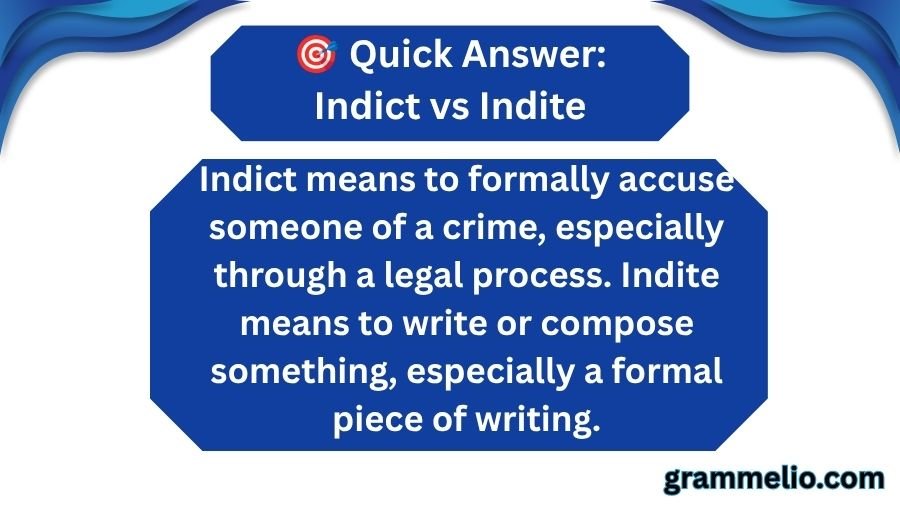
Indict means to formally accuse someone of a crime, especially through a legal process. Indite means to write or compose something, especially a formal piece of writing.
A simple memory trick is: indict = accuse in court; indite = write.
| Word | Basic Meaning | Main Context | Example |
|---|---|---|---|
| Indict | Formally accuse of a crime | Law | The grand jury decided to indict the suspect. |
| Indite | Write or compose | Writing | The poet chose to indite a long letter. |
🔎 Indict vs Indite: Meaning and Correct Use
The main difference is simple: indict is about a formal criminal accusation, while indite is about writing or composing. Although they sound alike, they perform completely different jobs in a sentence.
What does “indict” mean?
Indict is a verb that means to formally accuse a person of a serious crime through a legal process.
For example:
The grand jury voted to indict the businessman.
Here, indict means that the businessman was formally charged with a crime.
Another example:
Federal prosecutors may indict the suspect on several charges.
The word is strongly connected to criminal law. You will often see it with words such as:
- criminal
- suspect
- defendant
- prosecutor
- grand jury
- charges
- crime
- felony
- federal court
What does “indite” mean?
Indite is a verb meaning to write or compose something. It is uncommon in everyday modern English, but it is a real word.
For example:
The author sat down to indite a letter to his friend.
In this sentence, indite means “write” or “compose.”
It may appear in literary, historical, or formal writing. In ordinary conversation, however, most people would simply say write.
| Word | Part of Speech | Meaning | Example |
|---|---|---|---|
| Indict | Verb | Formally accuse of a crime | The jury chose to indict him. |
| Indite | Verb | Write or compose | She decided to indite a formal letter. |
| Indictment | Noun | Formal criminal accusation | The indictment listed several charges. |
| Indicted | Past tense | Formally accused | He was indicted last year. |
| Inditing | Present participle | Writing or composing | He was inditing a long poem. |
❓ Is Indict the Same as Indite?
No. Indict and indite are not the same word. They have different meanings even though they are pronounced the same.
Think of the difference this way:
Indict → legal accusation
Indite → writing
Consider these examples:
✅ The prosecutor plans to indict the suspect.
❌ The prosecutor plans to indite the suspect.
The first sentence says the prosecutor plans to formally accuse the suspect of a crime. The second uses a word related to writing, so it does not express the intended legal meaning.
Now look at the opposite situation:
✅ The writer hoped to indite a thoughtful letter.
❌ The writer hoped to indict a thoughtful letter.
The first sentence works because the writer is composing something. The second is wrong because a letter cannot be formally accused of a crime.
🧠 Why Do People Confuse Indict and Indite?
People often confuse these words because they are homophones. That means they sound alike but have different spellings and meanings.
When spoken aloud, you usually cannot tell which word someone means. Context does the work.
I once edited a student’s history assignment in which the student wrote that an author had “indicted a poem.” The student clearly meant that the author had written or composed the poem. The spelling mistake made the sentence sound like the poem had been charged with a crime. That small error changed the meaning in a funny way.
The spelling also adds to the problem. Both words contain letters that do not behave as you might expect from their sound.
| Feature | Indict | Indite |
|---|---|---|
| Sound | Same | Same |
| Spelling | Different | Different |
| Meaning | Legal accusation | Writing |
| Common today | Yes | Less common |
| Typical setting | Court and law | Literary or formal writing |
A useful mental picture
When you see indict, picture a courtroom.
When you see indite, picture a pen.
That simple visual link can make the difference easier to remember.
✍️ Indite: When Does It Mean “Write”?
Indite means to write, compose, or create written words. It is most useful in formal or literary contexts.
You might encounter it when reading older literature, historical material, or highly formal prose.
For example:
The scholar decided to indite a response to the criticism.
This means the scholar decided to write a response.
Another example:
The poet spent the evening inditing verses.
Here, inditing means composing verses.
Common meanings of indite
| Meaning | Word Type | Example Sentence |
|---|---|---|
| Write something | Verb | She indited a letter. |
| Compose formal words | Verb | He indited a response to the king. |
| Create literary work | Verb | The poet indited several verses. |
Because indite is uncommon today, replacing it with write or compose often makes modern writing clearer.
💡 Test Tip
If you can replace the word with write or compose, indite may be the correct choice.
If you can replace it with formally accuse, use indict.
⚖️ Indict: When Does It Mean “Formally Accuse”?
Indict is used when someone is formally accused of a crime through a legal process.
For example:
The grand jury indicted the defendant.
The defendant was formally accused.
You may also see the passive form:
The defendant was indicted on several charges.
The passive construction is common in news reports and legal writing.
The word can also appear with an object:
Prosecutors indicted the company executive.
Here, the executive is the person who received the formal accusation.
| Sentence | Meaning |
|---|---|
| The jury indicted the suspect. | The jury formally accused the suspect. |
| He was indicted on fraud charges. | He was formally accused of fraud. |
| Prosecutors indicted three people. | Prosecutors formally charged three people. |
Remember that being indicted is not the same as being found guilty. An indictment is an accusation. A court process must still determine guilt or innocence.
📝 Case Study: A Mistake in a Workplace Report
Imagine that an employee is preparing a report about a legal investigation.
The employee writes:
“The company board decided to indite the manager.”
That sentence is likely wrong if the intended meaning is that the manager was formally accused of a crime.
A better sentence is:
“The company board decided to report the matter to authorities, who could later indict the manager if the legal requirements were met.”
Now imagine a different report about a writer:
“The historian chose to indite a detailed account of the event.”
Here, indite can work because the historian is composing written material.
The lesson is simple: look at the action described by the sentence before choosing the spelling.
| Situation | Intended Action | Correct Word |
|---|---|---|
| A suspect faces a formal criminal accusation | Accuse | Indict |
| An author creates a letter | Write | Indite |
| A prosecutor brings formal charges | Accuse | Indict |
| A poet composes verses | Write | Indite |
📚 Grammar Rules Explanation
The grammar rule is straightforward. Indict and indite are both verbs, but they have different meanings and are used in different situations.
Indict describes a legal action involving a formal criminal accusation.
Indite describes the act of writing or composing.
Most standard English reference works treat these as separate words despite their identical pronunciation.
The key issue is not grammar in the narrow sense. Both words can function as verbs. The real issue is word choice and meaning.
For example:
The authorities indicted the suspect.
The subject performs a legal action, and the suspect receives the accusation.
Compare that with:
The poet indited a sonnet.
The subject creates written material.
Correct vs Incorrect at a Glance
| Sentence | Correct/Incorrect | Why |
|---|---|---|
| The grand jury indicted the suspect. | ✅ Correct | The suspect was formally accused. |
| The grand jury indited the suspect. | ❌ Incorrect | Indite means write or compose. |
| The poet indited a letter. | ✅ Correct | The poet composed a letter. |
| The poet indicted a letter. | ❌ Incorrect | A letter is being written, not accused. |
| Prosecutors indicted the defendant. | ✅ Correct | The sentence describes a legal accusation. |
⚠️ Common Mistakes With Indict and Indite
The biggest mistake is choosing the word based only on sound.
Because both words are pronounced alike, listening is not enough. You need to look at the meaning.
Why do these mistakes happen?
Common reasons include:
- Fast typing: Writers may type the first spelling that comes to mind.
- Autocorrect: A writing program may not understand the intended meaning.
- Lack of knowledge: Many readers rarely encounter the word indite.
- Homophone confusion: The words sound exactly alike.
- Unfamiliar legal vocabulary: People may know “indicted” from news reports without knowing how it is spelled.
| Common Confusion | Correct Choice | Basic Difference |
|---|---|---|
| It’s / its | Depends on meaning | Contraction vs possession |
| Your / you’re | Depends on meaning | Possession vs “you are” |
| They’re / their / there | Depends on meaning | Different functions |
| Affect / effect | Depends on sentence | Different uses and meanings |
| Indict / indite | Depends on meaning | Legal accusation vs writing |
Specific wrong forms to avoid
| Wrong Form or Use | What’s Wrong | Correct Form |
|---|---|---|
| Indite the suspect | Uses the writing word for a legal accusation | Indict the suspect |
| Indict a poem | Uses the legal word for writing | Indite a poem |
| Indite the defendant | Wrong meaning in a legal sentence | Indict the defendant |
| Indict a letter | Wrong meaning for composing | Indite a letter |
| He was indited for fraud | Uses the wrong verb | He was indicted for fraud |
| She indicted a formal reply | Uses the legal verb for writing | She indited a formal reply |
I once caught myself typing indite in a draft about criminal charges because I was thinking about the sound instead of the spelling. I stopped, checked the meaning, and changed it to indict. That is exactly why I recommend checking the action before checking the letters.
🏛️ Indict vs Indite in Legal Writing
Legal writing almost always calls for indict when the meaning is formal criminal accusation.
Examples include:
- The grand jury indicted the defendant.
- The suspect was indicted on federal charges.
- Prosecutors announced that they would seek to indict the accused.
- The company executive was indicted for alleged financial crimes.
Indite does not belong in these sentences because it has nothing to do with criminal charges.
One useful caution is that indict does not simply mean “criticize.” In ordinary writing, saying that someone “indicted” another person usually carries a strong legal meaning. It should not be used casually when you merely mean “blamed” or “criticized.”
| Legal Situation | Best Word | Example |
|---|---|---|
| Formal criminal accusation | Indict | The jury indicted him. |
| Writing a legal letter | Indite | The lawyer indited a formal letter. |
| Writing a court summary | Write/compose | The clerk wrote the summary. |
| Criminal accusation in news writing | Indict | Prosecutors indicted the suspect. |
💬 How Are Indict and Indite Used in Different Contexts?
The context usually makes the choice easy. Use indict for formal criminal accusations. Use indite only when you genuinely mean writing or composing, especially in formal or literary language.
| Context | Which Term to Use | Example |
|---|---|---|
| Everyday conversation | Usually neither | Say “charge” or “write” when those are clearer. |
| Professional writing | Indict for legal matters | The defendant was indicted. |
| Creative writing | Indite when a formal or old-fashioned tone fits | The poet indited a final verse. |
| Social media/texting | Usually “charge” or “write” | The suspect was charged; she wrote a post. |
Everyday conversation
Most speakers simply say charge or write.
For example:
The suspect was charged with fraud.
Or:
She wrote a letter.
These choices are more natural in casual speech.
Professional writing
Indict is useful when discussing criminal proceedings.
Indite can appear in formal writing, but it may sound old-fashioned or unusually literary.
Creative writing
A writer may choose indite deliberately to create a formal or historical tone.
For example:
He sat by the fire to indite a letter to his distant brother.
In modern fiction, however, write may sound more natural.
Social media and texting
Neither word is especially common in casual posts. Most people would say:
“The suspect was charged.”
or
“I wrote a message.”
❓ What Is the Difference Between Indict and Indite in a Sentence?
The difference depends on what the subject is doing.
If the subject is formally accusing someone of a crime, use indict.
If the subject is writing or composing something, use indite.
Compare:
The prosecutor indicted the defendant.
The prosecutor formally accused the defendant.
The poet indited the poem.
The poet composed the poem.
| Question | Answer |
|---|---|
| Is someone being formally accused of a crime? | Use indict. |
| Is someone writing or composing something? | Use indite. |
| Do the two words sound alike? | Yes. |
| Can one replace the other? | No. |
| Is indite common in casual English? | No, it is relatively uncommon. |
🧩 Common Phrases With Indict
Unlike indite, indict appears in several common legal expressions.
| Phrase | Meaning |
|---|---|
| Indict someone | Formally accuse someone of a crime |
| Indict a defendant | Formally charge a defendant |
| Be indicted | Receive a formal criminal accusation |
| Indict someone on charges | Formally accuse someone in connection with stated charges |
| Indict for fraud | Formally accuse someone of fraud |
| Grand jury indicts | A grand jury formally charges someone |
With indite, there are fewer common fixed expressions because the word itself is less common.
🔄 Synonyms and Alternatives for Indict and Indite
Sometimes another word will sound more natural.
For indict, possible alternatives include charge, accuse, or formally charge. These are not always exact replacements because legal terms can have different meanings.
For indite, the simplest alternatives are write and compose.
| Alternative | Works When | Does Not Work When |
|---|---|---|
| Charge | Talking about a formal criminal charge | You specifically need the precise legal meaning of indict |
| Accuse | Describing an accusation generally | You need to describe a formal indictment |
| Write | Describing ordinary writing | You want a formal or literary tone |
| Compose | Describing the creation of written material | You are discussing a criminal accusation |
| Draft | Describing preparation of written material | You mean formal criminal charges |
Choosing the simpler alternative is often a good idea. If you mean write, say write. If you mean a formal criminal accusation, indict is the stronger and more exact word.
❓ Why Does Getting Indict and Indite Right Matter?
Correct word choice matters because these two words can completely change the meaning of a sentence.
Imagine writing:
“The author indicted a novel.”
Readers may wonder why a novel is being treated as part of a criminal case.
Now imagine writing:
“The prosecutor indited the suspect.”
A reader may think the prosecutor wrote something rather than formally accused the suspect.
Clear writing helps readers understand your exact meaning without stopping to guess.
| Situation | Why Getting It Right Matters |
|---|---|
| Resume | Shows careful word choice and strong writing skills |
| Client email | Prevents confusing or embarrassing wording |
| Published content | Protects clarity and credibility |
| Social post | Helps readers understand your message quickly |
A useful writing principle is:
“The right word makes the meaning clear before the reader has to think twice.”
That is especially true with homophones.
🧠 How To Remember the Difference
The easiest memory trick is to connect each word with a simple idea.
Indict = illegal accusation
The letters dict can remind you of words connected with saying or declaring something. More importantly, memorize the whole word as the legal one:
indict → crime → court
Indite = ink
The ending -ite can remind you of writing with ink.
indite → ink → write
This is not a formal language rule. It is simply a memory aid.
| Word | Memory Clue | Meaning |
|---|---|---|
| Indict | Crime and court | Formally accuse |
| Indite | Ink and writing | Write or compose |
If you remember only one thing, remember this:
A person can be indicted. A poem can be indited.
❓ Can Indite Be Used in Modern English?
Yes. Indite is a real English word, but it is uncommon in everyday modern English.
It is most likely to appear in formal, literary, historical, or deliberately old-fashioned writing.
For most modern readers, write is clearer.
For example:
She indited a letter to her brother.
This is grammatically valid, but:
She wrote a letter to her brother.
sounds much more natural in everyday American English.
| Style | Better Choice |
|---|---|
| Casual conversation | Write |
| Modern business writing | Write |
| Simple educational writing | Write |
| Literary writing | Indite can work |
| Historical-style fiction | Indite can work |
| Criminal law | Indict |
❓ What Is the Past Tense of Indict?
The past tense of indict is indicted.
For example:
The grand jury indicted the suspect.
The present participle is indicting:
Prosecutors are indicting the suspect on additional charges.
The noun indictment refers to the formal criminal accusation itself.
| Form | Word | Example |
|---|---|---|
| Base verb | Indict | They may indict him. |
| Past tense | Indicted | They indicted him. |
| Present participle | Indicting | They are indicting him. |
| Noun | Indictment | The indictment was filed. |
❓ What Is the Past Tense of Indite?
The past tense of indite is indited.
For example:
The poet indited a long letter.
The present participle is inditing:
The writer was inditing a formal response.
The noun forms are much less common in ordinary English, so modern writers usually prefer simpler words such as writer, author, or composition, depending on the meaning.
| Form | Word | Example |
|---|---|---|
| Base verb | Indite | She may indite a letter. |
| Past tense | Indited | She indited a letter. |
| Present participle | Inditing | She was inditing a poem. |
| Related idea | Writing | She was writing a poem. |
❓ Can You Use Indict for Criticism?
Usually, indict should be reserved for its established legal sense when precision matters.
If you simply mean that someone criticized, blamed, or condemned something, choose a clearer word.
For example:
The report criticized the policy.
This is clearer than using indict if no legal accusation is intended.
In some figurative writing, indict can be used more broadly to suggest a strong condemnation. However, this use can sound formal or dramatic. For clear everyday writing, criticize, condemn, or blame may be better choices.
| Intended Meaning | Better Word |
|---|---|
| Formal criminal accusation | Indict |
| General accusation | Accuse |
| Negative review or judgment | Criticize |
| Strong moral disapproval | Condemn |
| Ordinary responsibility claim | Blame |
❓ How Can You Quickly Choose Between Indict and Indite?
Use a two-question test. Understanding indict vs indite is much easier when you focus on the meaning of the sentence rather than how the words sound.
Question 1: Is someone being formally accused of a crime?
If yes, use indict.
Question 2: Is someone writing or composing something?
If yes, use indite.
If neither meaning fits, you probably need a different word.
| Question | If Yes → Use |
|---|---|
| Is this about formal criminal charges? | Indict |
| Is this about writing or composing? | Indite |
| Is this ordinary writing? | Usually write |
| Is this a general accusation? | Usually accuse |
| Is this a criticism? | Usually criticize |
Practice examples
- The grand jury voted to ___ the suspect.
Answer: indict - The poet decided to ___ a final letter.
Answer: indite - The journalist ___ an article about the case.
Answer: write
📋 Indict vs Indite: Quick Comparison
| Category | Indict | Indite |
|---|---|---|
| Meaning | Formally accuse of a crime | Write or compose |
| Part of speech | Verb | Verb |
| Pronunciation | Same as indite | Same as indict |
| Main setting | Law | Literature/formal writing |
| Common today | Yes | Less common |
| Past tense | Indicted | Indited |
| Related noun | Indictment | Less commonly used forms |
| Memory clue | Court | Ink |
| Example | The jury indicted him. | She indited a letter. |
⚡ Indict vs Indite in One-Minute Review
If you need to make the correct choice quickly, focus on the object of the verb. A quick review of indict vs indite can help you make the right choice when you are writing or editing.
Indict + person accused of a crime
Prosecutors indicted the defendant.
Indite + written work
The author indited a letter.
This pattern makes the difference much easier to spot.
You can also remember the sentence:
The court indicts people; writers indite words.
It is short, clear, and easy to recall.
✅ Quick Recap Checklist
| Question | If Yes → Use |
|---|---|
| Am I talking about a formal criminal accusation? | Indict |
| Am I talking about someone being formally charged? | Indict |
| Am I talking about writing or composing? | Indite |
| Would “write” make sense here? | Probably indite |
| Would “formally accuse” make sense here? | Indict |
| Is the sentence casual modern writing? | Prefer write over indite when possible |
Try these
1. The grand jury decided to ___ the suspect.
Answer: indict
2. The poet wanted to ___ a beautiful letter.
Answer: indite
3. The defendant was ___ on several criminal charges.
Answer: indicted
❓ What Is the Difference Between Indict and Indite?
The difference is that indict means to formally accuse someone of a crime, while indite means to write or compose something.
They sound the same but have different meanings and spellings.
❓ Are Indict and Indite Homophones?
Yes. Indict and indite are homophones because they have the same pronunciation but different spellings and meanings.
❓ Is Indite a Correct English Word?
Yes. Indite is a correct English word meaning to write or compose. However, it is uncommon in everyday modern English.
❓ Is Indict a Legal Word?
Yes. Indict is strongly associated with criminal law. It means to formally accuse someone of a crime through the legal process.
❓ What Is an Example of Indict?
A clear example is: “The grand jury voted to indict the suspect.”
Here, indict means formally accuse the suspect of a crime.
❓ What Is an Example of Indite?
A clear example is: “The poet decided to indite a formal letter.”
Here, indite means write or compose.
❓ Which Is Correct: Indicted or Indited?
Both are correct, but they have different meanings. Indicted is the past tense of indict, while indited is the past tense of indite.
❓ Can I Replace Indite With Write?
Usually, yes. In modern everyday English, write is more common and easier for most readers to understand.
❓ Does Indict Mean Guilty?
No. Being indicted means a person has been formally accused of a crime. It does not by itself mean that the person has been found guilty.
❓ How Can I Remember Indict vs Indite?
Use this memory trick: indict = court and crime; indite = ink and writing. If the sentence involves a criminal accusation, choose indict. If it involves composing words, choose indite.
🎯 Final Takeaway: Indict vs Indite
Indict vs indite becomes easy once you focus on meaning instead of sound. Indict is the word for a formal criminal accusation. Indite is the word for writing or composing, although it is uncommon in everyday modern English. ✨
When you see a sentence about prosecutors, defendants, grand juries, or criminal charges, indict is almost certainly the word you need. When the sentence describes composing a letter, poem, or other written work, indite may fit. In normal modern writing, though, write is often the clearer choice.
The fact that these words sound alike is what makes them tricky. Their meanings are completely different. A person can be indicted, while a poem can be indited. Once you connect each spelling with its meaning, the confusion largely disappears.
Remember: indict belongs in court, while indite belongs on the page.



[…] tricks, examples, grammar rules, and practice sentences to help the distinction stick. ✍️ Indict vs Indite | Incidence vs Incidents | Gild vs […]