Have you ever stopped while writing because you were unsure whether to use instance vs instants? You are not alone. I see this mix-up often because the two words look almost identical, but they do very different jobs in a sentence. One usually points to a single example or case, while the other refers to more than one very short period of time.
If you are a student, teacher, writer, editor, or professional who wants clear US English, knowing this small difference can make your writing much sharper. ✍️ I want to make the rule simple enough that you can remember it without checking a dictionary every time.
Once you understand the meaning, number, and context of each word, choosing the right form becomes much easier. Let’s break down instance vs instants with clear rules and everyday examples. 😊 Ingenious vs Ingenuous | Indict vs Indite | Incidence vs Incidents
🎯 Quick Answer: Instance vs Instants
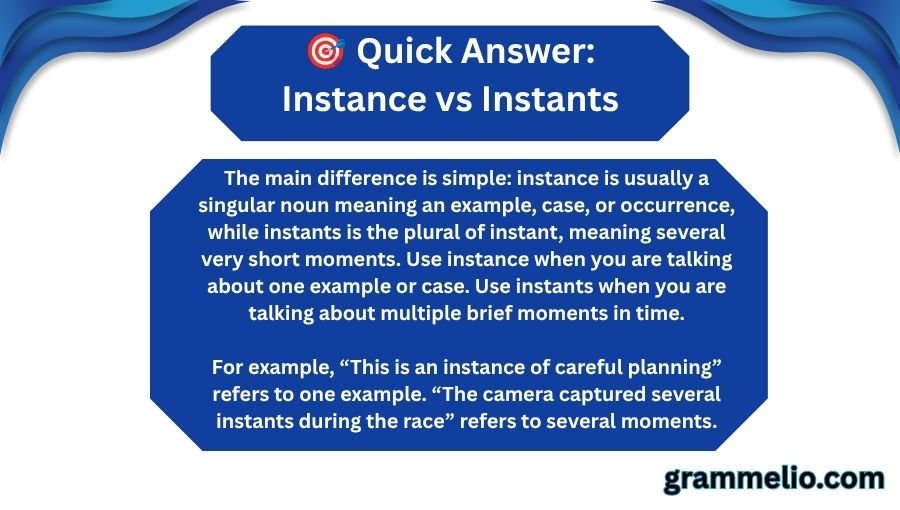
The main difference is simple: instance is usually a singular noun meaning an example, case, or occurrence, while instants is the plural of instant, meaning several very short moments. Use instance when you are talking about one example or case. Use instants when you are talking about multiple brief moments in time.
For example, “This is an instance of careful planning” refers to one example. “The camera captured several instants during the race” refers to several moments.
Related Word Forms You Should Know
Understanding the related forms makes this comparison much easier. Instance and instant are different words, so their plural forms are also different.
| Form | Type | Example |
|---|---|---|
| instance | Singular noun | This is one instance of the problem. |
| instances | Plural noun | We found several instances of the problem. |
| instant | Singular noun/adjective | Wait for an instant. |
| instants | Plural noun | Several instants passed before she answered. |
| instant’s | Possessive form | The instant’s timing was important. |
| instances’ | Plural possessive | The instances’ patterns were similar. |
The key point is that adding -s does not make instance and instant interchangeable. They begin with the same letters, but their meanings are different.
Understanding Instance vs Instants
The clearest way to understand instance vs instants is to ask what idea you are expressing.
If you mean one example, case, or occurrence, choose instance.
If you mean more than one very short moment, choose instants.
| Form | Type | Meaning | Example | Correct/Incorrect |
|---|---|---|---|---|
| instance | Singular noun | One example or case | This is an instance of good judgment. | ✅ Correct |
| instances | Plural noun | More than one example or case | We found three instances of the error. | ✅ Correct |
| instant | Singular noun | One very short moment | Give me an instant. | ✅ Correct |
| instants | Plural noun | More than one short moment | The final instants were tense. | ✅ Correct |
| instants | Noun used for an example | Not normally used to mean “examples” | This is an instants of poor planning. | ❌ Incorrect |
A useful trick is to separate the words in your mind:
- instance → example or case
- instant → moment
- instances → examples or cases
- instants → moments
That one connection solves most mistakes.
Is Instance the Same as Instant?
No. Instance and instant are separate words with different meanings. Instance usually refers to an example, case, or occurrence, while instant refers to a very short amount of time.
Consider these sentences:
- “That is an instance of excellent teamwork.” → one example
- “Wait an instant.” → one brief moment
The difference is small in spelling but large in meaning.
I once edited a student’s short essay where the writer used instant every time they meant “example.” The sentences looked almost right at first glance. Once we replaced the word with instance, the meaning became clear. That small correction improved the entire paragraph.
What Does Instance Mean?
Instance is a singular noun commonly used for one example, case, or occurrence of something.
It often appears when you want to point to a specific situation that proves or illustrates a larger idea.
For example:
“This is an instance of effective leadership.”
Here, instance means an example.
Another example is:
“I cannot remember a single instance when he was rude.”
Here, instance means a particular occurrence or case.
Instance as an Example
One of the most common uses of instance is to introduce a specific example.
“This decision is an instance of careful planning.”
The word does not mean “moment.” It identifies the decision as an example of a broader behavior.
Instance as a Case or Occurrence
Instance can also refer to a particular case.
“The report contains an instance of incorrect data.”
The writer is pointing to one specific case.
Instance in the Phrase “For Instance”
The phrase for instance is especially common in everyday and professional English. It means for example.
“You can improve your writing in several ways. For instance, you can use shorter sentences.”
You can often replace for instance with for example without changing the basic meaning.
Meaning Summary
| Meaning | Word Type | Example Sentence |
|---|---|---|
| Example | Noun | This is an instance of good design. |
| Case | Noun | The lawyer discussed one instance of fraud. |
| Occurrence | Noun | I remember one instance when the system failed. |
| Example marker | Phrase | For instance, you could start earlier. |
💡 Test Tip
Ask yourself:
Can I replace the word with “example” or “case”?
If yes, instance is probably the word you need.
If you can replace it with moment, you probably need instant or instants instead.
What Does Instant Mean?
Instant refers to a very short period of time. It can function as a noun or adjective.
As a noun:
“Wait an instant.”
Here, instant means a brief moment.
As an adjective:
“She received an instant reply.”
Here, instant describes something that happens immediately or very quickly.
Its plural noun form is instants:
“The final instants of the game were exciting.”
This means the final brief moments of the game.
Instance vs Instants in Time Expressions
This is where the difference becomes especially clear.
| Expression | Meaning | Example |
|---|---|---|
| an instant | one brief moment | Wait an instant. |
| instants | several brief moments | The final instants were dramatic. |
| an instance | one example or case | This is an instance of teamwork. |
| instances | several examples or cases | We found several instances of teamwork. |
Notice that instance and instant are not simply singular and plural versions of one word. They belong to different word families.
Why Do People Confuse Instance and Instants?
People confuse these words mainly because they look and sound similar. Their spelling differs by only a few letters, and both can appear in formal writing.
Another reason is that writers may remember the beginning of the word but not its meaning. Fast typing, autocorrect, and weak familiarity with the words can make the problem worse.
I once caught myself typing instants when I meant instances in an editing note. I was moving quickly and had the sentence in my head before I checked the word. The mistake reminded me how easily similar-looking words can slip into otherwise careful writing.
A Simple Meaning Test
Use this test:
Example? → instance.
Moment? → instant.
Examples? → instances.
Moments? → instants.
This is faster than trying to remember a complicated grammar rule.
📝 Case Study: Instance vs Instants in the Workplace
Imagine that a manager is writing an email after reviewing a customer service report.
The manager wants to say that the report contains three examples of excellent customer care.
The correct sentence is:
“The report includes three instances of excellent customer service.” ✅
Using instants would change the meaning:
“The report includes three instants of excellent customer service.” ❌
The second sentence suggests three brief moments in time. That is not what the manager intended.
Now imagine a sports writer describing the final seconds of a close game:
“The final instants of the match were full of tension.” ✅
Here, instants works because the writer means several brief moments.
This shows why context matters. The spelling alone does not tell you which word to choose. The intended meaning does.
Grammar Rules Explanation: Choosing the Correct Form
The grammar rule is based mainly on meaning and number.
Instance is a singular count noun. It can describe one example, case, or occurrence.
Instances is its plural form. It describes two or more examples, cases, or occurrences.
Instant is a different word. As a noun, it describes a brief moment.
Instants is the plural of instant, so it describes multiple brief moments.
Standard English reference works consistently distinguish these words by meaning. The important point is not their similar spelling but the idea each word represents.
Correct vs Incorrect at a Glance
| Sentence | Correct/Incorrect | Why |
|---|---|---|
| This is an instance of poor planning. | ✅ Correct | Instance means one example. |
| This is an instants of poor planning. | ❌ Incorrect | Instants means brief moments, not examples. |
| The final instants were exciting. | ✅ Correct | Instants means brief moments. |
| The final instances were exciting. | ❌ Incorrect | Instances means examples or cases. |
| We found several instances of the same error. | ✅ Correct | Several examples are being discussed. |
A quick substitution test can help. Replace the word with example or moment.
If “example” fits, use instance.
If “moment” fits, use instant.
⚠️ Common Mistakes With These Words
The most common mistakes happen when writers focus on spelling rather than meaning.
Here are three common causes:
- Fast typing: You know the correct word but type the similar one.
- Autocorrect: Software may not understand the meaning of your sentence.
- Lack of knowledge: You may not have learned the difference yet.
Similar-looking words cause the same problem in other pairs.
| Confusing Pair | Correct Difference |
|---|---|
| its / it’s | Possession vs. “it is” or “it has” |
| your / you’re | Possession vs. “you are” |
| their / there / they’re | Possession, place, and “they are” |
| affect / effect | Usually verb vs. noun, with important exceptions |
| then / than | Time/order vs. comparison |
| instance / instant | Example/case vs. brief moment |
Common Wrong Forms Specific to This Topic
| Wrong Form | What’s Wrong | Correct Form |
|---|---|---|
| an instants | Plural form cannot follow singular “an” | an instance or an instant |
| one instants | Instants is plural | one instance or one instant |
| several instance | Plural idea needs plural noun | several instances |
| several instant | Plural idea needs plural noun | several instants |
| an instances | Instances is plural | an instance |
| many instance | “Many” needs a plural count noun | many instances |
These errors are easy to fix once you identify the intended meaning.
Instance vs Instants in Different Contexts
The right choice depends on what you are talking about. The words can appear in casual speech, business writing, creative work, and digital communication.
| Context | Which Term to Use | Example |
|---|---|---|
| Everyday conversation | instance or instant | For instance, we could leave early. |
| Professional writing | instance or instances | The audit found several instances of error. |
| Creative writing | instant or instants | In the final instants, she changed her mind. |
| Social media/texting | Either, based on meaning | Give me an instant. |
| Academic writing | instance or instances | This is an instance of a wider trend. |
Everyday Conversation
In normal conversation, for instance is common.
“You could take the train, for instance.”
Instant is also common:
“Wait an instant.”
Professional Writing
Professional writing often uses instance when discussing examples or cases.
“The review identified two instances of missing information.”
Using instants here would make the sentence sound as though the writer is discussing moments in time.
Creative Writing
Creative writing may use instant or instants to create a sense of time.
“In those final instants, everything changed.”
This use focuses on brief moments.
Social Media and Texting
Informal digital writing follows the same meaning rules.
“Give me an instant!” ✅
“For instance, you could try this.” ✅
Short messages may be casual, but the meanings do not change.
Common Phrases With Instance
Instance appears in several useful phrases. Learning these phrases can help you remember the word naturally.
| Phrase | Meaning |
|---|---|
| for instance | for example |
| in this instance | in this particular case |
| in the first instance | at the first stage or as the first step |
| in every instance | in every case |
| in some instances | in some cases |
| an instance of | an example or occurrence of something |
The phrase for instance is especially useful because it directly connects instance with the meaning “example.”
Common Phrases With Instant
Instant also appears in many familiar expressions.
| Phrase | Meaning |
|---|---|
| in an instant | very quickly |
| at that instant | at that exact moment |
| for an instant | for a very short time |
| instant relief | relief that happens quickly |
| instant response | a response that happens immediately |
| instant decision | a decision made very quickly |
Notice how strongly these phrases connect instant with time.
That gives you another memory tool:
Instance = example.
Instant = time.
How To Remember the Difference
A good memory trick is to connect each word to a simple question.
Ask “Which example?”
Use instance.
“Which instance shows the problem?”
Ask “Which moment?”
Use instant.
“Which instant did the change happen?”
You can also remember the letter e in instance as standing for example. This is not a grammar rule, but it can be a useful memory trick.
Another method is to memorize these four lines:
- One example = instance
- Several examples = instances
- One moment = instant
- Several moments = instants
If you can remember those four lines, you will rarely confuse the words.
Synonyms and Alternatives
Sometimes you can replace instance with another word. The best alternative depends on the sentence.
| Alternative | Works When | Does Not Work When |
|---|---|---|
| example | You mean a specific example | You mean a brief moment |
| case | You mean a particular situation | You are describing a moment in time |
| occurrence | You mean something that happened | You need a simple example marker |
| situation | You mean a particular set of circumstances | You mean “for example” |
| moment | You mean a short period of time | You mean an example or case |
For instant, moment is often the closest everyday alternative.
For instance, example is often the easiest replacement.
Why Getting Instance vs Instants Right Matters
Small word choices can have a big effect on meaning. Using the wrong form may cause readers to pause and wonder what you intended.
Clear word choice helps with:
- Clarity: Readers understand your point faster.
- Professionalism: Careful word use makes writing look polished.
- Digital communication: Short emails and posts leave little room for confusion.
- Academic writing: Precise terms make explanations easier to follow.
A simple rule I use when editing is:
“Choose the word that matches the idea, not the word that looks closest.”
| Situation | Why Getting It Right Matters |
|---|---|
| Resume | Precise language creates a polished impression. |
| Client email | Clear wording reduces confusion. |
| Published content | Correct word choice builds reader trust. |
| Social post | Short writing needs especially clear wording. |
Even when the mistake is minor, accurate language shows that you care about what you are saying.
Is “For Instance” the Same as “For Instant”?
No. For instance means for example, while for instant is not the normal expression when you mean “for example.”
Compare:
“For instance, you could call tomorrow.” ✅
“For instant, you could call tomorrow.” ❌
The first sentence introduces an example. The second uses instant, which relates to a moment in time.
This is one of the most useful fixed-phrase distinctions to remember.
Can Instance Be Plural?
Yes. The plural of instance is instances.
Use instances when you are talking about more than one example, case, or occurrence.
“The report contains several instances of the same error.”
Do not use instants for this meaning.
“The report contains several instants of the same error.” ❌
That sentence suggests several moments rather than several examples.
Can Instants Be Used for Moments?
Yes. Instants is the plural form of instant when instant is used as a noun meaning a very short period of time.
For example:
“The final instants of the race were thrilling.”
Here, the writer is talking about multiple brief periods near the end of the race.
The word is especially natural when describing dramatic or important moments.
Special Edge Cases to Watch
There is no major spelling exception that makes instance mean instant or vice versa. However, context can make either word appear in more formal or specialized expressions.
For example, instance can appear in phrases related to a particular case or situation:
“In this instance, the rule does not apply.”
Meanwhile, instant can be used as an adjective:
“The device provides instant results.”
That adjective use is important because it reminds us that instant is not always a noun. The sentence may describe something that happens immediately.
✅ Quick Recap Checklist
Use this checklist before submitting your sentence.
| Question | If Yes → Use |
|---|---|
| Do I mean one example? | instance |
| Do I mean several examples? | instances |
| Do I mean one brief moment? | instant |
| Do I mean several brief moments? | instants |
| Can I replace the word with “for example”? | instance |
| Can I replace the word with “moment”? | instant or instants |
Practice Examples
- “This is an ___ of careful planning.”
Answer: instance ✅ - “The final ___ of the race were exciting.”
Answer: instants ✅ - “We found several ___ of incorrect formatting.”
Answer: instances ✅
The more you connect each word to its meaning, the faster the choice becomes.
FAQs About Instance vs Instants
What is the difference between instance and instants?
Instance usually means one example, case, or occurrence. Instants means several very short moments. They are different words, not singular and plural versions of the same word.
Is instance singular or plural?
Instance is singular. Its plural form is instances.
“One instance”
“Several instances”
Is instants the plural of instance?
No. Instants is the plural of instant, not instance. The plural of instance is instances.
What is the plural of instance?
The plural of instance is instances.
“The editor found several instances of the error.”
What is the plural of instant?
The plural of instant is instants.
“The final instants were tense.”
Should I say “for instance” or “for instant”?
Use for instance when you mean for example.
“For instance, you could start with the introduction.”
For instant does not normally express that meaning.
When should I use instance in a sentence?
Use instance when you mean an example, case, or occurrence.
“This is an instance of excellent teamwork.”
When should I use instants in a sentence?
Use instants when you mean multiple very short moments.
“The final instants of the performance were unforgettable.”
Is “instance” the same as “example”?
Often, yes. In many sentences, instance can mean a specific example or case.
“This is an instance of good judgment.”
You could also say:
“This is an example of good judgment.”
Is “instant” the same as “moment”?
As a noun, instant can often mean a very short moment.
“Wait an instant.”
In that context, moment is a natural alternative.
Conclusion
Instance vs instants becomes easy once you focus on meaning instead of spelling. Use instance for one example, case, or occurrence. Use instances for multiple examples. Use instant for one brief moment, and use instants for multiple brief moments. 🧠
When I am proofreading, I use a simple test: if I can replace the word with example, I choose instance. If I can replace it with moment, I choose instant or instants. That quick check catches most errors before they reach the final draft. ✨
Remember the four-word pattern: instance = example, instances = examples, instant = moment, instants = moments. Once that pattern becomes familiar, this confusing word pair stops being confusing.
Choose the word that matches your meaning, and your writing will speak clearly every time.

[…] simple. By the end, you should feel confident choosing the right word every time. ✍️ Instance vs Instants | Ingenious vs Ingenuous | Indict vs […]
[…] to use each word, how to remember the difference, and which mistakes to avoid. Intense vs Intents | Instance vs Instants | Ingenious vs […]