Have you ever typed a sentence and stopped because you were not sure whether you needed to write knead vs need vs kneed? I understand that confusion because these three words sound almost the same, yet they have very different meanings. One is about working dough with your hands. Another is one of the most common verbs in English and means something is required.
The third is rare and usually relates to using your knee. 😊 I have helped students and writers sort out confusing English words for years, and this is one of those spelling groups that becomes easy once you connect each word with a clear picture.
In this guide, I will show you exactly when to use each word, how to remember the difference, and which mistakes to avoid. Intense vs Intents | Instance vs Instants | Ingenious vs Ingenuous
🎯 Quick Answer: Knead vs Need vs Kneed
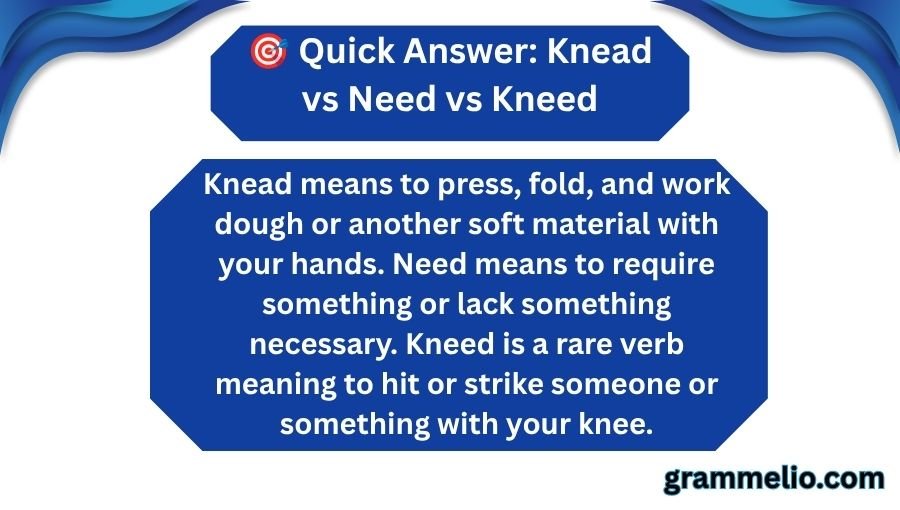
Knead means to press, fold, and work dough or another soft material with your hands. Need means to require something or lack something necessary. Kneed is a rare verb meaning to hit or strike someone or something with your knee.
A simple memory trick is:
- Knead → dough 🍞
- Need → require or must have
- Kneed → knee
The words knead, need, and kneed sound alike in standard English, but their meanings and uses are completely different.
🔤 Related Word Forms and Close Variants
The three words have different related forms. Knowing these forms makes it easier to recognize the correct spelling when the word changes tense or grammatical role.
| Form | Type | Example |
|---|---|---|
| knead | Verb | I knead the bread dough. |
| kneaded | Past tense | She kneaded the dough for ten minutes. |
| kneading | Present participle | He is kneading the dough. |
| need | Verb/Noun | I need some water. |
| needed | Past tense | We needed more time. |
| needing | Present participle | The plant is needing more care. |
| kneed | Past tense of kneed | He kneed the ball away. |
| knee | Noun | My knee hurts. |
| knees | Plural noun | Both knees were sore. |
Notice that kneed is already a past-tense form. Its base verb is knee when used as a verb. This is one reason learners may find it unusual.
📚 Understanding the Basics of Knead vs Need vs Kneed
The easiest way to understand these words is to focus on the action or idea behind each one.
Knead is connected to working something soft, especially bread dough.
Need is connected to necessity or requirement.
Kneed is connected to the knee and describes striking with the knee.
| Form | Type | Meaning | Example | Correct/Incorrect |
|---|---|---|---|---|
| knead | Verb | Work dough by pressing and folding it | I knead the dough before baking. | ✅ Correct |
| need | Verb/Noun | Require something or have a necessity | I need a new notebook. | ✅ Correct |
| kneed | Verb, past tense | Hit with the knee | The player kneed the ball. | ✅ Correct |
| need | Verb | Work dough | I need the dough for five minutes. | ❌ Incorrect |
| knead | Verb | Require something | I knead more time. | ❌ Incorrect |
| kneed | Verb | Require something | I kneed your help. | ❌ Incorrect |
The biggest mistake is choosing a word because it sounds right. Since all three words are pronounced alike, sound alone cannot help you.
🍞 What Does Knead Mean?
Knead means to work dough or another soft substance by pressing, folding, stretching, and pushing it with your hands.
You will most often see knead in cooking and baking.
Examples:
- I knead the dough until it becomes smooth.
- She kneaded the bread dough for several minutes.
- We are kneading the pizza dough now.
- The recipe says to knead the dough gently.
The word usually describes a physical action.
💡 Test Tip for Knead
If your sentence involves bread, dough, pizza, flour, or baking, check whether knead makes sense.
Try replacing the word with work the dough.
I need to knead the dough.
If you can say:
I need to work the dough.
then knead is probably the correct spelling.
| Meaning | Word Type | Example Sentence |
|---|---|---|
| Work bread dough | Verb | Knead the dough until smooth. |
| Work pizza dough | Verb | I kneaded the pizza dough. |
| Work a soft material | Verb | The baker kneaded the mixture by hand. |
🧠 What Does Need Mean?
Need means to require something because it is necessary, useful, or wanted.
It is by far the most common of the three words.
Examples include:
- I need some water.
- You need to finish your homework.
- We need more chairs.
- She needed help with the project.
- They need a larger room.
Unlike knead, this word is not mainly about cooking.
It can describe a basic requirement:
Plants need sunlight.
It can describe an action that must happen:
I need to call my doctor.
It can also be a noun:
There is a need for better communication.
🦵 What Does Kneed Mean?
Kneed is the past tense of the verb knee when knee is used to mean striking someone or something with the knee.
It is much less common than need or knead.
For example:
The player kneed the ball.
Here, kneed describes an action performed with the knee.
Another example is:
He kneed his opponent during the match.
Because this word is uncommon, many writers never need to use it. However, when you do need it, the spelling matters.
| Word | Main Idea | Typical Setting |
|---|---|---|
| knead | Work dough | Kitchen or bakery |
| need | Require something | Everyday life |
| kneed | Strike with the knee | Sports or physical action |
❓ Is Knead the Same as Need?
No. Knead and need are different words with different meanings, even though they sound alike. Understanding knead vs need vs kneed starts with matching each spelling to its specific meaning.
Use knead for working dough:
I knead the dough before baking.
Use need for something that is required:
I need some flour.
This distinction becomes easier when you picture the sentence.
If your hands are pressing dough, think knead.
If something is required, think need.
I once reviewed a short recipe written by a beginner who wrote, “You need the dough for five minutes.” The intended meaning was that the baker should work the dough. Once we changed need to knead, the instruction became clear.
❓ Is Kneed a Correct English Word?
Yes. Kneed is a real English word, but it is much less common than need and knead.
It is the past tense of knee when knee functions as a verb meaning to strike with the knee.
For example:
The athlete kneed the ball.
However, most everyday sentences involving the body part use knee as a noun:
My knee hurts.
You should not replace ordinary uses of knee with kneed.
| Sentence | Meaning |
|---|---|
| My knee hurts. | The body part is painful. |
| He kneed the ball. | He struck the ball with his knee. |
| She needs help. | Help is required. |
| She kneaded the dough. | She worked the dough. |
❓ How Can You Tell Which Word to Use?
Look at the meaning before you look at the spelling. Because these words are homophones, their sounds are not enough to identify them.
Ask yourself three questions:
- Am I working dough? → Use knead.
- Am I talking about something required? → Use need.
- Am I describing a strike with a knee? → Use kneed.
This simple three-question test works in most situations.
Correct vs Incorrect Examples
- ✅ Correct: I need more flour for the recipe.
- ❌ Incorrect: I knead more flour for the recipe.
- ✅ Correct: You should knead the dough for eight minutes.
- ❌ Incorrect: You should need the dough for eight minutes.
- ✅ Correct: The athlete kneed the ball toward the goal.
- ❌ Incorrect: The athlete need the ball toward the goal.
- ✅ Correct: I need to buy bread.
- ❌ Incorrect: I knead to buy bread.
- ✅ Correct: She kneaded the dough before putting it in the oven.
- ❌ Incorrect: She needed the dough before putting it in the oven.
📝 Case Study: A Small Spelling Error in a Recipe
Imagine that a home baker sends this message to a friend:
“Mix the flour and water, then need the dough for ten minutes.”
The friend might understand the intended meaning, but the sentence contains the wrong word.
The correct version is:
“Mix the flour and water, then knead the dough for ten minutes.”
Now imagine a different message:
“I knead some flour.”
That sentence would mean the writer is physically working flour, which is probably not the intended idea. If the writer means flour is required, the correct sentence is:
“I need some flour.”
The surrounding words often give you a strong clue. Words such as dough, bread, and pizza often point toward knead. Words such as must, require, and necessary often point toward need.
📏 Grammar Rules Explanation
The spelling difference comes from meaning, not pronunciation. Knead, need, and kneed are pronounced alike in standard English, but they belong to different word families and perform different jobs.
Knead is normally a verb. It describes the physical action of working dough or another soft material.
Need can be a verb or a noun. As a verb, it means to require something. As a noun, it refers to a necessity or requirement.
Kneed is the past-tense form of the verb knee. It describes striking something or someone with the knee.
Standard English reference works treat these as separate words. The key is to select the spelling that matches the meaning you want.
Correct vs Incorrect at a Glance
| Sentence | Correct/Incorrect | Why |
|---|---|---|
| I need a glass of water. | ✅ Correct | Water is required. |
| I knead the dough by hand. | ✅ Correct | Knead means to work dough. |
| He kneed the ball during the game. | ✅ Correct | Kneed describes striking with the knee. |
| I knead your help. | ❌ Incorrect | The intended word is need. |
| She needed the bread for five minutes. | ❌ Incorrect | The intended word is kneaded. |
⚠️ Why Do People Confuse Knead, Need, and Kneed?
People confuse these words mainly because they sound the same. English contains many groups of homophones, and this is one of them. The confusion in knead vs need vs kneed mainly comes from their identical sound.
Other common examples include:
| Confusing Words | Difference |
|---|---|
| its / it’s | Possession vs. “it is” or “it has” |
| your / you’re | Possession vs. “you are” |
| there / their / they’re | Place vs. possession vs. “they are” |
| to / too / two | Direction/infinitive vs. also vs. number |
| hear / here | Receive sound vs. location |
| knead / need / kneed | Work dough vs. require vs. strike with knee |
Three common causes make these errors more likely:
- Fast typing: You know what you mean, so your brain may ignore the spelling.
- Autocorrect: Software may choose a familiar word that sounds right.
- Lack of knowledge: A learner may know the pronunciation but not the separate meanings.
I once caught myself typing need in a sentence about bread while working quickly on a recipe note. The sentence looked normal at first because the pronunciation was identical. Reading the sentence for meaning, rather than sound, exposed the mistake immediately.
Common Wrong Spellings and Uses
| Wrong Form | What’s Wrong | Correct Form |
|---|---|---|
| need the dough | Uses the necessity word for a baking action | knead the dough |
| knead help | Uses the baking word instead of the requirement word | need help |
| kneed help | Uses the knee-related word incorrectly | need help |
| kneed the bread | Usually means “struck the bread with a knee” | knead the bread |
| needed the dough | Wrong tense and meaning for working dough | kneaded the dough |
| kneaded a new phone | Uses the dough verb instead of the requirement verb | needed a new phone |
🕰️ A Brief Look at the History of These Words
The three spellings did not develop as three versions of the same word. They are separate words that happen to sound alike.
The silent letters in knead and the k in knee are part of English spelling history. English has many words where older spellings remain even though modern pronunciation has changed.
The word need belongs to a different word family connected with necessity.
| Period | Form | General Note |
|---|---|---|
| Earlier English | Forms related to knee | The initial consonant was historically pronounced differently. |
| Earlier English | Forms related to need | The word expressed necessity or lack. |
| Later English | Knead | The spelling became associated with working dough. |
| Modern English | Knead / need / kneed | The words are spelled differently but can sound alike. |
The important lesson is that spelling can preserve clues from the history of English even when pronunciation changes.
🌎 Usage in Different Contexts
The correct choice depends on what you are trying to say. Knowing knead vs need vs kneed helps you choose the right spelling in different contexts.
| Context | Which Term to Use | Example |
|---|---|---|
| Everyday conversation | need | I need some coffee. |
| Professional writing | need | We need additional information. |
| Creative writing | knead or need | She began to knead the dough. |
| Social media/texting | need | I need this recipe! |
| Sports writing | kneed | The player kneed the ball. |
| Cooking instructions | knead | Knead the dough until smooth. |
| Personal needs | need | I need some rest. |
| Physical action | kneed | He kneed the object aside. |
Everyday Conversation
Need is by far the most likely word in ordinary conversation.
I need to leave soon.
Do you need anything?
You are unlikely to use knead unless you are discussing cooking or another hands-on process.
Professional Writing
In workplace writing, need is common:
We need your approval before Friday.
The team needs more information.
Knead may appear in professional food writing:
Knead the mixture until it forms a smooth ball.
Kneed is uncommon but may appear in sports reports or descriptions of physical action.
Creative Writing
Creative writers may use all three, depending on the scene.
She kneaded the dough while listening to music.
He knew he needed to leave.
The player kneed the ball across the field.
The context determines the spelling.
Social Media and Texting
Fast messages can make homophone mistakes more common.
I need this recipe!
I love kneading fresh bread dough.
A quick proofreading check can prevent an embarrassing spelling mistake.
💬 Common Phrases With Need
Need appears in many common English expressions. Knead also occurs in cooking phrases, while kneed is much less common in fixed expressions.
| Phrase | Meaning |
|---|---|
| need to | Have to or be required to |
| in need of | Requiring something |
| no need to | Something is unnecessary |
| as needed | When necessary |
| knead the dough | Work dough by hand |
| knead until smooth | Continue working dough until its texture changes |
Examples:
- You need to finish this today.
- The car is in need of repair.
- There is no need to worry.
- Take the medicine as needed.
- Knead the dough until smooth.
🔄 Synonyms and Alternatives
Sometimes you can replace one of these words with another word. However, a synonym may change the sentence slightly.
| Alternative | Works When | Does Not Work When |
|---|---|---|
| require | Something is necessary | Talking about physically working dough |
| must have | Something is essential | Describing the kneading action |
| work | Describing dough or a soft material | You specifically need the meaning of necessity |
| press and fold | Explaining the kneading action | You want a short general verb |
| strike with the knee | Explaining kneed | You are talking about needing something |
For example:
I need more time.
can become:
I require more time.
But:
I knead the dough.
cannot normally become:
I require the dough.
That changes the meaning completely.
❓ Why Does Getting the Spelling Right Matter?
Correct spelling makes your meaning clear. This matters most when two words sound exactly alike.
Imagine writing a recipe that says:
“Need the dough for five minutes.”
A reader may pause because need does not normally mean “work dough.”
Now imagine a business email that says:
“We knead your approval.”
The reader may understand the intended message, but the spelling looks careless.
A simple rule I use when editing is this:
When two words sound the same, check the meaning before checking the spelling.
That habit catches many homophone mistakes.
Why Accuracy Matters in Real Writing
| Situation | Why Getting It Right Matters |
|---|---|
| Resume | Shows care and writing skill |
| Client email | Prevents confusion and protects professionalism |
| Published content | Builds reader trust |
| Social post | Makes your message easier to understand |
Good writing is not only about sounding smart. It is about making your meaning easy to understand.
🧩 How to Remember the Difference
A visual memory trick can make these three words much easier.
Knead = Kitchen 🍞
Think of knead as the word with extra letters that belongs in the kitchen.
KNEAD → DOUGH
Picture your hands pressing and folding bread dough.
Need = Necessity 📌
Think:
NEED → REQUIRE
If something is necessary, use need.
I need more time.
Kneed = Knee 🦵
Think:
KNEED → KNEE
The word kneed contains the letters from knee plus d.
He kneed the ball.
This three-part memory system is simple:
Dough → knead.
Requirement → need.
Knee strike → kneed.
❓ Can Knead Be Used for Things Other Than Dough?
Yes. Knead can be used for working or pressing a soft substance with the hands, although dough is by far its most familiar use.
For example:
The baker kneaded the dough.
It can also be used when describing a similar pressing or working action with another soft material.
The exact meaning still involves a physical action. It does not mean “require.”
So:
I knead more time.
is incorrect if you mean “I require more time.”
The correct sentence is:
I need more time.
❓ Can Need Be a Noun and a Verb?
Yes. Need can function as both a noun and a verb.
As a verb:
I need help.
Here, need means require.
As a noun:
There is a need for help.
Here, need refers to a requirement or necessity.
This makes need much more flexible than knead and kneed.
| Use | Example | Meaning |
|---|---|---|
| Verb | I need water. | Water is required. |
| Verb | She needs help. | Help is required. |
| Noun | There is a need for help. | Help is necessary. |
| Noun phrase | Basic needs | Things necessary for life |
❓ Is “Kneed” Common in Everyday English?
No. Kneed is a valid word, but it is much less common than need.
You are most likely to encounter it in descriptions of sports, fighting, physical movement, or an action involving a knee.
For example:
The player kneed the ball.
If you are simply talking about the body part, use knee:
My knee hurts.
Do not write kneed unless you mean the action of striking with a knee.
❓ What Is the Easiest Way to Remember Knead vs Need vs Kneed?
Use the first meaningful association that comes to mind:
- Knead = dough
- Need = require
- Kneed = knee strike
You can also remember the spelling visually:
kneAD → think of making bread.
nEED → think of something you require.
kNEED → think of the word knee.
When you practice these associations, you no longer have to rely on pronunciation.
❓ Why Do Knead and Need Sound the Same?
They are homophones, which means they have the same pronunciation but different spellings and meanings.
English contains many homophones because spelling and pronunciation have developed separately over time.
This means you cannot decide between knead and need simply by saying the sentence aloud.
For example:
I need bread.
and
I knead bread.
sound alike when spoken, but they do not mean the same thing.
The first means bread is required. The second suggests that the speaker is physically working bread or dough.
❓ How Do You Use Knead in a Sentence?
Use knead when you describe pressing, folding, stretching, or working dough or another soft material.
Examples:
Knead the dough for five minutes.
She kneaded the dough until it became smooth.
I am kneading the pizza dough.
A useful sentence pattern is:
knead + object
For example:
knead the dough
knead the mixture
knead the bread dough
❓ How Do You Use Need in a Sentence?
Use need when something is required or necessary.
Common patterns include:
need + noun
I need water.
need + to + verb
I need to study.
need + object
We need more chairs.
need + noun phrase
The project needs more time.
These patterns are extremely common in everyday English.
❓ How Do You Use Kneed in a Sentence?
Use kneed when describing a past action in which someone or something was struck with a knee.
For example:
The athlete kneed the ball.
He kneed the opponent during the match.
The base verb is knee when it is used as a verb:
- Present: knee
- Past: kneed
- -ing form: kneeing
Because this verb is relatively uncommon, you should use it only when that specific meaning is intended.
🧪 Practice: Choose the Correct Word
Try filling in each blank before checking the answers.
- I ___ to buy some flour.
- You should ___ the dough carefully.
- The player ___ the ball.
- We ___ more time.
- She ___ the dough before baking it.
Answers
- need
- knead
- kneed
- need
- kneaded
The best way to learn homophones is to practice them in meaningful sentences rather than memorizing isolated spellings.
⚡ Quick Recap Checklist
This quick guide to knead vs need vs kneed can help you choose the correct word in seconds.
Use this checklist whenever you are unsure.
| Question | If Yes → Use |
|---|---|
| Am I working dough with my hands? | knead |
| Am I saying something is required? | need |
| Am I describing a past strike with a knee? | kneed |
| Am I talking about the body part itself? | knee |
| Am I talking about a requirement as a noun? | need |
Three Final Practice Examples
- I need more flour. → Something is required.
- I knead the flour mixture. → I am working the mixture.
- The player kneed the ball. → The player struck it with a knee.
If you can connect each spelling with its meaning, these words become much easier.
❓ What Is the Difference Between Knead, Need, and Kneed?
The difference is simple: knead means to work dough or another soft material, need means to require something, and kneed means to strike something or someone with the knee.
Their pronunciation may be the same, but their meanings are not.
❓ Which Word Should I Use for Bread Dough?
Use knead when you mean to work bread dough.
Correct:
Knead the dough until smooth.
Incorrect:
Need the dough until smooth.
If you are saying that bread is required, however, use need:
I need some bread.
The surrounding meaning tells you which word belongs there.
❓ Is “I Knead You” Correct English?
It can be grammatically correct, but the meaning is unusual.
“I knead you” would literally suggest that you physically work or press someone as if they were dough.
If you mean that someone is required or important to you, the intended sentence is:
I need you.
This can sometimes be used as a playful joke because knead and need sound alike.
❓ Is “I Need the Dough” Correct?
Yes, if you mean that you require the dough.
For example:
I need the dough for the recipe.
But if you mean that you are physically working the dough, use:
I knead the dough.
The difference comes entirely from meaning.
❓ Is “Kneed” the Past Tense of Knee?
Yes. When knee is used as a verb meaning to strike with the knee, its past tense is kneed.
For example:
He kneed the ball.
This is different from the noun knee:
His knee was sore.
The two forms are related, but they do different jobs in a sentence.
❓ What Is a Good Memory Trick for These Homophones?
Use three images:
🍞 Knead = bread dough
📌 Need = something required
🦵 Kneed = action with a knee
If you remember those three pictures, you can usually choose the correct spelling without hesitation.
❓ Are Knead, Need, and Kneed Homophones?
Yes. They can sound alike even though they have different spellings, meanings, and grammatical uses.
This is why listening alone will not tell you which spelling to write.
When you hear one of these words, mentally ask:
“What does the speaker mean?”
Then choose the spelling that matches that meaning. Once you understand knead vs need vs kneed, these homophones become much easier to use correctly.
🏁 Conclusion: Make These Three Words Easy
Knead vs need vs kneed becomes much easier once you stop focusing on sound and start focusing on meaning. 🍞 If you are working dough, choose knead. If something is required, choose need. If someone strikes something with a knee, choose kneed. 🦵
The most useful memory trick is short enough to remember anywhere: knead belongs with dough, need belongs with necessity, and kneed belongs with the knee.
I recommend reading your sentence once for meaning before checking its spelling. That small habit can prevent many homophone mistakes. It is especially helpful when writing quickly, using autocorrect, or working on professional content.
You do not need to memorize complicated rules. Just connect each spelling to its meaning. Once those connections become automatic, you will rarely confuse these three words again.
When the sounds match, let the meaning choose the spelling.

[…] memory tricks, common mistakes, and practical situations so you can use both words with confidence. Knead vs Need vs Kneed | Intense vs Intents | Instance vs […]