Have you ever typed a sentence and stopped because you could not remember whether you needed lessen vs lesson? I see this mix-up often, even in otherwise strong writing. The two words look and sound very similar, but they do very different jobs in a sentence. One describes making something smaller, weaker, or less intense.
The other refers to something you learn or a period of teaching. ✍️ I have found that once writers connect each word with its basic meaning, the difference becomes much easier to remember.
In this guide, I will walk you through lessen vs lesson with simple rules, clear examples, practical tests, common mistakes, and everyday situations. By the end, you should be able to choose the right word quickly and confidently. 😊 Lean vs Lien | Lead vs Led | Later vs Latter
🎯 Quick Answer: Lessen vs Lesson
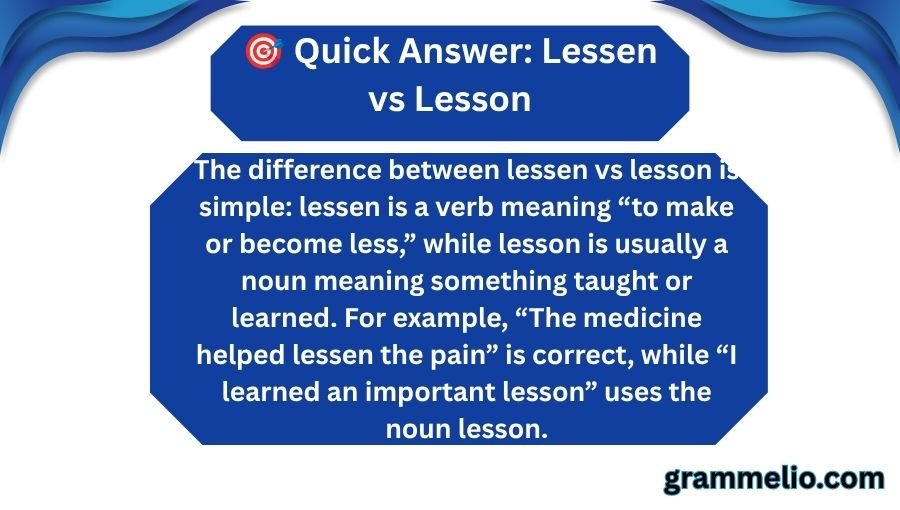
The difference between lessen vs lesson is simple: lessen is a verb meaning “to make or become less,” while lesson is usually a noun meaning something taught or learned. For example, “The medicine helped lessen the pain” is correct, while “I learned an important lesson” uses the noun lesson.
| Word | Part of Speech | Basic Meaning | Example |
|---|---|---|---|
| lessen | Verb | To make or become less | The rain began to lessen. |
| lesson | Noun | Something learned or taught | The teacher gave us a lesson. |
A quick memory trick is this:
- Lessen = less → something becomes smaller or weaker.
- Lesson = learn → something you learn or study.
That one connection solves most cases of lessen vs lesson.
Related Word Forms and Useful Variations
The two words have different forms because they belong to different parts of speech. Lessen is a verb, so it can change with tense. Lesson is mainly a noun, although it can also be used as a verb in less common situations.
| Form | Type | Example |
|---|---|---|
| lessen | Base verb | Exercise may lessen stress. |
| lessens | Present-tense verb | The noise lessens at night. |
| lessened | Past-tense verb | The pain lessened quickly. |
| lessening | Present participle | The lessening pressure helped. |
| lesson | Noun | The lesson was useful. |
| lessons | Plural noun | We have three lessons today. |
| lessoned | Verb, uncommon | The experience lessoned his pride. |
In normal writing, you will use lessen and lesson far more often than the less common verb forms of lesson.
📚 Understanding the Basics of Lessen vs Lesson
The easiest way to understand lessen vs lesson is to ask what the word is doing in the sentence. Lessen describes a reduction. Lesson normally names something that is taught, learned, or learned from experience.
| Form | Type | Meaning | Example | Correct/Incorrect |
|---|---|---|---|---|
| lessen | Verb | Reduce in amount or intensity | The medicine may lessen the pain. | ✅ Correct |
| lesson | Noun | A period or unit of teaching | The math lesson starts at nine. | ✅ Correct |
| lessen | Verb | Reduce something | The wind began to lessen. | ✅ Correct |
| lesson | Noun | Something learned | She learned a valuable lesson. | ✅ Correct |
| lesson | Noun | Reduce pain or noise | The treatment lesson the pain. | ❌ Incorrect |
The key point is that lessen is connected to the idea of less.
If something becomes less painful, less severe, less intense, or less noticeable, lessen is usually the word you need.
A lesson, however, is something you receive from a teacher, study in school, or learn from an experience.
Lessen: Meaning and Correct Use
Lessen means to make something less or to become less.
It can describe a decrease in:
- pain
- noise
- stress
- fear
- pressure
- damage
- intensity
- concern
- severity
- impact
For example:
The medicine helped lessen my headache.
Here, lessen is a verb. It tells us what the medicine did. The headache became less severe.
Another example is:
The curtains helped lessen the bright sunlight.
The curtains reduced the amount or effect of the sunlight.
Lesson: Meaning and Correct Use
Lesson usually means something taught or learned. It can refer to a class, a teaching session, or an idea learned from experience.
For example:
I have a driving lesson this afternoon.
Here, lesson means a period of instruction.
It can also mean something learned through an event:
The mistake taught me a valuable lesson.
In this sentence, the lesson is not a school class. It is an important idea learned from experience.
| Meaning | Word Type | Example Sentence |
|---|---|---|
| Make something less | Verb | Rest may lessen the pain. |
| Become less | Verb | The storm began to lessen. |
| A teaching session | Noun | My English lesson starts soon. |
| Something learned | Noun | Failure taught him a lesson. |
💡 Test Tip for Choosing the Right Word
Try replacing the word with reduce.
If reduce works, you probably need lessen.
Rest can lessen the pain.
Rest can reduce the pain.
Both make sense. ✅
Now try replacing the word with class or something learned.
The teacher gave us a lesson.
The teacher gave us a class.
That works in context. So lesson is correct. ✅
| Question to Ask | If the Answer Is Yes | Use |
|---|---|---|
| Does the word mean reduce? | Yes | lessen |
| Does it describe becoming weaker? | Yes | lessen |
| Does it mean a teaching session? | Yes | lesson |
| Does it mean something learned? | Yes | lesson |
| Is it an action that reduces something? | Yes | lessen |
Is Lessen the Same as Lesson?
No. Lessen and lesson are different words with different meanings and grammatical roles.
Lessen is a verb. It describes an action or change involving reduction.
Lesson is usually a noun. It identifies a class, teaching unit, or idea learned from experience.
Compare these sentences:
The treatment may lessen the pain. ✅
The treatment may lesson the pain. ❌
The first sentence says the treatment may reduce the pain. The second uses lesson, which does not have that meaning in ordinary modern English.
Now compare:
I learned an important lesson. ✅
I learned an important lessen. ❌
Here, lesson is the thing that was learned.
Why Do People Confuse Lessen and Lesson?
People confuse lessen vs lesson because the words are very close in spelling and pronunciation. Both begin with “less,” and both can appear in simple everyday sentences.
I once reviewed a short school assignment in which a student wrote, “This experience taught me a valuable lessen.” The student clearly understood the meaning but had chosen the wrong spelling. I asked the student to think of the word less. Once the student made that connection, the correction was immediate.
Another reason is fast writing. When we type quickly, our brains often focus on meaning instead of spelling. Autocorrect can also make the problem worse if the wrong word happens to look like a valid English word.
| Confusion | Why It Happens | Better Habit |
|---|---|---|
| lessen vs lesson | Similar spelling | Check the meaning |
| your vs you’re | Similar sound | Expand the contraction |
| its vs it’s | Similar appearance | Check possession vs “it is” |
| affect vs effect | Related meanings | Identify the grammar role |
| then vs than | Similar sound | Check comparison or time |
The good news is that lessen vs lesson is easy to separate once you focus on function rather than spelling.
📝 Case Study: Lessen vs Lesson at Work
Imagine that an employee is writing an email to a manager after a difficult project.
The employee writes:
“The new process should lesson the amount of stress on the team.”
That sentence contains a spelling mistake. The employee means that the process will reduce stress.
The corrected version is:
“The new process should lessen the amount of stress on the team.” ✅
Now imagine the employee is writing about what the project taught the team:
“The project taught us an important lesson about planning.” ✅
These two sentences use both words correctly, but their jobs are completely different.
| Workplace Sentence | Correct Word | Reason |
|---|---|---|
| The change should ___ the workload. | lessen | It means reduce. |
| We learned a valuable ___. | lesson | It means something learned. |
| The training ___ employee confusion. | lessen | It means reduce. |
| The training included a safety ___. | lesson | It means teaching content. |
| The delay did not ___ our concerns. | lessen | It means make less. |
This is why understanding meaning is more useful than simply memorizing spelling.
🧠 Grammar Rules Explanation for Lessen vs Lesson
The main grammar rule is based on the role of each word.
Lessen functions as a verb. A verb tells us about an action, process, or change. When something lessens, it becomes smaller or weaker. When something lessens another thing, it reduces that thing.
Examples include:
- The medicine lessened the pain.
- The noise lessened after midnight.
- Exercise can lessen stress.
- The wind is lessening.
Lesson usually functions as a noun. A noun names a person, place, thing, or idea. A lesson can be a teaching session or an idea gained from experience.
Examples include:
- The lesson was difficult.
- We studied a history lesson.
- She learned a lesson from the mistake.
- The teacher prepared a new lesson.
Standard English references agree on this basic distinction. The safest approach is to focus on meaning and grammatical role rather than trying to remember the words by appearance alone.
Correct vs Incorrect at a Glance
| Sentence | Correct/Incorrect | Why |
|---|---|---|
| The medicine helped lessen the pain. | ✅ Correct | Lessen means reduce. |
| The medicine helped lesson the pain. | ❌ Incorrect | Lesson does not normally mean reduce. |
| She learned a valuable lesson. | ✅ Correct | A lesson can be something learned. |
| She learned a valuable lessen. | ❌ Incorrect | Lessen is not the noun needed here. |
| The storm began to lessen. | ✅ Correct | The storm became weaker. |
⚠️ Common Mistakes With Lessen and Lesson
The most common mistake is choosing the word that looks right instead of the word that has the right meaning.
Three problems often cause this:
- Fast typing: You know what you mean but type the wrong spelling.
- Autocorrect: Your device may not flag the error because both words are real English words.
- Lack of knowledge: You may not know that the two words have different grammatical jobs.
I once caught myself typing lesson when I meant lessen while editing a sentence about reducing risk. Because both words looked familiar, I had to stop and check the meaning. That small pause is often all it takes.
| Common Mistake | Example | Better Choice |
|---|---|---|
| Using lesson for “reduce” | Lesson the pressure | Lessen the pressure |
| Using lessen for “something learned” | A valuable lessen | A valuable lesson |
| Choosing by sound | The pain will lesson | The pain will lessen |
| Relying only on autocorrect | Autocorrect misses the mistake | Check the meaning |
| Writing too quickly | A lesson in stress reduction | A lesson about stress reduction |
Specific Wrong Forms to Avoid
| Wrong Form | What’s Wrong | Correct Form |
|---|---|---|
| lesson the pain | Lesson is not the normal verb for reduce | lessen the pain |
| a valuable lessen | Lessen is not the normal noun here | a valuable lesson |
| lessen from the teacher | The meaning is a teaching session | lesson from the teacher |
| a driving lessen | The noun is needed | a driving lesson |
| the noise will lesson | The verb should mean decrease | the noise will lessen |
What Are the Most Common Uses of Lessen?
Lessen is commonly used when something becomes lower in amount, strength, effect, or intensity.
You might use it with physical discomfort:
The ice pack helped lessen the swelling.
You can also use it with emotions:
Talking to a friend helped lessen my worry.
It works with problems and effects too:
Better planning can lessen the risk of mistakes.
The word does not have to describe something physical. It can describe almost any effect that becomes smaller or weaker.
| Object | Example With Lessen |
|---|---|
| Pain | The medicine lessened the pain. |
| Stress | A break can lessen stress. |
| Noise | The wall lessened the noise. |
| Fear | Her explanation lessened my fear. |
| Risk | Planning can lessen the risk. |
| Impact | The change may lessen the impact. |
What Are the Most Common Uses of Lesson?
Lesson commonly refers to something taught, a period of instruction, or something learned from experience.
You can have:
- a math lesson
- a driving lesson
- a piano lesson
- a history lesson
- a grammar lesson
- a safety lesson
You can also learn a lesson from an event.
For example:
Missing the deadline taught me a lesson about planning.
In this case, the lesson is an idea gained from experience.
| Type of Lesson | Example |
|---|---|
| School lesson | We studied a science lesson. |
| Language lesson | Today’s English lesson was easy. |
| Music lesson | She has a piano lesson. |
| Driving lesson | My driving lesson starts at noon. |
| Life lesson | The mistake taught him a life lesson. |
| Safety lesson | The instructor gave us a safety lesson. |
How Should You Use Lessen vs Lesson in Different Contexts?
The correct word depends on what you are trying to say. Use lessen for reduction and lesson for teaching or learning.
| Context | Which Term to Use | Example |
|---|---|---|
| Everyday conversation | lessen | A short walk may lessen my stress. |
| Professional writing | lessen | The policy could lessen costs. |
| Creative writing | Either, depending on meaning | The fear began to lessen. |
| Social media/texting | Either, depending on meaning | Learned a big lesson today! |
Everyday Conversation
In casual speech, lessen often describes pain, stress, worry, or noise.
Can you turn that down to lessen the noise?
Lesson appears when talking about classes or personal experiences.
I learned my lesson.
Professional Writing
Professional writing often uses lessen when discussing costs, risks, delays, or negative effects.
The new system should lessen processing time.
Lesson may appear when discussing training or business learning.
The workshop included a lesson on workplace safety.
Creative Writing
Writers may use lessen to describe changing emotions or atmosphere:
As morning arrived, her fear began to lessen.
They may use lesson when a character learns something:
That night became a lesson she would never forget.
Social Media and Texting
Both words can appear in casual digital writing.
Learned my lesson today. 😅
Hopefully, this will lessen the stress.
The same meaning rule still applies, even in informal writing.
🔎 Common Phrases With Lesson
Lesson appears in several common phrases and expressions. These phrases can help you recognize the word quickly.
| Phrase | Meaning |
|---|---|
| learn a lesson | Gain knowledge from an experience |
| teach someone a lesson | Cause someone to learn something |
| learn your lesson | Understand the result of a mistake |
| valuable lesson | An important idea learned |
| life lesson | Something important learned through life |
| object lesson | An example that teaches an idea |
These expressions almost always point toward lesson, not lessen.
For example:
I learned my lesson. ✅
The word names something learned.
By contrast:
I learned my lessen. ❌
That spelling changes the sentence into an error.
Are There Synonyms for Lessen and Lesson?
Yes. Looking at synonyms can help you understand the difference because each word belongs to a different meaning group.
For lessen, possible alternatives include reduce, decrease, lower, ease, and diminish.
For lesson, alternatives may include class, instruction, teaching, learning, or moral, depending on context.
| Alternative | Works When | Does Not Work When |
|---|---|---|
| reduce | Something becomes smaller | You mean a class |
| decrease | Amount or level goes down | You mean something learned |
| ease | Pain or discomfort becomes less | You mean a school lesson |
| class | Referring to teaching | You mean reduction |
| instruction | Referring to teaching | You mean reduced intensity |
A useful test is to replace the word with one of these alternatives.
If reduce fits, choose lessen.
If class or something learned fits, choose lesson.
💼 Why Getting Lessen vs Lesson Right Matters
Correct spelling makes your writing easier to understand. It also shows that you understand how words work.
A reader may understand “lesson the pain” from context, but the sentence still looks incorrect. In professional writing, small mistakes can affect how polished your work appears.
| Situation | Why Getting It Right Matters |
|---|---|
| Resume | Shows attention to detail |
| Client email | Builds professional trust |
| Published content | Improves credibility |
| Social post | Makes your message clearer |
Here is a simple principle I use when editing:
Clear words create clear messages.
The goal is not to use complicated language. The goal is to choose the exact word that expresses your meaning.
How Can You Remember the Difference?
The easiest memory trick for lessen vs lesson is to connect each word to a short clue.
Remember “lessen” with “less”
Lessen contains the word idea less.
lessen = make less
So:
lessen the pain
lessen the noise
lessen the risk
lessen the pressure
Remember “lesson” with “learn”
Think:
lesson = learn
A lesson is something you learn or something designed to teach you.
English lesson
driving lesson
valuable lesson
life lesson
| Memory Clue | Word | Example |
|---|---|---|
| Less | lessen | Lessen the noise. |
| Learn | lesson | Learn a lesson. |
| Reduce | lessen | Lessen the risk. |
| Teaching | lesson | Take a lesson. |
| Become weaker | lessen | The pain lessened. |
| Something learned | lesson | That was a lesson. |
❓ Can Lessen Be Used as a Noun?
In ordinary modern English, lessen is normally used as a verb, not as the noun meaning a teaching session or something learned.
For example:
The medicine may lessen the pain. ✅
Here, lessen is a verb.
Do not write:
I attended a driving lessen. ❌
Use:
I attended a driving lesson. ✅
The noun you need is lesson.
❓ Can Lesson Be Used as a Verb?
Yes, lesson can appear as a verb in some contexts, but this use is uncommon and is not the meaning most writers need when they are trying to say “reduce.”
For everyday modern writing, if you mean make less, choose lessen.
If you mean a class or something learned, choose lesson.
This distinction keeps your writing natural and clear.
❓ Which Is Correct: Lessen the Pain or Lesson the Pain?
Lessen the pain is correct when you mean “reduce the pain.”
This medicine may lessen the pain. ✅
Lesson the pain is incorrect in standard everyday usage because lesson does not normally mean “reduce.”
The same pattern works with many other nouns:
- lessen the pressure
- lessen the risk
- lessen the stress
- lessen the damage
- lessen the impact
❓ Which Is Correct: A Valuable Lesson or A Valuable Lessen?
A valuable lesson is correct.
A lesson can be an important idea that you learn from an experience.
The mistake taught me a valuable lesson. ✅
A valuable lessen is incorrect for this meaning.
The easiest way to remember it is:
You learn a lesson, but you lessen a problem.
❓ Is Lessen a Verb or a Noun?
Lessen is a verb. It means to make something less or to become less.
Examples:
The noise lessened.
The treatment lessened her discomfort.
The word can take different verb forms:
lessen
lessens
lessened
lessening
Lesson, by contrast, is usually a noun.
❓ Is Lesson a Verb or a Noun?
Lesson is usually a noun. It can mean a teaching session or something learned from experience.
Examples:
The lesson begins at ten.
That mistake taught me a lesson.
Although lesson can have a less common verb use, ordinary writers should not use it as a replacement for lessen when they mean “reduce.”
❓ How Do I Remember Lessen vs Lesson?
Use the simple pair:
Lessen = less.
Lesson = learn.
If you can replace the word with reduce, use lessen.
If you can replace it with class or something learned, use lesson.
| If You Mean… | Choose |
|---|---|
| reduce | lessen |
| decrease | lessen |
| make weaker | lessen |
| a class | lesson |
| teaching | lesson |
| something learned | lesson |
❓ Why Does Autocorrect Not Always Catch This Mistake?
Autocorrect often checks whether a word is spelled like a real word. It may not understand what you intended to say.
Both lessen and lesson are real English words. Therefore, a sentence containing the wrong one may not trigger a spelling warning.
For example:
The medicine should lesson the pain.
A spell checker may accept lesson because it is a correctly spelled word. The problem is meaning, not basic spelling.
That is why proofreading still matters.
❓ What Is the Difference Between Lessen and Lesson in a Sentence?
Lessen acts as a verb and expresses reduction. Lesson usually acts as a noun and identifies teaching or something learned.
Compare:
The new plan may lessen the risk. ✅
The new plan taught us a lesson. ✅
The first sentence describes an action. The second names an idea learned from experience.
❓ What Is a Simple Trick for Lessen vs Lesson?
Think about two words:
LESSEN → LESS
LESSON → LEARN
This is one of the fastest ways to remember the distinction.
If something becomes less, it can lessen.
If something helps you learn, it can be a lesson.
❓ Can I Say “Learn My Lessen”?
No. The standard expression is “learn my lesson.”
I made the same mistake twice, so I finally learned my lesson. ✅
I made the same mistake twice, so I finally learned my lessen. ❌
The noun lesson is used in this fixed expression.
❓ Can I Say “Lessen My Mistake”?
Usually, no. Lessen means reduce something, so it needs a meaning that can become smaller or weaker.
You can say:
lessen the impact of my mistake
or:
lessen the damage caused by my mistake
But saying:
lessen my mistake
is usually unclear because the mistake itself is not normally described as something being reduced.
❓ How Can Students Avoid This Spelling Mistake?
Students can avoid the error by learning the meaning rather than memorizing spelling alone.
Use this three-step check:
- Ask what you mean.
- Replace the word with “reduce” or “learn.”
- Choose the matching word.
For example:
The medicine will ___ the pain.
“Reduce” works, so use lessen.
I learned an important ___.
“Something learned” works, so use lesson.
❓ Is Lessen vs Lesson a Common Grammar Mistake?
Yes, it is a common word-choice and spelling confusion because the words are visually and phonetically similar. The problem is easy to fix once you understand their roles.
The mistake is not usually caused by complex grammar. It is mainly caused by choosing a familiar-looking word without checking its meaning.
✅ Quick Recap Checklist
Use this checklist whenever you are unsure.
| Question | If Yes → Use |
|---|---|
| Do you mean “reduce”? | lessen |
| Do you mean “make weaker”? | lessen |
| Do you mean “decrease”? | lessen |
| Do you mean “a class”? | lesson |
| Do you mean “something learned”? | lesson |
| Do you mean “teaching”? | lesson |
| Can you replace it with “less”? | lessen |
| Can you connect it with “learn”? | lesson |
Practice Examples
1. The new treatment may ___ the pain.
Answer: lessen ✅
2. The mistake taught me an important ___.
Answer: lesson ✅
3. My piano ___ starts at six.
Answer: lesson ✅
4. Better planning can ___ the risk.
Answer: lessen ✅
5. The storm began to ___.
Answer: lessen ✅
Final Comparison: Lessen vs Lesson
Before you finish, here is the entire rule in one table.
| Feature | Lessen | Lesson |
|---|---|---|
| Main role | Verb | Usually noun |
| Main idea | Reduce | Teach or learn |
| Memory word | Less | Learn |
| Common use | Lessen pain | Learn a lesson |
| Example | The pain began to lessen. | I learned a lesson. |
| Can describe a class? | No | Yes |
| Can mean reduce? | Yes | No, not in normal usage |
| Common phrase | lessen the impact | valuable lesson |
FAQs About Lessen vs Lesson
What is the main difference between lessen and lesson?
Lessen is a verb meaning to make something less or to become less. Lesson is usually a noun meaning a teaching session or something learned.
Is “lessen the pain” correct?
Yes. Lessen the pain is correct because the sentence means “reduce the pain.”
Is “lesson the pain” correct?
No. In normal modern English, use lessen when you mean “reduce.”
Is “learn a valuable lesson” correct?
Yes. Lesson is the correct noun because it means something learned from an experience.
Is lessen always a verb?
In standard everyday use, lessen functions as a verb. It describes reducing something or becoming less.
Is lesson always a noun?
No. Lesson can have a less common verb use, but it is most commonly a noun. When you mean “reduce,” use lessen.
How do I remember the difference between lessen and lesson?
Think lessen = less and lesson = learn. If something becomes less, it can lessen. If you learn something, it can be a lesson.
Which word is correct in “I learned my ___”?
The correct word is lesson:
I learned my lesson. ✅
Which word is correct in “The medicine will ___ the pain”?
The correct word is lessen:
The medicine will lessen the pain. ✅
Why does spell-check miss lessen and lesson errors?
Because both words are correctly spelled English words. A spell checker may not understand that you chose the wrong word for the sentence’s meaning.
Conclusion
Lessen vs lesson becomes much easier when you connect each word to its core idea. Lessen means to reduce something or to become less. Lesson usually means a class, something taught, or something learned from experience. The fastest memory trick is simple: think less when you see lessen, and think learn when you see lesson. 🎯
I recommend using the replacement test whenever you are unsure. If reduce fits, choose lessen. If class, teaching, or something learned fits, choose lesson. This quick check works in school assignments, workplace emails, social media posts, and everyday messages. ✨
You do not need to memorize a complicated grammar rule. Just ask what you are trying to say. Are you describing something becoming smaller or weaker? Use lessen. Are you talking about something taught or learned? Use lesson.
Once that meaning-based habit becomes automatic, this confusing pair becomes easy. Remember: less means lessen, and learn leads to lesson.

[…] and how to remember the difference without having to stop and think every time you write. Lessen vs Lesson | Lean vs Lien | Lead vs […]
[…] situations. By the end, you should feel confident choosing the right word. Levee vs Levy | Lessen vs Lesson | Lean vs […]
[…] I want to make this comparison easy. Once you learn what each word means and see it in real sentences, you will have a simple way to choose the right spelling every time. Liable vs Libel | Levee vs Levy | Lessen vs Lesson […]