I have seen smart writers pause over meat vs meet vs mete because these three words sound almost the same, yet their meanings are completely different. If you are a student, teacher, content writer, professional, or simply someone who wants cleaner English, this is an easy mistake to make. 📝
The good news is that you do not need to memorize a complicated grammar rule. You only need to connect each word with its meaning. Meat is food that comes from animals. Meet usually means to come together, encounter someone, or satisfy a need.
Mete is a much less common verb that means to give or measure out something, often as a punishment. Once you see these meanings side by side, the difference becomes much easier to remember. Let’s break it down in simple US English. 😊 Marshal vs Martial | Marital vs Martial | Manner vs Manor
🎯 Quick Answer: What Is the Difference Between Meat vs Meet vs Mete?
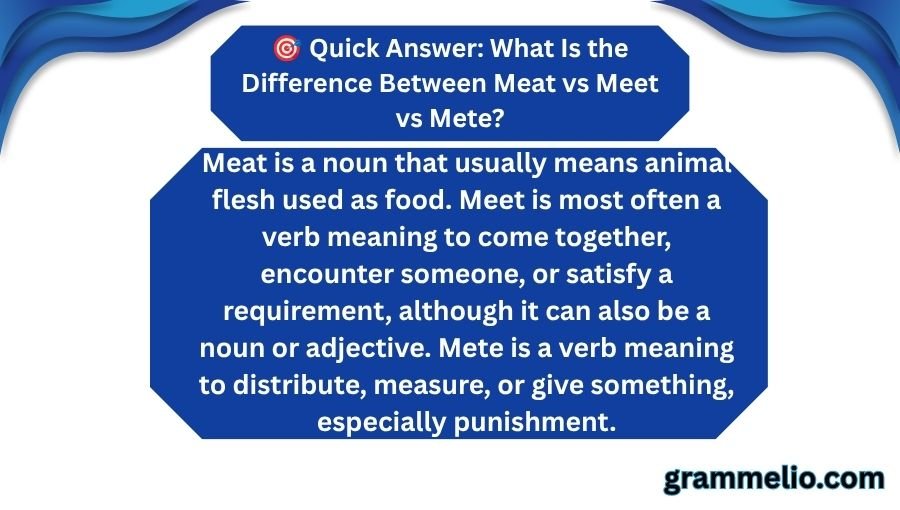
Meat is a noun that usually means animal flesh used as food. Meet is most often a verb meaning to come together, encounter someone, or satisfy a requirement, although it can also be a noun or adjective. Mete is a verb meaning to distribute, measure, or give something, especially punishment.
A quick memory trick is:
- Meat → food 🍖
- Meet → come together 🤝
- Mete → give or measure out
The words meat, meet, and mete are homophones or near-homophones in many varieties of English, so context tells you which spelling is correct.
Meat vs Meet vs Mete: Understanding the Basics
The easiest way to understand meat vs meet vs mete is to focus on what each word does in a sentence. Their spellings differ because their meanings differ.
| Form | Type | Meaning | Example | Correct/Incorrect |
|---|---|---|---|---|
| Meat | Noun | Animal flesh used as food | We bought fresh meat. | ✅ Correct |
| Meet | Verb/Noun/Adjective | Come together, encounter, or satisfy | I will meet you tomorrow. | ✅ Correct |
| Mete | Verb | Give, distribute, or measure out | The judge may mete out a penalty. | ✅ Correct |
| Meet | Noun in a sports context | An organized competition | She entered a track meet. | ✅ Correct |
| Mete | Noun | Not standard modern use in this sense | We bought mete for dinner. | ❌ Incorrect |
Meat Means Food
Meat is usually a noun. It refers to animal flesh that people eat.
For example:
- We cooked meat for dinner.
- The restaurant serves grilled meat.
- She does not eat meat.
- The butcher sells fresh meat.
The key idea is food. Think of beef, pork, lamb, chicken, or other animal flesh prepared for eating.
Meet Means Come Together
Meet is commonly used as a verb. It means to come together with another person or group.
For example:
- I will meet my friend after work.
- We need to meet at noon.
- Did you meet your new teacher?
- They plan to meet tomorrow.
It can also mean to encounter someone for the first time.
I met Sarah at the conference.
Notice that met is the past tense of meet.
Meet Can Also Mean Satisfy
Another common meaning of meet is to satisfy a need, rule, standard, or requirement.
For example:
- The product must meet safety standards.
- She worked hard to meet the deadline.
- This job does not meet my expectations.
- The building must meet local rules.
This meaning is especially common in school, business, law, and professional writing.
Mete Means Give or Measure Out
Mete is much less common than meat and meet. It is mainly used as a verb.
It means to give, distribute, or measure out something. It often appears in the phrase mete out, especially when talking about punishment or justice.
For example:
The court may mete out a severe punishment.
Here, mete out means to administer or give a punishment.
💡 Test Tip: Replace the Word With a Simple Idea
When I am checking a sentence, I use a fast mental test:
- Can I replace the word with food? → Use meat.
- Can I replace it with come together or satisfy? → Use meet.
- Can I replace it with give out or administer? → Use mete.
| Meaning | Correct Word | Easy Replacement |
|---|---|---|
| Animal food | Meat | Food |
| Come together | Meet | Gather |
| Encounter someone | Meet | See |
| Satisfy a requirement | Meet | Fulfill |
| Give out punishment | Mete | Administer |
| Measure or distribute | Mete | Give out |
Why Do People Confuse Meat, Meet, and Mete?
People confuse these words mainly because they sound alike. When we hear a word, we do not see its spelling. We have to use context to choose the right form.
I once caught myself typing “meet” when I meant “meat” in a grocery list. I was writing quickly and did not notice the error until I reread the list. The meaning was obvious from the surrounding items, but the spelling was still wrong.
Other factors make the problem worse:
- Fast typing can cause spelling errors.
- Autocorrect may choose the wrong word.
- Voice-to-text tools may not know which meaning you intend.
- Students may learn the sound before they learn the spelling.
- People may rarely encounter the word mete.
- Social media encourages quick, informal writing.
The three words are a classic example of why sound alone is not enough. Good writers also check meaning and context.
Is Meat the Same as Meet?
No. Meat and meet have different meanings and usually have different grammatical roles.
Meat normally refers to food. Meet normally refers to coming together, encountering someone, or satisfying a requirement.
Compare:
- I bought meat at the store. ✅
- I will meet you at the store. ✅
The first sentence is about food. The second is about people coming together.
| Sentence | Correct/Incorrect | Why |
|---|---|---|
| We need to buy more meat. | ✅ Correct | The sentence refers to food. |
| We need to buy more meet. | ❌ Incorrect | “Meet” does not mean animal food. |
| I will meet you at six. | ✅ Correct | “Meet” means come together. |
| I will meat you at six. | ❌ Incorrect | “Meat” is not the verb for gathering. |
| The company must meet the deadline. | ✅ Correct | “Meet” means satisfy a requirement. |
Is Mete a Common Word?
No. Mete is much less common in everyday English than meat or meet.
You are most likely to see it in formal writing, literature, legal language, or the fixed phrase mete out. If you are reading a sentence about someone receiving punishment, justice, or a consequence, mete out may be the expression you need.
For example:
The official had the power to mete out punishment.
In simple modern English, you could often replace mete out with “give,” “administer,” or “impose,” depending on the sentence.
| Expression | Meaning | Example |
|---|---|---|
| Mete out punishment | Give punishment | The court may mete out punishment. |
| Mete out justice | Administer justice | The system should mete out justice fairly. |
| Meet a deadline | Complete something on time | We must meet the deadline. |
| Meet a need | Satisfy a need | The service meets a real need. |
| Buy meat | Purchase animal food | We bought meat for dinner. |
Meat vs Meet vs Mete in Everyday English
In daily conversation, meat and meet are very common. Mete is far less likely to appear.
If you are talking about dinner, shopping, cooking, or food, choose meat.
If you are talking about people, plans, appointments, deadlines, standards, or needs, choose meet.
If you are talking about administering punishment or distributing something, mete may be appropriate.
| Context | Which Term to Use | Example |
|---|---|---|
| Everyday conversation | Meat | We need some meat for dinner. |
| Meeting a friend | Meet | I will meet Jake later. |
| Professional writing | Meet | The report must meet the requirements. |
| Creative writing | Mete | The king would mete out punishment. |
| Social media/texting | Meat or meet | I bought meat. / Let’s meet soon. |
How Does Meet Work in Different Sentences?
The word meet has several useful meanings, which is one reason learners may find it confusing.
Meeting a Person
I will meet my sister after school.
Here, meet means to come together.
Meeting a Standard
This application meets all the requirements.
Here, meets means satisfies.
Meeting a Deadline
We need to meet the deadline.
Here, meet means finish or achieve something by the required time.
Meeting a Need
The program helps meet the needs of local families.
Here, meet means satisfy or provide what is needed.
A Sports Meet
Meet can also be a noun.
The athletes are preparing for a track meet.
In this sentence, a meet is an organized sports competition.
That gives us another reason not to think of meet as only a verb.
What Are the Correct Uses of Meat?
The word meat is mainly a noun.
It can describe animal flesh used as food, but it can also appear in broader expressions.
For example:
- meat market
- meat dish
- meat counter
- meat product
- meat substitute
It can also be used in a figurative way. When people say something is the “meat” of a discussion, they mean the main or most important part.
The second half of the report contains the meat of the argument.
This figurative use has nothing to do with dinner. Context again gives us the meaning.
| Meaning | Word Type | Example Sentence |
|---|---|---|
| Animal food | Noun | The meat is ready to cook. |
| Main part | Noun | This section contains the meat of the argument. |
| Food product | Noun | The store sells several meat products. |
How Is Mete Used in Formal English?
Mete is generally found in the expression mete out.
The phrase means to give or administer something, especially punishment or justice.
Examples include:
The court will mete out a fair penalty.
The ruler was known to mete out harsh punishment.
The system should mete out justice fairly.
The word can sound formal or old-fashioned in casual conversation. In many everyday situations, “give,” “impose,” or “administer” may sound more natural.
A Useful Grammar Point
The phrase is mete out, not “meat out” or “meet out” when the intended meaning is to administer something.
That distinction matters because the words sound alike.
📝 Case Study: A Workplace Email
Imagine a manager writing this email:
Please meet with me at 2 p.m. so we can discuss the new deadline.
That is correct because the manager wants two people to come together.
Now imagine an employee writing:
We need to meet the project requirements before Friday.
That is also correct because meet means satisfy.
But consider this grocery message:
Please buy some meat for dinner.
Here, meat is correct because the writer means food.
Finally, consider a formal report:
The agency may mete out penalties for repeated violations.
That sentence uses mete correctly because the agency may administer penalties.
I once edited a short workplace notice where “meet the deadline” had been typed as “meat the deadline.” The mistake looked small, but it changed a professional sentence into something unintentionally funny. That is exactly why a quick proofreading pass matters.
Grammar Rules Explanation for Meat vs Meet vs Mete
The main grammar rule is simple: choose the spelling based on meaning and grammatical function.
Meat is generally a noun.
Meet can be a verb, noun, or adjective depending on the sentence.
Mete is primarily a verb and is often used with out.
Standard English references agree on these basic distinctions. You do not need a complicated rule to apply them.
Correct vs Incorrect at a Glance
| Sentence | Correct/Incorrect | Why |
|---|---|---|
| I will meet you after lunch. | ✅ Correct | “Meet” means come together. |
| I will meat you after lunch. | ❌ Incorrect | “Meat” means food, not gathering. |
| We cooked meat for dinner. | ✅ Correct | “Meat” refers to food. |
| We cooked meet for dinner. | ❌ Incorrect | “Meet” does not mean food. |
| The court may mete out a penalty. | ✅ Correct | “Mete out” means administer or give. |
⚠️ Common Mistakes With These Three Words
These mistakes happen because English spelling does not always match pronunciation.
A person may know exactly what they want to say but still choose the wrong spelling. This is especially common when typing quickly.
Three Common Causes
Fast typing: Your fingers may choose the first spelling that comes to mind.
Autocorrect: A device may replace an intended word with another correctly spelled word that does not fit the sentence.
Lack of knowledge: If you have learned the words mainly by hearing them, you may not know which spelling matches which meaning.
| Confusion | Correct Choice | Reason |
|---|---|---|
| its / it’s | Depends on meaning | Possession vs contraction |
| your / you’re | Depends on meaning | Possession vs “you are” |
| their / there / they’re | Depends on meaning | Possession, place, contraction |
| to / too / two | Depends on meaning | Direction, also, number |
| meat / meet / mete | Depends on meaning | Food, gathering/satisfying, administering |
Specific Wrong Forms to Avoid
| Wrong Form | What’s Wrong | Correct Form |
|---|---|---|
| I will meat you tomorrow. | “Meat” means food. | I will meet you tomorrow. |
| We are having meet for dinner. | “Meet” does not mean food. | We are having meat for dinner. |
| The court will meat out punishment. | Wrong spelling of the verb. | The court will mete out punishment. |
| The court will meet out punishment. | “Meet out” is not the standard phrase. | The court will mete out punishment. |
| Please buy some meet. | Wrong spelling for food. | Please buy some meat. |
| We need to meat the deadline. | Wrong word for satisfying a deadline. | We need to meet the deadline. |
How Can You Remember Meat, Meet, and Mete?
A short memory system can make these words easy.
Meat = Eat
Notice that meat contains eat.
M + EAT = MEAT
This is not a complete history lesson about the word. It is simply a useful spelling trick.
If you can eat it, think meat.
Meet = People
Think of two people coming together.
Meet = people meet.
You can also connect it with:
- meeting
- teammate
- meeting room
- meet a friend
- meet a deadline
Mete = Give Out
Connect mete with the phrase mete out.
Mete out = give or administer.
This is especially useful when the sentence involves punishment, justice, or consequences.
| Word | Memory Trick | Main Idea |
|---|---|---|
| Meat | M + EAT | Food |
| Meet | People meet | Come together |
| Mete | Mete out | Give or administer |
Common Phrases With Meat, Meet, and Mete
Each word appears in useful expressions. Learning these phrases can make the difference easier to remember.
| Phrase | Meaning |
|---|---|
| Meat and potatoes | The basic or most important part |
| Meat market | A place where meat is sold |
| Meet halfway | Compromise |
| Meet the deadline | Finish by the required time |
| Meet the requirements | Satisfy the stated conditions |
| Mete out justice | Administer justice |
The phrase meat and potatoes is often figurative. It can describe the main facts or practical parts of something.
For example:
Let’s get to the meat and potatoes of the proposal.
Meanwhile, meet halfway usually means that two sides make compromises.
What Are Good Alternatives to These Words?
Sometimes you can replace these terms with another word. The best choice depends on the sentence.
| Alternative | Works When | Does Not Work When |
|---|---|---|
| Food | You mean something to eat | You mean a meeting |
| Gather | People come together | You mean satisfying a requirement |
| Encounter | You come across a person | You mean animal food |
| Fulfill | You satisfy a condition | You mean physically meeting someone |
| Administer | You give a penalty or punishment | You mean coming together |
Do not replace words just to avoid repetition. If meet is the clearest word, keep it.
Why Getting These Words Right Matters
Correct spelling makes your meaning easier to understand. It also shows care in professional and academic writing.
A typo such as “meat the deadline” may be understood from context, but it can still make a writer look careless.
A simple principle I use when editing is:
“The right word makes the meaning easier to see.”
That matters in many settings.
| Situation | Why Getting It Right Matters |
|---|---|
| Resume | Shows attention to detail |
| Client email | Supports a professional image |
| Published content | Builds reader trust |
| Social post | Prevents confusing or funny mistakes |
In digital writing, mistakes can spread quickly. A sentence may be copied, shared, or quoted before you notice the error.
Is There a Special Exception to These Words?
There is no major spelling exception that changes the basic distinction between meat, meet, and mete. However, meet has several grammatical uses, while mete is commonly seen in the fixed expression mete out.
There is also the noun meet, especially in sports.
For example:
The swimmer competed in a regional meet.
So remember that meet is not always a verb.
The important point is to judge the word by the sentence around it.
How Are Meat, Meet, and Mete Used in Creative Writing?
Creative writers can use all three words, but their frequency differs.
Meat can be literal or figurative.
The campfire smelled of roasted meat.
The final chapter contains the meat of the story.
Meet is extremely flexible.
They agreed to meet beneath the old bridge.
Her actions meet the demands of the moment.
Mete can create a formal or dramatic tone.
The king would mete out judgment before the crowd.
Because mete is uncommon in casual speech, it can make a sentence sound formal or historical. Writers should use it when that tone fits the passage.
What Happens in Social Media and Text Messages?
Social media and texting create a special problem because people often type quickly. The reader may understand the intended meaning, but incorrect spelling can still distract from the message.
Compare:
Let’s meet at 7. ✅
Let’s meat at 7. ❌
The second sentence is understandable, but the spelling is wrong.
Likewise:
We need meat for the barbecue. ✅
We need meet for the barbecue. ❌
Autocorrect can make these errors worse because all three forms are legitimate English words. A spell checker may not recognize a wrong word if it is spelled correctly but used incorrectly.
How Can You Tell Which Word Belongs in a Sentence?
Ask one question: What does the word mean here?
If the answer is animal food, choose meat.
If the answer is come together, encounter, or satisfy, choose meet.
If the answer is give, distribute, or administer, especially in mete out, choose mete.
Quick Decision Table
| Ask Yourself | Use |
|---|---|
| Is this food? | Meat |
| Am I joining or seeing someone? | Meet |
| Am I satisfying a rule or deadline? | Meet |
| Is this a sports competition? | Meet |
| Am I administering punishment or justice? | Mete |
How Do the Three Words Compare in Real Sentences?
Here is a useful group of examples:
We bought meat before the party. ✅
We will meet before the party. ✅
The court may mete out a penalty. ✅
Each sentence has a different meaning.
Now compare the incorrect forms:
We bought meet before the party. ❌
We will meat before the party. ❌
The court may meat out a penalty. ❌
The wrong forms may sound identical or nearly identical when spoken, but the spelling does not match the intended meaning.
How Does Context Solve the Problem?
Context is one of the strongest tools in English.
Consider:
We need to buy ___.
The answer is probably meat if the topic is groceries.
Now consider:
We need to ___ at the station.
The answer is meet because people come together.
Finally:
The ruler would ___ out punishment.
The phrase tells us that mete is required.
The words around the blank give clues. You do not have to rely on sound alone.
✅ Quick Recap Checklist
Use this checklist whenever you are unsure.
| Question | If Yes → Use |
|---|---|
| Is it animal food? | Meat |
| Does it mean come together? | Meet |
| Does it mean encounter someone? | Meet |
| Does it mean satisfy a requirement? | Meet |
| Is it a sports competition? | Meet |
| Does it mean administer or give out? | Mete |
Practice Examples
- We will ___ at the restaurant at seven.
Answer: meet ✅ - Please put the ___ in the refrigerator.
Answer: meat ✅ - The court may ___ out a serious penalty.
Answer: mete ✅
If you can explain why each answer works, you understand the main distinction.
FAQs About Meat vs Meet
What is the difference between meat and meet?
Meat usually means animal flesh used as food. Meet usually means to come together, encounter someone, or satisfy a requirement.
What does mete mean?
Mete is a verb meaning to give, distribute, measure out, or administer something. It is especially common in the phrase mete out, as in “mete out punishment.”
Is mete the past tense of meet?
No. Mete and meet are different words. The past tense of meet is met.
Is “meat the deadline” correct?
No. The correct phrase is meet the deadline because it means to complete something by the required time.
Is “meet for dinner” correct?
Yes. Meet for dinner means to come together for dinner.
For example:
Let’s meet for dinner at seven.
Is “meat” a verb?
In standard everyday English, meat is mainly used as a noun. It refers to animal flesh used as food.
Is “meet” always a verb?
No. Meet can also be a noun, especially when referring to an organized sports competition, such as a track meet.
What does “mete out justice” mean?
Mete out justice means to administer or give justice. It is a formal expression.
How do I remember meat vs meet vs mete?
Use three simple connections: meat = eat, meet = come together, and mete out = give or administer.
Why are these words so easy to confuse?
They sound alike or very similar in many forms of English. Because spoken language does not show spelling, you must use context to choose the correct word.
Conclusion
Meat vs meet vs mete becomes much easier once you connect each spelling to its meaning. Meat is the food word. Meet is the word for coming together, encountering someone, satisfying a need, or reaching a requirement. Mete is a less common verb that usually appears in mete out, meaning to give or administer something such as punishment or justice.
I recommend using the simple memory trick “meat = eat” whenever you are unsure. Then connect meet with people coming together and mete with “mete out.” 🧠 These small links can prevent mistakes in school assignments, emails, articles, social posts, and everyday messages.
The next time these three words sound identical in your head, stop and ask what the sentence means. That one habit will usually reveal the correct spelling. ✨
When the sound is the same, let the meaning choose the spelling.

[…] the end, you will know exactly when to use each one. 😊 Meat vs Meet vs Mete | Marshal vs Martial | Marital vs […]
[…] so you can confidently choose the right word every time. 🔍 Medal vs Metal vs Meddle vs Mettle | Meat vs Meet vs Mete | Marshal vs […]