Have you ever typed a sentence and stopped because two words looked almost the same? I see this often with miner vs minor. The words differ by only one letter, but their meanings are completely different. A miner is a person who works in a mine and removes materials such as coal, gold, or other minerals from the earth.
A minor, on the other hand, can describe something smaller or less important, or it can refer to a person who is under the legal age of adulthood. If you are a student, writer, teacher, job seeker, or anyone who wants clear English, knowing this difference can save you from confusing mistakes.
✍️ I have seen these words mixed up in schoolwork, emails, and online posts. The good news is that the rule is simple once you connect each spelling with its meaning. 😊 Mettlesome vs Meddlesome | Medal vs Metal vs Meddle vs Mettle | Meat vs Meet vs Mete
🎯 Quick Answer: Miner vs Minor
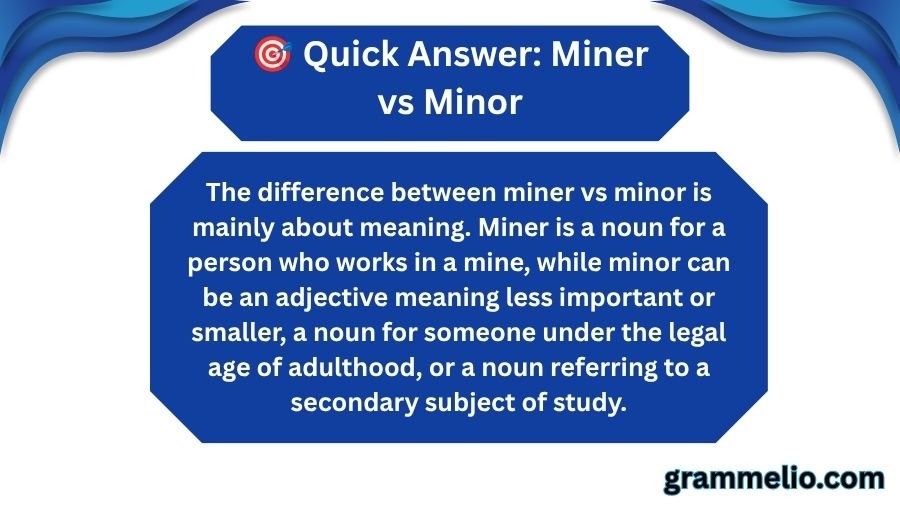
The difference between miner vs minor is mainly about meaning. Miner is a noun for a person who works in a mine, while minor can be an adjective meaning less important or smaller, a noun for someone under the legal age of adulthood, or a noun referring to a secondary subject of study.
A simple memory trick is this: miner has “mine” inside it, so think of a person who works in a mine. Minor has no “mine” because its meaning is different.
Related Word Forms
Both words have useful related forms. Learning them can make the difference easier to recognize in real sentences.
| Form | Type | Example |
|---|---|---|
| miner | Noun | The miner worked underground. |
| miners | Plural noun | Several miners entered the tunnel. |
| miner’s | Singular possessive | The miner’s helmet was nearby. |
| miners’ | Plural possessive | The miners’ equipment was inspected. |
| minor | Noun/Adjective | The minor waited with a parent. |
| minors | Plural noun | Minors may need an adult’s permission. |
| minor’s | Singular possessive | The minor’s guardian signed the form. |
| minors’ | Plural possessive | The minors’ section was closed. |
Notice that miner is closely connected to the word mine, while minor is not. That small spelling clue can help you choose the right word.
Understanding Miner vs Minor
The easiest way to understand miner vs minor is to focus on what each word describes. A miner is connected to mining. A minor is usually connected to age, size, importance, or a secondary role.
| Form | Type | Meaning | Example | Correct/Incorrect |
|---|---|---|---|---|
| miner | Noun | A person who works in a mine | The miner entered the shaft. | ✅ Correct |
| minor | Adjective | Less important, serious, or large | The car had minor damage. | ✅ Correct |
| minor | Noun | A person below the legal adult age | The minor was accompanied by a guardian. | ✅ Correct |
| minor | Noun | A secondary field of study | She chose biology as her minor. | ✅ Correct |
| miner | Noun | A person who works in a mine | The minor entered the shaft. | ❌ Incorrect |
The key point is that miner names a person connected to mining. Minor has several meanings, but none of its common meanings refers to a mine worker.
Miner: Meaning and Correct Use
A miner is a person who works in a mine. The person may remove coal, metal ores, salt, gemstones, or other materials from underground or surface mines.
For example:
- ✅ The miner checked his safety equipment before entering the tunnel.
- ❌ The minor checked his safety equipment before entering the tunnel.
The first sentence describes a worker in a mine. The second sentence changes the meaning. It sounds as if a young person checked the equipment.
The word miner is a noun. It usually refers to a person, although the exact type of mining work can vary.
Understanding miner vs minor becomes easier when you remember that minor can describe something small or less important. Minor: Meaning as an Adjective
Minor can describe something that is small, limited, or not very important.
For example:
- ✅ The driver had only minor injuries after the accident.
- ❌ The driver had only miner injuries after the accident.
Here, minor means the injuries were not major.
Other examples include:
- We found a minor error in the report.
- The building needs some minor repairs.
- She made a minor change to the design.
- The delay caused only a minor problem.
In each sentence, minor describes something relatively small or less serious.
Minor: Meaning Related to Age
Minor can also be a noun referring to someone who has not reached the legal age of adulthood under the relevant law.
For example:
- ✅ The minor needed a parent or guardian to complete the form.
- ❌ The miner needed a parent or guardian to complete the form.
The correct word depends on the intended meaning. The sentence is about age, not mining.
The exact legal definition of a minor can vary by location and situation, so writers should avoid assuming that one age rule applies everywhere.
Minor: Meaning in Education
In college and university settings, a minor can be a secondary area of academic study.
For example:
- He is majoring in business and minoring in history.
- Her minor is computer science.
- I chose psychology as my minor.
This meaning has nothing to do with mining. That is why context matters so much when deciding between the two words.
💡 Test Tip: Use the Mine Test
When I teach this distinction, I recommend a very quick test:
Can you replace the word with “mine worker”?
If yes, use miner.
If the sentence means small, less important, underage, or a secondary field of study, use minor.
| Meaning You Want | Word to Choose | Memory Clue |
|---|---|---|
| Person who works in a mine | miner | mine + worker |
| Small or less important | minor | opposite of major |
| Person under legal adulthood | minor | age |
| Secondary college subject | minor | secondary study |
This test takes only a few seconds and works in most everyday situations.
Why Do People Confuse Miner and Minor?
People confuse miner and minor because the words look and sound very similar. They also share the same first three letters. The only difference in spelling is the final vowel.
I once reviewed a short school assignment in which a student wrote that a “minor” had discovered gold underground. The student knew the story well but had simply switched the two words while typing. Once I explained that miner contains “mine,” the mistake made sense immediately.
There are several reasons this mix-up happens:
- The words are only one letter apart.
- Their pronunciations can sound similar in casual speech.
- Autocorrect may not catch the wrong word because both are real English words.
- Writers may know the spelling but forget which meaning belongs to each word.
- Fast typing can cause the letters to switch.
The biggest problem is that spell-check software may not identify the mistake. If you write “The minor worked in a coal mine,” every word is spelled correctly. The sentence is simply using the wrong word.
Key Differences Between Miner and Minor
The main differences become clearer when we compare their meanings, grammar roles, and common settings.
| Feature | Miner | Minor |
|---|---|---|
| Main meaning | A person who works in a mine | Small, less important, underage, or secondary |
| Common word type | Noun | Noun or adjective |
| Connected idea | Mining | Size, importance, age, or study |
| Can describe a person? | Yes | Yes |
| Can describe a problem? | No | Yes |
| Can describe a college subject? | No | Yes |
| Memory clue | Mine worker | Opposite of major |
A miner is usually a person. A minor can be a person, but it can also describe a thing or situation.
For example:
- ✅ The miner carried a lamp into the tunnel.
- ❌ The minor carried a lamp into the tunnel.
But:
- ✅ The report contains a minor error.
- ❌ The report contains a miner error.
The context tells you which word belongs.
Is Miner a Person or a Thing?
Miner is normally a noun referring to a person who works in mining. It is not normally used as an adjective for something small or unimportant.
Consider these examples:
- The miner wore protective clothing.
- The miners worked together.
- A local miner described the conditions underground.
The word identifies people connected to mining work.
A useful word family includes:
- mine
- mining
- miner
- miners
These words share the same basic connection to extracting materials from the earth.
Is Minor Always About Age?
No. Minor does not always refer to a young person. It has several common meanings.
It can mean:
- Less important.
- Smaller in degree or size.
- A person below the legal age of adulthood.
- A secondary subject of academic study.
- In music, a term used to describe a type of scale, key, or chord.
For example:
- The injury was minor.
- She made a minor adjustment.
- The minor was accompanied by an adult.
- His minor is economics.
- The song is written in a minor key.
The correct meaning comes from the context.
Case Study: A Workplace Email
Imagine that an employee is writing an email about a construction project. This example shows why miner vs minor matters in professional communication.
The employee writes:
“A miner issue delayed the project by two hours.”
That sentence is incorrect if the writer means a small issue.
The correct version is:
“A minor issue delayed the project by two hours.”
Now imagine the email is about workers:
“A miner discovered a problem in the underground tunnel.”
Here, miner is correct because the sentence describes a person who works in a mine.
The distinction can matter in professional writing. One letter can completely change the meaning.
| Intended Meaning | Correct Sentence |
|---|---|
| Small problem | A minor problem delayed the work. |
| Mine worker | The miner reported the problem. |
| Secondary study | Her minor is English. |
| Young person | The minor needed permission. |
Grammar Rules Explanation
The grammar rule is simple: choose the word based on its meaning, not just its spelling or sound.
Miner functions as a noun. It identifies a person who works in a mine.
Minor can function as an adjective when it describes something as small or less important. It can also function as a noun when it refers to a person below the legal age of adulthood or a secondary academic subject.
This means you should first identify the role of the word in your sentence.
Ask yourself:
- Am I talking about a mine worker?
- Am I describing something small or less important?
- Am I referring to a person who has not reached legal adulthood?
- Am I talking about a secondary college subject?
If the answer is the first question, choose miner. For the other common meanings, minor is usually the correct choice.
Standard English reference works distinguish these words by meaning. The spelling difference is small, but the meanings are not interchangeable.
Correct vs Incorrect at a Glance
| Sentence | Correct/Incorrect | Why |
|---|---|---|
| The miner worked deep underground. | ✅ Correct | A miner works in a mine. |
| The miner problem was easy to fix. | ❌ Incorrect | “Minor” means small or less important. |
| She had only a minor injury. | ✅ Correct | “Minor” describes a less serious injury. |
| The minor entered the mine with a worker. | ✅ Correct | “Minor” can refer to a person under legal adulthood. |
| He chose history as his miner. | ❌ Incorrect | The academic term is “minor.” |
⚠️ Common Mistakes With Miner and Minor
The most common mistake is choosing the word by sound instead of meaning.
I once caught myself typing “miner change” in a document when I meant “minor change.” I noticed it during a final read-through because the sentence was about editing, not mining. That small error reminded me why context checks are so useful.
Other common English mix-ups work the same way.
| Confusing Pair | Correct Difference |
|---|---|
| its / it’s | Possession vs. “it is” or “it has” |
| your / you’re | Possession vs. “you are” |
| their / there / they’re | Possession, place, and “they are” |
| affect / effect | Usually verb vs. noun, depending on use |
| then / than | Time/order vs. comparison |
| miner / minor | Mine worker vs. small, underage, or secondary |
Why These Mistakes Happen
Fast typing: When people type quickly, similar words can appear without being noticed.
Autocorrect: Autocorrect may accept the wrong word because both “miner” and “minor” are valid English words.
Lack of knowledge: A learner may recognize both words but not know which meaning belongs to each one.
Sound-based writing: Some people write based on what they hear. Similar sounds can make that risky.
Weak proofreading: A sentence can look normal at first glance even when the wrong word has been used.
Specific Wrong Forms to Avoid
| Wrong Form or Use | What’s Wrong | Correct Form |
|---|---|---|
| miner problem | A problem is not a mine worker | minor problem |
| minor worked underground | Wrong word for a mine worker | miner worked underground |
| miner injury | “Miner” does not mean less serious | minor injury |
| miner in college | Wrong if referring to secondary study | minor in college |
| minor found coal underground | Wrong if the person is a mine worker | miner found coal underground |
| miner adjustment | Wrong adjective | minor adjustment |
Word Origin and History
The history of these words helps explain why their spellings are so close even though their modern meanings are different.
Miner is directly connected with mine and the practice of mining. The word developed as a name for a person involved in mining work.
Minor has a different history and is related to the idea of being smaller, lesser, or secondary. Its meaning later developed into several common uses, including age and education.
The important lesson for modern writers is not the exact historical timeline. It is the meaning connection:
miner → mine → mining work
minor → smaller, lesser, secondary
| Period | Form/Idea | Note |
|---|---|---|
| Earlier English use | mine | Connected with underground extraction |
| Later English use | miner | A person involved in mining |
| Earlier language history | minor | Connected with the idea of being smaller or lesser |
| Modern English | minor | Used for size, importance, age, education, and more |
Usage in Different Contexts
Context is one of the best tools for choosing between miner and minor. The miner vs minor difference becomes especially clear when you look at different writing contexts.
Everyday Conversation
In everyday speech, minor is often used for small problems or less serious situations.
- It was just a minor mistake.
- She had a minor headache.
Miner appears when people are talking about mining.
- His grandfather was a miner.
- The miner returned home after his shift.
Professional Writing
Professional writing requires extra care because a wrong word can make a sentence confusing.
- The report found a minor error.
- The miner reported unsafe conditions.
Creative Writing
Writers may use both words in stories.
- The old miner walked out of the tunnel.
- A minor detail changed the entire mystery.
Social Media and Texting
Short messages are especially vulnerable to typing mistakes.
Someone might post:
“I made a miner mistake.”
If the writer means a small mistake, the correct sentence is:
“I made a minor mistake.”
| Context | Which Term to Use | Example |
|---|---|---|
| Everyday conversation | minor or miner, depending on meaning | It was a minor problem. |
| Professional writing | minor or miner, depending on meaning | The miner submitted his report. |
| Creative writing | minor or miner, depending on meaning | The miner entered the cave. |
| Social media/texting | minor or miner, depending on meaning | Sorry for the minor mistake. |
Common Phrases With Miner
There are several natural phrases involving miner, especially in mining contexts.
| Phrase | Meaning |
|---|---|
| coal miner | A person who works in coal mining |
| gold miner | A person who searches for or extracts gold |
| mine worker | A worker in a mining operation |
| underground miner | A miner who works below the surface |
| experienced miner | A miner with substantial work experience |
| former miner | Someone who used to work as a miner |
These phrases clearly connect miner with mining.
Common Phrases With Minor
The word minor appears in many everyday expressions.
| Phrase | Meaning |
|---|---|
| minor problem | A small or less serious problem |
| minor injury | An injury that is not serious |
| minor change | A small change |
| minor detail | A detail of limited importance |
| minor issue | A relatively small issue |
| minor subject | A secondary academic field |
These phrases make the meaning easy to recognize.
How Can You Remember the Difference?
The easiest way to remember miner vs minor is to connect each word with a simple idea. The strongest memory trick is to connect each word to a simple idea.
Remember Miner With “Mine”
Look at the spelling:
MINER
You can see:
MINE + R
Think:
miner = mine worker
Remember Minor With “More Small”
Think of minor as something that is less important or smaller than something major.
You can also connect:
major ↔ minor
These are often opposites when discussing importance or academic fields.
| Word | Memory Connection |
|---|---|
| miner | mine worker |
| minor | less important or smaller |
| major | more important or main |
| mining | work of extracting materials |
Synonyms and Alternatives
Choosing alternatives correctly also depends on understanding the miner vs minor difference. The best alternative depends on the meaning.
If you mean miner, you might use mine worker when you want to be very clear.
If you mean minor as “small,” alternatives can include slight, small, or limited.
If you mean minor as a person under legal adulthood, young person may work in some contexts, but it is not always an exact legal replacement.
| Alternative | Works When | Does Not Work When |
|---|---|---|
| mine worker | You mean a miner | You mean something small |
| small | You mean minor in size or degree | You mean a legal minor |
| slight | You mean a small degree | You mean a college minor |
| limited | You mean restricted or small in scope | You mean a mine worker |
| secondary | You mean a minor academic field or role | You mean a mine worker |
Why It Matters
Knowing the difference between miner vs minor helps you communicate your meaning clearly.
Using the right word makes your writing easier to understand. Miner and minor are not interchangeable. A reader may understand your intended meaning from context, but a wrong word can still make your writing look careless.
This matters in several areas:
- Clarity: Readers should understand your exact meaning.
- Professionalism: Correct word choice makes emails and reports stronger.
- Digital communication: A small spelling difference can change a sentence.
- Academic writing: Word choice affects grades, essays, and applications.
A useful rule I give writers is:
Clear words create clear meaning.
| Situation | Why Getting It Right Matters |
|---|---|
| Resume | Prevents confusing or embarrassing wording |
| Client email | Protects professional communication |
| Published content | Builds trust with readers |
| Social post | Keeps the intended meaning clear |
Is Miner vs Minor Important in Formal Writing?
Yes. Formal writing needs precise word choice because readers cannot always ask what you meant.
Consider these two sentences:
- The company reported a minor delay.
- The company reported a miner delay.
The first sentence makes sense. The second sounds as if the delay belongs to a mine worker, which is not the intended meaning.
Likewise:
- The miner inspected the equipment.
- The minor inspected the equipment.
Both are grammatically possible, but they communicate different ideas.
The issue is not grammar alone. It is word meaning.
Can Minor and Miner Be Used in the Same Sentence?
Yes. They can appear together when a sentence needs both meanings.
For example:
The miner reported a minor problem in the tunnel.
Here, miner refers to the worker, while minor describes the problem.
Another example is:
The miner helped a minor who had entered the restricted area.
Here, the first word refers to a mine worker, while the second refers to a young person under the applicable legal age.
These sentences are useful because they show that the two words can exist side by side without being interchangeable.
How Do You Choose the Right Word?
When deciding between miner vs minor, always focus on the meaning you want to express.
Use a meaning-first approach.
Ask these questions:
- Does the word refer to a person who works in a mine?
- Does it describe something small or less important?
- Does it refer to someone below the legal age of adulthood?
- Does it describe a secondary academic subject?
Then choose the word.
If the answer is mine worker, choose miner.
If the answer is small, less important, underage, or secondary study, choose minor.
This approach is more reliable than trying to memorize spelling alone.
Quick Recap Checklist
| Question | If Yes → Use |
|---|---|
| Is the person a worker in a mine? | miner |
| Does the word mean small or less important? | minor |
| Does it refer to someone below legal adulthood? | minor |
| Is it a secondary college subject? | minor |
| Does it connect directly to mining work? | miner |
Practice Examples
1. The ___ found a new section of the tunnel.
Answer: miner ✅
2. The doctor said the injury was ___.
Answer: minor ✅
3. She chose history as her college ___.
Answer: minor ✅
A good final test is to replace the word mentally. If “mine worker” fits, use miner. If “small,” “less important,” “underage person,” or “secondary study” fits, use minor.
FAQs About Miner vs Minor
What is the difference between miner and minor?
A miner is a person who works in a mine. A minor can mean something small or less important, a person below the legal age of adulthood, or a secondary field of academic study.
Is a miner a person who works in a mine?
Yes. A miner is a person who works in mining. For example, “The miner entered the underground tunnel.”
What does minor mean in a sentence?
Minor can mean small, less important, or less serious. It can also refer to a person below the legal age of adulthood or a secondary area of study.
Is it minor mistake or miner mistake?
The correct phrase is minor mistake. A mistake can be small or not serious, so minor is the correct adjective.
Is it miner injury or minor injury?
The correct phrase is minor injury when you mean an injury that is not serious. Miner refers to a person who works in a mine.
How do I remember miner vs minor?
Remember miner by connecting it to mine. A miner works in a mine. Remember minor by connecting it with major. A minor thing can be smaller or less important than a major thing.
Can minor be a noun?
Yes. Minor can be a noun when it refers to a person below the legal age of adulthood. It can also be a noun for a secondary academic field.
Can minor be an adjective?
Yes. Minor is commonly used as an adjective to describe something small, less important, or less serious.
Can miner and minor be used in the same sentence?
Yes. For example: “The miner reported a minor problem.” The first word identifies the worker. The second describes the problem.
Which word should I use for a person who extracts coal?
Use miner. A coal miner is a person who works in coal mining.
Conclusion
Miner vs minor becomes easy once you connect each word with its main meaning. A miner is a person who works in a mine, while minor can describe something small or less important, refer to a person below the legal age of adulthood, or identify a secondary area of study. The spelling trick is simple: miner contains “mine,” so think “mine worker.” For minor, think “less than major” when the word describes importance or a secondary role. 🧠
I recommend checking the meaning of the whole sentence before choosing either word. Do not rely only on how the words sound. This is especially helpful when proofreading emails, school assignments, resumes, and online posts. ✨
When you remember the connection between miner and mine, and between minor and small, secondary, or underage, the confusion largely disappears. One letter may separate the words, but their meanings are worlds apart.
Remember the mine, choose miner; think smaller or secondary, choose minor.

[…] meanings, grammar rules, common mistakes, examples, and easy memory tricks you can use right away. Miner vs Minor | Mettlesome vs Meddlesome | Medal vs Metal vs Meddle vs […]
[…] tricks. By the end, you should be able to choose the right word with confidence. Moral vs Morale | Miner vs Minor | Mettlesome vs […]