Have you ever typed a sentence and suddenly wondered whether you need ordinance vs ordnance? I see this mix-up often because the two words look almost identical, sound similar, and both appear in serious writing. Yet their meanings are very different. Ordinance usually refers to an official rule or law, while ordnance refers to military weapons, ammunition, and related equipment.
That one extra “n” changes the meaning completely. If you write reports, emails, school assignments, news stories, or online content, knowing the difference can save you from an awkward mistake. 😊
I have found that a simple memory trick makes these words much easier to separate. In this guide, I will explain ordinance vs ordnance with clear definitions, examples, tables, common mistakes, usage tips, and practice questions so you can choose the right word with confidence. ✍️ Oar vs Or vs Ore | Moral vs Morale | Miner vs Minor
🎯 Quick Answer: Ordinance vs Ordnance
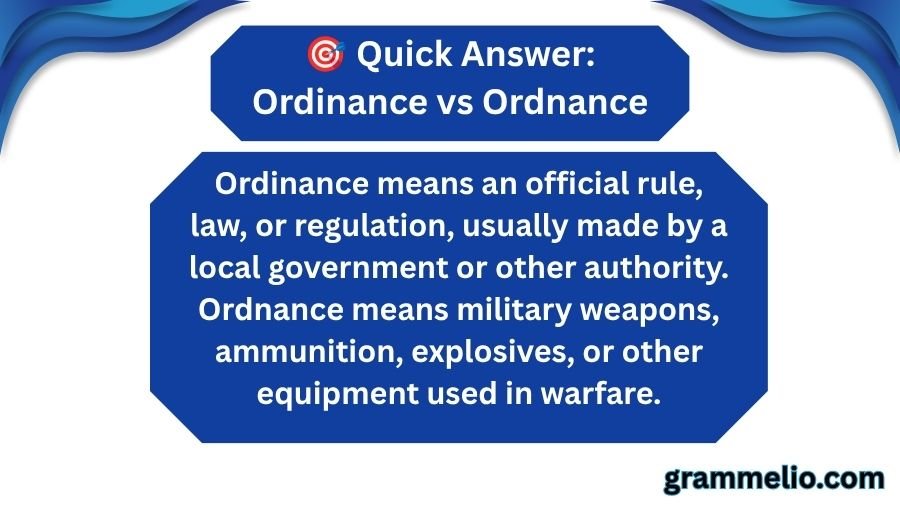
Ordinance means an official rule, law, or regulation, usually made by a local government or other authority. Ordnance means military weapons, ammunition, explosives, or other equipment used in warfare.
A quick way to remember the difference is this: ordinance = rule, while ordnance = military equipment.
| Word | Basic Meaning | Typical Context | Example |
|---|---|---|---|
| Ordinance | An official rule or law | Government, cities, communities | The city passed an ordinance about parking. |
| Ordnance | Military weapons or ammunition | Army, navy, war, defense | The base stored military ordnance. |
What Does Ordinance Mean?
When learning ordinance vs ordnance, start with ordinance. Ordinance is a noun that means an official rule, law, or regulation. It is often used for a law passed by a city, county, town, or other local government.
Ordinance is a noun that means an official rule, law, or regulation. It is often used for a law passed by a city, county, town, or other local government.
For example:
The city passed an ordinance banning overnight parking on that street.
Here, ordinance means a local law.
You may see the word in government notices, legal documents, news reports, workplace rules, and public announcements. An ordinance can cover many topics, including noise, parking, construction, pets, signs, business operations, and public safety.
Common uses of ordinance
An ordinance may:
- Set rules for parking.
- Control noise levels.
- Regulate building projects.
- Restrict certain activities.
- Protect public property.
- Establish local safety rules.
- Set requirements for businesses.
The key idea is authority creating a rule.
Examples of ordinance
✅ Correct: The town adopted an ordinance requiring permits for large outdoor events.
❌ Incorrect: The town adopted an ordnance requiring permits for large outdoor events.
The second sentence suggests military equipment, which makes no sense in this context.
What Does Ordnance Mean?
The other half of ordinance vs ordnance is ordnance. Ordnance is a noun associated with military weapons and ammunition. It can refer to weapons, ammunition, explosives, and other military equipment used in warfare.
Ordnance is a noun associated with military weapons and ammunition. It can refer to weapons, ammunition, explosives, and other military equipment used for fighting.
For example:
The soldiers inspected the ordnance before the exercise began.
In this sentence, ordnance refers to military equipment.
The word is most common in military, defense, historical, and technical writing. You might see it in discussions about weapons storage, military operations, naval equipment, or old battle sites.
Common uses of ordnance
Ordnance can refer to things such as:
- Ammunition
- Bombs
- Missiles
- Artillery shells
- Military weapons
- Other military equipment related to weapons
The exact scope can depend on the context, but the central idea is military weapons and ammunition.
Examples of ordnance
✅ Correct: The crew carefully handled the unexploded ordnance.
❌ Incorrect: The crew carefully handled the unexploded ordinance.
The first sentence refers to dangerous military material. Therefore, ordnance is the correct word.
🔍 Is Ordinance the Same as Ordnance?
No. Ordinance and ordnance are different words with different meanings.
Ordinance refers to an official rule or law. Ordnance refers to military weapons, ammunition, or related equipment.
| Feature | Ordinance | Ordnance |
|---|---|---|
| Part of speech | Noun | Noun |
| Main meaning | Official rule or law | Military weapons or ammunition |
| Common setting | Government and law | Military and defense |
| Example | A city ordinance | Unexploded ordnance |
| Memory idea | Rule | Weapons |
The spelling difference is small, but the meaning difference is large.
If you are talking about a city council creating a rule, choose ordinance. If you are talking about military weapons or ammunition, choose ordnance.
Ordinance vs Ordnance at a Glance
The easiest way to understand ordinance vs ordnance is to connect each word with one main idea.
Ordinance = law or rule.
Ordnance = military weapons or ammunition.
| Word | Think Of | Example |
|---|---|---|
| Ordinance | Rule | A city noise ordinance |
| Ordnance | Weapons | Military ordnance |
| Ordinance | Government | A local ordinance |
| Ordnance | Armed forces | Unexploded ordnance |
A useful spelling clue
Look at the middle of each word:
- ordinance → contains “in”
- ordnance → drops the “i”
That missing “i” can help you remember that ordnance has the shorter spelling and the military meaning.
💡 How Can You Remember the Difference?
You can remember the difference by using a simple word association.
Think:
Ordinance → ordinance = official rule.
Ordnance → ordnance = military equipment.
Another trick is to connect the “i” in ordinance with an idea such as instructions. An ordinance gives people an official instruction or rule.
For ordnance, think of the shorter spelling as belonging to the military world.
I once helped a student who kept writing “military ordinance” in a history assignment. She knew exactly what she meant but could not remember which spelling to use. I told her to connect ordnance with weapons. After that, she stopped making the mistake.
💡 Test Tip
Ask yourself one question:
“Am I talking about a rule or weapons?”
- If the answer is a rule, use ordinance.
- If the answer is weapons or ammunition, use ordnance.
| Question | Answer | Word |
|---|---|---|
| Is it a local law? | Yes | Ordinance |
| Is it a government rule? | Yes | Ordinance |
| Is it ammunition? | Yes | Ordnance |
| Is it military weaponry? | Yes | Ordnance |
| Is it a city regulation? | Yes | Ordinance |
Ordinance: Meaning and Correct Use
Ordinance is used when an authority creates an official rule. It is especially common for local laws.
Local government
Cities often create ordinances to manage local issues.
✅ Correct: The city passed an ordinance limiting construction noise after 9 p.m.
❌ Incorrect: The city passed an ordnance limiting construction noise after 9 p.m.
The subject is a city rule, so ordinance is correct.
Public behavior
An ordinance can regulate behavior in public places.
✅ Correct: The new ordinance prohibits smoking in certain public areas.
❌ Incorrect: The new ordnance prohibits smoking in certain public areas.
Business rules
Local governments may also create ordinances that affect businesses.
✅ Correct: The restaurant must follow the city’s health and safety ordinances.
❌ Incorrect: The restaurant must follow the city’s health and safety ordnances.
Summary of ordinance meanings
| Meaning | Word Type | Example Sentence |
|---|---|---|
| Local law | Noun | The council approved the ordinance. |
| Official regulation | Noun | The ordinance sets limits on noise. |
| Government rule | Noun | Businesses must follow the ordinance. |
Ordnance: Meaning and Correct Use
Ordnance is used when discussing military weapons, ammunition, explosives, or related equipment.
Military operations
Military writing commonly uses ordnance when referring to weapons or ammunition.
✅ Correct: The unit transported ordnance to the training area.
❌ Incorrect: The unit transported ordinance to the training area.
Unexploded military material
The phrase unexploded ordnance is especially common.
It describes military weapons or ammunition that were used or deployed but did not explode as intended.
✅ Correct: Workers discovered unexploded ordnance near the old training site.
❌ Incorrect: Workers discovered unexploded ordinance near the old training site.
Historical sites
The word can also appear when people discuss old battlefields or former military areas.
✅ Correct: Archaeologists found old ordnance at the former military site.
❌ Incorrect: Archaeologists found old ordinance at the former military site.
| Meaning | Word Type | Example Sentence |
|---|---|---|
| Military weapons | Noun | The army inspected its ordnance. |
| Ammunition | Noun | The ordnance was moved safely. |
| Unexploded military material | Noun | The team reported unexploded ordnance. |
📝 Case Study: A Small Spelling Error With a Big Meaning
Imagine that a city employee sends this email:
“The new ordnance will limit parking near the downtown library.”
The employee means that the city has created a new parking rule. However, ordnance means military weapons or ammunition. The reader could wonder whether the message contains a serious spelling error.
The corrected version is:
“The new ordinance will limit parking near the downtown library.”
Now the meaning is clear.
I once edited a workplace document where a writer used ordnance when discussing a new local noise rule. The sentence looked almost right at first glance. Once I checked the meaning, the error became obvious. The writer had confused the two words because they look so much alike.
This is why spelling alone is not enough. You should always check the meaning of the word in the sentence.
📚 Grammar Rules Explanation
The difference between these words is mainly a difference in meaning and spelling, not a complicated grammar rule. Understanding ordinance vs ordnance is mainly about recognizing the meaning of each word before choosing the spelling.
Ordinance is a noun for an official rule, law, or regulation.
Ordnance is a noun for military weapons, ammunition, and related equipment.
Both words are nouns. Both can appear as subjects or objects in a sentence. The main question is which meaning you need.
Standard English reference sources treat these as separate words. A good dictionary can confirm the spelling and meaning when you are unsure.
Correct vs Incorrect at a Glance
| Sentence | Correct/Incorrect | Why |
|---|---|---|
| The city passed an ordinance about parking. | ✅ Correct | It refers to a local law. |
| The city passed an ordnance about parking. | ❌ Incorrect | Ordnance refers to military equipment. |
| The soldiers inspected the ordnance. | ✅ Correct | It refers to military material. |
| The soldiers inspected the ordinance. | ❌ Incorrect | Ordinance means a rule or law. |
| The new ordinance affects local businesses. | ✅ Correct | It is an official regulation. |
⚠️ Why Do People Confuse Ordinance and Ordnance?
People confuse these words because they look and sound very similar. They also share several letters.
The difference is easy to miss when you are reading quickly.
Common reasons include:
- Fast typing — You may type the familiar spelling without thinking.
- Autocorrect — Software may not understand the meaning you intended.
- Lack of knowledge — You may have heard the words but never learned the difference.
- Similar pronunciation — The words can sound close enough to cause confusion.
- Visual similarity — Only a small spelling change separates them.
| Confusing Pair | Main Difference |
|---|---|
| It’s / its | Contraction vs. possessive |
| Your / you’re | Possessive vs. contraction |
| Their / there / they’re | Possession, place, contraction |
| Affect / effect | Usually verb vs. noun |
| Principal / principle | Person or main item vs. rule or belief |
| Ordinance / ordnance | Rule or law vs. military equipment |
Common wrong forms
| Wrong Form or Use | What’s Wrong | Correct Form |
|---|---|---|
| Military ordinance | Uses the word for laws | Military ordnance |
| City ordnance | Uses the military word | City ordinance |
| Parking ordnance | Wrong meaning | Parking ordinance |
| Unexploded ordinance | Wrong meaning | Unexploded ordnance |
| Government ordnance | Usually means military equipment instead of a rule | Government ordinance |
| Weapon ordinance | Wrong word for weapons | Weapon ordnance |
🕰️ A Brief History of the Two Words
The two words have different histories even though their modern spellings are very close.
Ordinance developed from a word family connected with ordering, arranging, and establishing rules. That history fits its modern meaning because an ordinance establishes an official order or rule.
Ordnance developed through a different history connected with military stores and weapons. Over time, it became strongly associated with military weapons and ammunition.
The important lesson is that similar spelling does not mean two words have the same history or meaning.
| Stage | Word | General Development |
|---|---|---|
| Earlier English usage | Ordinance | Connected with established rules or orders |
| Later English usage | Ordinance | Increasingly used for official laws and regulations |
| Earlier English usage | Ordnance | Connected with military stores and weapons |
| Modern English | Ordnance | Commonly refers to military weapons and ammunition |
You do not need to memorize the history to use these words correctly. The meaning-based distinction is much more useful in everyday writing.
🌎 How Are These Words Used in Different Contexts?
The context usually makes the correct choice clear.
In everyday conversation, ordinance may appear when people discuss local rules. Ordnance is more likely to appear in military, historical, or safety discussions.
| Context | Which Term to Use | Example |
|---|---|---|
| Everyday conversation | Ordinance | Did the city change its parking ordinance? |
| Professional writing | Ordinance | The report explains the new zoning ordinance. |
| Creative writing | Either, depending on meaning | The story mentions an old ordinance or military ordnance. |
| Social media/texting | Either, depending on meaning | The post discusses a new city ordinance. |
Everyday conversation
You might say:
“The city has a new ordinance about outdoor fires.”
That means the city created a rule.
Professional writing
Legal, business, and government documents often use ordinance.
“The proposed ordinance would change local building requirements.”
Military reports may use ordnance.
“The report discusses the safe handling of ordnance.”
Creative writing
A historical novel might use both words:
“The mayor announced a new ordinance while soldiers prepared their ordnance.”
The sentence works because the words have separate meanings.
Social media
People often shorten their writing online, but correct spelling still matters.
If you are posting about a city law, write ordinance. If you are discussing military weapons, write ordnance.
💬 Common Phrases With Ordinance
Some combinations appear frequently in government and public writing.
| Phrase | Meaning |
|---|---|
| City ordinance | A rule passed by a city |
| Local ordinance | A local government law or regulation |
| Zoning ordinance | A rule about land use and development |
| Noise ordinance | A rule controlling certain noise |
| Parking ordinance | A rule about parking |
| Municipal ordinance | An ordinance created by a municipality |
These phrases all relate to rules or laws, so ordinance is the correct spelling.
For example:
✅ The city updated its noise ordinance.
❌ The city updated its noise ordnance.
🪖 Common Phrases With Ordnance
Ordnance also appears in several common combinations.
| Phrase | Meaning |
|---|---|
| Military ordnance | Military weapons and ammunition |
| Unexploded ordnance | Military material that failed to explode |
| Ordnance disposal | Work involving the safe handling or removal of dangerous military material |
| Ordnance equipment | Equipment related to military weapons |
| Naval ordnance | Weapons and ammunition used by naval forces |
| Heavy ordnance | Large or powerful military weapons or ammunition |
For example:
✅ The team reported unexploded ordnance.
❌ The team reported unexploded ordinance.
🔄 Synonyms and Alternatives
Sometimes you can replace one of these words with a simpler phrase. This can even make your writing easier for a general audience.
For ordinance, alternatives include law, rule, regulation, and local law.
For ordnance, alternatives depend on the exact context. You might use weapons, ammunition, or military equipment.
| Alternative | Works When | Does Not Work When |
|---|---|---|
| Law | You mean an official legal rule | You mean military weapons |
| Rule | You mean a general official requirement | You need a specific military meaning |
| Regulation | You mean an official requirement | You mean ammunition |
| Weapons | You mean military weapons | You mean a city law |
| Ammunition | You specifically mean ammunition | You mean every type of military equipment |
Be careful with synonyms. Ordnance can cover more than one specific type of weapon-related material, so replacing it with “ammunition” may make the meaning narrower.
❓ Why Does Getting the Difference Right Matter?
Correct word choice makes your writing clearer. A spelling error between these two words can completely change the subject of a sentence.
Imagine writing:
“The county adopted new ordnance.”
Readers may think you mean military weapons.
If you write:
“The county adopted a new ordinance.”
Readers immediately understand that you mean a law or regulation.
| Situation | Why Getting It Right Matters |
|---|---|
| Resume | Shows strong attention to language |
| Client email | Prevents confusion |
| Published content | Protects accuracy and credibility |
| Social post | Helps readers understand your meaning |
A useful writing rule is:
Choose the word that matches the meaning, not the word that merely looks familiar.
I use this rule whenever I edit confusing word pairs. If two words look nearly identical, I stop and ask what the sentence actually means. That small pause often catches an error before it reaches the reader.
🧠 How to Use Ordinance vs Ordnance in a Sentence
The fastest method is to identify the subject first.
If your sentence involves:
- A city council
- A local government
- A regulation
- A parking rule
- A zoning rule
- A public law
Use ordinance.
If your sentence involves:
- Soldiers
- Weapons
- Ammunition
- Bombs
- Military equipment
- Unexploded military material
Use ordnance.
| Sentence Idea | Correct Word |
|---|---|
| A city creates a parking law | Ordinance |
| A county changes its zoning rule | Ordinance |
| Soldiers inspect ammunition | Ordnance |
| A team finds an unexploded bomb | Ordnance |
| A town regulates noise | Ordinance |
| A military unit stores weapons | Ordnance |
🎯 A Simple Memory Trick for Ordinance vs Ordnance
Here is the shortcut I recommend:
ORDINANCE = ORDER
Both ordinance and order connect naturally with rules.
ORDNANCE = WEAPONS
The shorter spelling points you toward the military meaning.
Try saying this to yourself:
Ordinance orders. Ordnance arms.
It is short, clear, and easy to remember.
Another visual trick is to imagine two signs:
🏛️ ORDINANCE → “This is the law.”
🪖 ORDNANCE → “These are weapons.”
If you can connect each word to a picture, you are less likely to mix them up.
📝 Practice Examples
Try choosing the correct word before checking the answers.
Example 1
“The city passed a new ______ requiring permits for large signs.”
Answer: ordinance
The sentence refers to a local rule.
Example 2
“The soldiers moved the ______ to a secure storage area.”
Answer: ordnance
The sentence refers to military weapons or ammunition.
Example 3
“The county’s noise ______ limits loud construction at night.”
Answer: ordinance
A noise ordinance is a local regulation.
Example 4
“The workers discovered unexploded ______ near the former military base.”
Answer: ordnance
The phrase refers to unexploded military material.
| Practice Sentence | Answer | Reason |
|---|---|---|
| The council approved a new ___ . | Ordinance | Official rule |
| The soldiers handled the ___ . | Ordnance | Military equipment |
| The city changed its parking ___ . | Ordinance | Local regulation |
⚠️ Common Sentence Errors to Avoid
Small spelling mistakes can create strange meanings. If you are still unsure about ordinance vs ordnance, look at the words surrounding the term. Government, city, parking, and zoning usually point to ordinance, while military, ammunition, weapons, and unexploded material point to ordnance.
✅ Correct: The mayor signed the new ordinance.
❌ Incorrect: The mayor signed the new ordnance.
Why? A mayor signs or approves laws and regulations, not military weapons.
✅ Correct: The military stored the ordnance securely.
❌ Incorrect: The military stored the ordinance securely.
Why? The sentence concerns military material.
Watch for these patterns:
| If You See… | Think… | Use… |
|---|---|---|
| Mayor | Law | Ordinance |
| City council | Rule | Ordinance |
| Parking | Regulation | Ordinance |
| Zoning | Local law | Ordinance |
| Soldiers | Weapons | Ordnance |
| Ammunition | Military material | Ordnance |
| Unexploded | Dangerous military material | Ordnance |
🧩 Special Context: Unexploded Ordnance
One phrase deserves special attention: unexploded ordnance, often shortened to UXO in technical or military contexts.
This phrase refers to military weapons or ammunition that did not explode as intended. Such material can remain dangerous long after a conflict or military exercise has ended.
The spelling is always ordnance in this phrase.
✅ Correct: Officials warned residents about unexploded ordnance.
❌ Incorrect: Officials warned residents about unexploded ordinance.
The word ordinance would mean a law or regulation, so it does not fit the meaning.
📋 Quick Recap Checklist
Use this checklist whenever you are unsure.
| Question | If Yes → Use |
|---|---|
| Am I talking about a city law? | Ordinance |
| Am I talking about a government rule? | Ordinance |
| Am I talking about parking regulations? | Ordinance |
| Am I talking about military weapons? | Ordnance |
| Am I talking about ammunition? | Ordnance |
| Am I talking about unexploded military material? | Ordnance |
Practice these three
- The town passed a new ordinance about parking.
- The soldiers inspected the ordnance.
- The workers reported unexploded ordnance near the old base.
If you remember ordinance = rule and ordnance = weapons, you will get most uses right.
FAQs About Ordinance vs Ordnance
What is the difference between ordinance and ordnance?
Ordinance means an official law, rule, or regulation. Ordnance means military weapons, ammunition, explosives, or related equipment.
Is a city ordinance a law?
Yes. A city ordinance is an official rule or law created by a local government. It can address subjects such as parking, zoning, noise, signs, and public behavior.
Does ordnance mean weapons?
Yes. Ordnance is commonly used for military weapons, ammunition, and related military material.
Is it military ordinance or military ordnance?
The correct phrase is military ordnance when you mean weapons, ammunition, or related military equipment.
Is it parking ordinance or parking ordnance?
The correct phrase is parking ordinance because a parking ordinance is a local rule or regulation.
What is unexploded ordnance?
Unexploded ordnance refers to military weapons or ammunition that failed to explode as intended. It can remain dangerous and may require trained professionals to handle it.
Why are ordinance and ordnance easy to confuse?
They have very similar spellings and sounds. The main difference is the extra i in ordinance, while the meanings are completely different.
How can I remember ordinance vs ordnance?
Remember: ordinance = order or rule, while ordnance = weapons or ammunition.
Can ordinance and ordnance be used as synonyms?
No. They are not synonyms. Ordinance relates to official rules and laws, while ordnance relates to military weapons and ammunition.
Which word should I use for a government regulation?
Use ordinance. For example: “The city passed an ordinance regulating outdoor signs.”
🏁 Final Thoughts on Ordinance vs Ordnance
Ordinance vs ordnance becomes much easier once you connect each spelling with its meaning. Ordinance refers to an official rule, law, or regulation. Ordnance refers to military weapons, ammunition, and related equipment. The words may look almost the same, but they belong to very different areas of English.
When you are writing about a city council, parking, zoning, noise, or another local rule, choose ordinance. When you are writing about soldiers, weapons, ammunition, or unexploded military material, choose ordnance.
I recommend using the simple memory line: “Ordinance is a rule; ordnance is military equipment.” If you pause for just a second and ask what your sentence is actually talking about, the correct spelling usually becomes obvious. 😊
Clear word choice makes your writing easier to understand and helps your readers trust what you have written. Once you remember the rule, these two look-alike words do not have to be confusing anymore. ✨

[…] the rule, and walk through common mistakes so you can choose the right word with confidence. ✍️ Ordinance vs Ordnance | Oar vs Or vs Ore | Moral vs […]