Have you ever typed a sentence and suddenly wondered whether you should write overdo vs overdue? I have seen this mix-up many times, especially when people are writing emails, school assignments, or quick messages. The two words look almost the same, but they have very different jobs.
One describes doing too much of something, while the other describes something that should have happened or been paid by an earlier time. That small space can change the entire meaning of a sentence. 😊 If you are learning English or simply want cleaner writing, understanding this difference will make your messages much easier to read.
In this guide, I will show you exactly when to use each word, give you simple tests to remember the rule, and walk through common mistakes so you can choose the right word with confidence. ✍️ Ordinance vs Ordnance | Oar vs Or vs Ore | Moral vs Morale
🎯 Quick Answer: Overdo vs Overdue
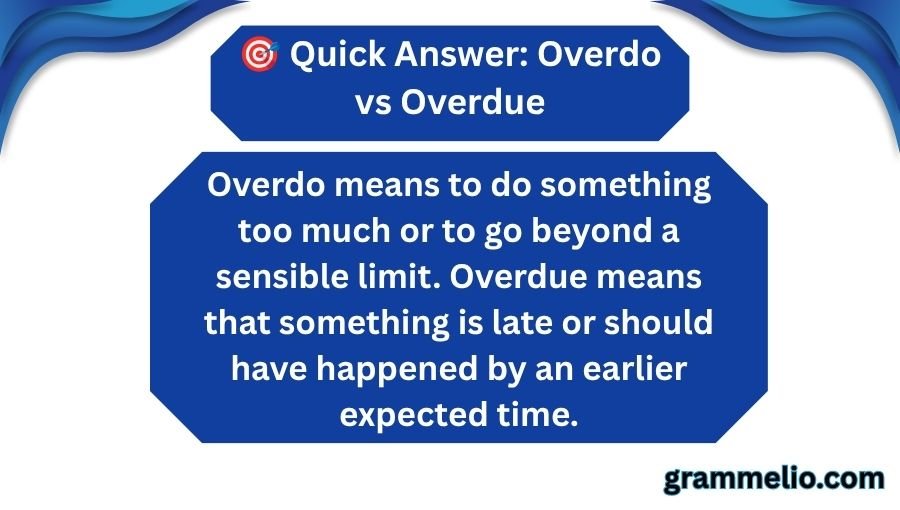
Overdo means to do something too much or to go beyond a sensible limit. Overdue means that something is late or should have happened by an earlier expected time.
For example, you can overdo exercise by exercising too hard, but a bill can be overdue if you did not pay it on time.
| Word | Basic Meaning | Part of Speech | Example |
|---|---|---|---|
| overdo | Do too much | Verb | Don’t overdo the exercise. |
| overdue | Late; past the expected time | Adjective | My library book is overdue. |
The easiest rule is simple: overdo = too much action; overdue = too late.
What Does Overdo Mean?
In the overdo vs overdue comparison, overdue is the word connected with lateness, missed deadlines, or something that should have happened earlier.
Overdo is a verb that means to do something too much, too strongly, or beyond what is reasonable. It often describes an action that goes farther than necessary.
For example:
- ✅ Don’t overdo the salt in the soup.
- ❌ Don’t overdue the salt in the soup.
The first sentence is correct because someone is being warned not to use too much salt.
Overdo as a Verb
The word overdo describes an action. It can refer to physical activity, work, decoration, humor, cooking, exercise, or almost anything else that can be done in excess.
Consider these examples:
- ✅ I think I overdid it at the gym yesterday.
- ❌ I think I overd ue it at the gym yesterday.
- ✅ She tends to overdo the decorations for every party.
- ❌ She tends to overdue the decorations for every party.
- ✅ Don’t overdo the jokes during the meeting.
- ❌ Don’t overdue the jokes during the meeting.
Notice the pattern. If the sentence tells someone not to do too much, the verb overdo is usually the correct choice.
Overdo Can Describe Excess
You can overdo something even when the action itself is normally good.
Exercise is good. Too much exercise can be harmful or tiring.
A joke can be funny. Too many jokes can become annoying.
Seasoning can improve food. Too much seasoning can ruin it.
| Meaning | Word Type | Example Sentence |
|---|---|---|
| Do too much | Verb | Don’t overdo the workout. |
| Go too far | Verb | He overdid the criticism. |
| Use too much of something | Verb | I overdid the sugar in the recipe. |
| Make something excessive | Verb | They overdid the decorations. |
What Does Overdue Mean?
Overdue is an adjective that describes something that is late or has not happened by the expected time.
For example:
- ✅ The payment is overdue.
- ❌ The payment is overdo.
Here, the word describes the payment. The payment should have been made earlier, so overdue is correct.
You might see overdue used with:
- bills
- payments
- assignments
- books
- reports
- projects
- appointments
- repairs
- responses
- deadlines
Overdue Means Late
If something was expected by a certain date but has not happened, it may be overdue.
- ✅ My rent payment is overdue.
- ❌ My rent payment is overdo.
- ✅ The assignment is overdue.
- ❌ The assignment is overdo.
- ✅ That report is three days overdue.
- ❌ That report is three days overdo.
The key idea is time. When something is late, think overdue.
Overdue Can Also Mean Long Expected
Sometimes overdue does not describe a late payment or missed deadline. It can describe something that should have happened much earlier.
For example:
The company finally gave its employees an overdue raise.
The raise may not have had a strict deadline. Instead, it was something people felt should have happened earlier.
Another example is:
Her apology was long overdue.
This means the apology should have come much sooner.
| Use of Overdue | Meaning | Example |
|---|---|---|
| Late payment | Payment was not made on time | The bill is overdue. |
| Late assignment | Work was not submitted on time | My paper is overdue. |
| Late return | Something was not returned on time | The book is overdue. |
| Long expected | Something should have happened earlier | His promotion was overdue. |
🔍 Overdo vs Overdue at a Glance
The main difference is the role each word plays. Overdo is a verb about excessive action. Overdue is an adjective about lateness or something that should have happened earlier.
| Form | Type | Meaning | Example | Correct/Incorrect |
|---|---|---|---|---|
| overdo | Verb | Do too much | Don’t overdo it. | ✅ Correct |
| overdue | Adjective | Late | The payment is overdue. | ✅ Correct |
| overdo | Verb | Late | The payment is overdo. | ❌ Incorrect |
| overdue | Adjective | Do too much | Don’t overdue the exercise. | ❌ Incorrect |
A useful mental shortcut is:
Overdo → Do too much.
Overdue → Due too late.
That connection makes the spelling much easier to remember.
Why Do People Confuse Overdo and Overdue?
People confuse these words because they share the beginning over- and both relate to situations that have gone beyond a normal point. However, the endings tell you what the word means.
Do connects to an action.
Due connects to a deadline, expectation, or time.
I once caught myself typing a quick work message that said, “The invoice is overdo.” I stopped because the sentence was about a missed payment date, not excessive action. Changing it to “The invoice is overdue” fixed the problem immediately. That tiny spelling difference completely changed the meaning.
Fast typing also makes this mistake easy. When you know both words, your brain may choose one based on sound rather than meaning.
💡 Test Tip: Use the Action-or-Time Test
When I teach this distinction, I recommend a very simple test.
Ask yourself:
Am I talking about doing too much?
If yes, use overdo.
Am I talking about something being late or expected earlier?
If yes, use overdue.
Try these:
- ✅ I don’t want to overdo the workout.
- ❌ I don’t want to overdue the workout.
The sentence describes too much exercise, so overdo wins.
Now try:
- ✅ The payment is overdue.
- ❌ The payment is overdo.
The sentence describes a missed deadline, so overdue is correct.
A One-Second Memory Trick
Think of the words this way:
over + do = do too much
over + due = past the due time
This works because the words do and due already give you a clue about their jobs.
📝 Case Study: A Workplace Email
Imagine that an employee needs to send a message to a manager.
The employee writes:
❌ I think the invoice is overdo, so I will pay it tomorrow.
The manager may understand the intended meaning, but the spelling is wrong.
The corrected version is:
✅ I think the invoice is overdue, so I will pay it tomorrow.
Why?
The invoice was supposed to be paid earlier. The employee is talking about time, not excessive action.
Now consider another workplace message:
❌ I don’t want to overdue the presentation with too many slides.
The correct sentence is:
✅ I don’t want to overdo the presentation with too many slides.
This time, the writer is talking about doing too much.
The difference becomes clear when you focus on the meaning instead of the spelling.
| Situation | Correct Word | Example |
|---|---|---|
| Too much exercise | overdo | Don’t overdo your workout. |
| Late bill | overdue | The bill is overdue. |
| Too much decoration | overdo | They overdid the decorations. |
| Late assignment | overdue | The assignment is overdue. |
| Too much detail | overdo | You may be overdoing the explanation. |
Grammar Rules Explanation for Overdo vs Overdue
The grammar rule is based on both meaning and word type.
Overdo functions as a verb. It describes an action. Its basic meaning is to do something excessively.
Overdue functions mainly as an adjective. It describes something that is late or has gone beyond an expected time.
Standard English reference sources agree on this basic distinction, and ordinary sentence structure supports it.
Compare:
I overdid the workout.
Here, overdid is the action performed by the subject.
Now compare:
The workout plan is overdue.
Here, overdue describes the condition of the plan.
Verb Forms of Overdo
Because overdo is a verb, it can change form.
| Verb Form | Example |
|---|---|
| Base form | I try not to overdo it. |
| Third-person singular | She overdoes everything. |
| Present participle | He is overdoing the exercise. |
| Past tense | I overdid the workout. |
| Past participle | We have overdone the decorations. |
This is one reason overdo is easy to recognize. It behaves like a verb.
Overdue Does Not Work Like a Verb
You would not normally say:
❌ I overdue the bill.
Instead, say:
✅ The bill is overdue.
The adjective describes the bill’s status.
Correct vs Incorrect at a Glance
| Sentence | Correct/Incorrect | Why |
|---|---|---|
| Don’t overdo the exercise. | ✅ Correct | The sentence means do not exercise too much. |
| The payment is overdue. | ✅ Correct | The payment is late. |
| She overdid the decorations. | ✅ Correct | She used too many decorations. |
| My assignment is overdo. | ❌ Incorrect | The assignment is late, so use overdue. |
| Don’t overdue the sauce. | ❌ Incorrect | The action involves using too much sauce, so use overdo. |
⚠️ Common Mistakes With Overdo and Overdue
Most mistakes happen because the words look and sound similar. The shared over- beginning makes them even easier to mix up.
Three common causes are especially worth remembering:
1. Fast Typing
When people type quickly, they often choose a familiar spelling without stopping to check meaning.
2. Autocorrect
Autocorrect can sometimes make a sentence look polished even when the wrong word was selected.
3. Lack of Knowledge
If you have never learned the difference, there is no reason for your brain to pause when choosing between the two.
I once edited a short company notice where overdo had been used several times when the writer actually meant overdue. The writer knew exactly what the notice meant, but the wrong word made each sentence sound strange. Once we focused on the idea of a missed deadline, the correction was easy.
| Common Confusion | Correct Choice | Simple Rule |
|---|---|---|
| it’s / its | Depends on meaning | Contraction vs possession |
| your / you’re | Depends on meaning | Possession vs “you are” |
| there / their / they’re | Depends on meaning | Place vs possession vs “they are” |
| then / than | Depends on meaning | Time/order vs comparison |
| overdo / overdue | Depends on meaning | Too much vs too late |
Specific Wrong Uses to Avoid
| Wrong Form | What’s Wrong | Correct Form |
|---|---|---|
| The bill is overdo. | The bill is late. | The bill is overdue. |
| Don’t overdue it. | The action is excessive. | Don’t overdo it. |
| My work is overdo. | The work is late. | My work is overdue. |
| She overdue the exercise. | The verb is wrong. | She overdid the exercise. |
| The assignment is overdo. | A late assignment is overdue. | The assignment is overdue. |
| Don’t overdue the decorations. | Too many decorations means excessive action. | Don’t overdo the decorations. |
How Can You Remember the Difference?
The fastest way to remember the difference is to connect each word to one short phrase.
Overdo = do too much.
Overdue = past due.
You can also use the sentence:
I overdo actions, but deadlines become overdue.
This gives you a clear picture.
If someone works too hard, they may overdo it.
If someone submits work too late, the work becomes overdue.
| Memory Phrase | Word | Meaning |
|---|---|---|
| Do too much | overdo | Excessive action |
| Past due | overdue | Late |
| Go too far | overdo | Excess |
| Miss the expected time | overdue | Late status |
Usage in Different Contexts
The difference between overdo vs overdue remains the same whether you are speaking casually, writing professionally, creating content, or posting on social media.
Both words can appear in everyday writing, but they appear in different kinds of sentences.
Everyday Conversation
People often use overdo when discussing food, exercise, work, or behavior.
Don’t overdo it at the party.
People often use overdue when talking about bills, books, tasks, or expected events.
My library book is overdue.
Professional Writing
In professional writing, overdue commonly appears in notices about payments, reports, tasks, and deadlines.
Overdo may appear when discussing excessive work, design, detail, or effort.
Creative Writing
A writer might use overdo to describe a character who exaggerates.
He tended to overdo every dramatic entrance.
Overdue can create a sense that something has been delayed.
Her return was long overdue.
Social Media and Texting
Informal posts often use overdo when talking about food, fitness, fashion, or reactions.
Overdue is useful when describing something late or something that should have happened earlier.
| Context | Which Term to Use | Example |
|---|---|---|
| Everyday conversation | overdo | Don’t overdo the coffee. |
| Everyday conversation | overdue | My payment is overdue. |
| Professional writing | overdo | We should not overdo the design. |
| Professional writing | overdue | The report is overdue. |
| Creative writing | overdo | The actor overdid the dramatic scene. |
| Creative writing | overdue | The apology was long overdue. |
| Social media/texting | overdo | I definitely overdid the dessert. |
| Social media/texting | overdue | This update is long overdue. |
Common Phrases With Overdo and Overdue
Neither word has a huge list of idioms, but several common phrases are useful.
| Phrase | Meaning |
|---|---|
| overdo it | Do something too much |
| overdo the details | Add more detail than needed |
| overdo the decorations | Decorate excessively |
| overdo the exercise | Exercise too much |
| long overdue | Expected or needed for a long time |
| seriously overdue | Very late |
The phrase overdo it is especially common in everyday English.
For example:
You can enjoy dessert, but don’t overdo it.
The phrase long overdue is also very common.
The team finally received the recognition they deserved, and it was long overdue.
Synonyms and Alternatives
Sometimes you can replace overdo or overdue with another phrase. However, the replacement depends on the exact meaning.
For overdo, useful alternatives include exaggerate, overuse, go too far, and take too far.
For overdue, useful alternatives include late, past due, delayed, and outstanding.
| Alternative | Works When | Does Not Work When |
|---|---|---|
| go too far | Something becomes excessive | Something is simply late |
| exaggerate | A person makes something too extreme | A bill has passed its due date |
| overuse | Something is used too much | An assignment is late |
| late | Something has missed a time | Someone is doing too much |
| past due | A payment or obligation is late | A person is exaggerating |
Be careful with late. It can replace overdue in many situations, but it does not carry exactly the same tone in every sentence.
Is Overdue Always About a Deadline?
No. Overdue can describe something that is late, but it can also describe something that is strongly expected or deserved after a long delay.
For example:
The city finally repaired the old bridge. The repair was long overdue.
There may not have been a single strict deadline. The phrase means the repair should have happened much earlier.
Likewise:
She received an overdue promotion.
This can mean the promotion was deserved and should have happened earlier.
So, overdue is broader than simply “past a deadline.”
Can Overdo Be Used for People?
Yes. Overdo can describe a person’s actions or efforts.
For example:
I think you are overdoing the criticism.
This means the criticism has become excessive.
You can also say:
He overdid it during the workout.
This means he pushed himself too hard.
The word can apply to many actions:
- overdo a workout
- overdo a joke
- overdo a performance
- overdo a design
- overdo the seasoning
- overdo an explanation
Can Overdue Be Used for People?
Usually, overdue describes something rather than a person.
You would normally say:
Her payment is overdue.
You would not normally say:
❌ She is overdue.
However, in some contexts, people may be described as overdue for something.
For example:
She is overdue for a vacation.
Here, the phrase means she has gone too long without taking a vacation.
Another example:
He is overdue for a promotion.
The meaning is that a promotion should have happened earlier.
Which Is Correct: Overdo It or Overdue It?
The correct phrase is overdo it.
✅ Don’t overdo it.
❌ Don’t overdue it.
This is one of the easiest ways to remember the distinction. The common expression uses the verb overdo because it means doing too much.
You can also change the tense:
I overdid it yesterday.
She is overdoing it.
We have overdone it.
The word changes because it is functioning as a verb.
Why Does Getting Overdo vs Overdue Right Matter?
Correct word choice makes your writing easier to understand. A reader should not have to stop and guess what you meant.
In a professional email, one incorrect word can make a simple message look careless.
On a resume, website, article, or school paper, repeated word mistakes can weaken the reader’s trust.
A useful writing principle is:
Clear words make clear messages.
That simple idea applies to every form of communication.
| Situation | Why Getting It Right Matters |
|---|---|
| Resume | Shows attention to detail |
| Client email | Keeps your message professional |
| Published content | Builds reader trust |
| Social post | Makes the meaning clear |
How Do These Words Work in Digital Communication?
Digital writing creates special problems because people often type quickly. Short messages also encourage people to rely on memory instead of checking the meaning.
If you write:
❌ Your payment is overdo.
The reader may understand you, but the sentence contains an obvious word-choice error.
Instead:
✅ Your payment is overdue.
Likewise:
❌ Don’t overdue the explanation.
Should be:
✅ Don’t overdo the explanation.
The correction is small, but the meaning becomes precise.
Practice Examples for Overdo vs Overdue
Try choosing the correct word before looking at the answers.
Example 1
I think I ___ the garlic in this recipe.
Answer: overdid
✅ I think I overdid the garlic in this recipe.
The speaker used too much garlic.
Example 2
The credit card payment is ___.
Answer: overdue
✅ The credit card payment is overdue.
The payment is late.
Example 3
Don’t ___ the special effects.
Answer: overdo
✅ Don’t overdo the special effects.
The warning is about using too many effects.
| Practice Sentence | Answer | Reason |
|---|---|---|
| The bill is ___. | overdue | It is late. |
| Don’t ___ the seasoning. | overdo | Use less of it. |
| The report is three days ___. | overdue | It missed the expected time. |
| She ___ the makeup. | overdid | She used too much. |
| Don’t ___ it. | overdo | Do not go too far. |
Quick Recap Checklist
Use this checklist whenever you are unsure.
| Question | If Yes → Use |
|---|---|
| Does the sentence mean “do too much”? | overdo |
| Does it describe a late bill? | overdue |
| Does it describe excessive effort? | overdo |
| Does it describe a missed deadline? | overdue |
| Can you replace it with “past due”? | overdue |
| Can you replace it with “do too much”? | overdo |
Final Practice
- Don’t ___ the presentation with unnecessary slides.
Answer: overdo - The payment is two weeks ___.
Answer: overdue - I think I ___ it by adding too much detail.
Answer: overdid
If the sentence involves too much action, choose overdo. If it involves lateness, choose overdue.
FAQs About Overdo vs Overdue
What is the difference between overdo and overdue?
Overdo means to do something too much or go beyond a reasonable limit. Overdue means something is late or should have happened earlier.
Is it overdo it or overdue it?
The correct expression is overdo it. For example, say, “Don’t overdo it.” The phrase means do not go too far.
Is it overdo or overdue for a bill?
Use overdue for a bill because a bill can be late. For example, “My electricity bill is overdue.”
Can I say my assignment is overdo?
No. The correct sentence is “My assignment is overdue.” An assignment is overdue when it has not been submitted by the expected time.
What does overdo mean in a sentence?
Overdo means to do something excessively. For example, “Don’t overdo the exercise” means do not exercise more than you should.
What does overdue mean in a sentence?
Overdue means late or past the expected time. For example, “The library book is overdue” means the book should have been returned earlier.
How can I easily remember overdo vs overdue?
Remember overdo = do too much and overdue = past due. The word do points to an action, while due points to a deadline or expected time.
Is overdue only used for money?
No. You can use overdue for bills, assignments, books, reports, projects, repairs, responses, and many other things that are late or should have happened earlier.
Can overdo be used in the past tense?
Yes. The past tense is overdid. For example, “I overdid the workout yesterday.” The past participle is overdone, as in “I have overdone it.”
Which word should I use for “too much”?
Use overdo. If you mean someone did something excessively, overdo is the correct verb. For example, “You can enjoy the food, but don’t overdo it.”
Conclusion: Master Overdo vs Overdue Once and For All
Overdo vs overdue becomes much easier once you connect each word with its main idea. Overdo is a verb that means to do too much, push something too far, or make something excessive. Overdue is an adjective that means late or expected earlier than it actually happened. 😊
When you are unsure, ask one simple question: Am I talking about too much action or too much time? If the answer is too much action, choose overdo. If the answer is lateness, choose overdue.
Remember these two short clues:
Overdo = do too much.
Overdue = past due.
I recommend using that test whenever you are writing an email, assignment, report, or social post. It takes only a second and can prevent an embarrassing mistake. ✨
Once you learn to focus on meaning instead of just spelling, these two words stop being confusing. Do too much? Overdo. Past the expected time? Overdue. That simple rule is all you need to get it right.




[…] stopping to second-guess yourself. Let’s make passed vs past simple once and for all. ✍️ Overdo vs Overdue | Ordinance vs Ordnance | Oar vs Or vs […]