Have you ever typed a sentence and stopped because you could not decide between passed vs past? I have seen this mix-up countless times in student work, emails, social posts, and even polished business writing.
The two words sound alike, but they do different jobs in a sentence. That small difference can change the meaning of what you write. If you are a student, writer, teacher, job seeker, or simply someone who wants clearer English, learning this rule will save you time and prevent easy mistakes. 😊
I’ll break the difference down with simple rules, examples, memory tricks, and real-life situations. By the end, you should feel confident choosing the right word without stopping to second-guess yourself. Let’s make passed vs past simple once and for all. ✍️ Overdo vs Overdue | Ordinance vs Ordnance | Oar vs Or vs Ore
🎯 Quick Answer: Passed vs Past
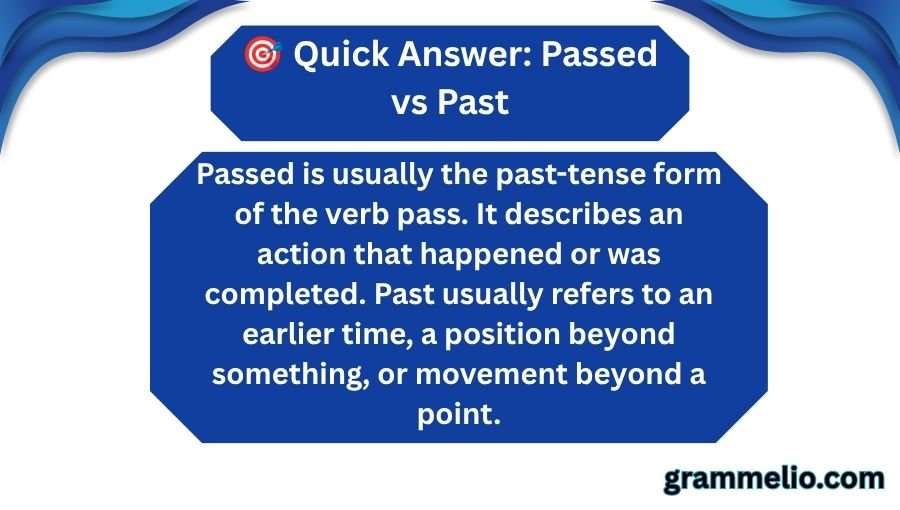
Passed is usually the past-tense form of the verb pass. It describes an action that happened or was completed. Past usually refers to an earlier time, a position beyond something, or movement beyond a point.
For example:
- I passed the test. ✅
- I walked past the school. ✅
A simple rule is this: passed is usually a verb, while past is usually a noun, adjective, preposition, or adverb.
Is Passed the Same as Past?
No, passed and past are not the same. They sound almost identical in many forms of spoken English, but they have different meanings and grammatical roles.
Think of passed as an action word. Someone or something does the passing.
Think of past as a word connected to time, position, or movement beyond something.
| Form | Type | Meaning | Example | Correct/Incorrect |
|---|---|---|---|---|
| passed | Verb | Moved beyond, succeeded, handed, or completed | I passed the exam. | ✅ Correct |
| past | Noun | Time before now | We cannot change the past. | ✅ Correct |
| past | Adjective | Earlier or former | Past events can teach us. | ✅ Correct |
| past | Preposition | Beyond a place or point | She walked past me. | ✅ Correct |
| past | Adverb | Beyond a certain point | The train went past. | ✅ Correct |
The biggest mistake is treating these words as interchangeable simply because they sound alike.
Passed vs Past: Meaning and Correct Use
The easiest way to understand passed vs past is to look at what each word does in a sentence.
Passed normally tells us that an action happened. Past usually tells us about time, position, or something beyond a point.
Passed as a Verb
Passed is the past tense and past participle of pass.
You use it when someone or something completes an action involving passing.
Examples:
- I passed my driving test. ✅
- She passed me on the highway. ✅
- He passed the ball to his teammate. ✅
- We passed the old bridge. ✅
Here, each sentence describes an action.
The subject performs the action. That is a useful clue.
Past as a Noun
Past can refer to a time that has already happened.
Examples:
- We should learn from the past. ✅
- She often talks about her past. ✅
- The past cannot be changed. ✅
In these sentences, past is not an action. It refers to earlier time.
Past as a Preposition
Past can also show movement beyond a person, place, object, or point.
Examples:
- I walked past the library. ✅
- The car drove past our house. ✅
- She ran past me. ✅
Here, past means something like “beyond.”
Past as an Adjective
Past can describe something that happened earlier.
Examples:
- We discussed past mistakes. ✅
- His past experiences helped him. ✅
- The past president attended the event. ✅
A Quick Meaning Table
| Meaning | Word Type | Example Sentence |
|---|---|---|
| Completed an action | Verb | She passed the exam. |
| Earlier time | Noun | The past is behind us. |
| Beyond a point | Preposition | He walked past the store. |
| Earlier or former | Adjective | We reviewed past records. |
💡 Test Tip: Try “Did Someone Do It?”
Here is one of my favorite tests.
Ask yourself:
Did someone or something perform an action?
If yes, passed may be the right choice.
- She passed the test. → Did she perform the action of passing? Yes. ✅
- He passed the ball. → Did he perform an action? Yes. ✅
But:
- She walked past the store. → “Past” describes where she walked. ✅
This test will not solve every sentence by itself, but it works very well in common cases.
Why Do People Confuse Passed and Past?
People confuse these words mainly because they sound alike. The problem becomes even worse when people type quickly or rely on sound instead of grammar.
I once edited a short school essay where a student wrote, “We drove passed the museum.” The sentence looked reasonable at first glance. The student had simply chosen the word based on how it sounded. Once I explained that past meant “beyond the museum,” the mistake made sense to them.
Here are some common reasons for the confusion:
- They are pronounced very similarly.
- Both can appear in sentences about movement.
- Fast typing can lead to the wrong spelling.
- Autocorrect may not catch the error.
- Writers may not know which grammatical role each word plays.
- People often choose the word that “sounds right.”
| Confusing Pair | Main Difference | Example |
|---|---|---|
| passed / past | Action vs. time or position | I passed the store / I walked past it. |
| it’s / its | It is vs. possession | It’s cold / Its color is blue. |
| your / you’re | Possession vs. you are | Your car / You’re late. |
| they’re / their / there | They are vs. possession vs. place | They’re here with their bags. |
| then / than | Time/order vs. comparison | First this, then that / Taller than me. |
The key is to focus on meaning rather than sound.
How Can You Remember Passed vs Past?
You can remember the difference by connecting passed with the verb pass.
If the sentence describes an action, think:
pass → passed
If the sentence describes earlier time or movement beyond something, think:
past
Here are a few memory clues:
- Passed = action
- Past = time
- Past = beyond
- Passed = completed passing
| Memory Clue | Word | Example |
|---|---|---|
| An action happened | passed | I passed the test. |
| Something happened before now | past | That happened in the past. |
| Something is beyond a place | past | Walk past the bank. |
| Someone moved beyond something | passed | The runner passed me. |
A useful trick is to replace the word with “moved beyond”.
If that idea describes an action performed by the subject, passed may work.
If you are describing a location that someone moves beyond, past is often the better choice.
Passed vs Past in Movement Sentences
Movement sentences are one of the biggest trouble spots because both words can appear in similar situations.
Compare these:
- The runner passed me. ✅
- The runner ran past me. ✅
Both sentences are correct, but the grammar is different.
In the first sentence, passed is the verb.
In the second sentence, ran is the verb. Past tells us where the runner went.
This difference is extremely useful.
| Sentence | Main Verb | Role of Passed/Past |
|---|---|---|
| The car passed us. | passed | Verb |
| The car drove past us. | drove | Preposition |
| She passed the house. | passed | Verb |
| She walked past the house. | walked | Preposition |
| He passed the finish line. | passed | Verb |
| He ran past the finish line. | ran | Preposition |
Passed or Past After a Verb?
When another verb already describes movement, past is often used to describe the direction or position.
For example:
- She walked past the café. ✅
- He ran past the gate. ✅
- They drove past the stadium. ✅
But if pass itself is the action, use passed:
- She passed the café. ✅
- He passed the gate. ✅
- They passed the stadium. ✅
Both structures can be correct. The important question is which word is acting as the verb.
📝 Case Study: A Simple Workplace Example
Imagine that you work in an office and need to tell your manager that you drove by a client’s building.
You write:
“I drove passed the client’s office this morning.”
That sentence is incorrect.
The correct version is:
“I drove past the client’s office this morning.” ✅
Why?
Because drove is already the verb. Past tells us where the car went.
Now change the sentence:
“I passed the client’s office this morning.” ✅
That sentence is also correct.
Here, passed is the main verb.
I once caught a similar error in a business email while proofreading a report. The writer had used “passed” after another movement verb. The meaning was clear, but the grammar looked careless. Changing one word made the sentence much cleaner.
| Original | Better Version | Reason |
|---|---|---|
| I drove passed the office. | I drove past the office. | “Drove” is the verb. |
| She walked passed me. | She walked past me. | “Walked” is the verb. |
| He passed me on the road. | He passed me on the road. | “Passed” is the verb. |
| We went past the store. | We went past the store. | “Past” shows location. |
What Are the Grammar Rules for Passed and Past?
The main grammar rule is simple: passed is a form of the verb pass, while past usually has another grammatical role.
Passed can show that someone moved ahead of something, succeeded in something, handed something over, or completed an action.
Examples:
- She passed the exam.
- He passed the ball.
- The car passed our house.
- They passed the final checkpoint.
Past can refer to time that has already happened.
Examples:
- The past cannot be changed.
- We studied past events.
- He has learned from his past.
Past can also show movement beyond a location or person.
Examples:
- She walked past the door.
- The bus went past us.
- I drove past the store.
Standard English references agree on this basic distinction. The best way to apply it is to identify the grammatical job of the word in your sentence.
Correct vs Incorrect at a Glance
| Sentence | Correct/Incorrect | Why |
|---|---|---|
| I passed the test. | ✅ Correct | “Passed” is the verb. |
| I walked past the test center. | ✅ Correct | “Past” shows location. |
| I walked passed the test center. | ❌ Incorrect | “Walked” is the verb, so “past” is needed. |
| We passed the old building. | ✅ Correct | “Passed” is the main verb. |
| We drove passed the old building. | ❌ Incorrect | “Drove” is the verb; “past” shows direction. |
⚠️ Common Mistakes With Passed and Past
Understanding passed vs past can help you avoid some of the most common mistakes in everyday English.
Most mistakes happen when writers hear the sentence instead of looking at its grammar.
For example:
❌ I walked passed your house.
The sentence sounds natural when spoken quickly. But walked is already the verb.
Correct:
✅ I walked past your house.
Another common mistake is using past where an action is required.
❌ I past the exam.
Correct:
✅ I passed the exam.
Here are specific errors to watch for.
| Wrong Form | What’s Wrong | Correct Form |
|---|---|---|
| I past the test. | “Past” cannot be the past-tense verb here. | I passed the test. |
| She walked passed me. | “Walked” is already the verb. | She walked past me. |
| He drove passed the bank. | “Drove” is the main verb. | He drove past the bank. |
| We past the house. | The action requires “passed.” | We passed the house. |
| They ran passed us. | “Ran” is the verb. | They ran past us. |
| I have past the deadline. | The verb form is incorrect. | I have passed the deadline. |
Why Fast Typing Causes Problems
When I type quickly, I sometimes catch myself choosing a word because it sounds right rather than because it fits the sentence. That is exactly how homophone errors happen.
Autocorrect can make this worse because both passed and past are valid English words. A spelling checker may not flag the wrong choice.
That means you need a meaning check, not just a spelling check.
Is Passed Always a Verb?
In standard English use, passed is primarily a verb form. It is the past tense and past participle of pass.
Examples:
- She passed the exam.
- He passed the ball.
- They passed the house.
- The deadline has passed.
The word describes an action or a completed event.
| Example | What “Passed” Means |
|---|---|
| She passed the exam. | She succeeded. |
| He passed the ball. | He gave or threw it onward. |
| The car passed us. | The car moved ahead of us. |
| Time passed quickly. | Time moved forward. |
Can Past Be a Verb?
No. Past is not the standard past-tense form of pass.
The correct verb form is passed.
Compare:
- I passed the exam. ✅
- I past the exam. ❌
If you need a verb showing the action of passing, use passed.
This is one of the easiest rules in the entire topic.
How Is Past Used for Time?
Past commonly refers to a time before the present.
Examples:
- In the past, people wrote more letters.
- We cannot change the past.
- She has moved beyond her past.
- His past taught him valuable lessons.
It can also appear in time expressions.
Examples:
- It is half past three. ✅
- The meeting ended ten minutes past noon. ✅
- We arrived a little past midnight. ✅
| Time Expression | Meaning |
|---|---|
| past noon | After noon |
| past midnight | After midnight |
| half past three | 3:30 |
| in the past | At an earlier time |
This use has nothing to do with the verb passed.
How Is Past Used for Location?
Past can show that someone or something is beyond a particular place.
For example:
- Walk past the library.
- Drive past the school.
- Run past the finish line.
- Go past the blue door.
In these sentences, past helps explain direction or position.
| Sentence | Meaning of Past |
|---|---|
| Walk past the store. | Go beyond the store. |
| Drive past the house. | Travel beyond the house. |
| Run past me. | Move beyond my position. |
| Go past the gate. | Move beyond the gate. |
How Do Passed and Past Work in Professional Writing?
In professional writing, choosing the right word helps your message sound polished.
Consider these examples:
- “The deadline has passed.” ✅
- “The deadline is in the past.” ✅
- “I drove past the office.” ✅
- “I passed the office on my way home.” ✅
All four can be correct because the grammar changes with the sentence.
| Professional Situation | Which Term to Use | Example |
|---|---|---|
| Completed a test | passed | She passed the certification test. |
| Earlier events | past | We reviewed past reports. |
| Movement beyond a place | past | I drove past the office. |
| Completed movement | passed | I passed the office at 9 a.m. |
Passed vs Past in Different Contexts
The context can make the choice much easier. Look at what you are trying to say before choosing the spelling.
| Context | Which Term to Use | Example |
|---|---|---|
| Everyday conversation | Either, depending on meaning | I passed him / I walked past him. |
| Professional writing | Either, depending on grammar | The deadline passed. |
| Creative writing | Either, depending on meaning | She looked into her past. |
| Social media/texting | Either, depending on meaning | I drove past your place. |
The important point is that neither word is “better.” They simply perform different jobs.
What Are Common Phrases With Passed?
Several common expressions use passed because they describe an action or event.
| Phrase | Meaning |
|---|---|
| passed the test | Succeeded on a test |
| passed away | Died |
| passed by | Moved or went by |
| passed on | Gave something to another person or moved onward |
| passed the deadline | Went beyond a deadline |
| passed the ball | Sent the ball to another player |
Examples:
- She passed the test. ✅
- His grandfather passed away. ✅
- The opportunity passed by. ✅
These phrases can help you recognize passed as a verb.
What Are Common Phrases With Past?
Past also appears in many common expressions connected to time or movement.
| Phrase | Meaning |
|---|---|
| in the past | At an earlier time |
| past midnight | After midnight |
| past experience | Experience from an earlier time |
| past mistakes | Mistakes made before now |
| move past | Go beyond something |
| look past | Ignore or see beyond something |
Examples:
- We learn from the past. ✅
- She moved past her fears. ✅
- He has learned from past mistakes. ✅
Are There Alternatives to Passed and Past?
Sometimes you can rewrite a sentence to avoid the confusion, but you should not replace these words blindly.
For example, instead of:
“I walked past the store.”
you might say:
“I walked beyond the store.”
The meaning is similar.
Instead of:
“I passed the test.”
you might say:
“I succeeded on the test.”
That works because succeeded expresses the same general idea in that context.
| Alternative | Works When | Does Not Work When |
|---|---|---|
| beyond | Showing movement or position | Talking about passing a test |
| earlier | Referring to previous time | Describing a passing action |
| succeeded | Talking about success | Showing physical movement |
| went by | Describing movement or time | Formal contexts where “passed” is clearer |
| before | Referring to earlier time | Replacing every use of “past” |
Choose an alternative only when it keeps the original meaning.
Why Does Getting Passed vs Past Right Matter?
Correct word choice makes your writing easier to understand. It also shows that you understand how English works.
A sentence like “I past the exam” can distract the reader because the word is not being used as a verb correctly.
A sentence like “I walked passed the store” can make polished writing look less careful.
Here is a useful principle:
Clear writing begins with choosing the word that matches the meaning.
That matters in schoolwork, resumes, client emails, reports, websites, and social posts.
| Situation | Why Getting It Right Matters |
|---|---|
| Resume | Shows attention to detail |
| Client email | Builds professional trust |
| Published content | Improves clarity and quality |
| Social post | Prevents confusing readers |
Good grammar does not need to sound fancy. It needs to make your meaning clear.
What Is the Best Way to Learn the Difference?
The fastest method is to practice the two words in contrasting sentences.
Start with this pair:
- I passed the store. ✅
- I walked past the store. ✅
Now change the context:
- I passed the exam. ✅
- I studied events from the past. ✅
Notice the pattern.
Passed describes an action.
Past describes time, position, or movement beyond something.
| Question to Ask | If Yes | Use |
|---|---|---|
| Is it an action performed by the subject? | Yes | passed |
| Does it mean an earlier time? | Yes | past |
| Does it mean beyond a place or point? | Yes | past |
| Is it the past form of “pass”? | Yes | passed |
How Can You Practice Passed and Past?
Try filling in each blank before checking the answers.
- I ______ the final exam.
- We walked ______ the restaurant.
- The deadline has ______.
- She talked about her ______.
- The bus drove ______ us.
- He ______ the ball to me.
Answers
- passed ✅
- past ✅
- passed ✅
- past ✅
- past ✅
- passed ✅
The more you see these words in different sentence patterns, the faster the difference becomes automatic.
✅ Quick Recap Checklist
Use this passed vs past checklist whenever you are unsure which word belongs in a sentence.
Use this checklist whenever you are unsure.
| Question | If Yes → Use |
|---|---|
| Is the word describing the action of passing? | passed |
| Does the word mean an earlier time? | past |
| Does the word mean beyond a place? | past |
| Can you replace it with “pass” in the present tense? | passed |
| Is another verb already showing movement? | Often past |
Practice Examples
1. I ______ my driving test yesterday.
Answer: passed ✅
2. We walked ______ the library.
Answer: past ✅
3. She learned from her ______ mistakes.
Answer: past ✅
Is “I Passed the Store” Correct?
Yes. “I passed the store” is correct when passed means that you moved beyond the store.
For example:
I passed the store on my way to work. ✅
You can also say:
I walked past the store on my way to work. ✅
The difference is grammatical. In the first sentence, passed is the verb. In the second sentence, walked is the verb and past describes the movement.
Is “I Walked Passed the Store” Correct?
No. The standard form is:
I walked past the store. ✅
The reason is simple: walked is already the verb. You need past to show that you moved beyond the store.
This is one of the most common mistakes involving these words.
Should I Say “Passed Time” or “Past Time”?
Both phrases can exist, but they have different meanings.
Passed time usually refers to time that has gone by or an action involving the verb pass.
- The hours passed quickly. ✅
Past time can refer to a time that has already gone by, depending on the sentence.
- That event is in the past. ✅
There is also the phrase past time, meaning a previous period.
The exact sentence matters, so do not choose based only on sound.
Is “Time Has Past” or “Time Has Passed” Correct?
The standard expression is:
Time has passed. ✅
Here, passed is the verb.
You could also say:
Time is in the past. ✅
But the meaning and structure are different.
Compare:
| Sentence | Correct? | Reason |
|---|---|---|
| Time has passed. | ✅ | “Passed” is the verb. |
| Time has past. | ❌ | “Past” is not the correct verb form. |
| The past is behind us. | ✅ | “Past” is a noun. |
| We cannot change the past. | ✅ | “Past” refers to earlier time. |
FAQs About Passed vs Past
What is the difference between passed and past?
Passed is generally a verb that describes an action. Past usually refers to earlier time or something beyond a place or point.
Example: “I passed the test” and “I walked past the school.”
Is passed the past tense of pass?
Yes. Passed is the simple past form of the verb pass, and it is also used as the past participle.
Examples:
- I pass the test.
- I passed the test.
- I have passed the test.
Is past a verb?
No. Past is not the standard past-tense form of pass. When you need the verb, use passed.
- I passed the exam. ✅
- I past the exam. ❌
Should I use passed or past for movement?
It depends on the sentence. Use passed when it is the verb. Use past when another verb describes the movement and past shows movement beyond something.
- The car passed us. ✅
- The car drove past us. ✅
Is “walked past” correct?
Yes. “Walked past” is correct because walked is the verb and past shows movement beyond a person, place, or object.
Example:
She walked past my desk. ✅
Is “walked passed” correct?
No. In standard English, use walked past, not walked passed.
- He walked past me. ✅
- He walked passed me. ❌
Is “passed the house” correct?
Yes. “Passed the house” is correct when passed is the main verb.
Example:
We passed the house on our way home. ✅
You can also say:
We drove past the house. ✅
Both are grammatical.
Is “past” used for time?
Yes. Past can refer to an earlier period or a time before the present.
Examples include:
- in the past
- past mistakes
- past experiences
- half past three
How can I remember passed vs past?
Remember this simple rule:
Passed = action. Past = time or beyond.
If someone performs the action of passing, passed is usually right. If you are talking about an earlier time or something beyond a point, past is usually right.
Which is correct: “I passed by” or “I past by”?
The correct phrase is “I passed by.” Here, passed is the verb.
Example:
I passed by your house yesterday. ✅
Conclusion: Passed vs Past Made Simple
Passed vs past becomes much easier when you stop focusing on how the words sound and start looking at their jobs in the sentence. Passed is generally the verb form of pass, so use it for an action that happened. Past usually refers to earlier time, something beyond a point, or movement beyond a location. 😊
When you are unsure, ask yourself one quick question: Am I describing an action, or am I describing time or position? If it is an action of passing, choose passed. If it refers to earlier time or means beyond something, choose past.
Remember these two examples:
I passed the test.
I walked past the school.
Once this pattern becomes familiar, you will spot the correct word much faster. Keep the rule simple, practice with real sentences, and trust the meaning rather than the sound. ✨
Passed is the action. Past is the time or the place beyond.

[…] can help you avoid small spelling mistakes that completely change the meaning of a sentence. Passed vs Past | Overdo vs Overdue | Ordinance vs […]
[…] make this confusing pair simple. 😊 Patience vs Patients | Passed vs Past | Overdo vs […]