Have you ever stopped while writing because you were unsure whether to use threw vs through vs thorough? I have seen this mix-up many times in student assignments, emails, workplace documents, and online posts.
These three words look and sound similar, but they have very different meanings and grammatical jobs. If you are learning English, improving your writing, or trying to avoid common spelling mistakes, understanding this difference can make your writing much clearer. 😊
The good news is that you do not need a complicated grammar rule to master these words. Once you connect each spelling with its meaning, choosing the right one becomes much easier.
In this guide, I will explain each word with simple definitions, practical examples, memory tricks, common mistakes, and real-life situations. By the end, you will know exactly when to use each word with confidence. ✍️ Tear vs Tier | Team vs Teem | Taught vs Taut
🎯 Quick Answer: Threw vs Through vs Thorough
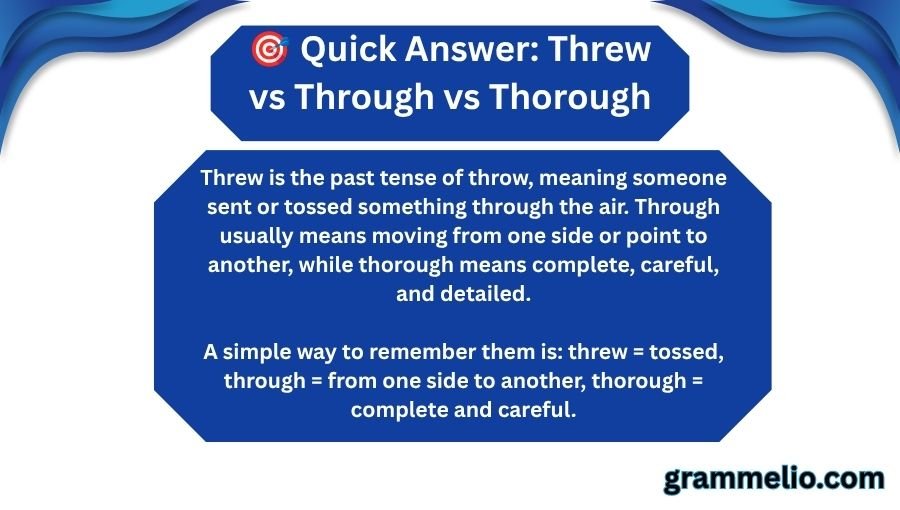
Threw is the past tense of throw, meaning someone sent or tossed something through the air. Through usually means moving from one side or point to another, while thorough means complete, careful, and detailed.
A simple way to remember them is: threw = tossed, through = from one side to another, thorough = complete and careful.
| Word | Part of Speech | Basic Meaning | Example |
|---|---|---|---|
| Threw | Verb | Tossed or sent through the air | She threw the ball. |
| Through | Preposition/Adverb | From one side or point to another | We walked through the park. |
| Thorough | Adjective | Complete and careful | He did a thorough review. |
Related Word Forms
These three words do not share the same word family, but each has related forms that can help you understand its use.
| Form | Type | Example |
|---|---|---|
| Throw | Base verb | I throw the ball every day. |
| Threw | Past-tense verb | I threw the ball yesterday. |
| Thrown | Past participle | She has thrown the ball. |
| Through | Preposition/adverb | We walked through the door. |
| Thorough | Adjective | The inspection was thorough. |
| Thoroughly | Adverb | We thoroughly checked the report. |
| Thoroughness | Noun | Her thoroughness impressed the team. |
The biggest trap is the relationship between throw and threw. Threw is a verb, but through and thorough are not past forms of throw. Their spellings may look similar, but their meanings are separate.
🧠 Understanding the Basics of Threw vs Through vs Thorough
The easiest way to understand threw vs through vs thorough is to focus on the action or idea in the sentence.
Threw describes an action involving throwing something.
Through describes movement, passage, completion of a process, or a position inside or across something.
Thorough describes something done with great care and attention to detail.
| Form | Type | Meaning | Example | Correct/Incorrect |
|---|---|---|---|---|
| Threw | Verb | Tossed something | Mia threw the keys. | ✅ Correct |
| Through | Preposition | From one side to another | We drove through the tunnel. | ✅ Correct |
| Thorough | Adjective | Complete and careful | She gave the file a thorough review. | ✅ Correct |
| Through | Verb | Past tense of throw | He through the ball. | ❌ Incorrect |
| Thorough | Verb | Past tense of throw | She thorough the ball. | ❌ Incorrect |
Threw: Meaning and Correct Use
Threw is the simple past tense of throw. Use it when someone tossed, launched, or sent something through the air.
For example:
- She threw the ball to her brother.
- The child threw the toy across the room.
- He threw the paper into the trash.
- I threw the old box away.
- The pitcher threw the ball toward home plate.
Look at this sentence:
Jake threw the keys onto the table.
The word threw tells us what Jake did. He sent the keys through the air.
Through: Meaning and Correct Use
Through has several common uses. The main idea is movement from one side, point, or stage to another.
For example:
- We walked through the forest.
- The train passed through the tunnel.
- She looked through the window.
- I read through the entire report.
- He worked through the night.
It can also describe finishing a process.
I am through with my homework.
Here, through does not mean that something physically passed from one side to another. It means the activity is finished.
Thorough: Meaning and Correct Use
Thorough is an adjective. It describes something that is complete, careful, and detailed.
Examples include:
- The doctor performed a thorough examination.
- Please give the document a thorough review.
- We need a thorough investigation.
- She conducted a thorough search.
- His explanation was thorough and easy to understand.
Notice that thorough describes a person, action, examination, search, review, explanation, or similar noun. It does not describe the act of tossing something.
A Quick Meaning Table
| Meaning | Word Type | Example Sentence |
|---|---|---|
| Tossed something | Verb | Liam threw the ball. |
| Moved from one place to another | Preposition/adverb | We walked through the building. |
| Finished or completed a process | Preposition/adverb | I am through with the project. |
| Complete and careful | Adjective | She gave the report a thorough review. |
💡 Test Tip: Ask What the Sentence Is Doing
When I teach this difference, I recommend asking one quick question:
Is someone tossing something?
If yes, use threw.
Is something moving from one place or stage to another?
If yes, use through.
Does the word describe careful, complete work?
If yes, use thorough.
| Question | Answer | Word |
|---|---|---|
| Did someone toss something? | Yes | Threw |
| Is something passing from one point to another? | Yes | Through |
| Is something complete and careful? | Yes | Thorough |
Is Threw the Same as Through or Thorough?
No. Threw is the past tense of throw, while through and thorough have different meanings and grammatical roles.
Consider these examples:
✅ Maria threw the ball over the fence.
❌ Maria through the ball over the fence.
The second sentence is wrong because through does not mean “tossed.”
Now consider:
✅ We walked through the doorway.
❌ We walked threw the doorway.
The second sentence is wrong because threw is a past-tense verb. It cannot replace the preposition through.
Finally:
✅ The manager conducted a thorough review.
❌ The manager conducted a through review.
The second sentence is wrong because the manager’s review is being described as complete and careful. The correct adjective is thorough.
Why Do People Confuse Threw, Through, and Thorough?
People confuse these words mainly because they look and sound similar. English has many words that share letters or similar sounds but perform different jobs.
I once edited a short school essay in which a student wrote, “The teacher threw the chapter.” The student meant that the teacher read the chapter completely. The intended word was not threw at all. The sentence needed through: “The teacher read through the chapter.” That small spelling choice completely changed the meaning.
Common reasons for confusion include:
- Similar spelling
- Similar pronunciation
- Fast typing
- Autocorrect
- Learning English by sound
- Not knowing the part of speech
- Writing before checking the sentence meaning
| Confusing Pair | Main Difference |
|---|---|
| Your / You’re | Possession vs. “you are” |
| It’s / Its | “It is” vs. possession |
| There / Their / They’re | Place vs. possession vs. “they are” |
| Then / Than | Time/order vs. comparison |
| To / Too / Two | Direction/infinitive vs. also vs. number |
| Threw / Through / Thorough | Tossed vs. passage vs. complete/careful |
The best solution is not simply memorizing spelling. You should connect each spelling to its job.
📝 Case Study: A Simple Workplace Example
Imagine that a manager sends an email after a project review.
The manager might write:
“I threw the old notes away after I read through the report and completed a thorough review.”
Each word has a different job.
- Threw = tossed the old notes away.
- Through = read from beginning to end.
- Thorough = careful and complete review.
This example shows why the difference matters. All three words can appear in the same sentence without meaning the same thing.
I once caught myself typing through when I meant thorough in an editing note. I noticed because I was describing a detailed review, not movement through a document. That quick meaning check saved the sentence.
📚 Grammar Rules Explanation for Threw vs Through vs Thorough
The grammar rule is simple once you identify the role of each word.
Threw is a past-tense verb. It tells us that someone or something performed the action of throwing in the past.
David threw the ball.
Through commonly works as a preposition or adverb. It can describe movement inside, across, or from one point to another.
David walked through the gate.
It can also describe movement across a process or period.
David worked through the problem.
Thorough is an adjective. It describes a noun as complete, careful, or detailed.
David gave the problem a thorough review.
Most standard English references agree on these basic distinctions. A good dictionary can also help when you encounter an unusual use.
Correct vs Incorrect at a Glance
| Sentence | Correct/Incorrect | Why |
|---|---|---|
| She threw the ball. | ✅ Correct | Threw is the past tense of throw. |
| She through the ball. | ❌ Incorrect | Through is not the past tense of throw. |
| We walked through the park. | ✅ Correct | Through describes movement. |
| He completed a thorough search. | ✅ Correct | Thorough describes the search. |
| He completed a threw search. | ❌ Incorrect | Threw cannot describe a search. |
A useful grammar check is to replace the word mentally.
- Threw → tossed
- Through → from one side to another / all the way through
- Thorough → complete and careful
If the replacement makes sense, you have probably chosen correctly.
⚠️ Common Mistakes With Threw vs Through vs Thorough
The most common mistakes happen when writers choose a word because it sounds right rather than because it fits the meaning.
Fast typing makes this worse. Autocorrect can also fail because all three spellings are legitimate English words. A spell-checker may not flag the wrong word if the word itself is spelled correctly.
For example, “She threw the tunnel” is spelled correctly but does not make normal sense in the intended context.
| Mistake | Why It Happens | Better Approach |
|---|---|---|
| Using through for tossed | Similar spelling | Replace it with “tossed” |
| Using threw for movement | Similar sound | Ask whether something moved through a place |
| Using threw as an adjective | Confusing verb and adjective | Look for a noun being described |
| Using thorough for movement | Similar letters | Ask whether the meaning is “complete and careful” |
| Trusting autocorrect | All forms are real words | Check meaning, not just spelling |
Common Wrong Forms and Uses
| Wrong Form/Use | What’s Wrong | Correct Form |
|---|---|---|
| I through the ball. | Through is not past tense of throw. | I threw the ball. |
| We threw the tunnel. | Threw does not mean movement through a tunnel. | We went through the tunnel. |
| A through inspection | The intended adjective is “complete and careful.” | A thorough inspection |
| She thorough the paper away. | Thorough is not a verb meaning tossed. | She threw the paper away. |
| He gave it a threw review. | Threw cannot describe a review. | He gave it a thorough review. |
| We walked thorough the door. | The intended meaning is movement through a doorway. | We walked through the door. |
How Can You Remember the Difference?
The easiest memory trick is to give each word a short nickname.
Threw = tossed.
Through = passage.
Thorough = complete.
| Word | Memory Word | Mental Picture |
|---|---|---|
| Threw | Tossed | 🏀 A ball flying through the air |
| Through | Passage | 🚪 Walking from one side of a door to another |
| Thorough | Complete | 🔎 Checking every part of a report |
Try this three-step test:
- Replace the word with tossed.
- Replace it with from one side to another.
- Replace it with complete and careful.
Only one replacement should normally fit.
For example:
She ___ the keys onto the desk.
“Tossed” works. So the answer is threw.
We walked ___ the hallway.
“From one side to another” works. So the answer is through.
The inspector performed a ___ check.
“Complete and careful” works. So the answer is thorough.
Threw vs Through vs Thorough in Different Contexts
The correct word depends on what you want to say. The setting does not change the basic meanings, but different settings create different common uses.
| Context | Which Term to Use | Example |
|---|---|---|
| Everyday conversation | Threw | I threw the keys on the table. |
| Professional writing | Thorough | We completed a thorough review. |
| Creative writing | Through | The hero walked through the dark forest. |
| Social media/texting | Threw | She threw the ball so far! |
| Work instructions | Through | Read through the instructions first. |
| Reports | Thorough | A thorough analysis was completed. |
| Sports | Threw | The quarterback threw the ball. |
| Travel | Through | We drove through the city. |
Everyday Conversation
You may use threw when talking about something someone tossed.
“He threw his jacket on the chair.”
You may use through when describing movement.
“We drove through downtown.”
You may use thorough when describing careful work.
“She did a thorough job.”
Professional Writing
Professional writing often uses through and thorough.
Examples include:
- Please read through the contract.
- We need to work through the issue.
- The team conducted a thorough review.
- Please perform a thorough check before submission.
Threw is also correct when the action actually happened.
The employee threw the damaged item away.
Creative Writing
Writers often use through to describe movement, time, or experience.
The traveler walked through the rain.
Threw can add action:
The boy threw a stone into the lake.
Thorough can describe a careful search or investigation:
The detective made a thorough search of the room.
Social Media and Texting
Casual writing still benefits from choosing the correct word.
“I threw my phone on the couch.”
is different from:
“I read through your message.”
And:
“I did a thorough check.”
uses the adjective correctly.
Common Phrases With These Words
Each word appears in common phrases that can make the differences easier to remember.
| Phrase | Meaning |
|---|---|
| Throw it away / threw it away | Put something in the trash |
| Read through | Read from beginning to end |
| Go through | Experience or examine something |
| Look through | Examine or search |
| Thorough review | Complete and careful review |
| Thorough investigation | Careful investigation of all important details |
Notice that read through is especially useful. If you read through a report, you move across the report from one part to another.
Likewise, thorough review means the review is detailed and complete.
What Are Good Alternatives for Each Word?
Sometimes another word can replace the target word. The replacement depends on the exact meaning.
| Alternative | Works When | Does Not Work When |
|---|---|---|
| Tossed | Someone sent something through the air | You mean movement through a place |
| Passed | Something moved from one point to another | You mean a careful review |
| Across | Something moves from one side to another | You mean throwing an object |
| Complete | You mean fully done | You mean physically moving through something |
| Detailed | You mean careful and full of information | You mean tossing something |
For example, threw can sometimes be replaced with tossed.
She threw the ball.
becomes:
She tossed the ball.
But tossed cannot replace through in:
We walked through the park.
Similarly, complete can sometimes replace thorough.
We conducted a thorough review.
could become:
We conducted a complete review.
However, the two words are not identical in every situation.
Why Does Getting These Words Right Matter?
Correct word choice makes your writing easier to understand. A reader should not have to stop and guess what you meant.
In professional writing, small errors can also make your work look rushed. A client may understand “Please read threw the report,” but the sentence still looks incorrect.
A useful rule is:
Clear words make clear messages.
| Situation | Why Getting It Right Matters |
|---|---|
| Resume | Shows attention to detail |
| Client email | Creates a professional impression |
| Published content | Improves trust and readability |
| Social post | Prevents avoidable confusion |
| School assignment | Shows strong language skills |
This is especially important when using threw vs through vs thorough in formal writing. These mistakes are easy to prevent once you connect the spelling to the meaning.
Can the Same Sentence Use More Than One of These Words?
Yes. A sentence can correctly use two or even all three words because they have different meanings.
For example:
She threw the papers away after reading through the report and completing a thorough review.
Here:
- Threw describes the action of tossing the papers.
- Through describes reading from beginning to end.
- Thorough describes the careful review.
| Word in Sentence | Meaning |
|---|---|
| Threw | Tossed |
| Through | From beginning to end |
| Thorough | Complete and careful |
This is one of the best ways to understand the distinction. When the words appear together, their separate jobs become very clear.
When Should You Use Threw Instead of Through?
Use threw when the subject performed the action of throwing in the past.
Examples:
- I threw the ball.
- She threw the paper away.
- They threw the rope over the fence.
- He threw his backpack onto the floor.
Use through when the sentence describes movement, passage, examination, or completion.
Examples:
- I walked through the door.
- She looked through the files.
- They worked through the problem.
- He read through the instructions.
A simple question helps:
Could you replace the word with “tossed”?
If yes, threw is probably correct.
When Should You Use Thorough Instead?
Use thorough when you want to say that something was complete, careful, or detailed.
Examples:
- We need a thorough inspection.
- She gave the book a thorough review.
- The mechanic performed a thorough check.
- He made a thorough search of the room.
Do not use thorough to describe the act of throwing.
❌ She thorough the ball.
✅ She threw the ball.
Do not use threw to describe careful work.
❌ We completed a threw inspection.
✅ We completed a thorough inspection.
What Makes Threw vs Through vs Thorough Easy to Learn?
The key is to stop treating the three spellings as one group of interchangeable words. They are separate words with separate meanings.
Think of them as three cards:
THREW → ACTION
Someone tossed something.
THROUGH → MOVEMENT OR PROCESS
Something moves through a place, object, period, or process.
THOROUGH → QUALITY
Something is complete and careful.
| Word | Think | Example |
|---|---|---|
| Threw | Action | He threw the ball. |
| Through | Movement/process | We walked through the tunnel. |
| Thorough | Quality | She did a thorough review. |
Once this mental system becomes automatic, spelling becomes much easier.
💡 Practice: Choose the Correct Word
Try these before checking the answers.
- Sarah ___ the ball to Mike.
- We walked ___ the museum.
- The editor completed a ___ review.
- He ___ the old papers away.
- Please read ___ the instructions.
- The team conducted a ___ investigation.
Answers
| Number | Answer | Reason |
|---|---|---|
| 1 | Threw | Sarah tossed the ball. |
| 2 | Through | The group moved inside and across the museum. |
| 3 | Thorough | The review was complete and careful. |
| 4 | Threw | He tossed the papers away. |
| 5 | Through | He should read from beginning to end. |
| 6 | Thorough | The investigation should be complete and careful. |
How Do You Avoid These Mistakes When Writing?
I recommend using a three-part check before you submit important writing.
1. Check the meaning
Ask what you are trying to say.
2. Check the grammar
Ask whether the word is acting as a verb, preposition, adverb, or adjective.
3. Check the spelling
Only after meaning and grammar are clear should you focus on spelling.
| Check | Question |
|---|---|
| Meaning | What am I trying to say? |
| Grammar | What job does this word do? |
| Spelling | Which spelling matches that meaning? |
This method is better than relying only on spell-check software because spell-checkers often recognize all three forms as correctly spelled words.
✅ Quick Recap Checklist
Use this checklist whenever you are unsure.
| Question | If Yes → Use |
|---|---|
| Did someone toss or send something? | Threw |
| Did something move from one point to another? | Through |
| Did someone examine or read something from beginning to end? | Through |
| Is something complete and careful? | Thorough |
| Are you describing a detailed review? | Thorough |
Three Final Practice Examples
1. He ___ the ball across the yard.
Answer: threw
2. We walked ___ the narrow hallway.
Answer: through
3. She performed a ___ inspection.
Answer: thorough
If you remember only three words, remember:
Threw = tossed. Through = passage. Thorough = complete.
FAQs About Threw vs Through
What is the difference between threw and through?
Threw is the past tense of throw. Through describes movement, passage, or progress through something.
Is threw the past tense of throw?
Yes. The past tense of throw is threw.
I throw the ball every day.
I threw the ball yesterday.
The past participle is thrown.
I have thrown the ball.
How do you use through in a sentence?
Use through when describing movement from one side or point to another, or when describing progress through something.
We walked through the park.
She read through the report.
What does thorough mean?
Thorough means complete, careful, and detailed.
The manager conducted a thorough review.
Is thorough a verb?
No. Thorough is an adjective. It describes something as complete, careful, or detailed.
Is through the same as threw?
No. Through and threw have different meanings. Threw means tossed something in the past. Through commonly describes movement, passage, or progress.
Why do threw and through sound similar?
They can sound similar in many forms of spoken English, which makes them easy to confuse. Their meanings and spellings are different, so context is the best guide.
When should I use thorough instead of through?
Use thorough when you mean complete or careful. Use through when you mean movement, passage, or progress.
Compare:
We walked through the building.
We completed a thorough inspection.
How can I remember threw, through, and thorough?
Use the simple memory rule:
Threw = tossed. Through = passage. Thorough = complete and careful.
Which word is correct: “read threw” or “read through”?
The correct phrase is read through.
Please read through the instructions.
Here, through means reading from one part to another until the material has been covered.
Conclusion: Threw vs Through vs Thorough Made Simple
Threw vs through vs thorough becomes much easier when you focus on meaning instead of spelling alone. Use threw when someone tossed something in the past. Use through when you describe movement, passage, or progress from one point to another. Use thorough when you mean complete, careful, or detailed. 😊
I recommend using the three-word memory rule whenever you hesitate: threw means tossed, through means passage, and thorough means complete and careful. This quick test works in everyday conversation, school assignments, professional emails, reports, and online writing.
Remember that spell-check may not catch these mistakes because all three words are real English words. Your best tool is context. Ask what the sentence means, identify the word’s job, and then choose the spelling that matches.
Once you learn the difference, these words stop looking like confusing spelling twins and start working as three clear, useful words. ✨ Choose the meaning first, and the spelling will follow.

[…] show you how to use both words correctly, explain common mistakes, and give you plenty of examples. Threw vs Through vs Thorough | Tear vs Tier | Team vs […]