Have you ever typed a sentence about wood or music and suddenly wondered whether you needed timber vs timbre? I have seen this mix-up many times while teaching and editing English. The two words look almost the same, but they have very different meanings.
Timber usually relates to wood, trees, or the sound of something being cut down. Timbre, on the other hand, is a music term that describes the quality or character of a sound. 🎵🌲
This small spelling difference can cause big confusion. A writer might describe the “timbre” of a wooden building when they really mean its timber.
Another person might talk about the “timber” of a singer when they mean timbre. The good news is that the rule is simple once you connect each word with its meaning.
In this guide, I will explain timber vs timbre in plain US English. You will learn what each word means, how to use it, how to remember the difference, and how to avoid common spelling mistakes.
By the end, you should be able to choose the right word without stopping to second-guess yourself. Tick vs Tic | Throes vs Throws | Threw vs Through vs Thorough
🎯 Quick Answer: Timber vs Timbre
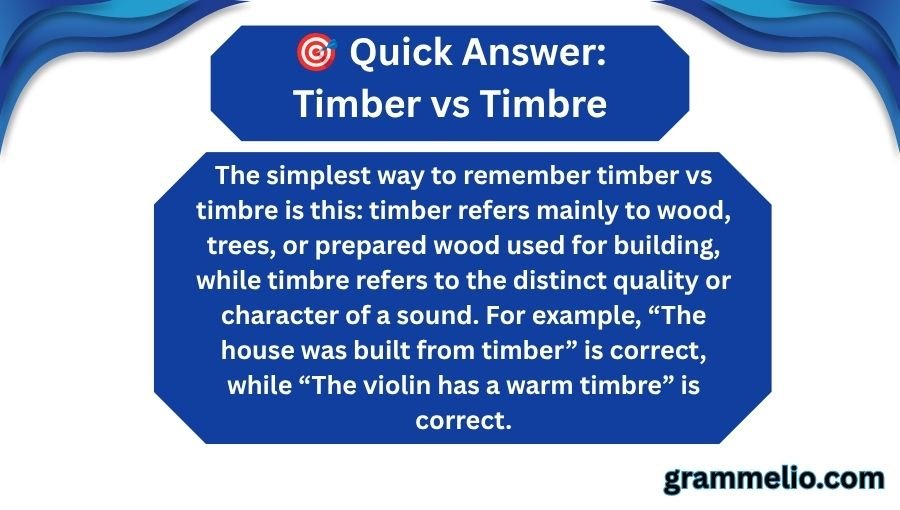
The simplest way to remember timber vs timbre is this: timber refers mainly to wood, trees, or prepared wood used for building, while timbre refers to the distinct quality or character of a sound. For example, “The house was built from timber” is correct, while “The violin has a warm timbre” is correct.
Think of timber = wood and timbre = sound quality.
| Word | Main Meaning | Example |
|---|---|---|
| Timber | Wood, especially wood prepared for building or use | The cabin was made of timber. |
| Timbre | The character or quality that makes one sound different from another | Her voice has a rich timbre. |
| Timber | Can also refer to trees used as a source of wood | The forest contains valuable timber. |
| Timbre | Commonly used when discussing music and sound | The flute has a bright timbre. |
🌲 Is Timber the Same as Timbre?
No. Timber and timbre are different words with different meanings. Their spelling and pronunciation can cause confusion, but they belong to different areas of language.
Timber is connected to wood. You might see it in conversations about forests, construction, furniture, logging, or wooden buildings.
Timbre is connected to sound. You might see it in discussions about music, singing, instruments, voices, or audio.
Here is the easiest mental picture:
- 🌲 Timber → trees and wood
- 🎵 Timbre → sound and music
If you are talking about what a tree can provide for construction, choose timber. If you are talking about what makes a trumpet sound different from a piano, choose timbre.
Timber: Meaning and Correct Use
Timber is a noun that commonly means wood prepared for building or other practical purposes. It can also refer to trees that are suitable for producing wood.
For example:
The workers carried the timber into the new building.
Here, timber means pieces of wood used in construction.
Another example is:
The company manages a large area of timberland.
In this setting, the word is connected to trees and wood resources.
Timbre: Meaning and Correct Use
Timbre is a noun that describes the quality or character of a sound. It helps explain why two sounds can have the same pitch and loudness but still sound different.
For example:
The singer’s timbre is warm and smooth.
The sentence does not describe how high or low the singer’s voice is. Instead, it describes the character of the sound.
You can also say:
The instrument has a bright timbre.
That means the instrument produces a sound with a particular quality that listeners can recognize.
🔎 Timber vs Timbre at a Glance
The key difference is the subject you are discussing. Timber belongs mostly to the world of wood and trees. Timbre belongs mostly to the world of sound.
| Form | Type | Meaning | Example | Correct/Incorrect |
|---|---|---|---|---|
| Timber | Noun | Wood or trees used as a source of wood | The timber was stacked outside. | ✅ Correct |
| Timbre | Noun | Character or quality of a sound | The singer has a deep timbre. | ✅ Correct |
| Timber | Noun | Sound quality | The piano has a soft timber. | ❌ Incorrect |
| Timbre | Noun | Building wood | The barn was made of timbre. | ❌ Incorrect |
| Timber | Noun | Wood used in construction | They ordered more timber. | ✅ Correct |
The two words are not interchangeable.
If you switch them, your sentence may still look reasonable at first glance. However, the meaning changes completely.
💡 How Can You Remember the Difference?
I use a very simple memory trick: timber has an “e” connection to trees? Actually, that trick can be unreliable, so I prefer a meaning-based memory method.
Picture a forest when you see timber. Then picture a singer or musical instrument when you see timbre.
| Word | Memory Picture | Meaning |
|---|---|---|
| Timber | 🌲 Forest | Wood or trees |
| Timbre | 🎤 Singer | Sound quality |
| Timber | 🪵 Wooden beam | Building material |
| Timbre | 🎻 Violin | Character of sound |
Another helpful clue is context.
Words near timber often include:
- forest
- wood
- lumber
- tree
- construction
- beam
- building
- logging
Words near timbre often include:
- voice
- instrument
- music
- sound
- tone
- singer
- piano
- violin
If you see “voice,” timbre is usually the word you need. If you see “wood,” timber is usually the answer.
🪵 What Does Timber Mean in Everyday English?
In everyday English, timber usually refers to wood, especially wood that has been cut or prepared for use.
For example:
We bought timber for the roof.
The word tells us that the material is wood.
Timber can also refer to trees that are grown or managed for their wood.
The landowner planted trees for future timber.
In this sentence, the focus is on trees as a source of usable wood.
In some settings, especially construction, people may use timber for large wooden structural pieces.
Common Uses of Timber
| Use | Example |
|---|---|
| Construction | The workers used timber beams. |
| Forestry | The area is known for its timber. |
| Furniture | The table was made from local timber. |
| Wooden structures | The old house has a timber frame. |
| Forest resources | The company manages timber carefully. |
Timber in a Sentence
Here are several natural examples:
✅ Correct: The cabin was built from strong timber.
❌ Incorrect: The cabin was built from strong timbre.
✅ Correct: The workers loaded the timber onto the truck.
❌ Incorrect: The workers loaded the timbre onto the truck.
The correct choice is timber because both sentences are about wood.
🎵 What Does Timbre Mean in Music?
Timbre describes the quality or character of a sound. It is one reason a violin and a piano can play the same note but still sound different.
Imagine that both instruments play the same musical note at the same loudness. You can still tell which instrument is playing. The difference in sound character is related to timbre.
Timbre can be described with words such as:
- warm
- bright
- dark
- rich
- smooth
- harsh
- soft
- deep
- clear
- nasal
For example:
The flute has a light, airy timbre.
The sentence focuses on the quality of the flute’s sound.
Timbre Beyond Instruments
Timbre is not limited to musical instruments. People can also have different vocal timbres.
For example:
His voice has a deep, rough timbre.
Two people may speak at the same pitch, but their voices can still sound very different because of their individual sound qualities.
| Sound Source | Possible Timbre Description |
|---|---|
| Human voice | Warm and rich |
| Violin | Bright and expressive |
| Flute | Light and airy |
| Trumpet | Bold and bright |
| Piano | Clear and full |
Correct vs Incorrect Sound Examples
✅ Correct: The singer’s timbre makes her voice easy to recognize.
❌ Incorrect: The singer’s timber makes her voice easy to recognize.
✅ Correct: The violin has a warm timbre.
❌ Incorrect: The violin has a warm timber.
✅ Correct: The producer wanted a darker timbre.
❌ Incorrect: The producer wanted a darker timber.
When the sentence describes sound, timbre is the right choice.
🧠 Why Do People Confuse Timber and Timbre?
People confuse these words because they are almost identical in spelling. Both begin with “tim” and contain the same basic letters. The only difference is the order of the final letters.
There is also a pronunciation issue. Depending on accent and context, learners may not hear enough difference to separate the words easily.
I once reviewed a student’s music assignment in which the student repeatedly wrote “timber” when discussing a singer’s voice. The student knew exactly what the concept meant. The problem was spelling, not understanding. Once we connected timbre with sound, the mistake disappeared.
Typing makes the problem worse. If you type quickly, your fingers may automatically produce the more familiar spelling.
Common Reasons for the Confusion
| Reason | How It Causes Errors |
|---|---|
| Fast typing | You type the familiar spelling without checking it. |
| Autocorrect | Software may suggest or accept the wrong word. |
| Similar spelling | The words differ by only two letters. |
| Lack of knowledge | You may not know that both words exist. |
| Weak context clues | You may not connect the word with wood or sound. |
The best solution is not to memorize a complicated rule. It is to learn the meaning of each word.
📚 Grammar Rules Explanation
The grammar rule is straightforward: timber and timbre are separate nouns, so the correct choice depends on meaning.
Use timber when the noun refers to wood, trees used for wood, or wooden construction material.
Use timbre when the noun refers to the quality or character of sound.
Neither spelling is simply a grammatical variation of the other. You cannot replace one with the other just because the sentence structure looks the same.
For example:
The building uses timber.
This is correct because the building uses wood.
But:
The singer has a distinctive timbre.
This is correct because the singer has a distinctive sound quality.
A standard English dictionary can confirm that both words are established English nouns. The important point for learners is their different meanings.
Correct vs Incorrect at a Glance
| Sentence | Correct/Incorrect | Why |
|---|---|---|
| The house has a timber frame. | ✅ Correct | A timber frame is made of wood. |
| The house has a timbre frame. | ❌ Incorrect | The sentence is about wood, not sound. |
| Her voice has a unique timbre. | ✅ Correct | Timbre describes sound quality. |
| Her voice has a unique timber. | ❌ Incorrect | Timber does not mean sound quality. |
| The forest produces valuable timber. | ✅ Correct | Timber can refer to usable wood. |
⚠️ Common Mistakes With Timber vs Timbre
The most common mistake is choosing the spelling based on how the word looks instead of what the sentence means.
A quick way to catch the mistake is to ask:
Am I talking about wood or sound?
If the answer is wood, choose timber.
If the answer is sound, choose timbre.
I once caught myself typing “timber” while editing a short review of a singer. I stopped because the surrounding words were “voice,” “tone,” and “sound.” Those clues made the correct spelling obvious: timbre.
Similar English Confusions
| Confusing Pair | Correct Difference |
|---|---|
| It’s / its | “It’s” means “it is”; “its” shows possession. |
| Your / you’re | “Your” shows possession; “you’re” means “you are.” |
| They’re / their / there | Different meanings involving people, possession, and place. |
| Then / than | “Then” relates to time; “than” is used for comparison. |
| Affect / effect | Usually a verb versus a noun, though both have multiple uses. |
| Timber / timbre | Timber relates to wood; timbre relates to sound. |
Common Wrong Forms
| Wrong Form or Use | What’s Wrong | Correct Form |
|---|---|---|
| The guitar has a beautiful timber. | The sentence describes sound. | The guitar has a beautiful timbre. |
| The table is made of timbre. | The sentence describes wood. | The table is made of timber. |
| A timber voice | The intended meaning is sound quality. | A timbre of the voice / a distinctive timbre |
| Timber of the violin | Timber is not the sound term. | Timbre of the violin |
| Timbre beams | The sentence describes wooden beams. | Timber beams |
📝 Case Study: A Simple Workplace Example
Imagine a music company is preparing a short report about a new recording.
An employee writes:
“The singer has a powerful timber that gives the song its emotional character.”
At first glance, the sentence looks fine. But the word timber does not fit the meaning. The writer is describing the quality of the singer’s voice.
The edited sentence should be:
“The singer has a powerful timbre that gives the song its emotional character.”
Now the sentence clearly uses the sound-related word.
Consider a different report about a building:
“The studio was constructed with local timbre.”
That would also be wrong. The intended word is:
“The studio was constructed with local timber.”
Here, the sentence is about wood.
This shows why context is more useful than spelling alone.
| Situation | Correct Word | Example |
|---|---|---|
| Building materials | Timber | The studio uses timber beams. |
| Singer’s voice | Timbre | Her timbre is easy to recognize. |
| Forest resources | Timber | The region produces timber. |
| Instrument sound | Timbre | The cello has a deep timbre. |
✍️ How Should You Use Timber vs Timbre in Writing?
The easiest method is to look at the nouns around the word.
If the sentence contains words connected to forests, buildings, wood, or construction, timber is probably correct.
If it contains words connected to voices, instruments, music, or sound, timbre is probably correct.
Here are four quick examples:
✅ Correct: The architect chose local timber for the walls.
❌ Incorrect: The architect chose local timbre for the walls.
✅ Correct: The singer’s timbre was warm and expressive.
❌ Incorrect: The singer’s timber was warm and expressive.
The sentence topic gives you the answer.
🌎 Timber vs Timbre in Different Contexts
Both words can appear in many types of writing, but their meanings stay separate.
| Context | Which Term to Use | Example |
|---|---|---|
| Everyday conversation | Timber for wood | We need more timber for the project. |
| Professional writing | Either, depending on meaning | The report discusses timber production. |
| Creative writing | Either, depending on meaning | The singer’s timbre filled the room. |
| Social media/texting | Either, depending on meaning | Love the warm timbre of this guitar! |
Everyday Conversation
You might hear timber when people discuss construction or wood.
We need to order more timber.
You might hear timbre in a music-related conversation.
I love the timbre of that singer’s voice.
Professional Writing
Professional writing requires extra care because a spelling mistake can change the meaning of a technical statement.
A construction report might say:
The building uses locally sourced timber.
A music report might say:
The recording highlights the natural timbre of the instrument.
Creative Writing
Writers may use both words to create vivid descriptions.
For example:
The cabin stood among tall trees, its dark timber walls covered in snow.
Or:
Her soft timbre made the quiet room feel peaceful.
Social Media and Texting
Informal writing is more forgiving, but the correct spelling still matters.
If you are posting about a new guitar, write:
“The timbre on this guitar is amazing.”
If you are posting about a woodworking project, write:
“This timber looks beautiful after sanding.”
💬 Common Phrases With Timber
Timber appears in several common combinations, especially in construction and forestry.
| Phrase | Meaning |
|---|---|
| Timber frame | A structural frame made mainly from wood |
| Timber industry | Business involving timber and wood production |
| Timber forest | A forest managed or valued for wood |
| Timber beam | A large wooden structural piece |
| Timber construction | Building with wood as a major material |
| Fallen timber | Trees or branches that have fallen |
Some of these phrases are more common in technical or regional writing, but they all center on wood.
🎶 Common Phrases With Timbre
Timbre is strongly connected with music and descriptions of sound.
| Phrase | Meaning |
|---|---|
| Vocal timbre | The character of a person’s voice |
| Rich timbre | A full or pleasing sound quality |
| Warm timbre | A soft or pleasant sound character |
| Bright timbre | A clear, lively sound quality |
| Dark timbre | A deeper or less bright sound character |
| Distinctive timbre | A sound quality that is easy to recognize |
These phrases can help you recognize the word quickly.
If you see vocal timbre, instrument timbre, or rich timbre, you are almost certainly reading about sound.
🔄 Synonyms and Alternatives
Neither word has a perfect replacement in every sentence. The best alternative depends on context.
For timber, you might use wood or lumber in some contexts.
For timbre, you might use sound quality, tone quality, or voice quality when the context allows it.
| Alternative | Works When | Does Not Work When |
|---|---|---|
| Wood | You mean material from trees | You mean a sound’s character |
| Lumber | You mean processed wood, especially in US usage | You mean musical sound |
| Sound quality | You mean the character of a sound | You mean building material |
| Tone quality | You are discussing a sound or voice | You are discussing forests |
| Voice quality | You are specifically describing someone’s voice | You mean wood |
Remember that lumber and timber are not always exact matches. Their use can vary by region and context. In US English, lumber is especially common for processed wood used in construction.
🎯 Why Does Getting Timber vs Timbre Right Matter?
Correct spelling makes your writing easier to understand. That matters even when the mistake seems small.
Imagine reading:
“The orchestra searched for the right timber.”
A reader familiar with music may stop and wonder whether the writer means wood.
Now compare:
“The orchestra searched for the right timbre.”
The meaning is immediately clear.
The same issue happens in construction writing.
“The contractor ordered new timbre.”
The reader may understand what you intended, but the spelling looks incorrect because the subject is wood.
A useful rule is:
Clear words make clear ideas easier to read.
| Situation | Why Getting It Right Matters |
|---|---|
| Resume | Spelling errors can make professional writing look careless. |
| Client email | The correct word prevents confusion. |
| Published content | Accuracy improves trust and readability. |
| Social post | Correct spelling makes your message easier to understand. |
🧩 Can Timber and Timbre Ever Be Interchanged?
No. They should not normally be treated as interchangeable words.
Their meanings are too different. Timber refers to wood or trees used for wood. Timbre refers to the character of sound.
There can be a sentence where both words appear naturally.
For example:
The musician recorded the sound inside a timber cabin because she liked the room’s natural timbre.
Here, both words are correct because they describe two different things.
Timber describes the cabin’s wooden material.
Timbre describes the character of the sound.
That sentence is a useful reminder that the two words can appear together without having the same meaning.
🧠 A Fast Test for Timber vs Timbre
When you are unsure, stop and ask one question:
What am I describing?
| Question | Answer | Word |
|---|---|---|
| Am I describing wood? | Yes | Timber |
| Am I describing trees used for wood? | Yes | Timber |
| Am I describing a wooden building part? | Yes | Timber |
| Am I describing sound? | Yes | Timbre |
| Am I describing a voice? | Yes | Timbre |
| Am I describing an instrument’s sound character? | Yes | Timbre |
This test takes only a few seconds.
📋 Quick Recap Checklist
Use this checklist whenever you need to choose between the two words.
| Question | If Yes → Use |
|---|---|
| Is the sentence about wood? | Timber |
| Is the sentence about trees used for wood? | Timber |
| Is the sentence about construction wood? | Timber |
| Is the sentence about a voice? | Timbre |
| Is the sentence about an instrument’s sound? | Timbre |
| Is the sentence about sound quality? | Timbre |
Practice Examples
- The carpenter selected strong ___ for the project.
Answer: timber 🪵 - The singer’s ___ gave her voice a unique character.
Answer: timbre 🎤 - The old barn has a beautiful ___ frame.
Answer: timber 🏠
These examples follow the same basic rule every time.
❓ FAQs About Timber vs Timbre
What is the difference between timber and timbre?
Timber mainly refers to wood or trees used as a source of wood. Timbre refers to the distinctive quality or character of a sound.
Is timber related to music?
Usually, no. In music, the word you generally want is timbre. Timbre describes why different instruments or voices can sound different even when producing the same note.
What does timbre mean in simple English?
Timbre means the particular character of a sound. It helps describe what makes one person’s voice or one instrument sound different from another.
What does timber mean in simple English?
Timber means wood, especially wood prepared for building or other uses. It can also refer to trees grown or valued for their wood.
Is “the timbre of a voice” correct?
Yes. Timbre is an appropriate word for describing the character or quality of a person’s voice.
Is “timber frame” correct?
Yes. Timber frame is correct when you mean a structural frame made from wood.
Which word should I use for a guitar’s sound?
Use timbre when you are describing the character or quality of the guitar’s sound.
For example:
The guitar has a warm timbre.
Which word should I use for building wood?
Use timber when you mean wood used in construction.
For example:
The house was built with heavy timber beams.
Why are timber and timbre so easy to confuse?
They look almost identical and differ mainly in the arrangement of their final letters. Their similar appearance makes spelling mistakes common, especially when people type quickly.
How can I remember timber vs timbre?
Connect timber with 🌲 wood and timbre with 🎵 sound. If you are talking about a tree, beam, or wooden structure, use timber. If you are talking about a voice or instrument’s sound, use timbre.
🎯 Final Takeaway
Timber vs timbre becomes easy once you connect each spelling with its meaning. Timber is the word for wood, trees used for wood, and wooden construction material. Timbre is the word for the character or quality of a sound.
When I teach this distinction, I tell learners to stop focusing on the spelling for a moment and focus on the picture in their minds. If you can picture a forest, wooden beam, or cabin, think timber. 🌲 If you can picture a singer, guitar, piano, or other sound source, think timbre. 🎵
A quick context check can also save you from most errors. Look at the words around the blank. Construction and forests point toward timber. Music, voices, and sound point toward timbre.
Once that connection becomes automatic, this spelling pair stops being a frustrating trap.
Remember: timber is wood, while timbre is the character of sound.

[…] exactly which word to choose and feel much more confident using these common English words. ✍️ Timber vs Timbre | Tick vs Tic | Throes vs […]