Have you ever paused while writing because you were unsure whether to use to vs too vs two? I see this confusion often when helping students, English learners, bloggers, and everyday writers improve their grammar.
These three words sound alike, but they have completely different meanings and jobs in a sentence. 😊 To usually shows direction or comes before a verb, too can mean “also” or “more than needed,” and two means the number 2.
Because they sound so similar, even strong English writers can occasionally choose the wrong spelling when typing quickly.
In this guide, I will explain the difference in simple US English with clear rules, practical examples, common mistakes, and easy memory tricks.
By the end, you will know exactly which word to choose and feel much more confident using these common English words. ✍️ Timber vs Timbre | Tick vs Tic | Throes vs Throws
🎯 Quick Answer: To vs Too vs Two
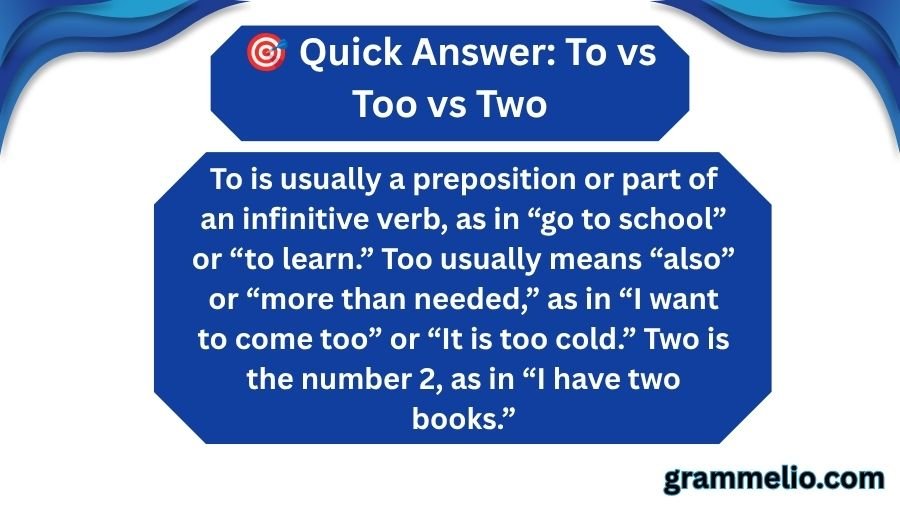
To is usually a preposition or part of an infinitive verb, as in “go to school” or “to learn.” Too usually means “also” or “more than needed,” as in “I want to come too” or “It is too cold.” Two is the number 2, as in “I have two books.”
A quick way to remember them is:
- To = direction, connection, or verb form
- Too = also or more than enough
- Two = the number 2
Understanding To vs Too vs Two
The easiest way to understand these words is to separate their jobs. Although they sound alike in many forms of spoken English, their meanings are not alike.
| Form | Type | Meaning | Example | Correct/Incorrect |
|---|---|---|---|---|
| to | Preposition / infinitive marker | Direction, relationship, or verb form | I went to work. | ✅ Correct |
| too | Adverb | Also; excessively | I want coffee too. | ✅ Correct |
| two | Number / determiner | The number 2 | She has two cats. | ✅ Correct |
| to | Wrong word for “also” | Not “also” | I want to come to. | ❌ Incorrect |
| too | Wrong word for direction | Not a direction marker | We went too the store. | ❌ Incorrect |
The key is not pronunciation. The key is meaning and sentence function.
If you are talking about the number 2, use two. If you mean “also” or “more than necessary,” use too. In most other common situations involving movement or an infinitive verb, to is the right choice.
To: Meaning and Correct Use
To has several common uses in English. The two most important are showing direction or connection and introducing the base form of a verb.
To for Direction
We use to when something moves toward a place, person, or destination.
Examples:
- I walked to the store.
- She drove to work.
- We flew to Chicago.
- He gave the letter to his teacher.
- They went to the park.
Here, to helps show where someone or something is going.
To Before a Verb
We also use to before the base form of many verbs. This is called an infinitive.
Examples:
- I want to learn.
- She needs to study.
- We plan to travel.
- He decided to leave.
- They hope to win.
Notice that to is not showing a physical destination in these sentences. Instead, it connects with a verb.
To Showing a Relationship
To can also show a relationship between people or things.
- This gift belongs to Sarah.
- The answer is important to me.
- He spoke to his manager.
- Please listen to the teacher.
Test Tip 💡
When you see to, ask yourself:
“Am I showing a destination, relationship, or verb that follows it?”
If the answer is yes, to is probably correct.
| Use of “to” | Word Type | Example Sentence |
|---|---|---|
| Destination | Preposition | We went to school. |
| Recipient | Preposition | Give it to Mark. |
| Relationship | Preposition | This matters to me. |
| Infinitive | Infinitive marker | I want to read. |
| Purpose | Infinitive marker | She came to help. |
Too: Meaning and Correct Use
Too has two main meanings. It can mean “also”, or it can mean “more than is wanted, needed, or suitable.”
Too Meaning “Also”
Use too when you want to say that something applies to another person or thing as well.
Examples:
- I like pizza too.
- She is coming too.
- He wants to play too.
- I was tired too.
- They enjoyed the movie too.
In these sentences, you could replace too with also.
For example:
I like pizza too.
means:
I also like pizza.
That substitution is a useful test.
Too Meaning “Excessively”
Too can also mean more than necessary or more than is desirable.
Examples:
- The coffee is too hot.
- This bag is too heavy.
- He talks too loudly.
- The test was too difficult.
- It is too late to call.
Here, too often appears before an adjective or adverb.
Compare:
- The soup is hot.
- The soup is too hot.
The first sentence simply describes the soup. The second says the soup has an excessive level of heat.
Too Can Change the Meaning of a Sentence
Consider these examples:
- She is too tired to work.
- She is tired too.
The first means she is excessively tired. The second means she is tired as well.
The spelling is the same, but the position and meaning are different.
| Meaning of “too” | What It Means | Example |
|---|---|---|
| Also | In addition | I want to go too. |
| Excessively | More than needed | It is too expensive. |
| Excessively | More than acceptable | He is too loud. |
| Also | As well | She likes music too. |
Two: Meaning and Correct Use
Two is the easiest of the three to define because it is the number 2.
Use two when you are talking about quantity.
Examples:
- I have two brothers.
- She bought two tickets.
- We need two chairs.
- He ate two apples.
- They waited for two hours.
You can usually replace two with the numeral 2.
For example:
I have two dogs.
can become:
I have 2 dogs.
That is a strong clue that two is the correct word.
Two Can Describe Quantity
Two can come before a noun:
- two books
- two people
- two houses
- two questions
- two weeks
It can also appear by itself when the noun is already understood.
- “How many cookies do you want?”
- “Two, please.”
Test Tip 💡
If the word represents the number 2, use two.
Ask:
“Can I replace this word with 2?”
If yes, two is almost certainly the correct choice.
| Number Meaning | Correct Form | Example |
|---|---|---|
| Quantity of people | two | Two students arrived. |
| Quantity of objects | two | I bought two pens. |
| Length of time | two | We waited two hours. |
| Number of choices | two | There are two options. |
🧩 To vs Too vs Two at a Glance
The three words become much easier when you compare their basic functions side by side.
| Word | Main Meaning | Common Job | Example |
|---|---|---|---|
| to | Direction or connection | Preposition / infinitive marker | I went to school. |
| too | Also or excessively | Adverb | I want one too. |
| two | Number 2 | Number / determiner | I have two books. |
Here is another simple test:
| Question to Ask | If Yes | Use |
|---|---|---|
| Does it mean “also”? | Yes | too |
| Does it mean “more than enough”? | Yes | too |
| Does it mean the number 2? | Yes | two |
| Does it show direction? | Yes | to |
| Does it come before a base verb? | Yes | to |
Why Do People Confuse To, Too, and Two?
People confuse these words mainly because they sound alike. This makes them homophones: words that have the same pronunciation but different meanings and spellings.
When we speak, context usually makes the meaning clear. When we write, spelling carries that meaning.
I once worked with a student who wrote, “I have too dogs.” When I asked what she meant, she immediately said, “I mean the number two.” She knew the meaning perfectly. The problem was choosing the spelling quickly while writing.
Other reasons include:
- Fast typing
- Autocorrect
- Texting habits
- Limited grammar practice
- Focusing on pronunciation instead of meaning
- Not checking the sentence before submitting it
The mistake is especially common in informal digital writing because people often type quickly and do not reread their messages.
Common Uses of To in Everyday English
To appears constantly in normal English sentences.
You may use it when talking about:
- Going somewhere
- Giving something to someone
- Talking to someone
- Listening to someone
- Wanting to do something
- Planning to do something
- Trying to do something
- Learning something
Examples:
- I need to go home.
- She talked to her friend.
- Please give this to John.
- We want to eat.
- He went to the office.
- I listened to the podcast.
A useful clue is that to often connects words rather than adding the meaning “also” or “2.”
Common Uses of Too in Everyday English
Too is also very common in casual and formal writing.
Use it when you mean:
“Also”
- I want to come too.
- She likes tea too.
- He was invited too.
“Excessively”
- The room is too cold.
- The box is too large.
- The music is too loud.
One easy trick is to look for the feeling of “more than necessary.”
If that meaning is present, too may be the correct word.
Common Uses of Two in Everyday English
Two is used whenever you need to express the number 2.
Examples include:
- two minutes
- two dollars
- two miles
- two children
- two answers
- two days
You will see it in schedules, measurements, instructions, stories, conversations, and almost every other kind of writing.
📝 Case Study: A Simple Workplace Example
Imagine that a manager sends this message:
“I need you to send the report to two clients too.”
This sentence contains all three words.
- to = part of “need you to send”
- to = shows the report’s destination
- two = the number 2
- too = means “also”
Now compare it with these incorrect versions:
❌ “I need you too send the report too two clients.”
This version changes the meaning and uses the wrong spellings.
I once caught a similar mistake while reviewing a short work message. The writer had typed “to” where “too” was needed at the end of a sentence. The meaning was understandable, but the error made the message look rushed. A quick reread fixed it.
The lesson is simple: when these words appear together, identify each word’s job instead of relying on sound.
Grammar Rules Explanation
The basic grammar rule is based on function and meaning, not pronunciation.
To commonly functions as a preposition or as the marker used before an infinitive verb. It can introduce a destination, recipient, relationship, or verb phrase.
Too functions as an adverb. It commonly means “also” or “more than necessary.”
Two refers to the number 2.
Standard English grammar references consistently distinguish these three words by their spelling and function.
Correct vs Incorrect at a Glance
| Sentence | Correct/Incorrect | Why |
|---|---|---|
| I want to learn Spanish. | ✅ Correct | To introduces the verb “learn.” |
| I want too learn Spanish. | ❌ Incorrect | Too cannot replace infinitive to. |
| She has two sisters. | ✅ Correct | Two means the number 2. |
| She has too sisters. | ❌ Incorrect | Too does not mean 2. |
| I want some pizza too. | ✅ Correct | Too means “also.” |
⚠️ Common Mistakes With To, Too, and Two
The biggest mistake is choosing the word because it sounds right instead of asking what it means.
Here are common problems:
| Confusion | Example | Correct Choice |
|---|---|---|
| “also” vs “to” | I want to come also. | too at the end if replacing “also” |
| Number vs “to” | I have to dogs. | two |
| Infinitive vs “too” | I want too sleep. | to |
| Excessive vs “to” | It is to cold. | too |
| Number vs “too” | She bought too books. | two |
Specific Wrong Forms
| Wrong Form | What’s Wrong | Correct Form |
|---|---|---|
| I have to cats. | To does not mean 2. | I have two cats. |
| I want too leave. | Too cannot introduce this infinitive. | I want to leave. |
| It is to hot. | “More than desired” requires too. | It is too hot. |
| I like it to. | “Also” requires too. | I like it too. |
| Two the store | Two is a number, not a direction marker. | To the store |
| Too books | Too does not mean the number 2. | Two books |
How Fast Typing Creates These Errors
Fast typing is a major reason people mix up homophones.
Your brain may know exactly what you want to say. Your fingers simply choose the wrong spelling. Autocorrect can make the problem worse when it accepts a correctly spelled but incorrect word.
For example, all three forms are real English words:
- to
- too
- two
A spell checker may not flag the wrong one because the spelling itself is valid.
That means grammar checking requires more than spell checking.
A Better Editing Habit
After writing, search mentally for every to, too, and two.
Ask:
- Does it mean direction or introduce a verb? → to
- Does it mean also or excessively? → too
- Does it mean 2? → two
This takes only a few seconds.
How To Remember the Difference
Memory tricks can make to vs too vs two much easier.
Remember “Two” With the Number
Two contains a “w,” and you can think of the extra letters as helping it look more substantial, like a word that carries a quantity.
More simply:
Two = 2
That is the most reliable memory trick.
Remember “Too” With Extra Meaning
Think of too as having an extra “o.”
The extra “o” can remind you of:
“Too much”
“Too many”
“Also”
For example:
- It is too hot.
- I want to come too.
Remember “To” as the Basic Form
When the word is not about “also,” “excessive,” or the number 2, to is often the correct choice.
For example:
- go to school
- want to eat
- talk to me
- give it to her
To vs Too vs Two in Different Contexts
The correct choice does not change because the writing is casual or formal. The meaning still controls the spelling.
| Context | Which Term to Use | Example |
|---|---|---|
| Everyday conversation | Any, depending on meaning | I want two tacos. |
| Professional writing | Any, depending on meaning | Please send it to the client. |
| Creative writing | Any, depending on meaning | The wind was too strong. |
| Social media/texting | Any, depending on meaning | I want one too! |
Even in texting, using the correct form makes your meaning clearer.
Common Phrases With To
To appears in many common phrases and structures.
| Phrase | Meaning |
|---|---|
| go to school | Travel toward school |
| talk to someone | Speak with someone |
| listen to music | Hear music carefully |
| want to learn | Have a desire to learn |
| need to work | Have a need or duty to work |
| give it to me | Transfer something to me |
These phrases are useful because repeated exposure helps you recognize the correct form naturally.
Common Phrases With Too
Too has several very common patterns.
| Phrase | Meaning |
|---|---|
| me too | I also agree or feel the same |
| too much | More than needed |
| too many | More than needed |
| too late | Later than acceptable |
| too early | Earlier than suitable |
| too difficult | More difficult than acceptable |
If you learn these patterns as complete phrases, choosing too becomes easier.
Common Phrases With Two
Two naturally appears in expressions involving quantity.
| Phrase | Meaning |
|---|---|
| two of them | A quantity of 2 |
| two at a time | In groups of 2 |
| two more | An additional quantity of 2 |
| two days ago | Two days before now |
| two weeks later | After two weeks |
| the two of us | A group containing 2 people |
Is To the Same as Too or Two?
No. To, too, and two are different words with different meanings.
They may sound alike, but their grammatical roles are different. To commonly marks direction or introduces an infinitive. Too means “also” or “excessively.” Two means the number 2.
For example:
- I went to the store.
- I went too.
- I bought two apples.
The sentence meanings show why spelling matters.
Can Too Mean “Very”?
Sometimes too may seem similar to “very,” but the two words are not always interchangeable.
Compare:
The room is very cold.
This simply says the room has a high level of coldness.
The room is too cold.
This usually suggests that the coldness is excessive or causes a problem.
For example:
The water is very hot.
The water has a high temperature.
The water is too hot to drink.
The temperature is higher than what is suitable for drinking.
So too often carries an idea of excess.
Can Two Be Used Without a Noun?
Yes. Two can stand alone when the noun is clear from context.
For example:
“How many tickets do you need?”
“Two.”
The listener understands that “two tickets” is intended.
This is common in conversation.
Other examples include:
- “How many cookies?” — “Two.”
- “How many seats?” — “Two.”
- “How many questions did you answer?” — “Two.”
Can To Appear Before Every Verb?
No. To commonly introduces an infinitive, but not every verb takes to.
For example:
- I want to go. ✅
- I hope to win. ✅
- I need to study. ✅
But after some modal verbs, English uses the base verb without to:
- I can swim. ✅
- She must leave. ✅
- We should go. ✅
So the rule is not “put to before every verb.” Instead, learn which structures require an infinitive with to.
Why Getting To, Too, and Two Right Matters
Correct word choice improves clarity, even when the reader can guess your meaning.
| Situation | Why Getting It Right Matters |
|---|---|
| Resume | Shows care and attention to detail |
| Client email | Creates a professional impression |
| Published content | Makes writing easier to trust and read |
| Social post | Prevents avoidable confusion |
A simple spelling error can make a polished sentence look careless.
I often tell writers that grammar is not about sounding fancy. It is about making your meaning easy to understand.
A useful rule is:
Clear writing respects the reader’s time.
That principle applies whether you are writing a school assignment, work email, blog post, or quick text.
A Simple Three-Step Test
When you are unsure which word to use, follow these steps.
Step 1: Check for the Number
If the word means 2, choose two.
I have two pencils. ✅
Step 2: Check for “Also” or “Excessive”
If it means also, choose too.
I want to go too. ✅
If it means more than needed, choose too.
The box is too heavy. ✅
Step 3: Check for Direction or an Infinitive
If it shows direction or comes before a base verb in an infinitive, choose to.
We went to the store. ✅
I want to sleep. ✅
This three-step test solves most everyday cases.
Quick Recap Checklist
Use this checklist whenever you hesitate.
| Question | If Yes → Use |
|---|---|
| Does it mean the number 2? | two |
| Does it mean “also”? | too |
| Does it mean “more than needed”? | too |
| Does it show a destination? | to |
| Does it introduce an infinitive? | to |
| Does it connect someone with an action or destination? | Usually to |
Practice Examples
- I have ___ brothers.
Answer: two ✅ - I want ___ go home.
Answer: to ✅ - I want to come ___.
Answer: too ✅
Practice: Choose To, Too, or Two
Try these before checking the answers.
Practice Set
- She went ___ the library.
- I have ___ pencils.
- He wants ___ play outside.
- The soup is ___ salty.
- I want some ___.
- We need ___ more chairs.
- Give the book ___ me.
- They arrived ___ late.
- I have ___ finish my homework.
- She invited me ___.
Answers
| # | Answer | Reason |
|---|---|---|
| 1 | to | Shows destination |
| 2 | two | Means 2 |
| 3 | to | Introduces the verb “play” |
| 4 | too | Means excessively |
| 5 | too | Means also |
| 6 | two | Means 2 |
| 7 | to | Shows the recipient |
| 8 | too | Means excessively |
| 9 | to | Introduces “finish” |
| 10 | too | Means also |
FAQs About To vs Too vs Two
What is the difference between to, too, and two?
To usually shows direction, connection, or introduces an infinitive. Too means “also” or “more than necessary.” Two means the number 2.
Is it “too much” or “to much”?
The correct form is too much. Here, too means more than needed.
There is too much sugar in the tea. ✅
Is it “two people” or “too people”?
The correct form is two people because the word refers to the number 2.
Two people came to the meeting. ✅
Is it “I want to go” or “I want too go”?
The correct form is I want to go. To introduces the base verb “go.”
Is “me too” correct?
Yes. Me too is correct when you mean “I also” or “the same is true for me.”
“I love this song.”
“Me too.” ✅
How can I remember two means 2?
The simplest memory rule is:
Two = 2.
Whenever you are talking about the quantity 2, use two.
How can I remember when to use too?
Think of too as meaning either “also” or “more than needed.”
Examples:
- I want to go too. = I also want to go.
- It is too hot. = It is more hot than suitable.
Why are to, too, and two pronounced alike?
They are commonly pronounced alike in standard English, even though they have different spellings and meanings. That is why they are easy to confuse in writing.
Is “too” always at the end of a sentence?
No. Too can appear in other positions, especially when it means “excessively.”
It is too expensive.
When too means “also,” it often appears near the end:
I want to go too.
What is the easiest rule for to vs too vs two?
Remember three ideas:
- To = direction or verb
- Too = also or excessive
- Two = 2
If you identify the meaning first, the spelling usually becomes obvious.
Final To vs Too vs Two Review
Learning these three words does not require memorizing a long list of grammar rules. I find that the fastest method is to focus on meaning.
Use to for direction, relationships, recipients, and many infinitive verb structures.
Use too when you mean also or more than needed.
Use two when you mean the number 2.
When you see one of these words, stop for a second and ask what the sentence means. Is someone going somewhere? Is an action about to happen? Does the sentence mean “also”? Does it describe something excessive? Or are you counting two things?
Once you build that habit, these homophones become much easier. 😊 A few minutes of practice can prevent dozens of small writing errors over time.
Remember the simplest version: to = direction or verb, too = also or excessive, and two = 2. Keep that rule in mind, and you will have a reliable way to choose the correct word whenever you write.

[…] you connect toe with your foot and tow with pulling, the spelling becomes much easier to remember. To vs Too vs Two | Timber vs Timbre | Tick vs […]