Have you ever stopped while writing because two words looked almost identical, but you were not sure which one belonged in the sentence? I see this often with grisly vs gristly, especially because both words begin with “gris” and differ by only one letter. 😅
Yet their meanings are completely different. One word usually describes something shocking, bloody, or horrifying. The other describes something tough, chewy, or full of gristle. If you are a student, writer, editor, job seeker, or anyone who wants to sound clear in US English, knowing the difference can save you from an awkward mistake
. In this guide, I’ll show you exactly when to use each word, how to remember the difference, and how to avoid common spelling traps. By the end, grisly vs gristly should feel much easier to handle. ✍️ Gourmet vs Gourmand | Fiancé vs Fiancée | Farther vs Father
🎯 Quick Answer: Grisly vs Gristly
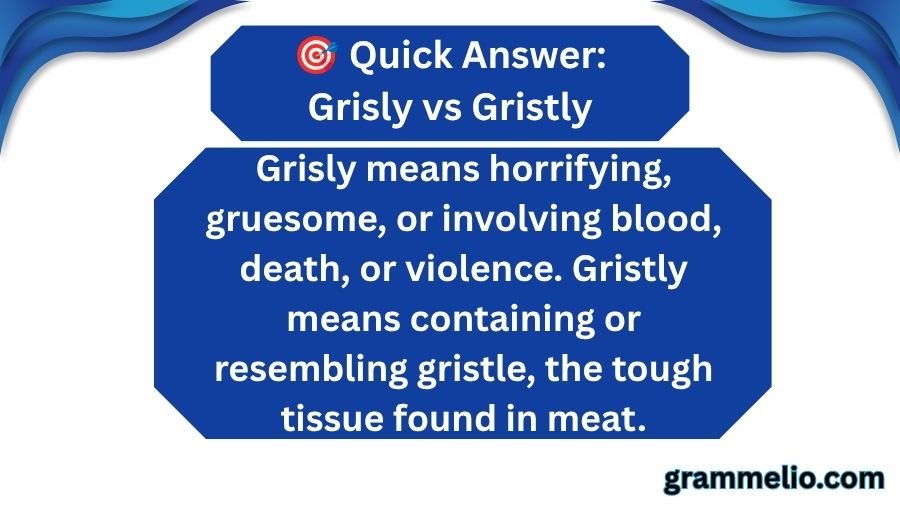
Grisly means horrifying, gruesome, or involving blood, death, or violence. Gristly means containing or resembling gristle, the tough tissue found in meat.
A simple memory trick is this: grisly = gruesome, while gristly = gristle.
- ✅ The detective described a grisly crime scene.
- ❌ The detective described a gristly crime scene.
- ✅ The steak was gristly and difficult to chew.
- ❌ The steak was grisly and difficult to chew.
The words sound and look similar, but they belong to very different situations.
🔎 Understanding the Basics of Grisly vs Gristly
The core difference is simple: grisly describes something frightening or gruesome, while gristly describes something tough because it contains gristle.
| Form | Type | Meaning | Example | Correct/Incorrect |
|---|---|---|---|---|
| Grisly | Adjective | Horrifying, gruesome, or shocking | The reporter covered a grisly discovery. | ✅ Correct |
| Gristly | Adjective | Tough or containing gristle | The roast was gristly. | ✅ Correct |
| Grisly | Adjective | Tough because of gristle | The steak was grisly. | ❌ Incorrect |
| Gristly | Adjective | Bloody or horrifying | The murder was gristly. | ❌ Incorrect |
The easiest way to separate the two is to focus on the t in gristly. That extra letter connects naturally with gristle.
If you are talking about a disturbing scene, use grisly.
If you are talking about meat, chewing, or gristle, use gristly.
Grisly: Meaning and Correct Use
Grisly is an adjective used for something that causes horror, shock, or disgust. It is often connected with death, injuries, violence, or other disturbing events.
For example:
- ✅ The police investigated a grisly murder.
- ❌ The police investigated a gristly murder.
The correct word is grisly because the sentence describes a violent and disturbing event.
Here is another example:
- ✅ The hikers made a grisly discovery in the woods.
- ❌ The hikers made a gristly discovery in the woods.
The discovery is frightening or disturbing, so grisly is the right choice.
You might see grisly used with words such as:
- murder
- crime
- accident
- discovery
- scene
- details
- tale
- story
- remains
- evidence
Not every use involves literal blood or death. Something can be called grisly when it is deeply unpleasant or horrifying.
Gristly: Meaning and Correct Use
Gristly describes something that contains gristle or feels tough and chewy because of it.
Gristle is the tough tissue found in some meat. It can be unpleasant to chew, especially when you expect a tender piece of steak or roast.
For example:
- ✅ The steak was so gristly that I could barely chew it.
- ❌ The steak was so grisly that I could barely chew it.
Here, the word gristly refers to the texture of the meat.
Another example:
- ✅ I ordered the roast, but several pieces were gristly.
- ❌ I ordered the roast, but several pieces were grisly.
The first sentence describes tough meat. The second would suggest something horrifying, which is not the intended meaning.
💡 Test Tip for Remembering the Difference
When I teach this pair, I use one very quick test:
Can you replace the word with “gruesome”?
If yes, choose grisly.
Can you connect the word to “gristle” or tough meat?
If yes, choose gristly.
| Meaning | Word Type | Example Sentence |
|---|---|---|
| Horrifying or gruesome | Adjective | The story contained grisly details. |
| Disturbing or shocking | Adjective | The newspaper reported a grisly accident. |
| Containing gristle | Adjective | The meat was gristly. |
| Tough and chewy | Adjective | The steak had a gristly texture. |
🧠 Why Do People Confuse Grisly and Gristly?
People confuse grisly vs gristly because the words look almost the same and have related sounds. The difference is just one letter, but that letter changes the meaning completely.
Another reason is that both words can appear in descriptions that make readers feel uncomfortable. A grisly scene may be unpleasant to imagine. Gristly meat may be unpleasant to eat. The shared “gris” beginning can make the words especially easy to mix up.
I once edited a short story in which a writer described a “gristly accident.” The writer clearly meant that the accident was horrible. We changed it to “grisly,” and the sentence immediately made sense.
Fast typing can make the problem worse. When you already know what you want to say, your fingers may produce the familiar-looking spelling without checking the meaning.
Autocorrect can also fail to catch the error because grisly and gristly are both legitimate English words. A spell checker may see nothing wrong even when you chose the wrong one.
📊 Grisly vs Gristly at a Glance
Here is the difference in one quick table:
| Feature | Grisly | Gristly |
|---|---|---|
| Main meaning | Horrifying or gruesome | Tough or containing gristle |
| Word type | Adjective | Adjective |
| Common topic | Death, violence, disturbing events | Meat and texture |
| Memory clue | Think “gruesome” | Think “gristle” |
| Example | A grisly murder | A gristly steak |
| Opposite idea | Pleasant or harmless | Tender or soft |
The key is not spelling alone. Always ask what the sentence is describing.
✍️ Correct Meanings and Uses of Grisly
The word grisly is most often used when something is horrifying, disturbing, or gruesome.
Grisly Crime and Violence
This is one of the most common uses.
- ✅ The detective found evidence of a grisly crime.
- ❌ The detective found evidence of a gristly crime.
The crime is disturbing, so grisly fits.
Grisly Discoveries
A discovery can be grisly when what someone finds is shocking or horrifying.
- ✅ The campers made a grisly discovery near the abandoned building.
- ❌ The campers made a gristly discovery near the abandoned building.
Grisly Details
People often use grisly details when discussing disturbing facts about an event.
- ✅ The article avoided describing the grisly details.
- ❌ The article avoided describing the gristly details.
The phrase refers to frightening or unpleasant information.
Grisly Stories
A story may be called grisly when it contains violent, horrifying, or disturbing events.
- ✅ He enjoys reading grisly horror stories.
- ❌ He enjoys reading gristly horror stories.
The intended meaning is clearly related to horror.
🥩 Correct Meanings and Uses of Gristly
The word gristly is strongly connected to food, especially meat.
Gristly Meat
This is the clearest use.
- ✅ The chicken was unusually gristly.
- ❌ The chicken was unusually grisly.
The speaker is describing the texture of the meat.
Gristly Steak
A steak can be called gristly if parts of it contain tough tissue.
- ✅ The steak looked good, but it was gristly.
- ❌ The steak looked good, but it was grisly.
Gristly Texture
You can also use the word to describe texture directly.
- ✅ The meat had a gristly texture.
- ❌ The meat had a grisly texture.
In normal food writing, gristly is the natural choice.
📝 Case Study: A Small Word Choice With a Big Difference
Imagine that a restaurant manager is writing a customer-service email.
The manager wants to say:
“I’m sorry that your steak was tough and difficult to chew.”
A careless draft might say:
- ❌ We apologize that your steak was grisly.
That sentence sounds as if the steak was horrifying or gruesome.
The correct version is:
- ✅ We apologize that your steak was gristly.
The word gristly tells the customer that the problem involved the meat’s texture.
I once caught a similar mix-up while reviewing a food-related piece. The writer had chosen a word associated with horror when describing tough meat. The meaning was clear from context, but the word was still wrong. A one-letter change fixed the problem.
This shows why context matters more than appearance. A spell checker might accept both words. A careful writer asks what the word actually means.
📚 Grammar Rules Explanation for Grisly vs Gristly
Both grisly and gristly are adjectives. They can modify nouns or appear after linking verbs such as was, were, seemed, and became.
The difference is semantic, meaning the words describe different qualities.
Grisly describes something horrifying, gruesome, or deeply disturbing.
Gristly describes something that contains gristle or has a tough, chewy texture.
Neither word is simply a different spelling of the other. They should not be exchanged based on sound.
Standard English reference works treat these as separate words with separate meanings. The safest approach is to learn the meaning of each word instead of trying to choose based only on spelling.
Correct vs Incorrect at a Glance
| Sentence | Correct/Incorrect | Why |
|---|---|---|
| The newspaper described the grisly accident. | ✅ Correct | The accident was horrifying. |
| The newspaper described the gristly accident. | ❌ Incorrect | Gristly relates to gristle or tough meat. |
| The steak was gristly. | ✅ Correct | The meat was tough and chewy. |
| The steak was grisly. | ❌ Incorrect | Grisly means horrifying or gruesome. |
| The novel contains grisly scenes. | ✅ Correct | The scenes are disturbing or violent. |
⚠️ Common Mistakes With Grisly and Gristly
Most mistakes with this pair come from spelling, sound, and context.
Here are some common causes:
- Fast typing: You may type the familiar-looking word without thinking.
- Autocorrect: Both words are real, so software may not flag the wrong choice.
- Lack of knowledge: If you have never learned the difference, the words can seem interchangeable.
- Sound similarity: When speaking quickly, the distinction may be hard to notice.
- Visual similarity: The two spellings differ by only one letter.
Similar Grammar Confusions
| Confusing Pair | Correct Distinction |
|---|---|
| Its / It’s | Possession vs. “it is” or “it has” |
| Your / You’re | Possession vs. “you are” |
| Their / They’re | Possession vs. “they are” |
| Affect / Effect | Usually a verb vs. usually a noun |
| Then / Than | Time or sequence vs. comparison |
| Grisly / Gristly | Horrifying vs. tough or containing gristle |
Common Wrong Forms for This Pair
| Wrong Form or Use | What’s Wrong | Correct Form |
|---|---|---|
| A gristly murder | Refers to meat texture | A grisly murder |
| A grisly steak | Suggests horror | A gristly steak |
| Grisly meat | Wrong when meaning tough meat | Gristly meat |
| Gristly crime scene | Wrong meaning | Grisly crime scene |
| Gristly horror story | Wrong meaning | Grisly horror story |
🕰️ Word History and How the Meanings Stayed Different
The two words have separate histories and meanings, even though their spellings look closely related today.
The most useful fact for modern writers is not a complicated history lesson. It is the connection between gristly and gristle. That connection gives you a practical memory tool.
The word grisly, meanwhile, developed as a word for something frightening or causing horror. Its modern use remains strongly connected with gruesome or disturbing things.
You do not need to memorize a long historical timeline to use either word correctly. The modern meanings are what matter most in everyday writing.
| Stage | Form | Useful Note |
|---|---|---|
| Earlier English use | Grisly | Developed around ideas of fear and horror |
| Later English use | Grisly | Continued to describe frightening or gruesome things |
| Earlier English use | Gristle | Referred to tough tissue or cartilage-like material |
| Modern English | Gristly | Describes food containing or resembling gristle |
| Modern English | Grisly vs. gristly | The words remain separate in meaning |
🌎 Usage in Different Contexts
The right word depends heavily on the subject.
Everyday Conversation
In casual speech, gristly is most likely to appear when someone is talking about food.
- That steak was really gristly.
Grisly is more likely when discussing a frightening event, crime, movie, or story.
- That movie had some grisly scenes.
Professional Writing
Professional writing needs extra care because readers may interpret every word literally.
A news writer might describe a grisly discovery.
A food reviewer might describe gristly meat.
Mixing them can make the writing sound careless.
Creative Writing
Writers often use grisly to create a dark or frightening mood.
- The detective entered the grisly room.
A food scene might use gristly to make the reader notice an unpleasant texture.
- He pushed the gristly piece of meat to the side of his plate.
Social Media and Texting
Informal writing still benefits from the correct word.
- That horror movie was seriously grisly.
- This burger is way too gristly.
| Context | Which Term to Use | Example |
|---|---|---|
| Everyday conversation | Grisly or gristly, depending on meaning | The steak was gristly. |
| Professional writing | Choose based on exact meaning | The report described a grisly incident. |
| Creative writing | Often grisly for horror | The story opened with a grisly discovery. |
| Social media/texting | Either, depending on context | This meat is gristly. |
💬 Common Phrases With Grisly
While these are not all fixed idioms, certain combinations are common and natural.
| Phrase | Meaning |
|---|---|
| Grisly murder | A horrifying or gruesome murder |
| Grisly crime | A disturbing or violent crime |
| Grisly scene | A horrifying scene |
| Grisly discovery | A shocking or disturbing discovery |
| Grisly details | Disturbing facts or descriptions |
| Grisly tale | A frightening or gruesome story |
These combinations can help you recognize grisly quickly when reading.
For example, if you see grisly details, the word almost certainly relates to something disturbing rather than food.
🥩 Common Phrases With Gristly
Gristly has fewer set phrases because it is mainly a descriptive food word. Still, it commonly appears with meat-related nouns.
| Phrase | Meaning |
|---|---|
| Gristly steak | Steak containing tough gristle |
| Gristly meat | Meat that is tough or contains gristle |
| Gristly beef | Beef with unpleasant tough tissue |
| Gristly piece of meat | A tough section of meat |
| Gristly texture | A tough, chewy texture |
These phrases give you another useful clue: if the sentence is clearly about eating meat, gristly is usually the word you need.
🔄 Synonyms and Alternatives
Sometimes you can replace the word with another adjective. However, the replacement must preserve the intended meaning.
For grisly, possible alternatives include:
- gruesome
- horrifying
- horrific
- disturbing
- shocking
For gristly, alternatives include:
- tough
- chewy
- fibrous
- tough-textured
The best replacement depends on the sentence.
| Alternative | Works When | Does Not Work When |
|---|---|---|
| Gruesome | Something is horrifying | Describing tough meat |
| Horrifying | Something causes fear or disgust | Describing food texture |
| Disturbing | Something is upsetting | Describing gristle specifically |
| Tough | Meat is difficult to chew | Describing a violent event |
| Chewy | Food requires a lot of chewing | Describing a murder |
For example, gruesome can replace grisly in “a grisly crime.” But it cannot replace gristly in “a gristly steak” without changing the meaning.
🎯 How Can You Remember the Difference?
The best memory trick is to connect each word to a simple clue.
Grisly = Gruesome
Both ideas point toward something horrifying.
Think:
grisly → gruesome → horror
Gristly = Gristle
The spelling gives you the clue.
Think:
gristly → gristle → tough meat
You can also remember these two mini-sentences:
- A grisly scene is frightening.
- A gristly steak is chewy.
If you remember those two sentences, you can handle most situations involving this pair.
❓ Is Grisly the Same as Gristly?
No. Grisly and gristly have different meanings.
Grisly describes something horrifying, gruesome, or disturbing. Gristly describes something containing gristle or having a tough, chewy texture.
The words should not be treated as interchangeable.
🤔 Why Does Grisly Mean Something Different From Gristly?
The words developed with different meanings, even though their spellings are very similar today.
Grisly is associated with fear, horror, and gruesome things.
Gristly is connected to gristle, so it relates to tough tissue and meat.
The extra t in gristly is therefore a helpful visual reminder.
📝 Which Word Should You Use for Meat?
Use gristly when you are describing meat that contains gristle or feels tough and chewy.
- ✅ The roast was gristly.
- ❌ The roast was grisly.
Use grisly only if the meat itself is part of a horrifying or disturbing description.
For normal food writing, gristly is the clear choice.
🩸 Which Word Should You Use for a Horrifying Event?
Use grisly.
For example:
- ✅ The journalist reported a grisly accident.
- ❌ The journalist reported a gristly accident.
Words such as murder, crime, accident, scene, and discovery often pair naturally with grisly when the subject is disturbing.
✏️ How Should Students Use These Words in Writing?
Students should first identify what they are describing.
If the sentence describes horror, violence, death, or something deeply disturbing, choose grisly.
If the sentence describes tough meat or gristle, choose gristly.
A useful editing question is:
“Am I describing something horrifying or something chewy?”
If the answer is horrifying, use grisly.
If the answer is chewy, use gristly.
📋 Quick Recap Checklist
Use this checklist whenever you are unsure.
| Question | If Yes → Use |
|---|---|
| Is the sentence about something horrifying? | Grisly |
| Is the sentence about violence or death? | Grisly |
| Is the sentence about a disturbing discovery? | Grisly |
| Is the sentence about tough meat? | Gristly |
| Does the sentence mention gristle? | Gristly |
| Is something difficult to chew because of tough tissue? | Gristly |
Practice Examples
- The detective described a ___ crime scene.
Answer: grisly ✅ - The steak was too ___ to enjoy.
Answer: gristly ✅ - The novel contained several ___ scenes.
Answer: grisly ✅
These examples cover the basic rule: horror takes grisly; tough meat takes gristly.
⚠️ A Simple Editing Trick for Grisly vs Gristly
When editing my own work, I do not rely only on spelling. I check the noun that follows the adjective.
If I see:
- grisly murder
- grisly scene
- grisly discovery
- grisly details
I expect the meaning to involve horror or something disturbing.
If I see:
- gristly steak
- gristly beef
- gristly meat
- gristly texture
I expect the meaning to involve tough food.
This is especially helpful when proofreading quickly.
FAQs About Grisly vs Gristly
What is the difference between grisly and gristly?
Grisly means horrifying, gruesome, or disturbing. Gristly means tough or containing gristle, especially when describing meat.
Is a grisly steak correct?
Usually, no. If you mean that the steak contains tough tissue or is difficult to chew, gristly steak is correct.
Is a gristly murder correct?
No. A murder that is horrifying or gruesome is a grisly murder.
How do you remember grisly vs gristly?
Remember grisly = gruesome and gristly = gristle. The t in gristly can remind you of tough meat.
Can grisly describe a person?
Yes, but context matters. A person may be described as grisly in certain literary or descriptive contexts, especially when the intended sense is frightening or unpleasant. It should not be confused with gristly.
Can gristly describe something other than meat?
Yes, although its most familiar use relates to gristle or tough tissue. It can describe something that has the texture or quality of gristle.
Is grisly always related to death?
No. Grisly often appears in descriptions of death, violence, or injury, but it can also describe something generally horrifying, gruesome, or disturbing.
Is gristly a synonym for chewy?
Not exactly. Gristly specifically suggests gristle or a tough texture associated with gristle. Chewy is broader and can describe many types of food.
Why does my spell checker not catch this mistake?
Both grisly and gristly are correctly spelled English words. A spell checker may therefore accept either one. It cannot always determine whether the word fits your intended meaning.
Which word should I use in a horror story?
Use grisly when you mean horrifying, gruesome, or disturbing. For example, “The detective found a grisly scene.”
🌟 Why Getting Grisly vs Gristly Right Matters
A one-letter spelling difference can completely change a sentence.
Imagine telling a restaurant customer:
- “Your steak was grisly.”
That can sound as if the steak was horrifying rather than simply tough.
Now compare:
- “Your steak was gristly.”
The meaning is clear. You are talking about its unpleasant texture.
The same issue happens in professional writing. A misplaced word can distract readers and make your work look less polished.
Clear writing starts with choosing the word that matches the meaning.
| Situation | Why Getting It Right Matters |
|---|---|
| Resume or application | Shows careful writing skills |
| Client email | Prevents awkward or confusing wording |
| Published content | Protects clarity and credibility |
| Social post | Helps readers understand your meaning quickly |
Accuracy is especially useful online because readers often scan rather than read every sentence closely. The right word helps them understand your message immediately.
💡 Final Memory Rule
If you remember only one thing, remember this:
Grisly is about horror. Gristly is about gristle.
Think of grisly when you see words such as:
- murder
- crime
- accident
- horror
- blood
- disturbing
- gruesome
Think of gristly when you see words such as:
- steak
- beef
- meat
- chewy
- tough
- gristle
- texture
That simple contrast covers most everyday uses.
Conclusion
Grisly vs gristly becomes much easier when you connect each word to its meaning instead of its spelling. Grisly describes something horrifying, gruesome, or disturbing. Gristly describes something tough or containing gristle, especially meat. 🧠
When you write about a frightening crime, choose grisly. When you describe a tough steak, choose gristly. 🥩 The extra t in gristly can serve as your reminder that the word connects to gristle.
I recommend using the simple test: horror = grisly; gristle = gristly. It works quickly and helps prevent the kind of error that spell checkers often miss because both words are correctly spelled.
Once you learn that one clear distinction, you will be able to spot the right word with confidence. Good word choice does not have to be complicated. Sometimes, one small letter is all it takes to make your meaning clear.

[…] and simple memory tips. By the end, you should feel confident choosing the right word. ✨📚 Grisly vs Gristly | Gourmet vs Gourmand | Fiancé vs […]
[…] should be able to choose the right word quickly and confidently. ✨ Homogeneous vs Homogenous | Grisly vs Gristly | Gourmet vs […]
[…] Whether you are a student, teacher, job seeker, blogger, or professional writer, learning imminent vs eminent can help you avoid an easy spelling and word-choice mistake. 😊 Once you know what each word points to, choosing the right one becomes much easier. Idle vs Idol vs Idyll | Homogeneous vs Homogenous | Grisly vs Gristly […]