Have you ever called someone a gourmet when you really meant gourmand? I have seen this mix-up many times in editing and everyday writing because both words are connected to food, taste, and a love of eating. At first glance, gourmet vs gourmand may seem like a small vocabulary question.
The difference, however, matters because the two words describe different things. One usually points to high-quality food, refined taste, or someone who knows a lot about fine food. The other usually describes a person who enjoys eating and may eat with great enthusiasm. 🍽️
If you are writing a restaurant review, preparing a menu, posting on social media, or simply trying to choose the right word, understanding this difference can make your writing much clearer.
Let us break down gourmet vs gourmand in a simple way so you can use both words with confidence. 😊 Fiancé vs Fiancée | Farther vs Father | Extant vs Extent
🎯 Quick Answer: Gourmet vs Gourmand
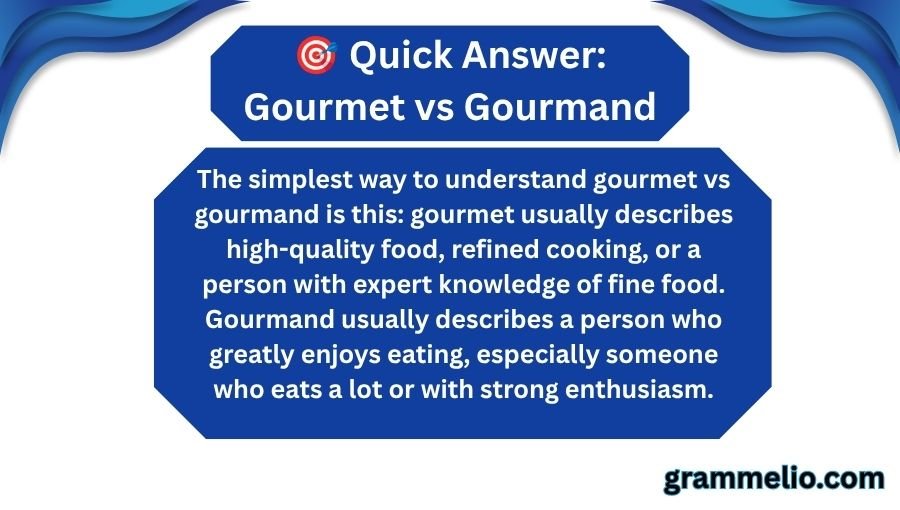
The simplest way to understand gourmet vs gourmand is this: gourmet usually describes high-quality food, refined cooking, or a person with expert knowledge of fine food. Gourmand usually describes a person who greatly enjoys eating, especially someone who eats a lot or with strong enthusiasm.
Think of it this way:
- Gourmet = quality, refinement, or knowledge of fine food.
- Gourmand = a person who loves eating, often in large amounts.
For example:
- ✅ She is a gourmet who can identify fine cheeses by taste.
- ✅ He is a gourmand who never turns down a second helping.
- ❌ He is a gourmand chef because his restaurant serves expensive food.
- ❌ She is a gourmet because she always eats huge portions.
The key is to focus on what the word emphasizes: gourmet is strongly connected with food quality and refined taste, while gourmand focuses on the person and their love of eating.
Is Gourmet the Same as Gourmand?
No. Gourmet and gourmand are related food words, but they are not interchangeable. Gourmet usually has a positive or approving sense connected to quality and refined taste. Gourmand focuses more on appetite and enjoyment of food.
This is one of those vocabulary pairs where a single letter change can lead to a different meaning.
Consider these sentences:
- ✅ The restaurant offers gourmet desserts.
- ✅ My brother is a serious gourmand.
- ❌ The restaurant offers gourmand desserts.
- ❌ My brother is a gourmet simply because he eats a lot.
The first two sentences use the words naturally. The last two confuse the main ideas behind them.
Gourmet as a Food Description
When gourmet is used as an adjective, it often describes food that is considered special, high-quality, carefully prepared, or more refined than ordinary food.
For example:
The hotel served a gourmet breakfast.
The sentence suggests that the breakfast was carefully prepared and featured high-quality ingredients or presentation.
Gourmet as a Person
Gourmet can also refer to a person who has refined knowledge or taste in food.
For example:
Maria is a gourmet who knows a great deal about French cuisine.
Here, the focus is not simply on how much Maria eats. It is on her knowledge and appreciation of fine food.
Gourmand as a Person
Gourmand is primarily used for a person who enjoys eating, especially someone with a hearty appetite.
For example:
My uncle is a lifelong gourmand who plans every vacation around local restaurants.
The sentence tells us that the person strongly enjoys food. It does not necessarily tell us that he has expert knowledge of fine cuisine.
🔎 Gourmet vs Gourmand at a Glance
The basic distinction becomes easier when the two terms are placed side by side.
| Form | Type | Meaning | Example | Correct/Incorrect |
|---|---|---|---|---|
| Gourmet | Noun | A person with refined food knowledge or taste | She is a gourmet. | ✅ Correct |
| Gourmet | Adjective | Related to high-quality or refined food | We bought gourmet chocolate. | ✅ Correct |
| Gourmand | Noun | A person who loves eating, often enthusiastically | He is a devoted gourmand. | ✅ Correct |
| Gourmand | Adjective | Not normally used as the standard adjective for fine food | Gourmand cheese | ❌ Incorrect |
| Gourmet | Noun | A person who simply eats huge amounts | He is a gourmet because he eats five burgers. | ❌ Usually incorrect |
| Gourmand | Noun | A person known mainly for enjoying food | She is a gourmand. | ✅ Correct |
The biggest clue is that gourmand is normally about a person, while gourmet can describe both people and food.
💡 What Does Gourmet Mean?
Gourmet describes something connected with fine food, high-quality ingredients, careful preparation, or refined knowledge of food. It can function as both a noun and an adjective.
As an adjective, it commonly modifies food, meals, products, or cooking.
Examples include:
- gourmet coffee
- gourmet chocolate
- gourmet cooking
- gourmet ingredients
- gourmet restaurant
As a noun, it can describe a person who appreciates or understands fine food.
Gourmet Examples
- ✅ The store sells gourmet olive oil.
- ✅ I took a gourmet cooking class.
- ✅ She considers herself a gourmet.
- ❌ The sandwich was gourmand.
- ❌ He is gourmet because he eats three desserts every night.
Notice that the adjective gourmet works naturally before food-related nouns.
What Does Gourmand Mean?
Gourmand is a noun that describes someone who takes great pleasure in eating. The word can suggest a hearty or excessive appetite, depending on the context.
It does not automatically mean that the person is rude or unhealthy. The tone depends on how the writer uses it.
For example:
James is a cheerful gourmand who loves exploring new restaurants.
This sentence sounds fairly positive.
But:
He became such a gourmand that he could never resist another plate.
This sentence places more attention on the person’s strong appetite.
Gourmand Examples
- ✅ She is a true gourmand who loves trying regional dishes.
- ✅ The food festival attracted gourmands from across the city.
- ❌ We ordered a gourmand dinner.
- ❌ The chef prepared a gourmand steak.
If you want to describe the food itself, gourmet is usually the better choice.
📚 Related Word Forms and Useful Variations
These words have several useful grammatical forms, although they do not behave in exactly the same way.
| Form | Type | Example |
|---|---|---|
| Gourmet | Noun | He is a gourmet. |
| Gourmet | Adjective | They sell gourmet bread. |
| Gourmand | Noun | She is a passionate gourmand. |
| Gourmands | Plural noun | The event attracted many gourmands. |
| Gourmet’s | Possessive noun | The gourmet’s opinion was respected. |
| Gourmand’s | Possessive noun | The gourmand’s appetite was impressive. |
| Gourmets | Plural noun | The gourmets compared the wines. |
A useful point is that gourmet can naturally be pluralized when it refers to people. Gourmands is also a normal plural form.
How Can You Remember the Difference?
A simple memory trick is to connect the words with their focus.
Gourmet → fine food and refined taste.
Gourmand → a person who loves to eat.
Try this mental picture:
🍰 Imagine a beautifully decorated dessert in a luxury restaurant. Think gourmet.
🍕 Now imagine someone happily eating three slices and asking for another. Think gourmand.
This trick is not a complete grammar rule, but it can help you make the right choice quickly.
🧠 Understanding the Basics of Gourmet vs Gourmand
The easiest way to understand gourmet vs gourmand is to ask one question: Are you talking mainly about the quality or style of food, or about the person who loves eating?
If you are describing food, gourmet is often the right word.
If you are describing someone with a strong appetite or deep enjoyment of eating, gourmand is often the better choice.
| Question | Better Choice | Example |
|---|---|---|
| Are you describing high-quality food? | Gourmet | They sell gourmet pastries. |
| Are you describing refined food preparation? | Gourmet | He enjoys gourmet cooking. |
| Are you describing a food expert? | Gourmet | She is a gourmet. |
| Are you describing someone who loves eating? | Gourmand | He is a dedicated gourmand. |
| Are you describing a huge appetite? | Gourmand | The young gourmand ordered another meal. |
Why Do People Confuse Gourmet and Gourmand?
People confuse these terms because both words are strongly associated with food and both can describe people who appreciate eating.
There is also a social reason for the confusion. In casual English, people often use gourmet as a general compliment for anyone who likes nice food. That broad use can make the distinction less obvious.
I once reviewed a restaurant article in which the writer called every enthusiastic customer a “gourmet.” The writer clearly understood that the people loved food. The problem was that the article was describing appetite, not refined food knowledge. Changing several instances to gourmand made the meaning much sharper.
Another reason is that gourmet appears frequently in food marketing. We see phrases such as “gourmet burgers,” “gourmet snacks,” and “gourmet coffee.” That repeated exposure can make people think gourmet simply means “someone who loves food.”
It does not.
📝 A Real-Life Case Study
Imagine that you are writing an email about a company dinner.
You write:
Our team has several gourmands, so we should choose a restaurant with large portions.
This works because you are talking about people who enjoy eating.
Now imagine a different email:
Our team has several gourmets, so we should choose a restaurant with carefully prepared dishes and an excellent menu.
This also works, but the meaning changes. Now you are emphasizing refined food tastes.
Here is the difference:
| Situation | Best Word | Reason |
|---|---|---|
| People want large portions | Gourmands | Focus is on appetite |
| People care about food quality | Gourmets | Focus is on refined taste |
| A restaurant serves premium dishes | Gourmet | Describes the food |
| Someone loves trying restaurants | Gourmand | Describes the person’s eating interest |
| Someone has strong food knowledge | Gourmet | Describes refined knowledge or taste |
The lesson is simple: choose the word based on the idea you want the reader to notice.
📖 Grammar Rules Explanation
The grammar rule is mainly about meaning and word function, not about a complicated spelling rule.
Gourmet can work as both a noun and an adjective.
As a noun:
She is a gourmet.
As an adjective:
She enjoys gourmet cuisine.
Gourmand is mainly a noun for a person who enjoys eating, especially with a strong appetite.
He is a gourmand.
Standard English reference works agree on the basic distinction between these terms. The safest approach is to keep the meanings separate rather than treating them as interchangeable synonyms.
Correct vs Incorrect at a Glance
| Sentence | Correct/Incorrect | Why |
|---|---|---|
| We ordered gourmet desserts. | ✅ Correct | Gourmet can describe high-quality food. |
| She is a knowledgeable gourmet. | ✅ Correct | Gourmet can describe a person with refined food knowledge. |
| He is a gourmand who loves huge meals. | ✅ Correct | Gourmand describes a person with a strong love of eating. |
| We ordered a gourmand pizza. | ❌ Incorrect | Gourmand normally describes a person, not the pizza. |
| She is a gourmand because she studies fine cuisine. | ❌ Usually incorrect | Studying and appreciating fine food may point more toward gourmet. |
⚠️ Common Mistakes With Gourmet and Gourmand
The most common mistake is using gourmand as if it were an adjective for fancy food.
Another mistake is using gourmet whenever someone eats a lot.
These errors often happen because of:
- Fast typing
- Autocorrect
- Similar food-related meanings
- Lack of knowledge about the distinction
- Marketing language
- Casual conversation
I once caught myself typing “gourmand menu” while editing a food feature. I stopped because I was describing the menu, not the customer. Gourmet menu was the natural choice.
Similar Word Confusions
| Confusing Pair | Correct Difference |
|---|---|
| It’s / Its | It’s means “it is”; its shows possession. |
| Your / You’re | Your shows possession; you’re means “you are.” |
| Then / Than | Then relates to time or sequence; than is used in comparisons. |
| Affect / Effect | Affect is usually a verb; effect is usually a noun. |
| Gourmet / Gourmand | Gourmet focuses on fine food or refined taste; gourmand focuses on a person who loves eating. |
Specific Wrong Forms to Avoid
| Wrong Form or Use | What’s Wrong | Correct Form |
|---|---|---|
| gourmand food | Gourmand normally describes a person | gourmet food |
| gourmand restaurant | The restaurant is not the person | gourmet restaurant |
| gourmand coffee | The coffee is being described | gourmet coffee |
| He is gourmet because he eats a lot. | Appetite alone does not make someone a gourmet | He is a gourmand. |
| She is a gourmand chef with refined food knowledge. | The intended meaning may be expertise rather than appetite | She is a gourmet chef |
| gourmet eater | Usually unnecessary and unclear | gourmand |
🕰️ Gourmet vs Gourmand: A Brief Word History
Both words entered English through French, and both have long been connected with food and eating. Their meanings developed along related but different paths.
The history helps explain why they look and sound somewhat alike while serving different roles in modern English.
| Period | Form | General Development |
|---|---|---|
| Earlier French usage | Gourmet-related forms | Connected with people knowledgeable about food and drink |
| Earlier French usage | Gourmand-related forms | Connected with a person who enjoys eating |
| Later English use | Gourmet | Developed strong associations with fine food and refined taste |
| Modern English | Gourmand | Commonly describes an enthusiastic or hearty eater |
| Modern English | Gourmet | Used for fine food, refined cooking, and knowledgeable food lovers |
The exact history of words can be more complex than a simple timeline suggests, but the modern distinction is clear enough to use confidently.
🌎 Usage in Different Contexts
The best word can change slightly depending on what you are writing.
Everyday Conversation
In everyday speech, gourmand can describe someone who really enjoys eating.
My dad is a bit of a gourmand. He plans every trip around food.
Gourmet is common when describing good-quality food.
This grocery store has a great gourmet section.
Professional Writing
In professional writing, precision matters more.
A food magazine might write:
The chef created a gourmet menu featuring seasonal ingredients.
A profile might say:
The critic is a respected gourmet with years of food experience.
Creative Writing
Creative writers can use gourmand to build a vivid picture of a character.
The cheerful gourmand attacked the buffet with great enthusiasm.
The word gives the character a strong relationship with food.
Social Media and Texting
Social media often uses gourmet in a broad, promotional way.
Examples include:
- My gourmet dinner tonight!
- Trying a new gourmet pizza place.
- Homemade gourmet cookies.
Gourmand can sound more literary or playful.
Officially becoming a weekend gourmand. 🍕
| Context | Which Term to Use | Example |
|---|---|---|
| Everyday conversation | Either, depending on meaning | He’s a gourmand. |
| Professional writing | Gourmet or gourmand, depending on meaning | The gourmet chef created a new menu. |
| Creative writing | Gourmand for character description | The gourmand ordered dessert. |
| Social media | Gourmet is more common | Look at this gourmet breakfast! |
🍴 Common Phrases With Gourmet
There are many natural combinations with gourmet, especially when it works as an adjective.
| Phrase | Meaning |
|---|---|
| Gourmet food | High-quality or carefully prepared food |
| Gourmet cuisine | Refined or special cooking |
| Gourmet restaurant | A restaurant associated with high-quality food |
| Gourmet coffee | Premium or specially prepared coffee |
| Gourmet chocolate | High-quality chocolate |
| Gourmet cooking | Cooking focused on quality and careful preparation |
With gourmand, natural phrases are more likely to focus on people.
| Phrase | Meaning |
|---|---|
| A true gourmand | Someone who deeply enjoys eating |
| A dedicated gourmand | Someone strongly interested in food and eating |
| A lifelong gourmand | Someone who has loved food for many years |
| A passionate gourmand | Someone highly enthusiastic about eating |
| A happy gourmand | A person who takes great pleasure in food |
🧩 How Does Gourmet vs Gourmand Work in Sentences?
The grammar becomes easier when you identify the role of the word.
If gourmet comes before a food noun, it is probably an adjective.
gourmet cheese
If gourmet follows a linking verb and describes a person, it may be a noun.
She is a gourmet.
If gourmand refers to a person, it is functioning as a noun.
He is a gourmand.
This simple sentence test can help you avoid many mistakes.
What Are Good Alternatives to Gourmet?
Depending on your sentence, you may be able to replace gourmet with words such as fine, premium, high-quality, refined, or specialty.
However, these alternatives are not always exact replacements.
| Alternative | Works When | Does Not Work When |
|---|---|---|
| Fine | You mean high quality or refined | You specifically mean a food expert |
| Premium | You mean higher quality | You mean a person’s food knowledge |
| Specialty | You mean a special food or product | You mean a person who loves eating |
| Refined | You mean polished taste or style | You simply mean expensive food |
| High-quality | You want a clear, simple description | You want the specific food-related sense of gourmet |
For gourmand, alternatives include food lover, enthusiastic eater, food enthusiast, or hearty eater.
What Are Good Alternatives to Gourmand?
The best replacement depends on whether you want a positive, neutral, or humorous tone.
| Alternative | Works When | Does Not Work When |
|---|---|---|
| Food lover | You want a warm, positive tone | You need to stress a large appetite |
| Food enthusiast | You want a neutral expression | You specifically mean someone who eats a lot |
| Hearty eater | You want to emphasize appetite | You want to emphasize refined taste |
| Foodie | You mean someone interested in food and restaurants | You need an exact synonym for gourmand |
| Enthusiastic eater | You want a very clear meaning | You want a stylish or compact word |
💼 Why Does the Difference Matter?
Knowing the difference between these terms improves clarity.
Imagine writing a restaurant review and saying:
The restaurant is perfect for gourmands.
That tells readers the restaurant is attractive to people who love eating.
But:
The restaurant is perfect for gourmets.
That suggests the restaurant appeals to people who care about refined food and quality.
Those statements overlap, but they are not identical.
Clarity in Communication
A precise word helps readers understand your exact meaning.
Professionalism
Correct word choice makes reviews, articles, menus, and business writing sound more polished.
Digital Writing
Online readers often scan quickly. Clear vocabulary helps them understand your message without stopping to guess what you mean.
A useful writing principle is:
The right word makes the intended picture easier to see.
| Situation | Why Getting It Right Matters |
|---|---|
| Resume or professional profile | Shows careful word choice |
| Client email | Prevents confusing descriptions |
| Published content | Builds trust with readers |
| Social post | Makes the message sharper and more engaging |
Is There a Special Exception?
There is no major grammar exception that makes gourmet and gourmand freely interchangeable.
However, real-world language can be flexible. People sometimes use food terms in creative or marketing ways. A restaurant might invent a playful expression involving gourmand, but that does not change the standard meaning of the word.
For formal or educational writing, stick to the normal distinction:
Gourmet describes fine food, refined taste, or food expertise.
Gourmand describes a person who loves eating, often with a strong appetite.
🎯 How to Remember Gourmet vs Gourmand
Use this three-step test:
- Are you describing food?
Choose gourmet. - Are you describing refined food knowledge or taste?
Choose gourmet. - Are you describing someone who loves eating or has a strong appetite?
Choose gourmand.
Try these:
- They served ______ chocolate.
- My cousin is a real ______.
- She knows a lot about fine cuisine and is considered a ______.
Answers:
- gourmet
- gourmand
- gourmet
That small test can settle most cases.
✍️ Practice: Choose the Correct Word
Fill in each blank with gourmet or gourmand.
- The hotel served a ______ breakfast.
- My brother is a serious ______ who loves trying new restaurants.
- She has a refined taste in food and considers herself a ______.
- We bought ______ cheese for the dinner party.
- The festival attracted hundreds of food-loving ______.
Answers
- gourmet
- gourmand
- gourmet
- gourmet
- gourmands
✅ Quick Recap Checklist
Use this checklist whenever you are unsure.
| Question | If Yes → Use |
|---|---|
| Am I describing high-quality food? | Gourmet |
| Am I describing refined cooking? | Gourmet |
| Am I describing a food expert or refined food lover? | Gourmet |
| Am I describing someone who loves eating? | Gourmand |
| Am I describing someone with a hearty appetite? | Gourmand |
| Am I describing the food itself as a person? | Stop and reconsider |
Three Quick Practice Examples
1. The chef prepared a ______ meal.
Answer: gourmet ✅
2. My friend is such a ______ that she knows every restaurant in town.
Answer: gourmand ✅
3. We bought ______ coffee for the office.
Answer: gourmet ✅
❓ FAQs About Gourmet vs Gourmand
What is the main difference between gourmet and gourmand?
Gourmet is usually connected with high-quality food, refined cooking, or knowledgeable appreciation of food. Gourmand usually describes a person who greatly enjoys eating, often with a strong appetite.
Is a gourmand someone who eats a lot?
A gourmand is someone who enjoys eating, and the word can suggest a hearty or excessive appetite. However, it does not always mean that the person eats an extreme amount.
Can gourmet describe a person?
Yes. Gourmet can be a noun for a person with refined knowledge or taste in food.
For example:
She is a gourmet who appreciates fine cuisine.
Can gourmet describe food?
Yes. This is one of its most common uses.
Examples include:
- gourmet cheese
- gourmet coffee
- gourmet desserts
- gourmet cuisine
Can I say “gourmand food”?
In standard English, that is generally not the natural choice. Gourmand normally describes a person. If you are describing high-quality or refined food, gourmet food is the better choice.
Is gourmet always positive?
Usually, gourmet has a positive or approving sense when it refers to high-quality food or refined taste. Context still matters, especially in marketing or casual speech.
Is gourmand a negative word?
Not necessarily. Gourmand can be playful, warm, or positive when describing someone who loves food. In some contexts, it can suggest excessive eating, so tone matters.
What is the difference between a gourmet and a foodie?
A foodie is a casual term for someone who is very interested in food, restaurants, or cooking. Gourmet can suggest more refined taste or knowledge. Gourmand focuses more strongly on the pleasure of eating.
Which word describes a fancy restaurant?
Gourmet is generally the better choice when you want to describe a restaurant associated with high-quality or refined food.
For example:
They booked a table at a gourmet restaurant.
How can I remember gourmet vs gourmand?
Remember:
Gourmet = fine food and refined taste.
Gourmand = person who loves to eat.
If you are talking about the food itself, gourmet is usually the safer choice.
🔑 Gourmet vs Gourmand: The Final Rule
Gourmet vs gourmand becomes easy once you focus on the main idea behind each word. Gourmet is connected with fine food, high quality, careful preparation, and refined knowledge or taste. Gourmand describes a person who takes great pleasure in eating and may have a hearty appetite.
When you write, ask yourself what you are describing. Is it the food, cooking, or refined taste? Choose gourmet. Are you describing a person who loves eating? Choose gourmand.
I recommend using the simplest mental test: gourmet points toward fine food; gourmand points toward the eater. 🍽️ Once that distinction becomes familiar, these two words are much easier to handle in emails, articles, restaurant reviews, social posts, and everyday conversation.
Good vocabulary does not require complicated rules. It simply requires choosing the word that gives your reader the picture you mean. Keep that picture in mind, and you will rarely confuse these two food-loving terms again. ✨


[…] common spelling traps. By the end, grisly vs gristly should feel much easier to handle. ✍️ Gourmet vs Gourmand | Fiancé vs Fiancée | Farther vs […]