Have you ever read a sentence and wondered whether extant vs extent is the right choice? I have seen this mix-up many times in student essays, work emails, and even carefully edited articles. The two words look almost the same, but they do very different jobs.
Extant describes something that still exists, while extent describes the size, range, or degree of something. That small spelling difference can completely change a sentence. If you are a student, writer, editor, professional, or English learner, knowing this difference can make your writing much clearer. 😊
I use a simple meaning test whenever I see these words: ask whether the sentence is talking about something that survives or about how much, how far, or how large something is.
Once you learn that test, extant vs extent becomes much easier to remember. Let’s break the difference down with simple rules and practical examples. ✨ Exercise vs Exorcise | Exalt vs Exult | Eligible vs Illegible
🎯 Quick Answer: Extant vs Extent
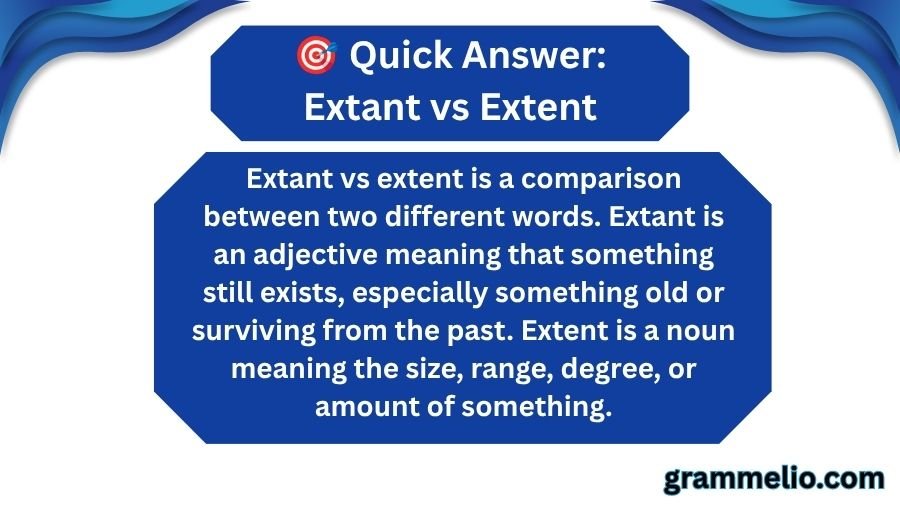
Extant vs extent is a comparison between two different words. Extant is an adjective meaning that something still exists, especially something old or surviving from the past. Extent is a noun meaning the size, range, degree, or amount of something.
A quick memory trick is:
- Extant = existingi
- Extent = how much or how far
For example, “an extant manuscript” means a manuscript that still exists. “The extent of the damage” means how much damage there is.
| Word | Part of Speech | Basic Meaning | Example |
|---|---|---|---|
| Extant | Adjective | Still existing | An extant copy was found. |
| Extent | Noun | Size, range, or degree | We measured the extent of the damage. |
Is Extant the Same as Extent?
No. Extant and extent are not interchangeable. Extant describes existence, while extent measures or describes the degree, size, or range of something.
Think of them as answering different questions:
- Extant: Does it still exist?
- Extent: How much? How far? How large?
For example:
“The extant records are valuable.”
Here, extant tells us that the records still exist.
“The extent of the records is impressive.”
This sentence would mean something different. It would suggest their size or range is impressive, although the wording may be unusual depending on the intended meaning.
The easiest way to understand extant vs extent is to focus on the job each word performs.
Extant describes existence
Use extant before a noun when you want to say that something still exists.
Examples include:
- extant manuscripts
- extant records
- extant buildings
- extant copies
- extant species
- extant documents
Extent describes degree or size
Use extent as a noun when discussing how large, serious, broad, or far-reaching something is.
Examples include:
- the extent of the damage
- the extent of the problem
- the extent of the research
- the full extent of the law
- to some extent
- to a great extent
| Question | Correct Word | Example |
|---|---|---|
| Does something still exist? | Extant | An extant letter survives. |
| How much damage occurred? | Extent | We assessed the extent of the damage. |
| Does an old building survive? | Extant | The extant building dates back centuries. |
| How far does an issue reach? | Extent | We do not know the extent of the issue. |
| Does a record still exist? | Extant | Several extant records remain. |
What Does Extant Mean?
Extant is an adjective that means still existing. It is often used when talking about something old, rare, historical, or surviving from an earlier period.
If someone says, “This is the oldest extant copy,” they mean it is the oldest copy that still exists.
Examples of extant
“The museum owns an extant copy of the original document.”
The word extant describes the copy. The copy still exists.
“Researchers studied several extant manuscripts.”
The manuscripts have survived and are still available to study.
“Only a few extant buildings remain from that period.”
The buildings still exist.
What kind of nouns can follow extant?
Extant often appears with nouns related to records, history, culture, science, and surviving objects.
| Phrase | Meaning |
|---|---|
| Extant manuscript | A manuscript that still exists |
| Extant record | A record that survives |
| Extant species | A species that still exists |
| Extant copy | A surviving copy |
| Extant building | A building that remains standing |
| Extant evidence | Evidence that still exists |
💡 Test Tip for Extant
Replace extant with “still existing.”
If the sentence keeps its intended meaning, extant is probably correct.
“The extant records are incomplete.”
Try:
“The still-existing records are incomplete.”
The meaning works, so extant is correct.
What Does Extent Mean?
Extent is a noun. It refers to the size, range, degree, or amount of something.
It often appears when someone wants to explain how much something exists, reaches, affects, or matters.
For example:
“We need to understand the extent of the problem.”
This means we need to understand how serious, large, or widespread the problem is.
Common uses of extent
You will often see extent in phrases such as:
- the extent of the damage
- the extent of the problem
- the extent of the impact
- the extent of the change
- to some extent
- to a large extent
- to a certain extent
- to what extent
| Expression | Meaning | Example |
|---|---|---|
| To some extent | Partly | I agree to some extent. |
| To a large extent | Mostly or considerably | The plan succeeded to a large extent. |
| To what extent | How much or how far | To what extent did it help? |
| The full extent | The complete amount or degree | We learned the full extent of the loss. |
| The extent of | The size, degree, or range | They measured the extent of the damage. |
How Does Extent Work in a Sentence?
Because extent is a noun, it usually appears with words that show measurement, degree, or range.
Consider:
“The extent of the damage was surprising.”
Here, extent means the amount or degree of damage.
Another example:
“I agree with her to some extent.”
This means the speaker agrees partly, but not completely.
A useful test is to replace extent with degree, amount, range, or size.
If one of those words fits, extent may be the correct choice.
| Sentence | Replacement Test | Result |
|---|---|---|
| The extent of the damage was severe. | Degree of the damage | Correct |
| To some extent, I agree. | To some degree | Correct |
| The extant manuscript was damaged. | The existing manuscript | Correct |
| The extent manuscript was damaged. | The degree manuscript | Incorrect |
🔍 Extant vs Extent at a Glance
The simplest difference between extant vs extent is that one describes survival and the other describes degree.
| Feature | Extant | Extent |
|---|---|---|
| Part of speech | Adjective | Noun |
| Main idea | Still existing | Size, range, amount, or degree |
| Answers | “Does it exist?” | “How much?” or “How far?” |
| Common setting | History, research, archives | Reports, analysis, everyday writing |
| Common phrase | Extant manuscript | Extent of the damage |
| Example | An extant record survives. | The extent of the damage is unknown. |
Why Do People Confuse Extant and Extent?
People confuse these words because they look and sound very similar. Both begin with ext-, contain similar letters, and are often used in formal writing.
The biggest problem is that the difference is only one letter in spelling, but the meanings are far apart.
I once edited a student paper about ancient books. The student repeatedly wrote “extent manuscripts” when they meant manuscripts that still survived. The intended word was extant. Once I showed the student the “still existing” test, the mistake disappeared.
Common causes of confusion include:
- Similar spelling
- Similar pronunciation
- Fast typing
- Autocorrect
- Limited vocabulary knowledge
- Rare use of the word extant
- Reading the words without focusing on their meanings
| Confusing Pair | Correct Difference |
|---|---|
| Extant / Extent | Existing / Degree or amount |
| Affect / Effect | Influence / Result |
| Advice / Advise | Recommendation / Give guidance |
| Compliment / Complement | Praise / Complete or match |
| Principal / Principle | Main person or thing / Rule or belief |
| Stationary / Stationery | Not moving / Writing materials |
📝 Case Study: Extant vs Extent at Work
Imagine that a museum team is preparing a report about an old building.
The first employee writes:
“The extent stone structure is one of the oldest buildings in the town.”
That sentence is incorrect because the writer is talking about a structure that still exists.
The better version is:
“The extant stone structure is one of the oldest buildings in the town.” ✅
Now imagine the report continues:
“Researchers are still studying the extent of the building’s historical influence.” ✅
Here, extent works because the sentence asks how broad or significant the influence is.
| Situation | Correct Word | Example |
|---|---|---|
| A building still exists | Extant | The extant building attracts visitors. |
| Measuring its influence | Extent | The extent of its influence is unclear. |
| A surviving document | Extant | The extant document is valuable. |
| Measuring the document collection | Extent | The extent of the collection surprised us. |
This example shows why context matters more than spelling.
📚 Grammar Rules Explanation for Extant and Extent
The grammar rule is simple: extant is an adjective, while extent is a noun.
An adjective describes a noun. That is why we can say:
“an extant manuscript”
The adjective extant describes the manuscript.
A noun can function as the name of a thing, idea, quality, or concept. Extent names the degree, range, or amount of something.
That is why we can say:
“the extent of the damage”
Here, extent is the noun being discussed.
Most standard English reference sources make the same basic distinction between these words.
Correct vs Incorrect at a Glance
| Sentence | Correct/Incorrect | Why |
|---|---|---|
| The extant manuscript is valuable. | ✅ Correct | It still exists. |
| The extent manuscript is valuable. | ❌ Incorrect | Extent does not mean existing. |
| We studied the extent of the damage. | ✅ Correct | Extent means degree or amount. |
| We studied the extant of the damage. | ❌ Incorrect | Extant cannot replace the noun extent. |
| Several extant records remain. | ✅ Correct | Extant describes surviving records. |
A simple grammar pattern
Remember these two structures:
Extant + noun
extant records
extant evidence
extant buildings
Extent + of + noun
extent of the damage
extent of the problem
extent of the impact
That pattern makes extant vs extent much easier to handle.
⚠️ Common Mistakes With Extant and Extent
The most common mistake is using extent when the writer means “still existing.”
For example:
❌ “The extent documents were preserved.”
The correct sentence is:
✅ “The extant documents were preserved.”
Another mistake is using extant where a noun is needed.
❌ “We need to determine the extant of the damage.”
The correct sentence is:
✅ “We need to determine the extent of the damage.”
I once caught myself typing “extent records” in a research note. I was moving quickly and relying on the similar spelling. I stopped, asked whether I meant “still existing,” and changed it to “extant records.” That quick pause saved the sentence.
Why these mistakes happen
| Cause | What Happens |
|---|---|
| Fast typing | Similar words are entered without checking meaning. |
| Autocorrect | A device may favor a familiar word. |
| Lack of knowledge | The writer may not know the meaning of extant. |
| Similar spelling | The words look almost identical. |
| Rare exposure | Extant is less common in casual speech. |
Common Wrong Forms and Uses
| Wrong Form or Use | What’s Wrong | Correct Form |
|---|---|---|
| Extent manuscript | Uses a noun where an adjective is needed | Extant manuscript |
| Extant of the damage | Uses an adjective where a noun is needed | Extent of the damage |
| Extent records | Does not mean surviving records | Extant records |
| Extant of the problem | Extant does not mean degree | Extent of the problem |
| Extent species | The intended meaning is “still existing” | Extant species |
🧠 How to Remember Extant vs Extent
A good memory trick is to connect extant with existing.
Both words describe something that is still around.
EXTANT → EXISTING
For extent, think about extent of damage or extent of a problem.
EXTENT → DEGREE / AMOUNT / RANGE
Another trick is to remember the grammar:
Extant describes. Extent measures.
That short sentence captures the core rule.
| Memory Question | Answer |
|---|---|
| Does it still exist? | Extant |
| How much is there? | Extent |
| How far does it reach? | Extent |
| Is it a surviving object? | Extant |
| Is it describing a noun? | Extant |
| Is it the degree or range? | Extent |
✍️ Usage in Different Contexts
The difference between these words remains the same across different types of writing. However, extant appears more often in formal, historical, academic, and scientific contexts. Extent is much more common in everyday and professional writing.
| Context | Which Term to Use | Example |
|---|---|---|
| Everyday conversation | Extent | I agree to some extent. |
| Professional writing | Extent | We assessed the extent of the risk. |
| Creative writing | Either, depending on meaning | An extant castle stood nearby. |
| Social media/texting | Usually extent | I agree to some extent. |
| Historical writing | Extant | The extant records reveal new details. |
| Academic research | Either, depending on meaning | Researchers examined the extent of the effect. |
Everyday conversation
You are more likely to hear extent in everyday speech.
“I agree to some extent.”
This means “I agree partly.”
You are less likely to hear extant in casual conversation because it is a more specialized word.
Professional writing
Extent is common in reports and business writing.
“The team assessed the extent of the financial impact.”
Extant may appear in historical or technical documents.
“The report examines extant records from the period.”
Creative writing
Writers can use either word depending on the intended meaning.
“The extant tower rose above the valley.”
The tower still exists.
“No one understood the extent of her influence.”
The sentence describes the degree of her influence.
Social media and texting
Extent is much more likely to appear in casual digital communication.
“I agree to some extent.”
Extant is possible, but it may sound formal or academic.
💬 Common Phrases With Extent
Extent appears in several common phrases. These expressions are useful because they give you ready-made patterns for correct writing.
| Phrase | Meaning |
|---|---|
| To some extent | Partly |
| To a certain extent | Partly or within limits |
| To a large extent | Considerably or mostly |
| To what extent | How much or how far |
| The full extent | The complete amount or degree |
| The extent of the damage | The amount or degree of damage |
Examples
“I agree to some extent.”
“The storm caused damage to a large extent.”
“We do not yet know the full extent of the problem.”
“To what extent did the decision affect the company?”
These phrases are excellent clues. When you see to some extent, to what extent, or extent of, the word is almost certainly extent.
Are There Common Phrases With Extant?
Extant does not have as many everyday fixed expressions as extent. It is most often paired naturally with nouns that describe surviving things.
Common combinations include:
- extant manuscripts
- extant records
- extant evidence
- extant copies
- extant buildings
- extant species
| Combination | Meaning |
|---|---|
| Extant manuscript | A manuscript that still survives |
| Extant record | A record that still exists |
| Extant species | A species that still exists |
| Extant copy | A surviving copy |
| Extant building | A building that remains |
| Extant evidence | Evidence that remains available |
🔄 Synonyms and Alternatives
Sometimes you can replace these words with simpler terms. The best replacement depends on the sentence.
For extant, useful alternatives include existing, surviving, and remaining.
For extent, possible alternatives include degree, amount, range, and scope.
| Alternative | Works When | Does Not Work When |
|---|---|---|
| Existing | You mean something still exists | You mean degree or amount |
| Surviving | Something has remained from the past | You are measuring size or range |
| Remaining | Something is still left | You mean the level of an effect |
| Degree | You mean level or intensity | You mean a surviving object |
| Range | You mean how far something extends | You mean whether something exists |
For example:
“The extant manuscript” → “The surviving manuscript”
This works well.
But:
“The extent of the damage” → “The surviving damage”
This changes the meaning, so it does not work.
📖 Extant vs Extent in Academic Writing
Academic writers often encounter both words. Extant is especially useful when discussing surviving historical material.
For example:
“The researcher compared several extant versions of the text.”
The writer is identifying versions that still exist.
Extent is useful when researchers discuss degree, scope, or impact.
“The study examined the extent of the environmental changes.”
Here, the study examines how large or widespread the changes are.
| Academic Situation | Best Word |
|---|---|
| Surviving manuscript | Extant |
| Surviving evidence | Extant |
| Degree of impact | Extent |
| Range of influence | Extent |
| Surviving historical record | Extant |
| Size of a research problem | Extent |
💼 Extant vs Extent in Professional Writing
Professional writing rewards precision. A one-letter mistake can make a sentence confusing.
Imagine a report says:
“The extent records show that the process worked.”
A reader may stop because extent records does not make sense.
If the writer means records that still exist, the sentence should say:
“The extant records show that the process worked.” ✅
Now consider:
“The team investigated the extant of the losses.”
That also needs correction:
“The team investigated the extent of the losses.” ✅
The second version asks about the amount or degree of loss.
| Professional Sentence | Correct Word |
|---|---|
| ___ records remain available. | Extant |
| We measured the ___ of the loss. | Extent |
| The ___ evidence is limited. | Extant |
| The ___ of the risk is unclear. | Extent |
🌎 Why It Matters
Using the right word improves clarity, professionalism, and trust. A reader should not have to guess whether you mean “still existing” or “how much.”
This matters especially in:
- resumes
- business emails
- academic papers
- research reports
- published articles
- websites
- social posts
A simple writing principle is:
“Choose the word that matches the meaning, not the spelling.”
| Situation | Why Getting It Right Matters |
|---|---|
| Resume | Clear writing creates a professional impression. |
| Client email | Precise wording reduces confusion. |
| Published content | Correct word choice strengthens credibility. |
| Social post | Clear language makes the message easier to understand. |
When I edit professional writing, I look for small word pairs like this because they can create big meaning problems. Correct spelling is helpful, but correct meaning is what makes communication work.
📝 More Correct Examples
Here are several examples that show the difference in real sentences.
Extant examples
“The library holds an extant copy of the rare book.” ✅
The copy still exists.
“Scientists studied an extant population of the species.” ✅
The population still exists.
“Only a few extant structures remain.” ✅
The structures still exist.
Extent examples
“The report describes the extent of the damage.” ✅
The report describes how much damage occurred.
“We underestimated the extent of the problem.” ✅
The problem was larger or more serious than expected.
“To some extent, the criticism was fair.” ✅
The speaker partly agrees with the criticism.
❌ More Common Incorrect Examples
“The extent manuscript was discovered in an old archive.” ❌
Use extant because the manuscript still exists.
“Researchers measured the extant of the damage.” ❌
Use extent because the sentence concerns the degree of damage.
“The extant of the problem is difficult to estimate.” ❌
Use extent because the sentence asks how large or serious the problem is.
“Several extent records survived.” ❌
Use extant because the records survived and still exist.
🧩 A Simple Decision Process
When you are unsure about extant vs extent, stop and ask one question.
Are you talking about existence or measurement?
If you mean existence, choose extant.
If you mean measurement, degree, size, amount, or range, choose extent.
| Step | Question | Choice |
|---|---|---|
| 1 | Does the thing still exist? | Extant |
| 2 | Are you describing a surviving thing? | Extant |
| 3 | Are you asking how much? | Extent |
| 4 | Are you asking how far? | Extent |
| 5 | Are you describing degree or range? | Extent |
This method works much better than trying to memorize the spelling alone.
🎯 Quick Recap Checklist
Use this checklist whenever you encounter these words.
| Question | If Yes → Use |
|---|---|
| Does it still exist? | Extant |
| Is it a surviving object, record, or species? | Extant |
| Am I describing an existing thing? | Extant |
| Am I asking how much? | Extent |
| Am I asking how far? | Extent |
| Am I discussing degree or range? | Extent |
| Does “to some ___” appear? | Extent |
| Does “___ of the damage” appear? | Extent |
Practice Examples
- “The ___ manuscript is still preserved.”
Answer: extant ✅ - “The researchers measured the ___ of the damage.”
Answer: extent ✅ - “To some ___, I agree with the proposal.”
Answer: extent ✅
The key is simple: extant means still existing; extent means degree, amount, size, or range.
Is Extant Used Only for Old Things?
No. Extant can describe anything that still exists, although it is especially common when discussing things that have survived from an earlier time.
For example:
“The extant species were included in the study.”
The word does not necessarily mean ancient. It simply means the species still exist.
It can also describe current records, evidence, buildings, or copies.
| Example | Why Extant Works |
|---|---|
| Extant species | They still exist. |
| Extant records | They still survive. |
| Extant evidence | It remains available. |
| Extant buildings | They still stand. |
Can Extant Be Used as a Noun?
In standard modern English, extant is normally used as an adjective. It describes something that still exists.
You should not normally use it as a replacement for the noun extent.
Correct:
“The extant documents were reviewed.” ✅
Incorrect:
“We examined the extant of the damage.” ❌
Correct:
“We examined the extent of the damage.” ✅
This difference is one of the most useful grammar clues for separating the two words.
Can Extent Describe Something That Exists?
Not by itself. Extent does not mean “existing.”
For example:
“The extent building” ❌
does not mean “the building that still exists.”
You would say:
“The extant building” ✅
However, extent can describe the size or degree of something that exists.
“The extent of the building’s damage was unclear.” ✅
Here, extent describes the degree of damage.
Which Word Is More Common in Everyday English?
Extent is much more common in everyday English. People frequently use phrases such as “to some extent,” “to a certain extent,” and “the extent of the problem.”
Extant is less common and tends to appear in formal, academic, historical, scientific, or research writing.
That does not make extant less useful. It simply means you should know its specific meaning before using it.
| Word | Everyday Frequency | Typical Context |
|---|---|---|
| Extant | Lower | Historical and formal writing |
| Extent | Higher | Everyday and professional writing |
FAQs About Extant vs Extent
What is the difference between extant and extent?
Extant means still existing. Extent means the size, degree, amount, or range of something.
Example: “an extant manuscript” means a manuscript that still exists. “the extent of the damage” means how much damage occurred.
Is extant an adjective or a noun?
Extant is an adjective. It describes something that still exists.
Example:
“The extant records are valuable.”
Here, extant describes the records.
Is extent a noun?
Yes. Extent is a noun that refers to the degree, size, amount, or range of something.
Example:
“The extent of the problem was surprising.”
How can I remember extant vs extent?
Use this memory trick:
Extant = existing.
Extent = degree, amount, or range.
You can also remember: Extant describes; extent measures.
Is “extent of the damage” correct?
Yes. “Extent of the damage” is a standard and natural phrase.
It means the amount or degree of damage.
Example:
“The inspectors assessed the extent of the damage.”
Is “extant manuscript” correct?
Yes. “Extant manuscript” is correct when you mean a manuscript that still exists.
Example:
“The researcher examined an extant manuscript from the period.”
Can I use extant and extent interchangeably?
No. They have different meanings and different grammatical roles. Extant is an adjective meaning still existing. Extent is a noun meaning degree, amount, size, or range.
Which is correct: “extant records” or “extent records”?
“Extant records” is correct when you mean records that still exist.
“Extent records” does not carry that meaning.
Which is correct: “extant of the problem” or “extent of the problem”?
“Extent of the problem” is correct. It means the size, seriousness, or range of the problem.
“Extant of the problem” is incorrect.
Is extent used in the phrase “to some extent”?
Yes. “To some extent” is a common phrase meaning partly or to a limited degree.
Example:
“I agree with the argument to some extent.”
Can extant refer to something modern?
Yes. Extant simply means still existing. Although it is often used for old or historical things, it can also describe something current.
For example:
“The study examined extant populations.”
The populations still exist.
Is extant a formal word?
Yes. Extant is relatively formal and is especially common in academic, historical, scientific, and research writing. In everyday conversation, simpler words such as “existing” or “surviving” may sound more natural.
What is the easiest way to choose between extant and extent?
Ask yourself what you mean:
- Still exists? → Extant
- How much, how far, or how large? → Extent
That two-question test will solve most cases.
Conclusion
Extant vs extent becomes easy once you connect each word with its core meaning. Extant is an adjective that means “still existing,” so you can write about extant manuscripts, extant records, extant buildings, or extant species. Extent is a noun that refers to degree, size, amount, or range, so you can write about the extent of the damage, the extent of a problem, or the extent of an effect. 😊 When I proofread writing, I use one quick test: if I can replace the word with “still existing,” I choose extant. If I can replace it with “degree,” “amount,” “size,” or “range,” I choose extent. That simple habit prevents most mistakes. ✨ Keep this rule in mind: extant describes what still exists, while extent tells you how much or how far. Once that distinction becomes automatic, you will never need to guess between these two words again.

[…] whether you are writing a school paper, sending a text, or preparing professional content. Extant vs Extent | Exercise vs Exorcise | Exalt vs […]
[…] use in real life. By the end, fiancé vs fiancée should feel much easier. 😊 Farther vs Father | Extant vs Extent | Exercise vs […]