Have you ever stopped while writing because you could not decide between exalt vs exult? You are not alone. These two words look and sound similar, but they do very different jobs in a sentence. I often see this mix-up in student essays, emails, and online writing because both words are linked to strong positive feelings.
The good news is that the difference is easy to learn once you connect each word with its main idea. 😊 Exalt usually means to praise, honor, or raise someone or something to a higher level. Exult means to feel or show great joy, especially after a success.
In this guide, I will break down the meanings, grammar rules, examples, common mistakes, and memory tricks so you can use both words with confidence. ✨ Eligible vs Illegible | Descent vs Dissent | Demur vs Demure
🎯 Quick Answer: Exalt vs Exult
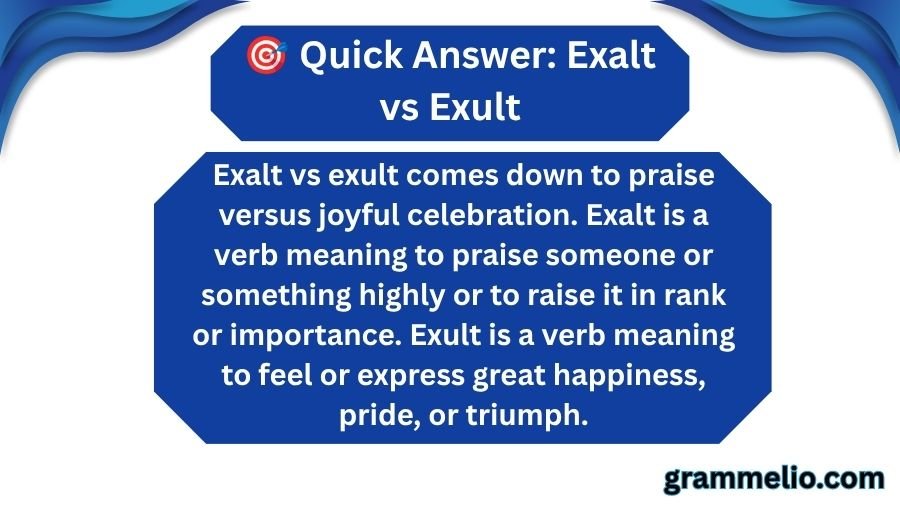
Exalt vs exult comes down to praise versus joyful celebration. Exalt is a verb meaning to praise someone or something highly or to raise it in rank or importance. Exult is a verb meaning to feel or express great happiness, pride, or triumph.
A simple memory trick is:
- Exalt = praise or raise
- Exult = rejoice or celebrate
For example:
- ✅ The poem exalts the courage of the firefighters.
- ❌ The poem exults the courage of the firefighters.
Here, exalts is correct because the poem praises the firefighters.
On the other hand:
- ✅ The players exulted after winning the championship.
- ❌ The players exalted after winning the championship.
Here, exulted is correct because the players felt and showed great joy.
What Does Exalt Mean?
Exalt means to praise someone or something very highly. It can also mean to raise someone or something to a higher position, status, or level of importance.
The word is normally used when the focus is on honor, praise, status, or high importance.
For example:
The speech exalted the value of honesty.
The speaker is not simply feeling happy. The speech is presenting honesty as something worthy of great respect.
Exalt as Praise
One common use of exalt is to praise a person, quality, idea, or achievement.
- ✅ The biography exalts her courage and kindness.
- ❌ The biography exults her courage and kindness.
The first sentence works because the biography praises her qualities.
Another example:
- ✅ The song exalts the beauty of nature.
- ❌ The song exults the beauty of nature.
The song is describing nature as highly valuable or admirable.
Exalt as Raise in Status
Exalt can also mean to raise someone or something to a higher position.
- ✅ The king exalted his trusted adviser to a position of great power.
- ❌ The king exulted his trusted adviser to a position of great power.
In this case, exalted refers to raising the adviser’s rank or status.
Quick Table: Meanings of Exalt
| Meaning | Word Type | Example Sentence |
|---|---|---|
| Praise highly | Verb | The article exalts courage. |
| Honor greatly | Verb | The leader was exalted for his service. |
| Raise in status | Verb | The ruler exalted his adviser. |
| Treat as highly important | Verb | The speech exalts family values. |
What Does Exult Mean?
Exult means to feel or show great joy, pride, or triumph. It often appears when someone has achieved something important or experienced a major success.
The focus is on the person’s joyful reaction.
For example:
- ✅ The fans exulted when their team won.
- ❌ The fans exalted when their team won.
The fans are celebrating their victory. Therefore, exulted is the right word.
Exult After a Victory
Exult is especially useful when people celebrate a win or success.
- ✅ The students exulted after hearing the good news.
- ❌ The students exalted after hearing the good news.
The students are expressing happiness.
You can also write:
- ✅ She exulted in her success.
- ❌ She exalted in her success.
The phrase exult in means to take great joy or pride in something.
Exult as a Strong Emotional Response
The word does not always require a competition. A person can exult after any major success or joyful event.
- He exulted when he learned that his application had been accepted.
- The children exulted at the sight of the surprise gifts.
- She exulted in her team’s remarkable comeback.
The key idea is always strong happiness, pride, or triumph.
🔍 Exalt vs Exult at a Glance
The easiest way to understand exalt vs exult is to compare what each word does.
| Form | Type | Meaning | Example | Correct/Incorrect |
|---|---|---|---|---|
| Exalt | Verb | Praise highly | The article exalts her work. | Correct |
| Exult | Verb | Show great joy | The crowd exulted after the win. | Correct |
| Exalt | Verb | Raise in status | The ruler exalted his adviser. | Correct |
| Exult | Verb | Praise someone | The book exults the hero. | Incorrect |
| Exalt | Verb | Celebrate joyfully | The players exalted after winning. | Incorrect |
Is Exalt the Same as Exult?
No. Exalt and exult are not the same. Exalt focuses on praising, honoring, or raising something, while exult focuses on experiencing or expressing intense happiness and triumph.
Think about the direction of the action.
With exalt, something is lifted up in praise or status.
With exult, emotion rises inside the person.
Compare these sentences:
- ✅ The writer exalted the hero’s bravery.
- ❌ The writer exulted the hero’s bravery.
The writer is praising bravery.
Now compare:
- ✅ The hero exulted after defeating his rival.
- ❌ The hero exalted after defeating his rival.
The hero is celebrating his success.
This distinction is the heart of exalt vs exult.
Why Do People Confuse Exalt and Exult?
People confuse these words because they look almost identical and both are connected with positive ideas. Their spellings differ by only one vowel, and both can appear in formal writing.
I once reviewed a student essay in which the writer used exult every time they meant “praise.” The student knew that the word had a positive meaning but had not learned the difference between praising something and feeling joy. Once we changed the sentences to focus on either praise or celebration, the distinction became much easier.
Here are some reasons the mix-up happens:
- Similar spelling — The words share the letters “ex” and “ult.”
- Similar sound — Their pronunciation can make them easy to confuse.
- Positive meanings — Both words can appear in sentences about success or admiration.
- Formal style — Both are less common than everyday words such as “praise” and “celebrate.”
- Fast writing — Writers may remember the general idea but not the exact meaning.
A Simple Comparison
| Question | Exalt | Exult |
|---|---|---|
| Does it mean praise? | Yes | No |
| Does it mean celebrate joyfully? | No | Yes |
| Can it mean raise in status? | Yes | No |
| Does it describe strong happiness? | Not usually | Yes |
| Main idea | Honor or raise | Rejoice or celebrate |
💡 How Can You Remember the Difference?
Use this two-word memory trick:
Exalt = elevate.
Exult = elated.
Both pairs start with a useful connection.
If you exalt something, you elevate it through praise or status.
If you exult, you feel elated because something good happened.
You can also ask yourself one question:
Am I praising something, or am I celebrating something?
If you are praising or honoring it, choose exalt.
If you are celebrating or showing great joy, choose exult.
Memory Test
| If You Mean… | Choose |
|---|---|
| Praise highly | Exalt |
| Honor someone | Exalt |
| Raise someone’s status | Exalt |
| Celebrate a victory | Exult |
| Feel great joy | Exult |
| Rejoice after success | Exult |
📝 Case Study: A Workplace Example
Imagine a company has just completed a difficult project. The manager sends an email praising the team.
The manager might write:
- ✅ “I want to exalt the dedication shown by our entire team.”
- ❌ “I want to exult the dedication shown by our entire team.”
The manager is praising the team’s dedication. Therefore, exalt fits.
Now imagine the employees receive bonuses after the successful project.
You could write:
- ✅ “The employees exulted when they learned about their bonuses.”
- ❌ “The employees exalted when they learned about their bonuses.”
This time, the employees are showing great happiness. Therefore, exulted is correct.
The same situation can use both words because the meanings are different:
The manager exalted the team’s hard work, and the employees exulted after receiving the reward.
That sentence gives you a useful real-world model for remembering the difference.
What Are the Grammar Rules for Exalt and Exult?
Both exalt and exult are verbs, but they normally take different kinds of meanings in a sentence.
Exalt usually takes a person, thing, idea, quality, or achievement as its object. It tells us what is being praised, honored, or raised.
Exult describes a person’s or group’s emotional response. It is often used with in, over, or at, depending on the sentence.
For example:
- The article exalts courage.
- The audience exulted over the victory.
- The players exulted in their success.
The grammar becomes clearer when you focus on the role of the word.
With exalt, ask:
What is being praised or raised?
With exult, ask:
Who is feeling or showing great joy?
Most standard English reference works make the same basic distinction between these two verbs.
Correct vs Incorrect at a Glance
| Sentence | Correct/Incorrect | Why |
|---|---|---|
| The poem exalts freedom. | ✅ Correct | The poem praises freedom. |
| The fans exulted after the victory. | ✅ Correct | The fans celebrated. |
| The leader exulted the team’s effort. | ❌ Incorrect | The intended meaning is praise, so “exalted” is better. |
| The team exalted after the final whistle. | ❌ Incorrect | The intended meaning is joyful celebration, so “exulted” is better. |
| The author exalts the value of courage. | ✅ Correct | The author praises courage. |
⚠️ Common Mistakes With Exalt and Exult
The biggest mistake is treating the two words as interchangeable. They are not.
Another problem is relying on spelling instead of meaning. A writer may remember that one of the words is related to happiness but forget which one.
I once caught myself typing exalt in a sentence about fans celebrating a championship. I stopped because the sentence described an emotional reaction, not praise. Changing it to exult fixed the meaning immediately. That small check is useful whenever these words appear in formal writing.
Similar Grammar Confusions
| Confused Pair | First Word | Second Word | Main Difference |
|---|---|---|---|
| Its / It’s | Possessive | It is | Ownership vs contraction |
| Your / You’re | Possessive | You are | Ownership vs contraction |
| Affect / Effect | Usually verb | Usually noun | Influence vs result |
| Compliment / Complement | Praise | Complete or match | Praise vs completion |
| Exalt / Exult | Praise or raise | Rejoice | Honor vs joy |
Why do these errors happen?
- Fast typing: Writers may choose the familiar-looking word without checking its meaning.
- Autocorrect: Software may not recognize a wrong word when it is spelled correctly.
- Lack of knowledge: A writer may know both words but not know how they differ.
- Similar spelling: Small spelling differences can hide major meaning differences.
Common Wrong Forms and Uses
| Wrong Form or Use | What’s Wrong | Correct Form |
|---|---|---|
| Exult a person’s courage | “Exult” does not normally mean praise | Exalt a person’s courage |
| Exalt after winning | “Exalt” does not mean celebrate joyfully | Exult after winning |
| Exult someone’s achievements | The intended meaning is praise | Exalt someone’s achievements |
| Exalt in victory | The common expression is “exult in” | Exult in victory |
| The crowd exalted after the win | The crowd is expressing joy | The crowd exulted after the win |
| The speech exulted the hero | The speech praises the hero | The speech exalted the hero |
How Does Exalt Work in Everyday Writing?
In everyday conversation, exalt is less common than “praise,” “honor,” or “celebrate.” Still, it can be useful when you want to describe very strong praise.
For example:
- The article exalts the value of hard work.
- The film exalts family loyalty.
- The speaker exalted the volunteers for their service.
The word often gives writing a formal or elevated tone.
How Does Exult Work in Everyday Writing?
Exult is also somewhat formal. In ordinary conversation, people often say “celebrate,” “rejoice,” or “be thrilled.”
However, exult is useful when you want to emphasize intense joy or triumph.
For example:
- The children exulted when school was canceled.
- The fans exulted after the dramatic win.
- She exulted in her achievement.
It is especially effective in storytelling, journalism, history, and formal descriptions of victory.
✍️ Exalt vs Exult in Different Contexts
The right choice can depend on what you are writing, but the meaning always stays the same.
| Context | Which Term to Use | Example |
|---|---|---|
| Everyday conversation | Exult for strong joy; exalt for strong praise | The fans exulted after the win. |
| Professional writing | Either, based on meaning | The report exalts ethical leadership. |
| Creative writing | Either, based on meaning | The villagers exulted at the news. |
| Social media/texting | Usually simpler alternatives | We celebrated the win! |
In casual texting, “praise” and “celebrate” may sound more natural. In polished writing, exalt and exult can add precision.
What Are Common Phrases With Exalt and Exult?
Neither word has a huge list of everyday idioms, but several useful patterns occur naturally.
| Phrase | Meaning |
|---|---|
| Exalt someone | Praise or honor someone highly |
| Exalt something | Treat something as highly important or worthy |
| Exalt a virtue | Praise a quality such as courage or honesty |
| Exult in victory | Take great joy in winning |
| Exult in success | Feel great happiness about success |
| Exult over a triumph | Celebrate a major success |
The phrase exult in is especially useful to remember. If you see a sentence about taking great joy in something, exult is often the right choice.
What Are Good Synonyms for Exalt and Exult?
Synonyms can help you test your choice. Replace the word with a simpler one. If the sentence still makes sense, you can often identify the intended meaning.
For exalt, try:
- praise
- honor
- glorify
- elevate
- celebrate
For exult, try:
- rejoice
- celebrate
- triumph
- cheer
- delight
Be careful with “celebrate.” It can sometimes fit both ideas depending on context, which is why it is not a perfect test every time.
| Alternative | Works When | Does Not Work When |
|---|---|---|
| Praise | You mean speak highly of something | You mean feel joyful |
| Honor | You mean show respect | You mean celebrate privately |
| Elevate | You mean raise in status | You mean express happiness |
| Rejoice | You mean feel great joy | You mean praise an idea |
| Celebrate | You mean mark or enjoy success | You need a precise word for praise |
Why Does Getting Exalt vs Exult Right Matter?
Choosing the right word makes your writing clearer. A reader should not have to guess whether you mean praise or celebrate.
It also matters in professional communication. A small word choice can change the meaning of a sentence.
For example, compare:
The report exalted the manager.
This means the report praised or elevated the manager.
Now compare:
The manager exulted.
This means the manager felt or showed great joy.
Those sentences describe very different actions.
A useful writing rule is:
Clear words make clear ideas.
Why Accuracy Matters
| Situation | Why Getting It Right Matters |
|---|---|
| Resume | Precise language creates a professional impression. |
| Client email | Correct word choice prevents confusion. |
| Published content | Readers expect accurate grammar and vocabulary. |
| Social post | Clear wording makes the intended message easier to understand. |
Can Exalt and Exult Ever Be Interchanged?
No. They should not normally be swapped simply because both can appear in positive contexts.
Consider this:
- ✅ The speech exalted the courage of the soldiers.
- ❌ The speech exulted the courage of the soldiers.
The speech is praising courage.
Now:
- ✅ The soldiers exulted after hearing the news.
- ❌ The soldiers exalted after hearing the news.
The soldiers are expressing joy.
The surrounding words may help you identify the correct choice, but the core meanings remain separate.
How Can You Use Exalt and Exult in Creative Writing?
Creative writing gives both words room to shine because they can describe strong emotions and dramatic praise.
For example:
The old song exalted the courage of those who had built the town.
Here, the song praises courage.
Later, you could write:
When the final bell rang, the crowd exulted in the victory.
Here, the crowd celebrates.
This contrast can make a story more vivid. Exalt directs attention toward the thing being praised. Exult directs attention toward the people experiencing joy.
How Do Exalt and Exult Work in Professional Writing?
Both words can appear in formal writing, but they should be used only when their meanings are exact.
Consider a company report:
The report exalts teamwork as a central value.
This means the report gives teamwork very high praise.
Now consider a report about employees after a major achievement:
Employees exulted after the company announced the successful launch.
This describes their emotional reaction.
In business writing, simpler words are often better when they communicate the idea just as clearly. “Praise” and “celebrate” may be more natural in many cases.
How Do Exalt and Exult Appear in Digital Communication?
Social media and text messages usually favor simple words. You are more likely to see:
We celebrated the win!
than:
We exulted after the victory!
Still, exult can be a fun choice in a polished post or humorous message.
Similarly, “praise” is usually more natural than “exalt” in casual writing.
The important rule does not change with the platform. Always choose based on meaning.
🧠 A Fast Three-Second Test
When you are unsure, use this three-step test.
Step 1: Find the action.
Ask what the sentence is describing.
Step 2: Look for praise or status.
If something is being praised, honored, or raised, use exalt.
Step 3: Look for joy or triumph.
If someone is feeling or showing great happiness, use exult.
For example:
The fans ___ after the final goal.
Fans are celebrating.
Answer: exulted.
Now:
The article ___ the team’s dedication.
The article praises dedication.
Answer: exalted.
This simple test can solve most cases quickly.
What Are the Related Forms of Exalt and Exult?
Both verbs have common related forms. Knowing them can help you recognize the words in different sentence structures.
| Base Word | Related Form | Type | Example |
|---|---|---|---|
| Exalt | Exalts | Present-tense verb | She exalts honesty. |
| Exalt | Exalted | Past tense/adjective | The writer exalted courage. |
| Exalt | Exalting | Present participle | The speech is exalting bravery. |
| Exult | Exults | Present-tense verb | He exults in victory. |
| Exult | Exulted | Past tense | The fans exulted after the win. |
| Exult | Exulting | Present participle | The crowd was exulting after the victory. |
Notice that changing the ending does not change the basic difference.
Exalted still relates to praise or elevation.
Exulted still relates to joy or triumph.
Which Word Should You Choose in a Sentence?
Use this final decision table whenever you are stuck.
| Sentence Idea | Best Word | Reason |
|---|---|---|
| Praise someone’s bravery | Exalt | Bravery is being praised. |
| Raise someone to a higher rank | Exalt | Status is being raised. |
| Feel joy after winning | Exult | The person is celebrating. |
| Celebrate a great success | Exult | The focus is triumph. |
| Praise a virtue | Exalt | A quality is being honored. |
| Take joy in success | Exult | The focus is happiness. |
❓ FAQs About Exalt vs Exult
What is the difference between exalt and exult?
Exalt means to praise, honor, or raise someone or something to a higher level. Exult means to feel or express great joy, pride, or triumph.
Is exalt a synonym for praise?
Yes. Exalt can mean to praise someone or something very highly. It can also refer to raising someone’s status or importance.
Is exult a synonym for celebrate?
Often, yes. Exult means to feel or show great joy, especially because of a success or victory. “Celebrate” is a broader and more common word.
Which is correct: exult in victory or exalt in victory?
Exult in victory is correct when you mean to take great joy in winning.
- ✅ The players exulted in victory.
- ❌ The players exalted in victory.
Can you exalt a person?
Yes. You can exalt a person by praising or honoring that person highly. The word can also suggest raising the person’s status or importance.
Can you exult someone?
Generally, no. If you mean “praise someone highly,” use exalt someone. If you mean “feel great joy,” the person themselves can exult.
Is exult a noun or a verb?
Exult is a verb. It describes the action or experience of feeling or showing great joy.
For example:
The fans exulted after the victory.
Is exalt a verb or an adjective?
Exalt is a verb. Its related form exalted can work as an adjective in some sentences.
For example:
The writer exalted the hero.
Or:
She had an exalted position.
What is an easy way to remember exalt vs exult?
Remember:
Exalt = elevate or praise.
Exult = feel elated or celebrate.
If you can replace the word with “praise,” choose exalt. If you can replace it with “rejoice,” choose exult.
Which word is better for formal writing?
Either can be correct. Choose exalt when you mean praise or raise in status. Choose exult when you mean express great joy or triumph. If a simpler word is clearer, “praise” or “celebrate” may be better.
✅ Quick Recap Checklist
Use this checklist before you finish your sentence.
| Question | If Yes → Use |
|---|---|
| Am I praising someone or something? | Exalt |
| Am I honoring something highly? | Exalt |
| Am I raising someone’s status? | Exalt |
| Am I feeling great joy? | Exult |
| Am I celebrating a victory? | Exult |
| Am I rejoicing over success? | Exult |
Practice Examples
1. The article ___ the value of courage.
Answer: exalts
2. The crowd ___ after the winning goal.
Answer: exulted
3. The award helped ___ her reputation as a leader.
Answer: exalt
Here is the rule one last time:
Exalt praises or raises. Exult rejoices or celebrates.
Final Thoughts
Exalt vs exult becomes much easier once you stop focusing on their similar spelling and focus on their different actions. Exalt is about praise, honor, or raising something to a higher level. Exult is about strong joy, pride, or triumph. 😊 When I edit a sentence containing either word, I ask one simple question: “Is something being praised, or is someone celebrating?” That quick test usually gives me the answer.
If you mean that a writer praises courage, use exalt. If you mean that a team celebrates after winning, use exult. Remember the helpful pair: exalt = elevate, while exult = elated. Once that connection becomes familiar, you will be able to choose the right word without stopping to second-guess yourself. ✨
Praise or raise? Choose exalt. Joy or triumph? Choose exult.

[…] and easy memory tips. By the end, you will know exactly which word to use in your writing. 💡 Exalt vs Exult | Eligible vs Illegible | Descent vs […]