Have you ever typed a sentence and stopped because you were unsure whether demur vs demure was the right choice? I have seen this mix-up many times in student essays, emails, and everyday writing.
The two words look almost the same, but they do very different jobs in a sentence. One is mainly a verb connected with objecting or showing reluctance. The other is an adjective that describes a quiet, modest, or reserved manner.
If you are learning English, writing professionally, or simply trying to make your sentences clearer, knowing this difference can save you from an awkward mistake. 😊
In this guide, I will break down demur vs demure with simple definitions, examples, grammar rules, memory tricks, and common mistakes. By the end, you should be able to choose the right word quickly and confidently. ✍️ Credible vs Incredible | Consul vs Council vs Counsel | Comedic vs Comic
🎯 Quick Answer: Demur vs Demure
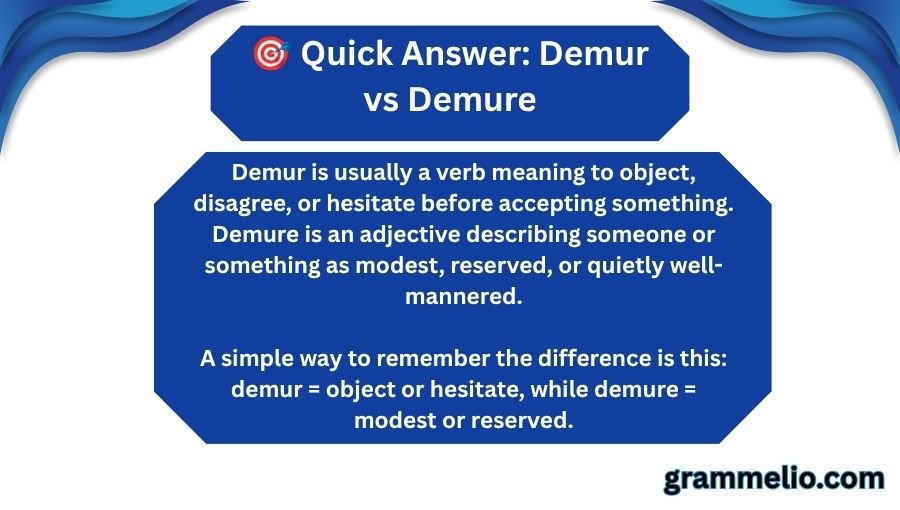
Demur is usually a verb meaning to object, disagree, or hesitate before accepting something. Demure is an adjective describing someone or something as modest, reserved, or quietly well-mannered.
A simple way to remember the difference is this: demur = object or hesitate, while demure = modest or reserved.
| Word | Part of Speech | Basic Meaning | Simple Example |
|---|---|---|---|
| Demur | Verb | To object or hesitate | She did not demur when asked to help. |
| Demure | Adjective | Modest or reserved | She gave a demure smile. |
| Demurred | Verb form | Objected or hesitated | He demurred at the suggestion. |
| Demurely | Adverb | In a modest or reserved way | She smiled demurely. |
| Demureness | Noun | A modest or reserved manner | Her demureness suited the setting. |
Demur vs Demure: The Basic Difference
The easiest way to understand demur vs demure is to focus on what each word does in a sentence. Demur normally acts as a verb. Demure normally acts as an adjective.
Think of the words this way:
- Demur describes an action or response.
- Demure describes a quality or manner.
- Demur often involves hesitation, disagreement, or objection.
- Demure often involves modesty, quietness, or reserve.
For example:
She did not demur when her manager asked her to lead the meeting.
Here, “demur” describes her response. She did not object or hesitate.
Now consider:
She wore a demure dress to the formal dinner.
Here, “demure” describes the dress. It suggests that the dress was modest or restrained.
Demur as a Verb
When you use demur, you are talking about someone objecting, hesitating, or showing reluctance.
He demurred when I asked him to take responsibility.
The word tells us how he responded. He hesitated or expressed some resistance.
Demure as an Adjective
When you use demure, you describe a person, expression, style, behavior, or appearance as modest and reserved.
She gave a demure smile.
The word “demure” describes the smile.
| Form | Type | Meaning | Example | Correct/Incorrect |
|---|---|---|---|---|
| Demur | Verb | Object or hesitate | He chose not to demur. | ✅ Correct |
| Demure | Adjective | Modest or reserved | She looked demure. | ✅ Correct |
| Demur | Adjective | Modest or reserved | She looked demur. | ❌ Incorrect |
| Demure | Verb | Object or hesitate | He did not demure at the plan. | ❌ Incorrect |
| Demurred | Verb | Objected or hesitated | She demurred at the request. | ✅ Correct |
Is Demur the Same as Demure?
No. Demur and demure are different words with different meanings and grammatical roles. Although they look and sound closely related, you cannot normally swap one for the other.
This is one of those English spelling pairs that can confuse even careful writers. The extra e in demure does not simply create another form of the verb demur. Instead, it gives you a separate adjective.
Compare these sentences:
He demurred at the proposal. ✅
He showed hesitation or disagreement.
He looked demure at the proposal. ❌
This sentence does not express the intended idea of objecting or hesitating.
The second sentence could technically be grammatical if “looked demure” means he appeared modest or reserved. But it does not mean that he objected.
That distinction matters.
A Quick Grammar Test
Ask yourself:
Am I describing an action of objecting or hesitating?
If yes, choose demur.
Am I describing someone or something as modest or reserved?
If yes, choose demure.
| Question | Choose | Why |
|---|---|---|
| Is someone objecting? | Demur | It is a verb. |
| Is someone hesitating? | Demur | It describes a response. |
| Is someone’s behavior modest? | Demure | It is an adjective. |
| Is someone’s expression reserved? | Demure | It describes appearance or manner. |
| Are you describing an action of resistance? | Demur | It functions as a verb. |
💡 Test Tip: How Can You Remember the Difference?
I use a very simple test when editing sentences: demur does; demure describes.
The word demur usually tells us what someone does.
She demurred.
The word demure usually tells us what someone is like or how something appears.
She was demure.
You can also remember the final e in demure as a reminder that the word often works like an adjective.
This is not a formal grammar rule, but it is a useful memory trick.
| Memory Clue | Word | Meaning |
|---|---|---|
| “Does” an action | Demur | Object or hesitate |
| “Describes” a quality | Demure | Modest or reserved |
| Response to a request | Demur | Shows hesitation or objection |
| Appearance or behavior | Demure | Shows quiet modesty |
📝 Case Study: Demur vs Demure in a Workplace Email
Imagine that a team leader asks an employee to present a report to a client.
The employee is unsure but agrees after a short discussion.
A natural sentence would be:
Maya initially demurred at the request, but she agreed to present the report.
Here, demurred is correct because Maya hesitated or showed reluctance.
Now imagine that the same employee speaks quietly and behaves modestly during the meeting:
Maya maintained a demure manner during the formal presentation.
Here, demure is correct because it describes her manner.
I once edited a short workplace note where the writer used “demure” when they meant “object.” The sentence sounded polished at first glance, but the meaning was completely different. Once we replaced it with “demur,” the message became clear immediately.
| Workplace Situation | Correct Word | Example |
|---|---|---|
| Employee objects to a task | Demur | He demurred at the extra assignment. |
| Employee hesitates | Demur | She demurred before accepting the role. |
| Employee has a modest manner | Demure | She has a demure manner. |
| A reserved expression | Demure | He gave a demure smile. |
🧠 Grammar Rules Explanation for Demur vs Demure
The main grammar rule is simple: demur is primarily a verb, while demure is primarily an adjective.
A verb describes an action, state, or response. Since demur describes the act of objecting or hesitating, it can appear in forms such as:
- demur
- demurs
- demurred
- demurring
Examples include:
I demur at that suggestion. ✅
She demurred when asked to sign the agreement. ✅
They demurred over the proposed change. ✅
By contrast, demure describes a quality or manner. It can modify a noun or follow a linking verb.
She wore a demure outfit. ✅
His expression was demure. ✅
The character appeared demure and quiet. ✅
Standard English reference sources agree on the basic distinction between these two words. The key is not to focus only on their similar spelling. Instead, look at their grammatical role and intended meaning.
Correct vs Incorrect at a Glance
| Sentence | Correct/Incorrect | Why |
|---|---|---|
| She demurred at the suggestion. | ✅ Correct | “Demurred” is a verb meaning hesitated or objected. |
| She wore a demure dress. | ✅ Correct | “Demure” describes the dress. |
| He was demur about the decision. | ❌ Incorrect | “Demur” is not the adjective needed here. |
| He demurely rejected the proposal. | ❌ Usually incorrect | “Demurely” means modestly or reservedly, not simply reluctantly. |
| They did not demur when asked to help. | ✅ Correct | “Demur” means object or hesitate. |
Why Do People Confuse Demur and Demure?
People confuse these words mainly because their spelling is nearly identical. The pronunciation can also feel similar, especially to learners who have mostly encountered the words in writing.
Another problem is that both words can appear in discussions about behavior. A person who is “demure” may be quiet and reserved, while a person who “demurs” may hesitate. Because both ideas involve restraint, the meanings can blur in the mind.
I once caught myself pausing over this pair while proofreading a short article. I knew the meanings, but the sentence was moving quickly. I stopped, identified the part of speech, and the answer became obvious.
| Similar Confusion | Main Difference |
|---|---|
| Its vs. It’s | Possession vs. “it is” or “it has” |
| Your vs. You’re | Possession vs. “you are” |
| Affect vs. Effect | Usually verb vs. usually noun |
| Advice vs. Advise | Noun vs. verb |
| Demur vs. Demure | Verb meaning object/hesitate vs. adjective meaning modest/reserved |
Why These Mistakes Happen
Fast typing
When people type quickly, they often choose a familiar-looking word without checking its role.
Autocorrect
Autocorrect may not recognize the intended meaning because both spellings are legitimate English words.
Lack of knowledge
If you have not learned the distinction, it is easy to assume that one word is simply a spelling variation of the other.
Reading without context
Seeing a word alone does not always reveal its meaning. The sentence around it matters.
⚠️ Common Mistakes With Demur vs Demure
The most common error is using demure when the writer means “object” or “hesitate.” Another mistake is using demur as though it were an adjective.
| Wrong Form or Use | What’s Wrong | Correct Form |
|---|---|---|
| She was demur about the plan. | “Demur” is not the adjective needed. | She was hesitant about the plan. |
| He wore a demur suit. | “Demure” is the adjective. | He wore a demure suit. |
| She demured at the request. | The usual past form is spelled “demurred.” | She demurred at the request. |
| He was demure to the proposal. | “Demure” does not mean object. | He demurred at the proposal. |
| She demurely objected. | The adverb suggests modest or reserved behavior, not simply objection. | She objected reluctantly. |
| They demure the suggestion. | The verb needs the proper tense and construction. | They demur at the suggestion. |
What Does Demur Mean?
Demur means to raise an objection, express disagreement, or hesitate before accepting something.
It is most often used when someone does not immediately agree with a request, plan, statement, or decision.
For example:
The employee demurred at the proposed schedule.
This means the employee expressed some objection or hesitation.
Another example:
I would demur if someone claimed that the task was easy.
Here, the speaker means they would disagree with or challenge that claim.
Common Forms of Demur
| Form | Grammar Role | Example |
|---|---|---|
| Demur | Base verb | I demur at that claim. |
| Demurs | Third-person singular | She demurs when asked to agree. |
| Demurred | Past tense | He demurred at the idea. |
| Demurring | Present participle | They are demurring over the proposal. |
What Does Demure Mean?
Demure is an adjective meaning modest, reserved, quiet, or restrained in behavior or appearance.
It is often used for a person’s manner, expression, clothing, or style.
For example:
She gave a demure smile.
The smile is described as quiet or modest.
You might also see:
The actress wore a demure gown.
Here, “demure” suggests that the gown was modest or restrained in style.
| Use | Example |
|---|---|
| Person | She seemed demure. |
| Smile | He gave a demure smile. |
| Manner | Her demure manner suited the setting. |
| Clothing | She chose a demure dress. |
| Expression | His demure expression surprised everyone. |
Demur and Demure in Different Contexts
The right choice depends on the meaning you want to express. The words can appear in everyday speech, professional writing, creative writing, and online communication, but their roles remain different.
| Context | Which Term to Use | Example |
|---|---|---|
| Everyday conversation | Demur | He demurred when I asked him to join us. |
| Professional writing | Demur | The committee demurred at the proposed change. |
| Creative writing | Demure | She gave a demure smile. |
| Social media/texting | Either, depending on meaning | She looked demure in the photo. |
| Formal discussion | Demur | The lawyer demurred at the claim. |
Everyday Conversation
In casual speech, demur can sound somewhat formal. People often use simpler words such as “hesitate,” “object,” or “disagree.”
Still, you may encounter it in educated or formal conversation.
Demure is also more common in descriptive writing than in casual speech.
Professional Writing
Both words can be useful in professional writing.
The board demurred at the proposed budget.
This is concise and formal.
The speaker maintained a demure tone.
This describes a restrained manner.
Creative Writing
Demure can be especially useful in creative writing because it helps describe appearance, body language, or character behavior.
She lowered her eyes with a demure smile.
Meanwhile, demur can show conflict or hesitation:
He demurred, unwilling to accept the offer.
Social Media and Texting
In texting, people usually choose simpler words. However, both terms can appear in captions, comments, or humorous posts.
For example:
“She looks so demure in this photo.”
That means she looks modest or reserved.
Common Phrases With Demur
Unlike some everyday word pairs, demur does not have a huge list of fixed idioms. Still, several common patterns appear naturally in formal English.
| Phrase or Pattern | Meaning |
|---|---|
| Demur at something | Object to or hesitate about something |
| Demur to a proposal | Express an objection to a proposal |
| Without demur | Without objection or complaint |
| Offer no demur | Raise no objection |
| Demur before accepting | Hesitate before accepting |
Examples:
She accepted the role without demur. ✅
He demurred at the suggestion. ✅
The phrase without demur is particularly useful in formal writing. It means that someone accepted or complied without objecting.
How To Remember the Difference
A strong memory trick can make this pair much easier.
Remember “Demur = Disagree”
Both words start with D, but imagine the D in “demur” standing for disagree.
Demur = disagree, object, or hesitate.
Then remember:
Demure = modest and reserved.
You can also connect demure with appearance.
A demure dress.
A demure smile.
A demure manner.
The word is describing something.
| Memory Trick | Meaning |
|---|---|
| Demur = Disagree | Object or hesitate |
| Demure = Describe | Describe a modest quality |
| Demur = Do | Describes an action |
| Demure = Describe | Describes appearance or behavior |
Synonyms and Alternatives
Sometimes a simpler word is better than either term. Choosing an alternative can make your writing clearer for a general audience.
For demur, possible alternatives include:
- object
- hesitate
- disagree
- resist
- question
For demure, possible alternatives include:
- modest
- reserved
- quiet
- restrained
- shy
The exact choice depends on the sentence.
| Alternative | Works When | Does Not Work When |
|---|---|---|
| Object | Someone expresses disagreement | You mean modest appearance |
| Hesitate | Someone pauses before acting | You mean quiet clothing or manner |
| Disagree | Someone rejects an idea | You mean reserved behavior |
| Modest | Someone or something is restrained | You mean objecting to a plan |
| Reserved | Someone is quiet or restrained | You mean active disagreement |
Why Does Getting Demur vs Demure Right Matter?
Getting this pair right matters because the words can change the meaning of an entire sentence.
Consider:
The employee demurred at the request.
The employee hesitated or objected.
Now compare:
The employee appeared demure during the meeting.
The employee appeared modest or reserved.
These are not minor variations. They communicate different ideas.
Clarity in Communication
Clear word choice helps your reader understand exactly what happened.
Professionalism
Correct vocabulary makes business emails, reports, and formal writing look more polished.
Digital Communication
Online writing is often short. That means each word carries more weight. Choosing the wrong word can create confusion quickly.
“She demured at the request.”
A reader may understand the intended meaning, but the spelling is still incorrect.
“She demurely at the request.”
This construction does not work because the adverb cannot replace the required verb.
A useful rule is:
Correct words make short sentences stronger.
| Situation | Why Getting It Right Matters |
|---|---|
| Resume | Shows careful language use |
| Client email | Prevents confusion |
| Published content | Protects accuracy and credibility |
| Social post | Keeps the intended meaning clear |
Is There a Special Exception?
There is no major spelling exception that changes the basic distinction between these words. Demur remains the verb for objecting or hesitating, while demure remains the adjective for a modest or reserved quality.
One useful edge case is the phrase without demur. Here, “demur” is still connected with objection, but the phrase means that someone did something without objecting.
For example:
She accepted the assignment without demur. ✅
This does not mean she accepted it in a modest or quiet manner. It means she accepted it without protest or objection.
📋 Related Word Forms
These words have several useful forms, especially demur, which changes according to tense.
| Word Form | Type | Example |
|---|---|---|
| Demur | Verb | I demur at that conclusion. |
| Demurs | Verb | She demurs at the suggestion. |
| Demurred | Past-tense verb | He demurred at the request. |
| Demurring | Participial form | They are demurring over the issue. |
| Demure | Adjective | She has a demure manner. |
| Demurely | Adverb | She smiled demurely. |
| Demureness | Noun | His demureness was noticeable. |
Be careful with demurred. Because the base verb ends in r, the past tense doubles the final consonant before -ed.
demur → demurred
Not:
demur → demured ❌
Which Word Fits the Sentence?
When you are unsure, examine the sentence structure.
If the blank needs a verb, demur may be the right choice.
She refused to ______ at the request.
The answer is:
demur
If the blank needs an adjective, demure may be correct.
She had a ______ manner.
The answer is:
demure
| Sentence Pattern | Likely Choice |
|---|---|
| Someone ___ at a proposal | Demur |
| Someone ___ when asked | Demur |
| A ___ smile | Demure |
| A ___ manner | Demure |
| A ___ appearance | Demure |
| Someone ___ about accepting | Demur |
📝 Another Real-Life Example
A student once wrote a sentence about a character in a novel:
“The character demurred smile showed that she was shy.”
The intended word was demure, because the student was describing the smile.
The corrected sentence was:
“The character’s demure smile showed that she was shy.”
This example highlights an important lesson: do not choose a word simply because it looks familiar. Look at what the word is doing in the sentence.
If the word modifies a noun, you probably need an adjective such as demure.
If the word describes an action of hesitation or objection, you probably need demur.
🔍 A Simple Decision Guide
Use this three-step process whenever you encounter the pair.
Step 1: Find the action
Ask whether someone is objecting or hesitating.
If yes, use demur.
Step 2: Find the description
Ask whether you are describing a person’s manner, expression, style, or behavior.
If yes, use demure.
Step 3: Check the grammar
Look at the word’s position in the sentence.
| If You Mean… | Use |
|---|---|
| Object | Demur |
| Hesitate | Demur |
| Protest | Demur |
| Modest | Demure |
| Reserved | Demure |
| Quietly restrained | Demure |
Is Demure Always About Clothing?
No. Demure can describe clothing, but it is not limited to clothing. It can describe behavior, expressions, manners, and overall appearance.
For example:
She gave a demure smile.
He maintained a demure manner.
The outfit was demure.
In each case, the word suggests modesty or reserve.
| Thing Described | Example |
|---|---|
| Clothing | A demure dress |
| Smile | A demure smile |
| Manner | A demure manner |
| Behavior | Demure behavior |
| Expression | A demure expression |
Can Demur Be Used in Formal Writing?
Yes. Demur is especially suitable in formal or serious writing when you need to express objection or hesitation in a concise way.
For example:
Several members demurred at the proposed policy.
This sounds formal but clear.
In casual writing, however, “objected” or “hesitated” may be easier for readers.
| Formal Choice | Simpler Alternative |
|---|---|
| He demurred at the plan. | He objected to the plan. |
| She demurred before accepting. | She hesitated before accepting. |
| They offered no demur. | They raised no objection. |
Can Demure Be Used for Men?
Yes. Demure can describe anyone. It is not grammatically limited to women.
For example:
The young man gave a demure smile.
He maintained a demure manner during the ceremony.
The word describes a reserved or modest quality. Context determines whether that description sounds natural.
Can You Use Demur and Demure in One Sentence?
Yes, if they serve different grammatical roles and express different ideas.
For example:
She demurred at first, then gave a demure smile.
Here, demurred describes her hesitation, while demure describes her smile.
This is a useful example because it shows that the two words can appear together without being interchangeable.
✅ Quick Recap Checklist
Use this checklist before you finalize your sentence.
| Question | If Yes → Use |
|---|---|
| Am I talking about objecting? | Demur |
| Am I talking about hesitation? | Demur |
| Am I describing a modest manner? | Demure |
| Am I describing a reserved smile? | Demure |
| Am I describing modest clothing? | Demure |
| Does the sentence need a verb? | Usually Demur |
| Does the sentence need an adjective? | Usually Demure |
Practice Examples
- She ______ at the idea of working late.Answer: demurred ✅
- She wore a ______ outfit to the ceremony.Answer: demure ✅
- He did not ______ when asked to help.Answer: demur ✅
FAQs About Demur vs Demure
What is the difference between demur and demure?
Demur is mainly a verb meaning to object, disagree, or hesitate. Demure is an adjective meaning modest, reserved, or restrained.
Is demur a verb or an adjective?
Demur is primarily a verb. It describes an action or response involving hesitation or objection.
Example:
She demurred at the proposal.
Is demure a verb or an adjective?
Demure is an adjective. It describes someone or something as modest, reserved, or restrained.
Example:
She had a demure manner.
Is it correct to say “she was demur”?
No. In standard English, demur is not the adjective you want in that sentence. If you mean that she was modest or reserved, say:
She was demure.
Is it correct to say “she demured”?
No. The standard past-tense spelling is demurred.
She demurred at the request. ✅
Does demur mean disagree?
Yes, depending on context. Demur can mean to object, disagree, or show hesitation about something.
For example:
He demurred at the suggestion.
This means he expressed some objection or reluctance.
Does demure mean shy?
It can suggest a shy or reserved quality, but demure more directly means modest, restrained, or reserved. “Shy” and “demure” are related in some contexts but are not always exact substitutes.
What does “without demur” mean?
Without demur means without objection, protest, or complaint.
Example:
She accepted the decision without demur.
Which is correct: “demur dress” or “demure dress”?
Demure dress is correct when you mean a modest or restrained dress.
She wore a demure dress. ✅
Which is correct: “demure at the proposal” or “demur at the proposal”?
Demur at the proposal is correct when you mean object or hesitate.
He demurred at the proposal. ✅
Can demur and demure be used together?
Yes. They can appear in the same sentence when they have their separate meanings.
She demurred at first but later gave a demure smile.
The first word describes hesitation. The second describes the smile.
Conclusion
Demur vs demure becomes much easier once you remember that demur is mainly a verb for objecting or hesitating, while demure is an adjective for someone or something modest, reserved, or restrained. 😊 When you see a sentence about a response to a request or proposal, check whether the person is hesitating or objecting. If so, demur is likely the word you need. When you are describing a smile, manner, outfit, expression, or quiet behavior, demure is usually the better choice.
I recommend using the simple memory trick “demur does, demure describes.” It gives you a fast way to check both meaning and grammar. With a little practice, this confusing-looking pair becomes easy to separate.
Good word choice is not about using complicated vocabulary. It is about choosing the exact word that says what you mean. ✨ Remember the difference, check the part of speech, and your writing will stay clear and accurate.

[…] remember the difference with simple examples. By the end, the choice should feel much easier. ✍️Demur vs Demure | Credible vs Incredible | Consul vs Council vs […]
[…] By the end, you should be able to choose the right word with confidence. Descent vs Dissent | Demur vs Demure | Credible vs […]