Have you ever typed a sentence and suddenly wondered whether you need idle vs idol vs idyll? I have seen this mix-up many times, especially because all three words look and sound similar. Yet they have very different meanings.
One can describe a person who is not doing anything, another can mean a person or thing greatly admired, and the third can describe a peaceful picture of country life. 😊
For students, writers, job seekers, and anyone who wants clearer English, knowing the difference can prevent confusing mistakes.
I will break down each word in simple terms, show you how it works in real sentences, and give you easy memory tricks. By the end, you should be able to choose the right word quickly and confidently. ✨ Homogeneous vs Homogenous | Grisly vs Gristly | Gourmet vs Gourmand
🎯 Quick Answer: Idle vs Idol vs Idyll
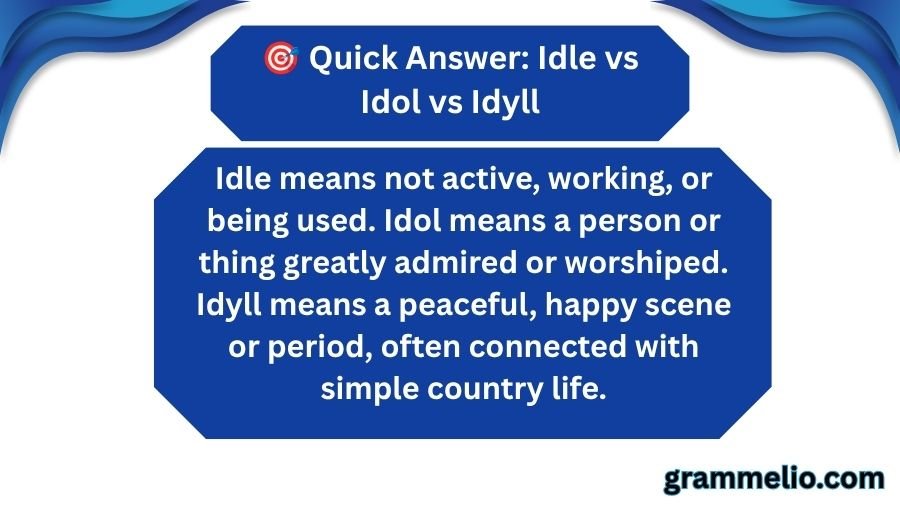
Idle means not active, working, or being used. Idol means a person or thing greatly admired or worshiped. Idyll means a peaceful, happy scene or period, often connected with simple country life.
A quick way to remember them is: idle = inactive, idol = admired, idyll = peaceful scene.
| Word | Part of Speech | Simple Meaning | Example |
|---|---|---|---|
| idle | Adjective, verb, noun | Not active or working | The machine sat idle. |
| idol | Noun | Someone or something greatly admired | The singer became my idol. |
| idyll | Noun | A peaceful, happy scene or period | The village looked like an idyll. |
Related Word Forms
These three words have useful related forms, although their forms do not behave in the same way.
| Form | Type | Example |
|---|---|---|
| idle | Base word | The workers were idle. |
| idled | Past tense verb | The engine idled for ten minutes. |
| idling | Present participle | The car was idling outside. |
| idleness | Noun | Too much idleness can become boring. |
| idol | Base noun | She is a sports idol. |
| idols | Plural noun | The museum displayed ancient idols. |
| idolatry | Noun | The text discusses idolatry. |
| idyll | Base noun | The poem describes an idyllic idyll-like setting. |
| idyllic | Adjective | They spent an idyllic weekend. |
The adjective idyllic is especially useful. It means peaceful, pleasant, and almost perfect. For example, you might describe a quiet lake, small village, or calm vacation as idyllic.
Understanding the Basics of Idle vs Idol vs Idyll
The main difference is simple: idle is about inactivity, idol is about admiration or worship, and idyll is about peaceful happiness.
I often tell students to look at the idea behind the sentence before looking at the spelling. Ask yourself: Is something inactive? Is someone admired? Or am I describing a peaceful scene?
| Form | Type | Meaning | Example | Correct/Incorrect |
|---|---|---|---|---|
| idle | Adjective | Not active or working | The computer remained idle. | ✅ Correct |
| idol | Noun | A greatly admired person or thing | The athlete was his idol. | ✅ Correct |
| idyll | Noun | A peaceful, happy scene | The farm was a rural idyll. | ✅ Correct |
| idol | Noun | Not active | The engine was idol. | ❌ Incorrect |
| idyll | Noun | A famous person you admire | She is my idyll. | ❌ Incorrect |
The spelling may cause trouble, but the meanings are far apart.
Idle: Not Active or Working
Idle describes something that is not doing its normal job. It can describe a machine, vehicle, worker, person, or period of time.
For example:
The car was idle in the driveway.
The car is not moving. That makes idle the correct choice.
It can also be a verb:
The engine idled while I waited.
Here, idled means the engine was running without doing much work.
It can also describe a person who is not busy:
The workers stood idle during the power outage.
The key idea is inactivity.
Idol: Someone or Something Greatly Admired
Idol is a noun. It refers to someone or something that is strongly admired or worshiped.
For example:
Serena Williams was an idol for many young tennis players.
Here, the word refers to a person who is deeply admired.
An idol can also be a physical object connected with worship:
The ancient people placed an idol inside the temple.
In modern English, however, idol is often used for a highly admired person.
Idyll: A Peaceful and Happy Scene
Idyll is a noun that describes a peaceful, pleasant, often idealized scene or period.
For example:
The small village seemed like an idyll.
The writer is presenting the village as calm, beautiful, and almost perfect.
You may also see idyll used for a peaceful period in someone’s life:
Their years in the countryside became a family idyll.
The word often creates a warm picture of simple happiness.
💡 Test Tip: Use the Meaning Test
When I teach these words, I recommend asking three questions:
- Is something inactive? → Use idle.
- Is someone or something admired? → Use idol.
- Is it a peaceful or idealized scene? → Use idyll.
| Meaning | Word Type | Example Sentence |
|---|---|---|
| Not active | Adjective | The machine was idle. |
| Not working | Verb | The engine idled all morning. |
| Greatly admired person | Noun | The actor became an idol. |
| Object of worship | Noun | The statue was treated as an idol. |
| Peaceful scene | Noun | The island was a tropical idyll. |
| Peaceful, ideal setting | Noun | The farm offered a rural idyll. |
Is Idle the Same as Idol or Idyll?
No. Idle, idol, and idyll are not interchangeable. They may look alike, but they perform different jobs in a sentence and express different ideas.
Consider these examples:
- The machine was idle. → It was not working.
- The musician was my idol. → I greatly admired the musician.
- The countryside was an idyll. → It was peaceful and beautiful.
Changing one word can completely change the meaning.
I once reviewed a student’s short essay about a family vacation. The student wrote that the beach was an “idol.” The intended meaning was a peaceful and beautiful place. We changed it to idyll, and the sentence immediately made sense.
That small error is a good reminder: similar spelling does not mean similar meaning.
Idle vs Idol vs Idyll at a Glance
The easiest way to compare the three is to focus on their central ideas.
| Word | Core Idea | Typical Use | Example |
|---|---|---|---|
| idle | Inactive | Machines, people, time | The equipment was idle. |
| idol | Admiration or worship | People, objects | He considers her an idol. |
| idyll | Peaceful happiness | Places, periods, scenes | The village was an idyll. |
Think of the Three Words as Three Pictures
Imagine three pictures in your mind.
Idle: A car sits in a parking lot with its engine off.
Idol: A crowd cheers for a famous singer.
Idyll: A quiet cottage sits beside a green field.
These mental pictures make the words much easier to separate.
Why Do People Confuse Idle, Idol, and Idyll?
People confuse these words mainly because their spellings and sounds are close. Fast typing and autocorrect can make the problem worse.
The words also belong to different meaning groups, so the mistake is not always obvious during casual writing.
The Role of Fast Typing
When people type quickly, they may choose the first familiar spelling that looks right. Since idle, idol, and idyll are visually similar, this can happen easily.
Autocorrect Can Add Trouble
Autocorrect may change an unusual word into a more common one. Idle and idol are both familiar words, while idyll is less common in everyday writing.
Lack of Knowledge
Sometimes the problem is simply that the writer has never learned the difference. Once you connect each word with its main meaning, the confusion becomes much easier to avoid.
I once caught myself typing idol when I meant idle in a quick work note. I noticed it because the sentence suddenly sounded strange. That was a useful reminder that even familiar words deserve a quick meaning check.
📝 Case Study: A Simple Workplace Example
Imagine a manager sends this message:
“The backup printer has been idle since Monday.”
That sentence is correct because the printer has not been operating.
Now imagine the manager writes:
“The backup printer has been an idol since Monday.”
That changes the meaning completely. The printer is now being described as something admired or worshiped.
Finally:
“The quiet office was an idyll.”
This means the office was peaceful and pleasant.
| Workplace Situation | Correct Word | Example |
|---|---|---|
| Equipment is not operating | idle | The printer remained idle. |
| Employee’s admired public figure | idol | The athlete was her idol. |
| Peaceful workplace scene | idyll | The quiet office felt like an idyll. |
This shows why context matters more than spelling.
Grammar Rules Explanation
The grammar rule is straightforward: choose the word based on its meaning and grammatical role.
Idle can function as an adjective, verb, or noun in different contexts. As an adjective, it describes something inactive. As a verb, it means to remain inactive or operate without doing useful work.
Idol is primarily a noun. It names a person or object that is greatly admired or worshiped.
Idyll is a noun. It describes a peaceful, pleasant, often idealized scene or period.
Standard English reference works agree on these basic distinctions. The safest method is to identify what your sentence is trying to say before choosing the spelling.
Correct vs Incorrect at a Glance
| Sentence | Correct/Incorrect | Why |
|---|---|---|
| The truck remained idle all afternoon. | ✅ Correct | The truck was not active. |
| My grandfather was an idol to me. | ✅ Correct | He was greatly admired. |
| The quiet village was an idyll. | ✅ Correct | It was peaceful and pleasant. |
| The engine was idol for an hour. | ❌ Incorrect | The correct word is idle. |
| The beach became an idle in my memory. | ❌ Incorrect | The intended word is idyll. |
⚠️ Common Mistakes With Idle, Idol, and Idyll
A clear understanding of idle vs idol vs idyll can help you avoid small spelling mistakes that change the meaning of an entire sentence.
Here are other word pairs that cause similar problems:
| Confused Words | Difference |
|---|---|
| it’s / its | “It’s” means “it is”; “its” shows possession. |
| your / you’re | “Your” shows possession; “you’re” means “you are.” |
| there / their / they’re | Location, possession, and “they are.” |
| affect / effect | Usually an action or influence versus a result. |
| then / than | Time or sequence versus comparison. |
| accept / except | Receive or agree versus exclude. |
The same basic strategy works for idle vs idol vs idyll: stop and ask what the word means.
Specific Wrong Forms and Their Corrections
| Wrong Form | What’s Wrong | Correct Form |
|---|---|---|
| The car was idol. | “Idol” does not mean inactive. | The car was idle. |
| She is my idle. | “Idle” does not mean admired person. | She is my idol. |
| The village was an idol. | “Idol” does not mean peaceful scene. | The village was an idyll. |
| The engine was idyll. | “Idyll” is a noun for a peaceful scene. | The engine was idle. |
| He became my idyll. | The intended meaning is likely a person greatly admired. | He became my idol. |
| Their vacation was an idle. | The intended meaning is probably a peaceful experience. | Their vacation was an idyll. |
Word History and How the Spellings Developed
These three words have separate histories, even though their modern spellings are similar.
Idle is an old English word connected with the idea of being useless, empty, or inactive. Over time, it developed its modern uses for people, machines, and time.
Idol entered English through older words associated with an image or object of worship. Its modern meaning also expanded to describe a person who is deeply admired.
Idyll comes from a word connected with a short literary piece or small picture. Over time, it became strongly associated with peaceful scenes and simple country life.
| Period | Word | General Development |
|---|---|---|
| Early English | idle | Connected with inactivity or lack of useful work |
| Later English | idol | Used for objects of worship and admired figures |
| Literary English | idyll | Connected with short, peaceful scenes or poems |
| Modern English | idle | Common for inactive people, machines, and time |
| Modern English | idol / idyll | Used for admired figures and peaceful idealized scenes |
The important lesson is that similar spelling does not mean shared meaning.
How Should You Use These Words in Different Contexts?
The context can make the correct choice almost automatic.
Everyday Conversation
Idle is common when talking about cars, machines, workers, or time.
The car was idling outside.
Idol is common when talking about celebrities, athletes, artists, or personal heroes.
That basketball player was my childhood idol.
Idyll is less common in casual conversation. It is often used when describing a peaceful or almost perfect setting.
The little town seemed like an idyll.
Professional Writing
In professional writing, idle often describes unused equipment, downtime, or inactive systems.
Idol may appear when discussing culture, entertainment, sports, or influential figures.
Idyll can work well in reports, essays, travel writing, and creative descriptions.
Creative Writing
Creative writers often use idyll to create a calm, beautiful picture.
For example:
The old farm was an idyll of green fields and quiet mornings.
Idle can create a feeling of stillness:
The empty station stood idle beneath the afternoon sun.
Idol can add emotional meaning:
She had become an idol to a generation of young musicians.
Social Media and Texting
Short messages usually favor idle and idol because they are more common.
You might write:
“My laptop is idle.”
or:
“She’s been my idol forever.”
Idyll is less common but can make a post sound more literary:
“A perfect little seaside idyll.”
| Context | Which Term to Use | Example |
|---|---|---|
| Everyday conversation | idle | The car is idle. |
| Everyday admiration | idol | She’s my idol. |
| Professional writing | idle | Several machines remained idle. |
| Professional cultural discussion | idol | The athlete became a national idol. |
| Creative writing | idyll | The valley was an idyll. |
| Social media | idle / idol / idyll | Choose based on the intended meaning. |
What Are Common Phrases With Idle, Idol, and Idyll?
Each word appears in familiar expressions and combinations.
| Phrase | Meaning |
|---|---|
| idle time | Time when no useful activity is taking place |
| idle hands | A phrase suggesting that inactive people may get into trouble |
| idle chatter | Talk without much useful purpose |
| idle engine | An engine running without moving the vehicle |
| pop idol | A popular music performer who is greatly admired |
| teen idol | A young celebrity admired by many teenagers |
| cultural idol | A person admired within a culture |
| rural idyll | An idealized picture of peaceful country life |
These combinations can help you remember the words naturally.
Synonyms and Alternatives
Sometimes another word may fit your sentence better.
For idle, useful alternatives include inactive, unused, still, and unoccupied.
For idol, alternatives include hero, role model, star, and favorite, depending on the meaning.
For idyll, alternatives include paradise, retreat, peaceful scene, or ideal setting.
| Alternative | Works When | Does Not Work When |
|---|---|---|
| inactive | Something is not active | You mean an admired person |
| unused | Something is available but not being used | You mean a peaceful scene |
| hero | Someone is deeply admired | You mean an inactive machine |
| role model | Someone is admired for their example | You mean a beautiful setting |
| peaceful scene | You mean an idyll | You mean an admired person |
Remember that synonyms are not always exact replacements. Context still matters.
Why Does Getting These Words Right Matter?
Correct word choice makes your writing easier to understand. A reader should not have to guess what you mean.
Clarity in Communication
If you write idol instead of idle, your reader may think you are talking about admiration or worship.
Professionalism
Spelling and word-choice mistakes can make an email, report, resume, or article look less polished.
Digital Communication
Text messages and social posts move quickly. That makes small errors easy to overlook. Still, the wrong word can change the meaning of a sentence.
| Situation | Why Getting It Right Matters |
|---|---|
| Resume | Shows careful writing skills |
| Client email | Prevents confusing messages |
| Published content | Protects clarity and credibility |
| Social post | Helps readers understand your point |
A useful writing rule is:
Choose the word that expresses your meaning, not the word that merely looks familiar.
That rule works far beyond these three words.
Is There a Special Exception to Remember?
There is no major spelling exception that changes the basic distinction among these words. However, idyllic is worth remembering because it is related in meaning to idyll.
For example:
We spent an idyllic afternoon by the lake.
Here, idyllic is an adjective. It means peaceful, beautiful, and almost perfect.
Compare:
The afternoon was an idyll.
Here, idyll is a noun.
So, do not confuse idyllic with idle. They look somewhat alike, but they have very different meanings.
How Can You Remember Idle, Idol, and Idyll?
I use a three-word memory trick:
Idle = Inactive
Think of an idle engine.
Idol = Admired
Think of your favorite idol.
Idyll = Ideal
Think of an idyll as an ideal, peaceful scene.
You can also remember the letters:
- idle → Inactive
- idol → Idolized person
- idyll → Ideal peaceful scene
The exact memory phrase does not matter as long as it helps you connect the spelling with the meaning.
Can You Test Yourself?
Yes. Cover the answers and choose the correct word.
Practice 1
The old factory equipment remained ______ for several months.
Answer: idle ✅
The equipment was not being used.
Practice 2
The young singer became a national ______.
Answer: idol ✅
The singer was greatly admired.
Practice 3
The quiet island seemed like a tropical ______.
Answer: idyll ✅
The island was presented as a peaceful, ideal scene.
Practice 4
The bus engine ______ while the driver waited.
Answer: idled ✅
The engine was running without the bus moving.
🎯 Quick Recap Checklist
Use this checklist whenever you are unsure.
| Question | If Yes → Use |
|---|---|
| Is something inactive or not working? | idle |
| Is a machine running without doing much work? | idle / idling |
| Is someone greatly admired? | idol |
| Is something worshiped as a sacred image or object? | idol |
| Is the sentence describing a peaceful, idealized scene? | idyll |
| Is the word describing something peaceful and almost perfect? | idyllic |
Three Final Practice Examples
- The computer was idle while I ate lunch. ✅
- My older brother was my idol when I was young. ✅
- The quiet mountain village was a perfect idyll. ✅
If you can match these three ideas, you have the core rule:
Inactive → idle. Admired → idol. Peaceful scene → idyll.
FAQs About Idle vs Idol
What is the difference between idle and idol?
Idle means inactive, unused, or not working. Idol is a noun for a person or thing that is greatly admired or worshiped.
Example: “The machine is idle” means it is not working. “She is my idol” means she is someone I admire greatly.
What does idyll mean?
An idyll is a peaceful, happy, often idealized scene or period. It is commonly used to describe simple country life or a calm, beautiful setting.
Example: “The village was a rural idyll.”
Is idle an adjective or a verb?
Idle can be both an adjective and a verb. As an adjective, it means inactive. As a verb, it means to remain inactive or to run without doing useful work.
Examples: “The machine is idle.” “The engine idled outside.”
Is idol always a person?
No. An idol can be a person who is greatly admired, but it can also refer to an object connected with worship. In modern everyday English, the word often describes a highly admired celebrity, athlete, performer, or other public figure.
Is idyll the same as idyllic?
No. Idyll is a noun. It names a peaceful or idealized scene or period. Idyllic is an adjective that describes something as peaceful, beautiful, or almost perfect.
Examples:
- “The village was an idyll.”
- “They enjoyed an idyllic vacation.”
Which word means not working: idle, idol, or idyll?
The correct word is idle.
For example:
The computer remained idle all afternoon.
Neither idol nor idyll means “not working.”
Which word means a person you admire?
The correct word is idol.
For example:
The famous athlete was her idol.
You can also use words such as hero or role model when they fit the meaning.
Can idyll describe a person?
Usually, idyll describes a scene, experience, or period rather than a person. If you mean a person you admire, idol is the correct word.
For example:
He was my idol. ✅
Not:
He was my idyll. ❌
Why are idle, idol, and idyll easy to confuse?
They have similar spellings and sounds, and idle and idol are especially easy to mix up when typing quickly. The best solution is to focus on meaning instead of sound.
Remember:
idle = inactive
idol = admired
idyll = peaceful scene
How do I remember the difference between idle, idol, and idyll?
Use the simple three-part memory trick:
- Idle → inactive
- Idol → admired
- Idyll → ideal, peaceful scene
If you remember those three ideas, you can usually select the correct spelling without hesitation.
Conclusion
Once you understand idle vs idol vs idyll, these three commonly confused words become much easier to recognize and use correctly. Idle vs idol vs idyll becomes much easier once you connect each spelling with its meaning. Idle describes something inactive, unused, or not working. Idol describes someone or something greatly admired or worshiped. Idyll describes a peaceful, happy, often idealized scene or period. 😊
When I am unsure about one of these words, I do not rely on how it sounds. I ask what the sentence actually means. Is something sitting unused? Choose idle. Is someone being admired? Choose idol. Is the writer describing a calm, beautiful scene? Choose idyll.
These words may look like close spelling cousins, but their meanings are clearly different. Once you learn the three key ideas—inactive, admired, peaceful—the choice becomes much faster. ✨
Keep this simple rule in mind: idle means inactive, idol means admired, and idyll means a peaceful ideal scene. That one line can save you from a surprisingly common English mistake.

[…] mistake. 😊 Once you know what each word points to, choosing the right one becomes much easier. Idle vs Idol vs Idyll | Homogeneous vs Homogenous | Grisly vs […]
[…] feel confident using both words without stopping to second-guess yourself. Imminent vs Eminent | Idle vs Idol vs Idyll | Homogeneous vs […]