Have you ever stopped while writing because you could not decide between loath vs loathe? You are not alone. I have seen this mix-up in school assignments, emails, blog posts, and even polished business writing.
The two words look almost identical, but they do different jobs in a sentence. Loath is an adjective that means unwilling or reluctant. Loathe is a verb that means to dislike or hate something very strongly.
That small extra e changes the word’s role and meaning. 😊 In this guide, I will break down the difference in simple US English, show you correct and incorrect examples, and give you easy ways to remember which word belongs where.
By the end, you should feel confident using both words without stopping to second-guess yourself. Imminent vs Eminent | Idle vs Idol vs Idyll | Homogeneous vs Homogenous
🎯 Quick Answer: Loath vs Loathe
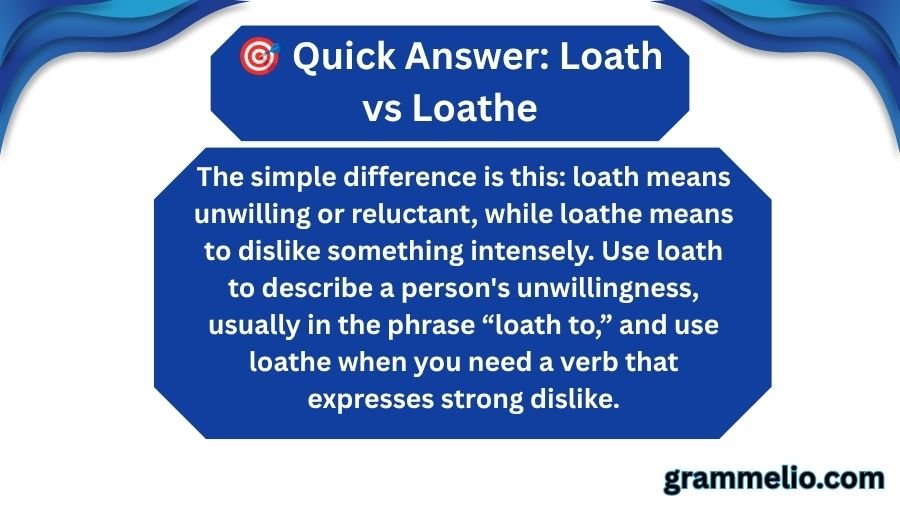
The simple difference is this: loath means unwilling or reluctant, while loathe means to dislike something intensely. Use loath to describe a person’s unwillingness, usually in the phrase “loath to,” and use loathe when you need a verb that expresses strong dislike.
For example:
- I am loath to leave the party early.
- I loathe waiting in long lines.
A quick memory trick is: loath = reluctant; loathe = hate.
Related Word Forms and Common Variations
The two words are closely related in appearance, but they are not interchangeable. Their grammatical forms also behave differently.
| Form | Type | Example |
|---|---|---|
| loath | Adjective | I am loath to complain. |
| loathe | Verb | I loathe rude behavior. |
| loathed | Past-tense verb | She loathed the unfair rule. |
| loathing | Noun/gerund | He felt loathing toward the dishonest act. |
| loathsome | Adjective | The character was loathsome. |
The most useful form to remember is loath to + verb. For example, “She was loath to admit her mistake.”
With loathe, you normally place a noun, pronoun, or -ing form after it:
- I loathe dishonesty.
- She loathes crowded buses.
- They loathe being ignored.
Notice that loathe can change tense because it is a verb. Loath does not work that way because it is an adjective.
Understanding the Basics of Loath vs Loathe
The core difference is based on both meaning and part of speech. Loath describes unwillingness. Loathe describes intense dislike.
| Form | Type | Meaning | Example | Correct/Incorrect |
|---|---|---|---|---|
| loath | Adjective | Unwilling or reluctant | I am loath to leave. | ✅ Correct |
| loathe | Verb | Strongly dislike | I loathe dishonesty. | ✅ Correct |
| loath | Adjective | Strongly dislike | I loath spicy food. | ❌ Incorrect |
| loathe | Verb | Unwilling | I am loathe to leave. | ❌ Incorrect |
This is why the two terms cannot simply replace each other.
What Does Loath Mean?
Loath is an adjective meaning unwilling, reluctant, or hesitant to do something.
It is most often followed by to + verb.
Examples:
- I am loath to criticize my friend.
- She was loath to sell her childhood home.
- He is loath to make a quick decision.
- They were loath to admit that they were wrong.
In each sentence, the person does not want to perform an action. That is the key idea.
The sentence “I am loath to leave” means “I am reluctant to leave.”
What Does Loathe Mean?
Loathe is a verb meaning to dislike or hate something very strongly.
Examples:
- I loathe dishonesty.
- She loathes waking up early.
- We loathed the unfair treatment.
- He loathes being interrupted.
Here, the word expresses a strong feeling of dislike. It does not describe reluctance.
The Fastest Way to Tell Them Apart
Ask yourself one question:
Am I talking about being unwilling to do something, or am I talking about strongly disliking something?
| Meaning | Use | Example |
|---|---|---|
| Unwilling | loath | She is loath to complain. |
| Strongly dislike | loathe | She loathes complaining. |
| Reluctant | loath | He was loath to agree. |
| Hate/dislike deeply | loathe | He loathes unfair rules. |
💡 Test Tip
Try replacing the word with reluctant.
If “reluctant” makes sense, choose loath.
I am ___ to interrupt.
I am reluctant to interrupt.
Therefore: I am loath to interrupt.
If the sentence means “strongly dislike,” choose loathe.
I ___ being interrupted.
I strongly dislike being interrupted.
Therefore: I loathe being interrupted.
This simple test solves most cases.
Is Loath the Same as Loathe?
No. Loath and loathe have different meanings and different grammatical roles. Loath is an adjective for unwillingness, while loathe is a verb for intense dislike.
Compare these sentences:
- I am loath to speak.
- I loathe speaking in public.
The first sentence says the speaker is reluctant to speak. The second says the speaker strongly dislikes speaking in public.
That distinction matters because replacing one word with the other changes the meaning.
Loath vs Loathe at a Glance
The difference becomes easier to see when the words are placed side by side.
| Feature | Loath | Loathe |
|---|---|---|
| Part of speech | Adjective | Verb |
| Main meaning | Unwilling or reluctant | Strongly dislike |
| Common pattern | loath to + verb | loathe + noun/-ing form |
| Example | I am loath to go. | I loathe going there. |
| Can take verb endings? | No | Yes |
| Main idea | Reluctance | Strong dislike |
One useful clue is grammar. If you see am, is, are, was, or were + ___ + to, loath is often the answer.
If you need a normal action verb meaning “strongly dislike,” use loathe.
Why Do People Confuse Loath and Loathe?
People confuse these words because they are pronounced similarly in many forms of speech and share almost the same spelling. The extra e is easy to overlook when typing.
I once edited a short workplace message that said, “I am loathe to delay the meeting.” The writer clearly meant “I am reluctant to delay the meeting.” The meaning was easy to understand, but the grammar was wrong. Adding the final e had turned an adjective into a verb.
Common reasons for the confusion include:
- The spellings differ by only one letter.
- Both words relate to negative feelings.
- Autocorrect may not catch the error.
- Writers may hear the words more often than they see them.
- People sometimes remember the sound but not the grammar.
- The phrase “loath to” is less common in everyday speech than “loathe.”
The best solution is not simply memorizing the spelling. Learn what each word does in a sentence.
Key Differences Between Loath and Loathe
There are three main differences to remember.
1. Their meanings differ
Loath = unwilling or reluctant.
Loathe = strongly dislike.
2. Their parts of speech differ
Loath is an adjective.
Loathe is a verb.
3. Their sentence patterns differ
Loath commonly appears in:
subject + be + loath + to + verb
Example:
She was loath to complain.
Loathe commonly appears in:
subject + loathe + object
Example:
She loathes complaints.
| Difference | Loath | Loathe |
|---|---|---|
| Meaning | Reluctant | Strongly dislike |
| Grammar | Adjective | Verb |
| Typical structure | be loath to do | loathe something |
| Example | He is loath to leave. | He loathes leaving. |
Correct Meanings and Uses
Understanding the two words becomes much easier when you see how they work in real sentences.
Using Loath for Reluctance
Use loath when someone does not want to do something.
- The manager was loath to cancel the event.
- I am loath to give up.
- She was loath to change her plan.
- They were loath to discuss the problem.
The word does not necessarily mean the person hates the action. It simply means the person is unwilling or reluctant.
For example, if you say:
I am loath to leave.
You may actually enjoy the place. You simply do not want to leave yet.
Using Loathe for Strong Dislike
Use loathe when someone has a very strong negative feeling.
- I loathe dishonesty.
- He loathes loud chewing.
- She loathed the unfair treatment.
- They loathe being ignored.
Here, the focus is on dislike, not reluctance.
A Small Meaning Summary
| Meaning | Word Type | Example Sentence |
|---|---|---|
| Reluctant | Adjective | I am loath to complain. |
| Unwilling | Adjective | She was loath to leave. |
| Strongly dislike | Verb | I loathe rude behavior. |
| Hate intensely | Verb | He loathes being lied to. |
📝 Case Study: A Workplace Email
Imagine that a team leader needs to delay a project. She writes:
“I am loath to delay the launch, but we need more testing.”
This is correct because she is saying that she is reluctant to delay the launch.
Now imagine she writes:
“I loathe delays because they cause extra work.”
That is also correct. Here, she is saying that she strongly dislikes delays.
The two words can even appear in the same discussion:
“I am loath to cancel the meeting because I loathe wasting everyone’s time.”
The first word describes reluctance. The second expresses strong dislike.
That is a great example of why context matters.
Grammar Rules Explanation
The grammar rule is simple: loath is an adjective, while loathe is a verb.
An adjective describes a person, thing, or state. In “I am loath to leave,” the word loath describes the speaker’s unwillingness.
A verb describes an action, state, or process. In “I loathe noisy restaurants,” loathe expresses the speaker’s strong dislike.
Standard English reference works consistently distinguish the two forms in this way.
A useful grammar pattern is:
be + loath + to-infinitive
Examples:
- I am loath to complain.
- She is loath to change the plan.
- He was loath to admit defeat.
For loathe, use the word as an ordinary verb:
- I loathe dishonesty.
- She loathes delays.
- They loathed the experience.
Because loathe is a verb, it can change form:
- loathe
- loathes
- loathed
- loathing
Because loath is an adjective, it does not behave like those verb forms.
Correct vs Incorrect at a Glance
| Sentence | Correct/Incorrect | Why |
|---|---|---|
| I am loath to leave. | ✅ Correct | Loath means reluctant. |
| I loathe crowded places. | ✅ Correct | Loathe means strongly dislike. |
| I am loathe to leave. | ❌ Incorrect | The adjective form is needed. |
| I loath crowded places. | ❌ Incorrect | The verb should be loathe. |
| She loathes being late. | ✅ Correct | Loathes is the verb form. |
⚠️ Common Mistakes With Loath and Loathe
Most mistakes with loath vs loathe happen when writers focus on spelling instead of the meaning and grammatical role of each word. The biggest mistake is choosing the word based only on how it looks or sounds.
Mistake 1: Writing “I am loathe to…”
This is one of the most common errors.
❌ I am loathe to complain.
✅ I am loath to complain.
The word after am needs to be the adjective loath.
Mistake 2: Writing “I loath…”
If you mean “strongly dislike,” you need the verb loathe.
❌ I loath cold weather.
✅ I loathe cold weather.
Mistake 3: Assuming the extra E is optional
It is not. The final e separates two different words.
| Confusion | Correct Pattern | Example |
|---|---|---|
| its/it’s | possession/contraction | Its color / It’s blue |
| your/you’re | possession/contraction | Your book / You’re ready |
| affect/effect | verb/noun in common uses | It affects me / The effect is clear |
| loose/lose | adjective/verb | Loose shirt / Lose weight |
| loath/loathe | adjective/verb | Loath to leave / Loathe delays |
Fast typing, autocorrect, and weak familiarity with the words can all cause these errors.
I once caught myself typing “loath” when I meant the verb “loathe” in a draft. I had written the sentence quickly and was thinking about the meaning rather than the word’s grammatical role. A quick reread fixed it.
Specific Wrong Forms to Avoid
| Wrong Form/Use | What’s Wrong | Correct Form |
|---|---|---|
| I am loathe to go. | Uses a verb where an adjective is needed. | I am loath to go. |
| I loath noise. | Missing the final e in the verb. | I loathe noise. |
| She is loathe to agree. | Incorrect adjective form. | She is loath to agree. |
| He loath the rule. | Incorrect verb form. | He loathes the rule. |
| They were loathe to respond. | Incorrect form after “were.” | They were loath to respond. |
| I loath being late. | Incorrect spelling of the verb. | I loathe being late. |
How To Remember the Difference
The easiest memory trick is to connect each word with a simple meaning.
Loath = reluctant.
Loathe = hate.
You can also remember the extra e in loathe by thinking:
The extra E goes with the strong emotion.
This is not a formal grammar rule. It is simply a memory aid.
Another useful trick is to look at the word that follows.
If you see:
___ to leave
and the sentence describes reluctance, choose loath.
If you see:
___ coffee
and the sentence means “strongly dislike coffee,” choose loathe.
| Memory Question | Answer |
|---|---|
| Am I reluctant? | loath |
| Am I unwilling? | loath |
| Do I strongly dislike something? | loathe |
| Do I need a verb? | loathe |
| Does “reluctant” fit? | loath |
Usage in Different Contexts
Knowing how loath vs loathe works in different contexts can help you choose the correct form in both casual and professional writing.
The distinction remains the same whether you are speaking casually or writing formally.
| Context | Which Term to Use | Example |
|---|---|---|
| Everyday conversation | Either, depending on meaning | I am loath to leave. |
| Professional writing | Either, depending on meaning | The company is loath to change its policy. |
| Creative writing | Either, depending on meaning | He loathed the silence. |
| Social media/texting | Either, depending on meaning | I loathe Monday mornings! |
Everyday Conversation
You might say:
I’m loath to leave because we’re having fun.
Or:
I loathe getting stuck in traffic.
The first expresses reluctance. The second expresses strong dislike.
Professional Writing
Both words can appear in formal writing.
The board was loath to approve the proposal.
This means the board was reluctant.
Customers may loathe a sudden increase in fees.
This means customers may strongly dislike it.
Creative Writing
Writers can use the contrast to show a character’s feelings:
Maria was loath to open the letter, yet she knew she had to.
Or:
He loathed the empty house.
The first shows hesitation. The second shows intense dislike.
Social Media and Texting
Informal writing often favors simpler words such as hate, can’t stand, or don’t want to. Still, loathe is perfectly valid:
I absolutely loathe slow Wi-Fi.
And loath can appear in a more playful or dramatic sentence:
I’m loath to admit it, but you were right.
Common Phrases With Loath and Loathe
The most useful phrases for loath vs loathe become easier to remember when you connect each phrase with its meaning. There are a few useful patterns worth learning.
| Phrase | Meaning |
|---|---|
| loath to admit | reluctant to admit |
| loath to say | reluctant to say |
| loath to leave | reluctant to leave |
| loath to change | unwilling to change |
| loathe the idea | strongly dislike the idea |
| loathe doing something | strongly dislike doing something |
The phrase “loath to” is especially common in formal or careful writing.
For example:
The company was loath to raise prices.
This means the company was reluctant to raise prices.
With loathe, common structures include:
loathe the idea
loathe being ignored
loathe doing something
loathe something about a situation
Is “Loath to” the Correct Expression?
Yes. “Loath to” is the standard expression when you mean reluctant or unwilling to do something.
Examples:
- I am loath to complain.
- She is loath to leave.
- He was loath to change his mind.
- We are loath to make that decision.
Do not write “loathe to” when you mean reluctant.
❌ I am loathe to cancel.
✅ I am loath to cancel.
Can “Loathe” Be Used Before “To”?
Usually, loathe is followed by an object or an -ing form when expressing strong dislike.
For example:
- I loathe waiting.
- She loathes being late.
- He loathes noisy offices.
The phrase “I loathe to…” is not the normal modern pattern when you mean “I am reluctant to…” In that situation, loath to is the correct choice.
This is one reason learners sometimes get stuck: both words can appear near to, but their grammatical structures differ.
Synonyms and Alternatives
Sometimes you can replace these words with simpler choices.
For loath, useful alternatives include:
- reluctant
- unwilling
- hesitant
- disinclined
For loathe, useful alternatives include:
- hate
- detest
- despise
- strongly dislike
| Alternative | Works When | Does Not Work When |
|---|---|---|
| reluctant | You mean unwilling | You mean intense dislike |
| unwilling | You do not want to act | You mean hatred |
| hesitant | Someone is unsure or slow to act | Someone strongly dislikes something |
| hate | You strongly dislike something | You mean simple reluctance |
| detest | You strongly dislike something | You mean hesitation |
For example:
I am reluctant to leave.
This has nearly the same meaning as:
I am loath to leave.
But:
I hate leaving.
expresses a stronger negative feeling. It is not exactly the same as reluctance.
Why Does Getting Loath and Loathe Right Matter?
Correct word choice improves clarity. A reader should not have to guess whether you mean “reluctant” or “strongly dislike.”
It also improves professionalism. A spelling mistake in a client email may seem small, but repeated errors can make writing look rushed.
Accuracy matters in:
| Situation | Why Getting It Right Matters |
|---|---|
| Resume | Shows attention to detail |
| Client email | Builds a professional impression |
| Published content | Improves trust and readability |
| Social post | Prevents confusion and comments about errors |
A useful writing principle is:
Clear words make clear ideas.
I use this idea when editing because grammar is not only about rules. It is also about helping readers understand your exact meaning.
Why the Difference Matters in Digital Writing
Online readers often scan instead of reading every sentence closely. A small spelling difference can therefore change meaning quickly.
Consider:
I am loath to approve it.
The reader understands that you are reluctant.
Now compare:
I loathe the proposal.
The reader understands that you strongly dislike it.
Those are very different attitudes. Choosing the wrong form can make your position sound much stronger or completely different from what you intended.
Is There a Special Exception?
There is no major spelling exception that changes the basic rule. The safest approach is to remember the normal distinction:
loath = adjective meaning reluctant
loathe = verb meaning strongly dislike
You may encounter unusual or older-looking constructions in historical or literary writing, but they do not change the standard rule modern writers should follow.
When writing ordinary US English, stick to the common patterns discussed above.
💡 A Simple Editing Method
When proofreading, I recommend using a three-step check.
Step 1: Identify the meaning
Ask whether the sentence expresses:
- reluctance, or
- strong dislike.
Step 2: Identify the grammar
Ask whether you need:
- an adjective, or
- a verb.
Step 3: Check the pattern
If the pattern is:
be + ___ + to + verb
and you mean reluctant, use loath.
If the word means strongly dislike, use loathe.
| Step | Question | Result |
|---|---|---|
| 1 | What does the sentence mean? | Reluctance or dislike |
| 2 | What part of speech is needed? | Adjective or verb |
| 3 | What pattern appears? | loath to / loathe something |
| 4 | Does the sentence sound natural? | Proofread |
| 5 | Is the spelling correct? | Final check |
Practice Examples
These practice sentences will help you apply the loath vs loathe rule without relying only on memorization.
Try choosing the correct word before looking at the answers.
Example 1
I am ___ to criticize my coworker.
Answer: loath
Why? The speaker is reluctant to criticize.
Example 2
I ___ rude behavior.
Answer: loathe
Why? The speaker strongly dislikes rude behavior.
Example 3
She was ___ to sell her old house.
Answer: loath
Why? She was unwilling or reluctant to sell it.
Example 4
He ___ being interrupted.
Answer: loathes
Why? He strongly dislikes being interrupted.
| Sentence | Answer | Reason |
|---|---|---|
| I am ___ to leave. | loath | Reluctant |
| I ___ noisy restaurants. | loathe | Strongly dislike |
| She was ___ to complain. | loath | Unwilling |
| He ___ waiting. | loathes | Strongly dislikes |
| They are ___ to change. | loath | Reluctant |
How Do You Use Loath and Loathe in a Sentence?
Use loath when you want to say that someone is reluctant or unwilling to do something. The common structure is be loath to + verb.
Use loathe when you want to say that someone strongly dislikes something. It works as a verb and can be followed by a noun or an -ing form. Loath vs loathe becomes easier to use when you first identify whether the sentence describes reluctance or strong dislike. Use loath when you want to say that someone is reluctant or unwilling to do something. The common structure is be loath to + verb.
Examples:
I am loath to argue.
I loathe arguments.
These sentences are easy to compare. The first focuses on reluctance. The second focuses on strong dislike.
Which Is More Common in Everyday English?
Loathe is generally easier to encounter because people can use it directly as a verb for strong dislike. Loath is most often seen in the specific construction “loath to.”
That does not make either word incorrect or unusual. It simply means their sentence patterns differ.
If you regularly read news articles, essays, business writing, or books, you may notice loath to in sentences about decisions, changes, admissions, or actions someone does not want to take.
For example:
The team was loath to abandon the plan.
The team did not necessarily hate the plan. It was simply reluctant to give it up.
What Is the Easiest Way to Remember the Difference?
Remember this two-word rule:
Loath = reluctant.
Loathe = strongly dislike.
Then remember the sentence patterns:
loath to do
loathe something
For example:
I am loath to leave.
I loathe leaving early.
The extra e in loathe can serve as your visual reminder that this is the verb for strong dislike.
✅ Quick Recap Checklist
Use this checklist whenever you are unsure.
| Question | If Yes → Use |
|---|---|
| Do I mean reluctant? | loath |
| Do I mean unwilling? | loath |
| Does the word come after “am/is/are/was/were” and before “to”? | loath |
| Do I mean strongly dislike? | loathe |
| Do I need a verb? | loathe |
| Am I talking about hating an activity or thing? | loathe |
Final Practice
- I am loath to interrupt the speaker.
- I loathe unnecessary meetings.
- She was loath to admit the mistake.
If you can explain why each answer works, you have mastered the basic distinction.
❓ FAQs About Loath vs Loathe
What is the difference between loath and loathe?
Loath means reluctant or unwilling, while loathe means to dislike something very strongly. Loath is an adjective, and loathe is a verb.
Is it “loath to” or “loathe to”?
When you mean reluctant, the correct phrase is “loath to.”
Correct:
I am loath to complain.
Incorrect:
I am loathe to complain.
Is “I loath it” correct?
No. If you mean “I strongly dislike it,” the correct sentence is:
I loathe it.
Loath is not the standard verb form for strong dislike.
Is “I loathe to leave” correct?
Not when you mean “I am reluctant to leave.” The standard expression is:
I am loath to leave.
For strong dislike, you could say:
I loathe leaving early.
Does loath mean hate?
No. Loath means reluctant or unwilling. It does not directly mean hate.
For example:
I am loath to leave.
This means:
I am reluctant to leave.
Does loathe mean reluctant?
No. Loathe means strongly dislike or hate.
For example:
I loathe dishonesty.
This means:
I strongly dislike dishonesty.
Is loath an adjective?
Yes. Loath is an adjective. It commonly appears in the structure “be loath to + verb.”
Example:
She was loath to change her mind.
Is loathe a verb?
Yes. Loathe is a verb meaning to dislike something very strongly.
Example:
He loathes unfair treatment.
Why does loathe have an extra e?
The extra e is part of the spelling of the verb loathe. It is not optional. The word loath is a separate adjective with a different meaning.
What is a good synonym for loath?
Good synonyms include reluctant, unwilling, and hesitant, depending on the sentence.
For example:
I am reluctant to leave.
has a similar meaning to:
I am loath to leave.
What is a good synonym for loathe?
Good alternatives include hate, detest, despise, and strongly dislike.
For example:
I loathe dishonesty.
can be expressed as:
I detest dishonesty.
The strength and tone may vary slightly between synonyms.
Conclusion
Loath vs loathe becomes easy once you focus on meaning and grammar rather than spelling alone. Loath is an adjective that means reluctant or unwilling, and it commonly appears in the pattern “loath to + verb.” Loathe is a verb that means to strongly dislike something. For example, “I am loath to leave” shows reluctance, while “I loathe waiting” shows strong dislike. 😊
When I edit my own writing, I use one quick test: can I replace the word with reluctant? If yes, I choose loath. If the sentence means strongly dislike, I choose loathe.
Keep the two patterns in mind: loath to do and loathe something. Once those patterns become familiar, this common spelling trap becomes much easier to avoid. ✨
Remember: loath means reluctant, while loathe means strongly dislike. Choose the meaning first, and the spelling will follow.

[…] the end, you will be able to use both forms with confidence. ✨ Loath vs Loathe | Imminent vs Eminent | Idle vs Idol vs […]
[…] with its meaning, choosing the correct spelling becomes much easier. 🔔🍊 Fmucus vs mucous | Loath vs Loathe | Imminent vs […]