Have you ever typed a sentence and stopped because you were unsure whether you needed persecution vs prosecution? You are not alone. These two words look and sound very similar, but they describe very different ideas.
One is about being treated badly or targeted, while the other is about a legal case brought against someone. 😅 I have seen this mix-up in school papers, workplace emails, news writing, and even carefully edited online content.
If you are learning English, writing professionally, or simply want to avoid an embarrassing spelling mistake, knowing the difference can make your writing much clearer.
In this guide, I will explain the difference in plain US English. You will learn what each word means, when to use it, how to remember the difference, and how to avoid the most common mistakes.
By the end, choosing the right word should feel simple. ✍️ Peal vs Peel | Fmucus vs mucous | Loath vs Loathe
🎯 Quick Answer: Persecution vs Prosecution
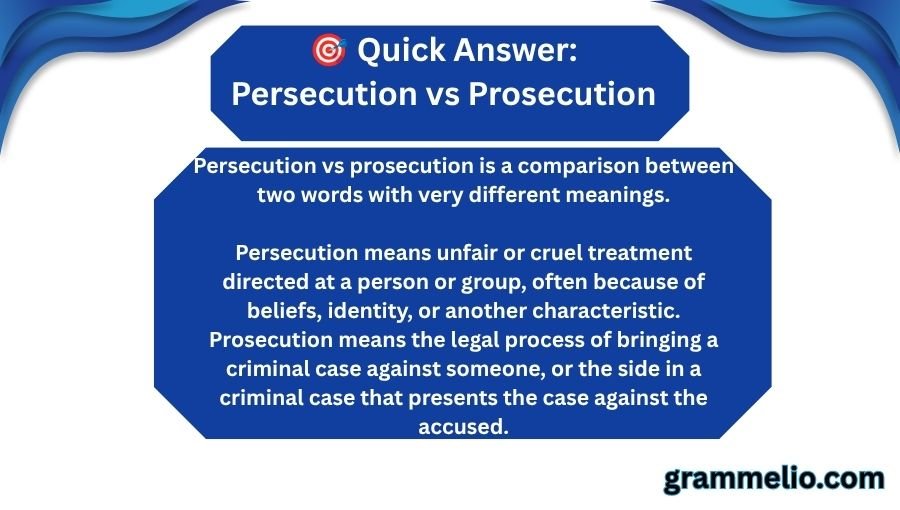
Persecution vs prosecution is a comparison between two words with very different meanings.
Persecution means unfair or cruel treatment directed at a person or group, often because of beliefs, identity, or another characteristic. Prosecution means the legal process of bringing a criminal case against someone, or the side in a criminal case that presents the case against the accused.
A simple memory trick is:
- Persecution = being targeted or mistreated
- Prosecution = a legal case
For example:
- ✅ The group faced persecution because of its beliefs.
- ✅ The lawyer handled the prosecution of the accused.
What Is the Difference Between Persecution and Prosecution?
The main difference is that persecution describes harmful treatment, while prosecution belongs mainly to the legal system.
| Form | Type | Meaning | Example | Correct/Incorrect |
|---|---|---|---|---|
| Persecution | Noun | Cruel or unfair treatment | The family faced persecution. | ✅ Correct |
| Prosecution | Noun | Legal action against an accused person | The prosecution presented evidence. | ✅ Correct |
| Persecute | Verb | To target or mistreat someone | They were persecuted for their beliefs. | ✅ Correct |
| Prosecute | Verb | To bring a legal case | The state decided to prosecute him. | ✅ Correct |
The words share several letters, which makes them easy to confuse. However, their meanings are not interchangeable.
If someone is being repeatedly targeted or mistreated, persecution is usually the right word. If prosecutors are bringing a criminal case to court, prosecution is the right word.
Is Persecution the Same as Prosecution?
No. Persecution and prosecution are not the same thing. Persecution involves harmful or unfair treatment, while prosecution involves legal action.
Consider these examples:
- ✅ The family escaped religious persecution.
- ❌ The family escaped religious prosecution.
The first sentence says the family was treated badly because of religion. The second suggests a legal case, which changes the meaning.
Now consider the legal meaning:
- ✅ The prosecution called its next witness.
- ❌ The persecution called its next witness.
A witness can be called by the prosecution in a criminal case. Persecution does not fit that context.
A Simple Meaning Test
Ask yourself one question:
Is the sentence about unfair treatment or a legal case?
If it is about unfair treatment, choose persecution.
If it is about a criminal legal case, choose prosecution.
Persecution: Meaning and Correct Use
Persecution means repeated cruel, unfair, or hostile treatment toward a person or group. It is often used when someone is targeted because of religion, race, political beliefs, identity, or another personal or group characteristic. Knowing this legal meaning makes persecution vs prosecution much easier to understand.
The word usually suggests more than one unpleasant event. It often describes a pattern of harmful treatment.
Example 1
The refugees fled their country to escape religious persecution.
Here, persecution means they were being targeted or mistreated because of their religious beliefs.
Example 2
The journalist claimed that she faced political persecution.
The sentence describes unfair treatment connected to political views.
Example 3
The community suffered years of persecution.
The phrase suggests a long period of harmful treatment.
Meaning Summary
| Meaning | Word Type | Example Sentence |
|---|---|---|
| Cruel treatment | Noun | The group experienced persecution. |
| Unfair targeting | Noun | He spoke about political persecution. |
| Religious targeting | Noun | They fled religious persecution. |
| Repeated hostile treatment | Noun | The community endured years of persecution. |
💡 Test Tip
If you could replace the word with “unfair treatment,” “targeting,” or “harassment” without changing the basic meaning, persecution may be the correct choice.
For example:
They suffered persecution.
You can mentally test:
They suffered unfair treatment.
The meaning still works.
Prosecution: Meaning and Correct Use
Prosecution is mainly a legal term. It refers to the process of bringing a criminal case against someone or to the legal team or side presenting the case against the accused.
It can also refer to the act of carrying out a legal case.
Example 1
The prosecution presented new evidence.
Here, prosecution refers to the side in a criminal case that is trying to prove the accused committed the crime.
Example 2
The prosecution called three witnesses.
Again, the word refers to the legal side bringing the case.
Example 3
The suspect faced prosecution for fraud.
Here, prosecution refers to legal action being taken against the suspect.
Meaning Summary
| Meaning | Word Type | Example Sentence |
|---|---|---|
| Legal action | Noun | He faced prosecution for fraud. |
| Legal side in a criminal case | Noun | The prosecution questioned the witness. |
| Bringing a criminal case | Noun | The prosecution continued despite the challenge. |
| Legal process | Noun | The prosecution took several months. |
The easiest way to remember the word is to connect it with court, lawyers, charges, evidence, and criminal cases.
Why Do People Confuse Persecution and Prosecution?
People confuse these words because they have almost the same structure and differ by only a few letters. Both contain -secution, which makes them especially easy to mix up when typing quickly.
I once edited a short article in which the writer used “persecution” when discussing a criminal trial. The sentence looked reasonable at first glance. But once I read it slowly, the meaning was clearly wrong. The writer knew the subject but had confused the two similar-looking words.
Fast typing is another common reason for this mistake. When your brain already knows what you want to say, your fingers may produce the wrong word before you notice.
Other causes include:
- Autocorrect choosing the wrong word
- Limited vocabulary knowledge
- Reading the words incorrectly
- Relying only on how the words look
- Writing quickly without proofreading
- Seeing the words used incorrectly online
The best solution is not to memorize their spelling alone. Learn their meanings and connect each word with its main context.
Persecution vs Prosecution at a Glance
The easiest way to compare them is to place them side by side.
| Feature | Persecution | Prosecution |
|---|---|---|
| Main field | Social, political, religious, historical | Legal |
| Basic idea | Cruel or unfair treatment | Legal action |
| Common subject | Person or group being targeted | Government or legal team |
| Related verb | Persecute | Prosecute |
| Common context | Religion, politics, identity | Crime, court, evidence |
| Example | Religious persecution | Criminal prosecution |
This table captures the central distinction. Persecution focuses on the person or group being targeted. Prosecution focuses on legal action.
What Does Persecution Mean in Everyday Writing?
In everyday writing, persecution is usually used when describing serious or repeated unfair treatment.
For example:
The family left because they feared persecution.
The word does not simply mean that someone disliked the family. It suggests serious targeting or mistreatment.
You may see it in discussions about:
- Religious freedom
- Political conflict
- Human rights
- History
- Refugees
- Social groups
- Government oppression
- Personal identity
It is usually stronger than words such as dislike or criticism.
Examples
- ✅ The community faced religious persecution.
- ✅ The activist described years of political persecution.
- ❌ The customer faced persecution because the store was busy.
The last sentence uses an unnecessarily strong word. A busy store does not normally represent persecution.
What Does Prosecution Mean in Legal Writing?
Prosecution belongs naturally in legal and criminal contexts.
You might see it alongside words such as:
- defendant
- accused
- criminal
- evidence
- attorney
- witness
- trial
- court
- charges
- conviction
For example:
The prosecution argued that the evidence was strong.
This clearly describes the legal side presenting a criminal case.
Another example:
The defendant’s attorney challenged the prosecution’s evidence.
Here, prosecution has a clear legal meaning.
Legal Usage Table
| Legal Situation | Correct Term | Example |
|---|---|---|
| Criminal case | Prosecution | The prosecution began its argument. |
| Legal action | Prosecution | He faced prosecution. |
| Targeting a religious group | Persecution | The group escaped persecution. |
| Unfair political treatment | Persecution | She reported political persecution. |
📝 Case Study: A Workplace Writing Mistake
Imagine that an employee is writing a report about a court case.
The employee writes:
The persecution presented evidence against the defendant.
That sentence is incorrect because the writer is referring to the legal side in the case.
The corrected sentence is:
The prosecution presented evidence against the defendant.
Now imagine a different report about a refugee family:
The family escaped prosecution because of their religion.
That sentence probably does not express the intended idea. If the family was targeted because of religious beliefs, the correct word is:
The family escaped persecution because of their religion.
The difference is small in spelling but large in meaning.
This is why I recommend checking the subject and action of the sentence before choosing between these words.
Grammar Rules Explanation
The grammar rule is simple: persecution and prosecution are both nouns, but they describe different actions or situations.
Persecution refers to harmful or unfair treatment.
Prosecution refers to legal action or the legal side bringing a criminal case.
Their related verbs also differ:
- Persecute = target or mistreat
- Prosecute = bring a legal case against someone
Compare:
The government persecuted the group.
versus:
The government prosecuted the suspect.
The first sentence describes harmful treatment. The second describes legal action.
Standard English reference sources agree on this basic distinction, so the safest approach is to focus on meaning rather than spelling.
Correct vs Incorrect at a Glance
| Sentence | Correct/Incorrect | Why |
|---|---|---|
| The prosecution presented evidence. | ✅ Correct | It refers to a legal case. |
| The community faced religious persecution. | ✅ Correct | It refers to unfair targeting. |
| The prosecution was based on religious beliefs. | ❌ Incorrect | The intended idea is likely persecution. |
| The persecution called its first witness. | ❌ Incorrect | A legal side is the prosecution. |
| The activist spoke about political persecution. | ✅ Correct | The sentence describes unfair treatment. |
How Can You Remember the Difference?
A simple memory trick can make the distinction much easier.
Think:
Persecution = pressure and pain
The word has per-, but you can simply associate it with someone being repeatedly targeted or mistreated.
Then think:
Prosecution = professional legal process
When you see words such as court, lawyer, defendant, trial, evidence, or charges, think prosecution.
Another helpful trick is to memorize the verbs:
Persecute a person. Prosecute a case.
This is one of the most useful shortcuts.
| If You Are Talking About… | Use |
|---|---|
| A targeted group | Persecution |
| Religious oppression | Persecution |
| Political targeting | Persecution |
| A criminal case | Prosecution |
| A prosecutor’s side | Prosecution |
| Legal action | Prosecution |
What Is the Difference Between Persecute and Prosecute?
Persecute means to repeatedly target or mistreat someone. Prosecute means to bring legal action against someone.
These are verbs, while persecution and prosecution are nouns.
Compare the four forms:
| Word | Part of Speech | Meaning | Example |
|---|---|---|---|
| Persecute | Verb | Target or mistreat | They persecuted the group. |
| Persecution | Noun | Targeting or mistreatment | The group faced persecution. |
| Prosecute | Verb | Bring a legal case | The state will prosecute him. |
| Prosecution | Noun | Legal action or legal side | The prosecution presented evidence. |
A useful sentence pair is:
The group was persecuted.
The suspect was prosecuted.
The first describes mistreatment. The second describes legal action.
Common Mistakes ⚠️
Most errors happen because the words are so similar in appearance. These errors are especially common when people are unsure about persecution vs prosecution.
Similar Word Confusions
| Confusing Words | Correct Distinction |
|---|---|
| Persecution / prosecution | Unfair treatment / legal action |
| Persecute / prosecute | Mistreat / bring a legal case |
| Advice / advise | Noun / verb |
| Affect / effect | Usually verb / usually noun |
| Your / you’re | Possession / you are |
| Its / it’s | Possession / it is |
Fast typing can make these errors worse. Autocorrect can also create problems because software may select a valid word that does not fit your meaning.
Lack of knowledge is another cause. If you have never learned the distinction, both words may look interchangeable.
I once caught myself typing “prosecution” while drafting a sentence about a group being targeted. I stopped because the surrounding words were about unfair treatment, not a courtroom. That quick meaning check prevented a much bigger editing problem.
Common Wrong Forms for These Terms
| Wrong Form or Use | What’s Wrong | Correct Form |
|---|---|---|
| Religious prosecution | Usually suggests legal action rather than targeting | Religious persecution |
| The persecution presented evidence | Persecution is not the legal side | The prosecution presented evidence |
| They were prosecuted for their beliefs | Changes the meaning to legal action | They were persecuted for their beliefs |
| Political prosecution of a group | May be correct only when legal action is meant | Political persecution if unfair targeting is meant |
| The prosecutor faced persecution in court | The intended legal role may be prosecution | The prosecutor faced opposition in court |
Not every use of political prosecution is wrong. Context matters. The phrase can describe legal action that is political in nature. The key is to ask what the sentence actually means.
Is Persecution Always Religious?
No. Persecution is not limited to religion. It can describe unfair or hostile treatment based on many different factors.
Examples include:
- Political beliefs
- Religion
- Ethnic background
- Nationality
- Social identity
- Membership in a particular group
For example:
The writer described years of political persecution.
This does not involve religion. It describes targeting connected to political beliefs or activity.
The word is therefore broader than religious persecution, even though that phrase is common.
Is Prosecution Always Criminal?
Prosecution is most strongly associated with criminal legal cases. However, the exact legal use can depend on the legal system and context.
For everyday English learning, the safest rule is:
If you are talking about a criminal case and the legal side bringing that case, use prosecution.
Examples include:
The prosecution questioned the witness.
The defense challenged the prosecution’s argument.
The suspect faced prosecution.
These are all legal contexts.
Usage in Different Contexts
The correct word can become much easier when you know the setting.
| Context | Which Term to Use | Example |
|---|---|---|
| Everyday conversation | Persecution when discussing unfair targeting | They left because of persecution. |
| Professional writing | Either, depending on meaning | The report discusses religious persecution. |
| Legal writing | Prosecution for a legal case | The prosecution filed its argument. |
| Creative writing | Either, depending on story | The character escaped persecution. |
| Social media/texting | Either, depending on context | The post discusses political persecution. |
The subject of your sentence should guide the choice.
Common Phrases With Persecution
Persecution appears in several common phrases.
| Phrase | Meaning |
|---|---|
| Religious persecution | Unfair treatment based on religion |
| Political persecution | Targeting connected to political beliefs or activity |
| Persecution complex | A strong belief that others are constantly targeting or mistreating someone |
| Face persecution | Experience serious unfair treatment |
| Escape persecution | Leave a situation to avoid being targeted |
| Suffer persecution | Experience repeated hostile treatment |
These phrases can help you recognize the word when you encounter it in books, news stories, or academic writing.
Common Phrases With Prosecution
Prosecution is common in legal phrases.
| Phrase | Meaning |
|---|---|
| Criminal prosecution | Legal action involving a criminal offense |
| Federal prosecution | A criminal case brought at the federal level |
| Prosecution case | The case presented by the prosecution |
| Prosecution evidence | Evidence presented by the legal side bringing the case |
| Prosecution attorney | Lawyer representing the prosecution |
| Face prosecution | Be subject to legal action |
The legal setting is the strongest clue that prosecution is the correct choice.
Synonyms and Alternatives
Sometimes you can replace these words with simpler terms. However, the replacement must preserve the meaning.
| Alternative | Works When | Does Not Work When |
|---|---|---|
| Oppression | Describing harsh unfair treatment | Referring to a courtroom case |
| Targeting | Describing deliberate unfair treatment | Referring to prosecutors |
| Harassment | Describing repeated unwanted treatment | Describing formal criminal proceedings |
| Legal action | Describing a court process | Describing general social mistreatment |
| Criminal case | Referring to a specific legal matter | Referring to persecution of a group |
For example, legal action can sometimes replace prosecution, but it is broader. Oppression can sometimes replace persecution, but it may not carry exactly the same meaning.
Why Does Correct Word Choice Matter?
Correct word choice matters because one small spelling difference can completely change a sentence.
A reader may understand your general topic but still misunderstand your exact point. This matters even more in professional and legal writing.
| Situation | Why Getting It Right Matters |
|---|---|
| Resume | Shows strong language skills |
| Client email | Prevents confusion |
| Published content | Builds trust and credibility |
| Social post | Keeps your meaning clear |
A useful writing principle is:
Clear words make clear ideas easier to trust.
That rule applies everywhere. Whether you are writing a school assignment, legal summary, blog post, or social media caption, precise words help readers understand you quickly.
Why Do Similar Words Cause So Many Errors?
Similar words often cause errors because our brains recognize patterns quickly. When two words share many letters, we may select the wrong one without fully processing its meaning.
This is especially common when:
- You are typing quickly.
- You are tired.
- You rely heavily on autocorrect.
- You are writing on a phone.
- You know the pronunciation but not the meaning.
- You learned the words separately without comparing them.
The solution is simple: pause and ask what the word means in context.
Do not ask only:
“Which spelling looks right?”
Ask:
“What idea am I trying to express?”
That question is much more useful.
How To Use These Words in Sentences
Here are more examples that show the difference clearly.
Persecution Examples
- ✅ The family feared religious persecution.
- ❌ The family feared religious prosecution.
- ✅ The activist spoke about political persecution.
- ❌ The activist spoke about political prosecution.
- ✅ The community suffered years of persecution.
- ❌ The community suffered years of prosecution.
Prosecution Examples
- ✅ The prosecution presented its evidence.
- ❌ The persecution presented its evidence.
- ✅ The defendant faced prosecution.
- ❌ The defendant faced persecution.
- ✅ The prosecution questioned the witness.
- ❌ The persecution questioned the witness.
The incorrect sentences are useful because they show how easy it is to create a sentence that looks almost right but makes no sense in context.
Can Prosecution and Persecution Ever Appear in the Same Sentence?
Yes. They can appear together when a sentence discusses both unfair treatment and legal action.
For example:
The report described the family’s persecution and the later prosecution of one member.
Here, the two words have separate meanings.
Persecution describes the harmful treatment of the family.
Prosecution describes legal action against one family member.
This is a good reminder that similar-looking words can work perfectly in the same sentence when they refer to different ideas.
A Quick Editing Method for Writers
If you are proofreading an article, essay, or email, use this three-step method.
Step 1: Find the Context
Look at the words around persecution or prosecution.
Are you seeing terms like:
- court
- trial
- evidence
- defendant
- lawyer
- charges
If yes, prosecution is probably intended.
Step 2: Check the Action
Ask whether someone is being targeted or whether someone is being legally charged.
- Targeted or mistreated → persecution
- Legally pursued → prosecution
Step 3: Read the Whole Sentence
Do not check only the spelling. Read the complete sentence.
A grammatically correct sentence can still use the wrong word.
🎯 How To Remember Persecution vs Prosecution
Use this short rule:
Persecution targets people. Prosecution targets a legal case.
This is not a legal definition, but it is a useful memory tool for everyday English.
You can also remember:
Persecute = mistreat
Prosecute = take legal action
Then turn them into nouns:
Persecution = mistreatment
Prosecution = legal action
| Verb | Noun | Basic Idea |
|---|---|---|
| Persecute | Persecution | Mistreat or target |
| Prosecute | Prosecution | Bring a legal case |
When Should You Use Persecution?
Use persecution when the sentence describes serious or repeated unfair treatment of a person or group.
Common patterns include:
persecution of a minority group
religious persecution
political persecution
escape persecution
suffer persecution
face persecution
If the central idea is being targeted, this is generally the word you want.
When Should You Use Prosecution?
Use prosecution when the sentence describes a criminal legal case or the side bringing that case.
Common patterns include:
face prosecution
criminal prosecution
the prosecution argued
the prosecution presented evidence
the prosecution called a witness
prosecution of the accused
If the central idea is legal action, choose this word.
⚠️ Common Mistakes to Avoid
Before publishing your writing, watch for these patterns:
- Do not use prosecution when you mean unfair treatment.
- Do not use persecution when you mean a prosecutor’s legal case.
- Do not assume similar spelling means similar meaning.
- Do not trust autocorrect without checking the sentence.
- Do not proofread spelling while ignoring meaning.
The strongest writers check both grammar and meaning.
Quick Recap Checklist
Use these questions whenever you are unsure.
| Question | If Yes → Use |
|---|---|
| Is someone being unfairly targeted? | Persecution |
| Is a group being mistreated because of beliefs or identity? | Persecution |
| Is the sentence about a criminal court case? | Prosecution |
| Is a legal team presenting evidence? | Prosecution |
| Is someone being brought to court for a crime? | Prosecution |
Practice Examples
1. The group fled because of religious _____.
Answer: persecution ✅
2. The _____ presented evidence against the defendant.
Answer: prosecution ✅
3. The activist described years of political _____.
Answer: persecution ✅
Try creating your own sentence for each word. If you can explain why you chose it, you have probably learned the distinction.
FAQs About Persecution vs Prosecution
What is the main difference between persecution and prosecution?
Persecution means cruel, unfair, or hostile treatment of a person or group. Prosecution means legal action against someone or the legal side presenting a criminal case.
Is religious prosecution correct?
Usually, religious persecution is the phrase you want when you mean people are being targeted or mistreated because of their religion. Religious prosecution would suggest a legal case connected to religion instead.
Is political persecution the correct phrase?
Yes. Political persecution is used when someone is unfairly targeted or mistreated because of political beliefs, activities, or associations.
What does prosecution mean in court?
In court, prosecution usually refers to the side responsible for bringing a criminal case against the accused. It can also refer to the process of pursuing that case.
What is the difference between persecute and prosecute?
Persecute means to target or mistreat someone. Prosecute means to bring legal action against someone.
Can a person face both persecution and prosecution?
Yes. A person can experience persecution and separately face prosecution. The words describe different situations.
How can I remember persecution vs prosecution?
Remember this simple rule: persecution is about harmful targeting, while prosecution is about legal action. You can also remember, “Persecute a person; prosecute a case.”
Is persecution a legal term?
It can appear in legal and human-rights discussions, but its basic meaning is broader than a courtroom process. It describes serious or repeated unfair treatment.
Is prosecution always about crime?
In everyday English, prosecution is most commonly connected with criminal legal proceedings. The exact legal meaning can depend on the legal system and context.
Which word should I use for a court case?
Use prosecution when you mean the legal process or the side bringing a criminal case. For example: “The prosecution presented new evidence.”
Final Comparison Table
| Point | Persecution | Prosecution |
|---|---|---|
| Meaning | Unfair or cruel treatment | Legal action |
| Related verb | Persecute | Prosecute |
| Main context | Social, political, religious | Legal |
| Typical target | Person or group | Accused person/case |
| Key clue | Being targeted | Being taken through a legal process |
| Example | They escaped persecution. | They faced prosecution. |
Conclusion
Persecution vs prosecution becomes much easier once you connect each word to its core meaning. Persecution describes serious or repeated unfair treatment, especially when a person or group is targeted. Prosecution describes legal action or the legal side presenting a criminal case. ✨
When I edit confusing word pairs like these, I always recommend focusing on meaning before spelling. Ask yourself whether the sentence is about being targeted or facing legal action. If someone is suffering unfair treatment, choose persecution. If a legal case is being brought, choose prosecution.
Remember the simplest rule: persecute a person, prosecute a case. That one contrast can help you avoid most mistakes with these words. Once you connect each term with its proper context, the spelling difference becomes much easier to remember. Keep the rule in mind, read your sentence once before publishing, and your word choice will be much clearer.



[…] forms, correct uses, common mistakes, examples, memory tricks, and answers to common questions. Persecution vs Prosecution | Peal vs Peel | Fmucus vs […]