Have you ever seen two words that look almost alike but mean completely different things? Adverse vs adverts is one of those tricky pairs.
The words share several letters, but they do very different jobs in a sentence. One describes something harmful or unfavorable. The other is a plural form of a word related to advertising.
I have seen this type of mix-up many times when helping people improve their writing. A small spelling error can change the meaning of a whole sentence.
That can be especially confusing in emails, school work, business writing, and online content. ✍️
The good news is that the difference is easy to understand once you focus on meaning and word type. In this guide, I will explain the difference between adverse vs adverts, show you how each word works, and give you simple examples that make the rule easy to remember.
By the end, you should be able to choose the right word without stopping to guess. 😊 Adieu vs Ado | Adage vs Adage | Accede vs Exceed
🎯 Quick Answer: Adverse vs Adverts
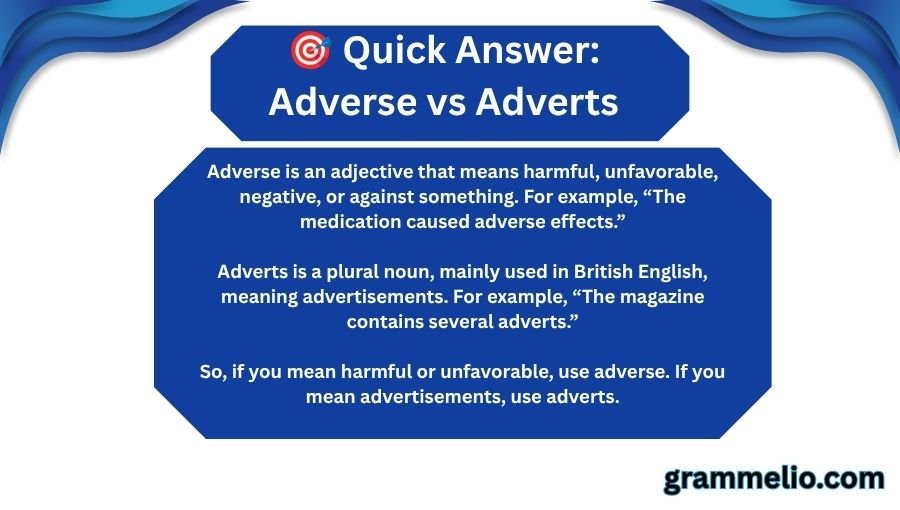
Adverse is an adjective that means harmful, unfavorable, negative, or against something. For example, “The medication caused adverse effects.”
Adverts is a plural noun, mainly used in British English, meaning advertisements. For example, “The magazine contains several adverts.”
So, if you mean harmful or unfavorable, use adverse. If you mean advertisements, use adverts.
Related Word Forms
These words have useful related forms, but they should not be treated as interchangeable.
| Form | Type | Example |
|---|---|---|
| adverse | adjective | The storm caused adverse conditions. |
| adversely | adverb | The decision adversely affected sales. |
| advert | noun | I saw an advert online. |
| adverts | plural noun | The website displays several adverts. |
| advertise | verb | The company will advertise its new service. |
| advertisement | noun | The advertisement appeared on television. |
| advertising | noun/participle | Advertising can help a new business grow. |
The key point is simple: adverse belongs to the group of words about negative effects or conditions. Advert and adverts belong to the group of words about advertising.
Is Adverse the Same as Adverts?
No. Adverse and adverts have different meanings, different word types, and different uses.
Adverse describes something negative, harmful, unfavorable, or difficult. Adverts refers to advertisements, especially in British English.
| Form | Type | Meaning | Example | Correct/Incorrect |
|---|---|---|---|---|
| adverse | adjective | harmful or unfavorable | The patient had an adverse reaction. | ✅ Correct |
| adverts | plural noun | advertisements | The newspaper contains several adverts. | ✅ Correct |
| adverts | adjective | harmful or unfavorable | The adverts conditions were severe. | ❌ Incorrect |
| adverse | noun meaning advertisements | advertisements | I watched three adverse. | ❌ Incorrect |
The spelling is similar, but the meaning gives you the answer.
A Simple Rule
Ask yourself:
Am I talking about something negative, or am I talking about advertisements?
If you mean something negative or harmful, choose adverse.
If you mean advertisements, choose adverts.
That one question can prevent most errors.
Adverse: Meaning and Correct Use
Adverse is an adjective. It describes something that is harmful, unfavorable, negative, or likely to create a problem.
You will often see it before a noun.
Examples include:
- adverse conditions
- adverse effects
- adverse reaction
- adverse outcome
- adverse impact
- adverse circumstances
- adverse weather
- adverse consequences
Example 1: Adverse Conditions
The hikers continued despite adverse weather.
Here, adverse describes the weather. The weather was unfavorable or difficult.
Example 2: Adverse Effects
The treatment may cause adverse effects.
In this sentence, adverse means negative or harmful.
Example 3: Adverse Decision
The court made an adverse decision for the company.
Here, the decision was unfavorable to the company.
Example 4: Adverse Impact
The policy could have an adverse impact on small businesses.
The policy may create a negative effect.
Meaning Summary
| Meaning | Word Type | Example Sentence |
|---|---|---|
| unfavorable | adjective | The company faced adverse conditions. |
| harmful | adjective | The drug caused adverse effects. |
| negative | adjective | The change had an adverse impact. |
| difficult | adjective | They worked under adverse circumstances. |
💡 Test Tip
Replace adverse with negative.
If the sentence still makes sense, adverse is probably the right choice.
For example:
The storm created adverse conditions.
Replace it:
The storm created negative conditions.
The meaning remains clear. That is a strong clue that adverse is correct.
Adverts: Meaning and Correct Use
Adverts is the plural form of advert. It means advertisements.
The word is especially common in British English. In American English, ads or advertisements is generally more natural.
For example:
The magazine has several adverts.
This means the magazine contains several advertisements.
Singular and Plural
The singular form is advert.
The plural form is adverts.
| Form | Meaning | Example |
|---|---|---|
| advert | one advertisement | I saw an advert for a new car. |
| adverts | more than one advertisement | I saw several adverts for new cars. |
| advertisement | one advertisement | The advertisement was creative. |
| advertisements | more than one | The advertisements were colorful. |
| ad | informal short form | I saw an ad online. |
| ads | plural informal form | The website contains many ads. |
British and American Usage
There is an important regional difference.
In British English, advert and adverts are common.
In American English, people are more likely to say ad, ads, or advertisement(s).
So an American writer might naturally write:
I saw three ads on the website.
A British writer might write:
I saw three adverts on the website.
Both communicate the same basic idea.
Adverse vs Adverts at a Glance
The easiest way to understand adverse vs adverts is to compare their grammar roles.
| Feature | Adverse | Adverts |
|---|---|---|
| Word type | Adjective | Plural noun |
| Main meaning | Negative or harmful | Advertisements |
| Describes | A noun | Refers to advertisements |
| Common use | adverse effects | several adverts |
| American English | Common | Less common |
| British English | Common | Common |
| Can describe conditions? | Yes | No |
| Can mean advertisements? | No | Yes |
The difference becomes much clearer when you look at the words around them.
Why Do People Confuse Adverse and Adverts?
People confuse these words because they look similar at first glance. They also begin with the same three letters: adv-.
When someone reads quickly, the brain may recognize the beginning of the word and overlook the ending.
Another reason is fast typing. If you are writing quickly, you may type a familiar-looking word without checking its meaning.
Autocorrect can also make things worse. A writing program may not understand what you intended because both forms can be correctly spelled words.
I once caught myself typing a similar-looking word while editing a business email. The spelling was technically correct, but the meaning was completely wrong for the sentence. A quick reread fixed it before the message was sent.
Common Reasons for Confusion
- Fast typing
- Autocorrect
- Similar spelling
- Weak knowledge of word meanings
- Reading without checking context
- Confusion between British and American vocabulary
Similar Grammar Confusions
| Confusing Pair | Correct Difference |
|---|---|
| its / it’s | possession / it is |
| your / you’re | possession / you are |
| their / they’re | possession / they are |
| affect / effect | influence / result |
| advice / advise | noun / verb |
| accept / except | receive / excluding |
The same lesson applies to adverse vs adverts: spelling alone is not enough. You must check the meaning.
Common Mistakes With Adverse vs Adverts
Here are some frequent errors involving these words.
| Wrong Form | What’s Wrong | Correct Form |
|---|---|---|
| adverse on TV | Adverse does not mean advertisement | adverts on TV |
| three adverse | Adverse is an adjective | three adverts |
| adverts conditions | Adverts does not describe conditions | adverse conditions |
| an adverts reaction | Adverts is not an adjective | an adverse reaction |
| adverse for a product | The intended meaning is likely advertisement | advert for a product |
| many adverse online | The plural noun for advertisements is adverts | many adverts online |
The easiest fix is to identify the role of the word.
If the word describes a noun, you may need adverse.
If the word names advertisements, you may need advert or adverts.
Grammar Rules Explanation
The main grammar rule is based on word class and meaning.
Adverse functions as an adjective. An adjective gives information about a noun. It can describe something as harmful, unfavorable, or negative.
For example:
The company faced adverse conditions.
The noun is conditions. The adjective adverse describes those conditions.
Adverts, on the other hand, is a plural noun. It names multiple advertisements.
For example:
The newspaper contains several adverts.
Here, adverts is the thing being discussed. It is not describing another noun.
Standard English reference sources agree on this basic distinction. The important point is not memorizing a dictionary entry. It is understanding how each word works in a sentence.
Correct vs Incorrect at a Glance
| Sentence | Correct/Incorrect | Why |
|---|---|---|
| The storm created adverse conditions. | ✅ Correct | Adverse describes unfavorable conditions. |
| The magazine contains several adverts. | ✅ Correct | Adverts means advertisements. |
| The storm created adverts conditions. | ❌ Incorrect | Adverts is not an adjective meaning unfavorable. |
| I saw three adverse in the magazine. | ❌ Incorrect | Adverse does not mean advertisements. |
| The medicine caused an adverse reaction. | ✅ Correct | Adverse describes a negative reaction. |
A useful grammar test is to replace the word.
If negative, harmful, or unfavorable fits, use adverse.
If advertisements fits, use adverts.
📝 Case Study: A Workplace Email
Imagine that a marketing manager writes this sentence:
“We should review the adverse before publishing the campaign.”
The sentence is confusing because adverse does not mean advertisements.
The manager probably means:
“We should review the adverts before publishing the campaign.”
Now imagine a safety report that says:
“The project was delayed because of adverts weather.”
That is also wrong.
The correct sentence is:
“The project was delayed because of adverse weather.”
The context tells you which word belongs.
I once edited a workplace document where a writer had chosen a word based only on how it looked. Once we replaced it with the word that matched the meaning, the entire sentence became clear.
How Context Helps You Choose the Right Word
Context is one of the strongest tools for solving adverse vs adverts confusion.
Look at the nouns around the word.
Words Commonly Used With Adverse
You will often see:
- adverse effects
- adverse reaction
- adverse conditions
- adverse weather
- adverse circumstances
- adverse outcome
- adverse result
- adverse consequences
- adverse impact
- adverse decision
These expressions usually describe something negative.
Words Commonly Used With Adverts
You may see:
- TV adverts
- newspaper adverts
- online adverts
- magazine adverts
- digital adverts
- television adverts
- classified adverts
- video adverts
- printed adverts
- job adverts
These expressions refer to advertisements.
| Context Clue | Likely Word |
|---|---|
| harmful effect | adverse |
| bad weather | adverse |
| negative result | adverse |
| unfavorable conditions | adverse |
| television advertisements | adverts |
| magazine advertisements | adverts |
| online advertisements | adverts |
| newspaper advertisements | adverts |
Usage in Different Contexts
The correct choice depends heavily on the context.
| Context | Which Term to Use | Example |
|---|---|---|
| Everyday conversation | Either, depending on meaning | The storm caused adverse conditions. |
| Professional writing | Either, depending on meaning | The report found an adverse impact. |
| Creative writing | Either, depending on meaning | The hero faced adverse circumstances. |
| Social media/texting | Adverts for advertisements | I keep seeing adverts for that brand. |
In American writing, ads is often the most natural choice for informal references to advertisements.
In more formal writing, advertisements may be better than adverts.
American English vs British English
Regional English matters when using adverts.
In the United States, advertisement and ad are very common.
In the United Kingdom, advert and adverts are widely used.
This does not change the meaning of adverse. The adjective remains useful in both varieties of English.
| Meaning | US English | British English |
|---|---|---|
| One advertisement | ad / advertisement | advert / advertisement |
| Several advertisements | ads / advertisements | adverts / advertisements |
| Harmful | adverse | adverse |
| Negative | adverse | adverse |
| Unfavorable | adverse | adverse |
So if you are writing for a US audience, ads may sound more natural than adverts when you mean advertisements.
Common Phrases With Adverse
Adverse appears in several common combinations.
| Phrase | Meaning |
|---|---|
| adverse effects | harmful or negative effects |
| adverse reaction | harmful or negative response |
| adverse conditions | difficult or unfavorable conditions |
| adverse weather | unfavorable weather |
| adverse impact | negative effect |
| adverse consequences | negative results |
These phrases are useful because they help you recognize adverse quickly.
If you see a phrase describing a problem, negative result, or difficult condition, adverse is often the right choice.
Common Phrases With Adverts
Adverts is commonly paired with words that identify where advertisements appear.
| Phrase | Meaning |
|---|---|
| TV adverts | television advertisements |
| online adverts | advertisements on the internet |
| newspaper adverts | advertisements in newspapers |
| magazine adverts | advertisements in magazines |
| digital adverts | advertisements in digital spaces |
| video adverts | advertisements in video form |
Remember that these phrases refer to advertising, not negative conditions.
How to Remember the Difference
A simple memory trick can make adverse vs adverts much easier.
Think:
Adverse = adversity
Both relate to difficult or unfavorable situations.
For example:
The team faced adverse conditions.
Think:
Adverts = advertisements
The word adverts contains the idea of an advertisement.
For example:
The website contains several adverts.
The Two-Word Memory Test
Ask:
Bad or harmful? → adverse
Advertisement? → advert/adverts
This is faster than trying to remember complicated grammar rules.
Synonyms and Alternatives
You can sometimes replace adverse with another word. However, the replacement must fit the sentence.
| Alternative | Works When | Does Not Work When |
|---|---|---|
| negative | You mean an unfavorable effect | You mean an advertisement |
| harmful | You mean something that causes harm | You simply mean difficult |
| unfavorable | You mean a poor or unwanted result | You mean a TV advertisement |
| difficult | You mean challenging conditions | You mean a harmful medical effect |
| bad | The context is informal | Formal or technical writing needs precision |
For adverts, alternatives include ads and advertisements.
| Alternative | Works When | Does Not Work When |
|---|---|---|
| ads | Informal US English | You mean negative |
| advertisements | Formal or general English | You mean harmful |
| commercials | TV or video advertising | You mean every type of advertisement |
| promotions | Marketing offers | You mean all advertisements |
Why It Matters
Choosing the right word improves clarity. This matters in school writing, workplace communication, published content, and online posts.
A reader should not have to guess what you mean.
Using adverse when you mean advertisements can make a sentence confusing. Using adverts when you mean harmful or unfavorable can change the meaning completely.
A simple writing principle is:
Clear words make clear messages.
Why Accuracy Matters
| Situation | Why Getting It Right Matters |
|---|---|
| Resume | Shows careful writing skills |
| Client email | Prevents confusion |
| Published content | Builds reader trust |
| Social post | Makes the message easier to understand |
Good writing is not always about using difficult words. It is often about choosing the simple word that means exactly what you want.
Adverse vs Adverts in Professional Writing
Professional writing requires extra care because small mistakes can affect how readers judge the message.
Consider these examples:
❌ “The new policy created adverts effects.”
This does not correctly describe negative effects.
✅ “The new policy created adverse effects.”
Now the meaning is clear.
Another example:
❌ “The campaign will appear in several adverse.”
This does not make sense if you mean advertisements.
✅ “The campaign will appear in several adverts.”
In US business writing, an even more natural option may be:
✅ “The campaign will appear in several ads.”
Adverse vs Adverts in Academic Writing
Academic writing often uses adverse when discussing negative effects, risks, or conditions.
Examples include:
The study examined the adverse effects of stress.
Researchers considered adverse environmental conditions.
The treatment produced fewer adverse outcomes.
Adverts is less common in formal US academic writing because advertisements is usually more suitable.
For example:
The researchers analyzed advertisements shown to consumers.
This is more formal than:
The researchers analyzed adverts shown to consumers.
Both can be understood, but the best choice depends on the audience and style.
Adverse vs Adverts in Everyday Speech
In everyday American speech, you are more likely to hear ads than adverts.
For example:
I keep getting ads on my phone.
In British English, someone may naturally say:
I keep getting adverts on my phone.
For the negative meaning, adverse is less common in casual speech than simpler words such as bad, harmful, or negative.
Still, you will often see it in formal writing.
| Meaning | Casual Choice | Formal Choice |
|---|---|---|
| harmful effect | bad effect | adverse effect |
| difficult conditions | bad conditions | adverse conditions |
| advertisements | ads | advertisements |
| British advertisements | adverts | adverts/advertisements |
Practice Examples
Try choosing the correct word before reading the answer.
Example 1
The medicine caused ______ effects.
Answer: adverse ✅
The sentence refers to harmful effects.
Example 2
The website contains several ______.
Answer: adverts ✅
The sentence refers to advertisements.
Example 3
The hikers faced ______ weather.
Answer: adverse ✅
The weather was unfavorable.
Example 4
The newspaper published several job ______.
Answer: adverts ✅
The sentence refers to advertisements for jobs.
Example 5
The decision could have an ______ impact on the company.
Answer: adverse ✅
The impact is negative.
Correct vs Incorrect Examples
| Incorrect ❌ | Correct ✅ | Reason |
|---|---|---|
| The drug caused adverts effects. | The drug caused adverse effects. | The effects are harmful. |
| I saw five adverse online. | I saw five adverts online. | The sentence means advertisements. |
| We faced adverts weather. | We faced adverse weather. | The weather was unfavorable. |
| The site displays adverse. | The site displays adverts. | The site displays advertisements. |
| The decision had an adverts impact. | The decision had an adverse impact. | The impact was negative. |
These examples show why context matters more than visual similarity.
How To Avoid the Mistake
Use this three-step check whenever you are unsure.
Step 1: Identify the Meaning
Ask what you want to say.
Is it:
- harmful?
- negative?
- unfavorable?
- an advertisement?
Step 2: Check the Grammar Role
If you need an adjective, adverse may be correct.
If you need a plural noun meaning advertisements, adverts may be correct.
Step 3: Replace the Word
Try a simple replacement.
Adverse → negative
Adverts → advertisements
If the replacement works, you have probably chosen correctly.
Why Spelling Alone Is Not Enough
The words adverse and adverts look close, but spelling cannot tell you everything.
English contains many words that look or sound alike while having different meanings.
For example:
- affect / effect
- advice / advise
- loose / lose
- accept / except
- principal / principle
The same habit works for all of them: stop and ask what the sentence means.
I tell students that this is one of the best editing habits they can build. Do not ask only, “Does this word look right?” Ask, “Does this word mean what I want it to mean?”
Frequently Asked Questions About Adverse vs Adverts
What is the difference between adverse and adverts?
Adverse means harmful, negative, or unfavorable. Adverts means advertisements and is especially common in British English.
Is adverse an adjective?
Yes. Adverse is an adjective. It describes something that is unfavorable, harmful, negative, or difficult.
For example:
The company faced adverse conditions.
Is adverts a noun?
Yes. Adverts is a plural noun meaning advertisements.
For example:
The magazine contains several adverts.
Can adverse mean advertisements?
No. Adverse does not mean advertisements. If you mean advertisements, use advertisements, ads, or adverts, depending on the context and variety of English.
Is adverts American English?
Adverts is more strongly associated with British English. In American English, ads and advertisements are usually more natural.
What is the singular of adverts?
The singular form is advert.
For example:
I saw an advert on television.
The plural is:
I saw several adverts on television.
What is the opposite of adverse?
Depending on the context, possible opposites include favorable, beneficial, positive, or helpful.
For example:
The treatment had adverse effects.
A contrasting sentence might be:
The treatment had beneficial effects.
Can I use adverse before a noun?
Yes. That is one of its main uses.
Examples include:
- adverse effects
- adverse weather
- adverse conditions
- adverse consequences
- adverse impact
Should Americans use adverts or ads?
Americans generally use ads or advertisements more often. Adverts is understandable but may sound more British.
How can I remember adverse vs adverts?
Use this simple rule:
Adverse = negative or harmful.
Adverts = advertisements.
If you remember those two meanings, the spelling becomes much easier to choose.
🎯 Quick Recap Checklist
Use this checklist whenever you are unsure.
| Question | If Yes → Use |
|---|---|
| Does the word mean harmful? | adverse |
| Does it mean negative? | adverse |
| Does it mean unfavorable? | adverse |
| Does it describe difficult conditions? | adverse |
| Does it mean advertisements? | adverts |
| Is it the plural of advert? | adverts |
| Are you writing casual US English about advertisements? | ads |
| Are you writing formal English about advertisements? | advertisements |
Practice
- The storm created ______ conditions.
Answer: adverse ✅ - The newspaper contains several ______.
Answer: adverts ✅ - The new drug may cause ______ reactions.
Answer: adverse ✅
A final mental shortcut is:
Adverse = bad. Adverts = ads.
That is enough to solve most cases.
Key Differences Between Adverse and Adverts
The biggest difference is their role in a sentence.
Adverse tells you what something is like. It describes a negative or unfavorable quality.
Adverts tells you what something is. It names multiple advertisements.
| Question | Adverse | Adverts |
|---|---|---|
| What does it mean? | Harmful/unfavorable | Advertisements |
| What is it? | Adjective | Plural noun |
| Example | adverse effects | TV adverts |
| Common US alternative | negative | ads |
| Common British usage | adverse | adverts |
Final Examples to Remember
Example A
The team worked in adverse conditions. ✅
The conditions were difficult or unfavorable.
Example B
The website contains several adverts. ✅
The website contains several advertisements.
Example C
The treatment caused an adverse reaction. ✅
The reaction was harmful or negative.
Example D
The newspaper printed several adverts. ✅
The newspaper printed several advertisements.
Incorrect Example
The company faced adverts conditions. ❌
The correct form is:
The company faced adverse conditions. ✅
The problem is not spelling alone. Adverts does not describe unfavorable conditions.
Conclusion
Adverse vs adverts is easy to separate once you focus on meaning. Adverse is an adjective that means harmful, negative, or unfavorable. Adverts is the plural of advert and means advertisements, especially in British English.
When you see a phrase such as adverse effects, adverse weather, or adverse conditions, think “negative” or “harmful.” When you see TV adverts, online adverts, or newspaper adverts, think “advertisements.” In American English, ads or advertisements will often sound more natural than adverts.
I recommend using the simple replacement test whenever you hesitate. Replace adverse with “negative” and adverts with “advertisements.” If the sentence still makes sense, you have your answer. ✨
Good grammar does not require complicated rules. It requires choosing the word that matches your meaning. Remember: adverse means unfavorable, while adverts means advertisements. Get the meaning right, and the spelling becomes much easier. ✅