Have you ever stopped while writing a sentence and wondered whether bloody vs bloodied is the correct choice? These two words look almost identical, but they do not always describe the same thing.
Many writers mix them up because both words connect to the idea of blood, injury, or something covered with blood. However, their meanings and uses are different.
When I edit articles and student writing, I often see this confusion appear in action scenes, news writing, stories, and personal descriptions.
Understanding the difference between these words can make your writing clearer and more accurate.
Whether you are describing a damaged object, a violent scene, or a strong emotional reaction, choosing the right word matters. 📝
This guide explains bloody vs bloodied, their meanings, grammar rules, examples, and common mistakes so you can confidently use both words in everyday and professional writing. Blond vs Blonde | Blond vs Blonde | Blond vs Blonde
🎯 Quick Answer: Bloody vs Bloodied
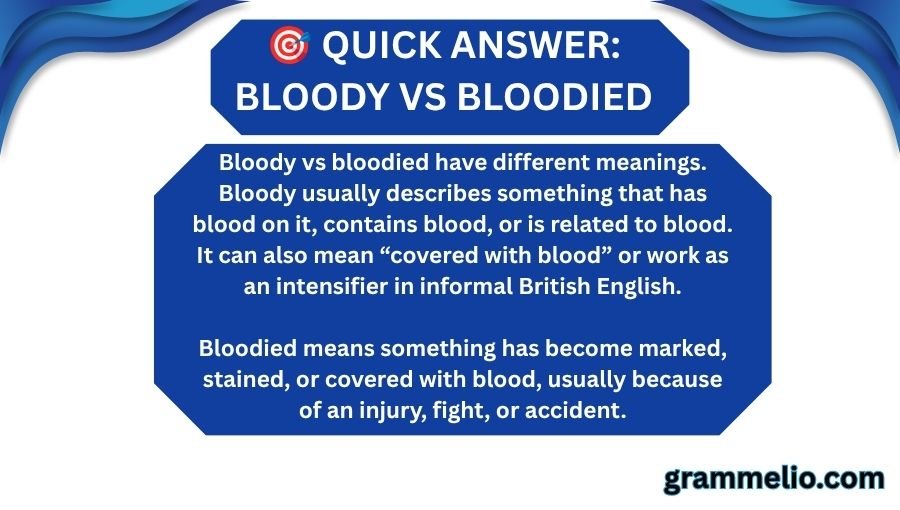
Bloody vs bloodied have different meanings. Bloody usually describes something that has blood on it, contains blood, or is related to blood. It can also mean “covered with blood” or work as an intensifier in informal British English.
Bloodied means something has become marked, stained, or covered with blood, usually because of an injury, fight, or accident.
| Word | Main Meaning | Example |
|---|---|---|
| Bloody | Having blood on it or related to blood | The bloody bandage was thrown away. |
| Bloodied | Made bloody through an event | His shirt was bloodied after the accident. |
A simple way to remember bloody vs bloodied is this: bloody describes a condition, while bloodied often describes a change that happened.
Bloody vs Bloodied at a Glance 🩸
The main difference between these words is the focus of the sentence. Bloody focuses on the state or quality of something. Bloodied focuses on the action or event that caused something to become stained with blood.
| Form | Type | Meaning | Example | Correct/Incorrect |
|---|---|---|---|---|
| Bloody | Adjective | Covered with or related to blood | The bloody cloth was removed. | ✅ Correct |
| Bloodied | Adjective / past participle | Marked with blood after an event | The fighter had a bloodied face. | ✅ Correct |
| Bloody | Verb | Rare or informal use | He bloodied his hand. | ❌ Usually incorrect |
| Bloodied | Verb form | Caused something to become bloody | The fall bloodied his knee. | ✅ Correct |
What Does Bloody Mean? 🩸
Bloody is an adjective that describes something connected with blood. It can describe a person, object, place, or situation.
The word does not always explain how the blood appeared. It simply tells the reader that blood is present or involved.
Bloody as “Covered With Blood”
The most common meaning of bloody is something that has blood on it.
Examples:
✅ The doctor cleaned the bloody wound carefully.
❌ The doctor cleaned the bloodied wound carefully.
Both words can sometimes work, but the meaning changes. “Bloody wound” describes a wound with blood. “Bloodied wound” suggests the wound became bloody because something happened.
Bloody as “Related to Blood”
Sometimes bloody means connected with blood rather than literally covered in it.
Examples:
✅ The story included a bloody battle scene.
✅ The movie showed a bloody conflict.
Here, bloody describes the violent nature of the event.
Bloody as an Informal Intensifier
In some varieties of English, especially British English, bloody can mean “very” or “extremely.”
Examples:
✅ That was a bloody difficult exam.
✅ This is a bloody amazing performance.
This meaning is informal and should usually be avoided in formal writing.
What Does Bloodied Mean? 🩸
Bloodied is usually a past participle that works as an adjective. It describes something that has been marked, stained, or affected by blood.
The word often suggests that an action caused the blood to appear.
Examples:
✅ The boxer walked away with a bloodied nose.
The nose was not simply bloody. It became bloody because of the fight.
Is Bloodied Different From Bloody? 🤔
Yes. The difference between bloody vs bloodied is mainly about cause and condition.
- Bloody = already showing blood.
- Bloodied = made bloody by an event.
Compare:
| Sentence | Meaning |
|---|---|
| The bloody towel was on the floor. | The towel had blood on it. |
| The fall bloodied his towel. | The fall caused blood to appear on the towel. |
| The soldier had a bloody uniform. | The uniform contained blood. |
| The explosion bloodied the soldier’s uniform. | The explosion caused the uniform to become stained. |
Why Do People Confuse Bloody and Bloodied? 💡
People often confuse these words because they share the same root word: “blood.” They also both describe situations involving injury, damage, or violence.
Another reason is that English often creates related words by adding endings like -ed. Writers may assume that adding -ed simply creates another form with the same meaning. However, the ending changes the focus.
I once edited a short story where a writer described a character’s “bloodied hands” after washing dishes with a small cut. The sentence was understandable, but the word choice made the scene sound more dramatic because “bloodied” suggested an event had caused the condition.
Understanding the difference helps writers control the feeling of their sentences.
Key Differences Between Bloody and Bloodied 📝
The easiest way to separate these words is to look at whether you are describing a thing or describing what happened to it.
| Feature | Bloody | Bloodied |
|---|---|---|
| Word type | Adjective | Adjective / verb form |
| Focus | Condition | Result of an action |
| Meaning | Has blood or relates to blood | Became marked with blood |
| Common use | Description | Describing a change |
| Example | A bloody shirt | A bloodied shirt after a fight |
Correct Meanings and Uses of Bloody 🩸
1. Describing Something With Blood
Bloody commonly describes objects or situations where blood is present.
Examples:
✅ The nurse replaced the bloody gloves.
❌ The nurse replaced the bloodied gloves.
The first sentence simply describes the gloves. The second suggests something caused the gloves to become bloody.
2. Describing Violent Events
Bloody can describe battles, fights, or accidents.
Examples:
✅ The novel contains a bloody scene.
✅ The team survived a bloody competition.
In these cases, bloody creates a stronger image.
3. Informal Emphasis
In casual speech, bloody can add emphasis.
Examples:
✅ That was a bloody good meal.
This use depends on region and tone. It may sound rude or inappropriate in some situations.
Correct Meanings and Uses of Bloodied 🩸
1. Showing the Result of Injury
Bloodied often appears when something becomes marked because of harm.
Examples:
✅ The athlete had a bloodied knee after the race.
The injury caused the knee to become bloody.
2. Describing Damage From an Event
Bloodied can show that an action changed something.
Examples:
✅ The accident bloodied his clothing.
The accident caused the clothing to become stained.
Meaning Summary Table
| Meaning | Word Type | Example Sentence |
|---|---|---|
| Covered with blood | Bloody | The bloody knife was evidence. |
| Related to violence | Bloody | The film showed a bloody battle. |
| Became stained with blood | Bloodied | The crash bloodied his arm. |
| Caused blood marks | Bloodied | The sharp edge bloodied his finger. |
💡 Test Tip: How to Choose the Right Word
Ask yourself one simple question:
“Am I describing something that already has blood, or am I explaining how it became bloody?”
Use:
- Bloody → describing the condition.
- Bloodied → describing the result of an action.
Example:
“The player had a ___ face after the accident.”
The accident caused the injury, so:
✅ The player had a bloodied face.
“The detective found a ___ glove.”
The glove already had blood on it, so:
✅ The detective found a bloody glove.
📝 Case Study: Using Bloody and Bloodied in Real Life
Understanding the difference between bloody vs bloodied becomes easier when we see how these words work in real situations. Writers, reporters, teachers, and everyday speakers often choose one word over the other depending on whether they want to describe a condition or explain a change.
Imagine a workplace safety report after a minor accident:
“The worker slipped near the equipment and suffered a small cut. His sleeve became bloodied, and the supervisor removed the bloody cloth from the area.”
In this example:
- Bloodied sleeve shows that the sleeve became stained because of the accident.
- Bloody cloth simply describes the cloth as having blood on it.
I once edited a safety newsletter where the writer used “bloodied equipment” when describing tools found after an inspection. The word created the impression that the equipment had recently caused an injury. The intended meaning was only that the equipment had blood on it, so “bloody equipment” was clearer.
Choosing the right word helps readers understand exactly what happened. 📝
Grammar Rules Explanation: Bloody vs Bloodied
The grammar difference between bloody vs bloodied comes from how English forms adjectives and verbs.
Bloody is mainly an adjective. It describes a noun by showing that blood is present or that something is connected with blood.
Examples:
✅ The bloody towel was placed in a bag.
The word “bloody” describes the towel.
Bloodied can work as an adjective or as the past form of the verb “bloody.” It often shows that something has been affected by an action.
Examples:
✅ The accident bloodied his shirt.
The accident caused the shirt to become stained.
Standard English references agree that related adjective forms can have different meanings depending on how they are used in a sentence. A shared root does not always mean two words can replace each other.
Correct vs Incorrect at a Glance ✅❌
| Sentence | Correct/Incorrect | Why |
|---|---|---|
| The fighter had a bloodied nose after the match. | ✅ Correct | The injury caused the nose to become marked with blood. |
| The detective found a bloody glove. | ✅ Correct | The glove had blood on it. |
| The accident bloody his shirt. | ❌ Incorrect | The verb form should be “bloodied.” |
| The soldier carried a bloodied weapon after the battle. | ✅ Correct | The weapon became stained during the event. |
| She cleaned the bloodied floor because it had stains. | ⚠️ Possible but less natural | “Bloody floor” may be clearer when only describing the condition. |
How To Remember The Difference Between Bloody and Bloodied 💡
A simple memory trick can prevent most mistakes:
Think about the letter “D” in bloodied.
The -ed ending often points to something that happened.
- Bloodied = something was changed.
- Bloody = something is already in that state.
Examples:
✅ The glass was bloody.
(The glass had blood on it.)
✅ The broken glass bloodied his hand.
(The glass caused the hand to become bloody.)
Common Mistakes With Bloody and Bloodied ⚠️
Many mistakes happen because writers focus only on the shared word “blood” and ignore the meaning of the ending.
Here are the main reasons people mix them up:
- Fast typing can cause writers to choose the first similar-looking word.
- Autocorrect may replace a word with a related but incorrect option.
- Some learners do not know that “-ed” can change the meaning of a word.
I once caught myself typing “bloody” in a personal note when I meant “bloodied.” The sentence was about a character who had received an injury, so the action-based word was the better choice. Even experienced writers can make this mistake when writing quickly.
Similar Grammar Confusions Table
| Confusing Words | Difference | Example |
|---|---|---|
| Its / It’s | Possession vs contraction | Its color is bright. / It’s raining. |
| Your / You’re | Possession vs “you are” | Your book is here. / You’re correct. |
| Affect / Effect | Influence vs result | It affected me. / The effect was clear. |
| Then / Than | Time vs comparison | Then we left. / Better than before. |
| Bloody / Bloodied | Condition vs caused change | A bloody shirt / A bloodied shirt after an injury |
Common Wrong Spellings and Uses of Bloody vs Bloodied
| Wrong Form | What’s Wrong | Correct Form |
|---|---|---|
| The accident bloody his arm. | Incorrect verb form | The accident bloodied his arm. |
| A bloodied knife on the table. | May suggest the knife caused the blood event | A bloody knife on the table. |
| The fight bloody his face. | Missing past ending | The fight bloodied his face. |
| A bloody fighter after the match. | Less clear when focusing on injury result | A bloodied fighter after the match. |
| The bloodied wound looked painful. | Often unnecessary because the wound itself already involves blood | The bloody wound looked painful. |
Usage in Different Contexts 📝
The best choice between bloody vs bloodied depends on the type of writing and the message you want to deliver.
| Context | Which Term to Use | Example |
|---|---|---|
| Everyday conversation | Both, depending on meaning | “His shirt was bloody.” / “His shirt was bloodied in the accident.” |
| Professional writing | Usually specific use | “The report described a bloodied injury.” |
| Creative writing | Both can create different effects | “A bloody battlefield” or “a bloodied warrior” |
| Social media/texting | Depends on tone | “That movie was bloody intense.” |
Bloody vs Bloodied in Professional Writing 📄
In professional writing, precision matters. Writers should avoid using these words interchangeably because they can create different images.
For example:
✅ “The report showed a bloody scene.”
This describes the scene.
✅ “The report explained how the accident bloodied the worker’s clothing.”
This explains the event.
A small word choice can change how readers understand responsibility, timing, and cause.
Bloody vs Bloodied in Creative Writing ✍️
Authors often use these words to create a specific mood.
Bloody can make a scene feel intense:
The battlefield was bloody after the long struggle.
Bloodied can focus attention on a character’s experience:
The bloodied warrior stood silently after the fight.
The first describes the environment. The second describes what happened to someone.
Common Phrases With Bloody 🩸
Some expressions use bloody naturally.
| Phrase | Meaning |
|---|---|
| Bloody battle | A violent battle with bloodshed |
| Bloody mess | A situation involving disorder or blood |
| Bloody nose | A nose that is bleeding |
| Bloody hand | A hand covered with blood |
| Bloody scene | A scene involving violence or blood |
Common Phrases With Bloodied 🩸
Bloodied appears often when describing injuries or results.
| Phrase | Meaning |
|---|---|
| Bloodied face | A face marked with blood |
| Bloodied hands | Hands stained because of an event |
| Bloodied nose | A nose injured and bleeding |
| Bloodied clothing | Clothing made stained with blood |
| Bloodied fighter | A fighter injured during combat |
Synonyms and Alternatives
Sometimes another word may communicate your meaning better.
| Alternative | Works When | Does Not Work When |
|---|---|---|
| Stained | You want to describe marks or spots | You need to specifically mention blood |
| Injured | You focus on harm to a person | You only describe blood presence |
| Bleeding | Blood is actively coming out | The blood is already dry |
| Marked | You describe visible signs | You need a strong blood image |
| Damaged | You describe harm generally | You need a blood-related meaning |
Why It Matters: Choosing the Right Word ✨
Correct word choice improves clarity, professionalism, and trust.
Using the wrong form may confuse readers or create a stronger image than you intended.
A sentence in a medical report, article, or story can change meaning because of one small word.
“Bloody” and “bloodied” are close, but they tell slightly different stories.
Clear words create clear pictures in a reader’s mind.
| Situation | Why Getting It Right Matters |
|---|---|
| Resume or application | Shows careful writing skills |
| Client email | Prevents misunderstandings |
| Published content | Improves credibility |
| Social media post | Helps readers understand your message |
FAQs About Bloody vs Bloodied 🩸
What is the difference between bloody and bloodied?
Bloody describes something that has blood on it or something connected to blood. Bloodied usually describes something that became covered or marked with blood because of an action, event, or injury.
Example:
✅ The bloody towel was on the floor.
(The towel already had blood on it.)
✅ The accident bloodied his shirt.
(The accident caused the shirt to become stained.)
Is bloody the same as bloodied?
No, bloody and bloodied are not exactly the same. They are related words, but they focus on different ideas.
Bloody focuses on the condition.
Bloodied focuses on the change or event that caused the condition.
For example:
- A bloody hand means the hand has blood on it.
- A bloodied hand suggests the hand became bloody because something happened.
When should I use bloody instead of bloodied?
Use bloody when you are simply describing something that contains or shows blood.
Examples:
✅ The hunter cleaned his bloody knife.
✅ The movie showed a bloody battle scene.
Use bloodied when you want to show that something became marked with blood after an event.
Example:
✅ The fall bloodied his knee.
Can bloodied be used as a verb?
Yes. Bloodied can be the past tense form of the verb “bloody.”
Examples:
✅ The sharp object bloodied his finger.
✅ The accident bloodied the driver’s clothing.
However, this verb use is less common than the adjective use.
Is bloody a bad word?
It depends on the context. In some places, especially informal British English, bloody can be used as an intensifier similar to “very.”
Example:
✅ That was a bloody difficult task.
However, some people consider this use informal or slightly rude, so it may not be suitable for professional writing.
Which is correct: bloody nose or bloodied nose?
Both can be correct, but they create slightly different meanings.
Bloody nose is the more common phrase for a nose that is bleeding or has blood on it.
Example:
✅ He had a bloody nose after the game.
Bloodied nose emphasizes that an injury caused the condition.
Example:
✅ The boxer walked away with a bloodied nose.
Can I use bloody and bloodied interchangeably?
No. While they are connected, replacing one with the other can change the meaning.
Compare:
✅ The bloody shirt was found near the door.
(The shirt had blood on it.)
✅ The fight bloodied his shirt.
(The fight caused the shirt to become stained.)
Why do writers confuse bloody and bloodied?
Writers often confuse these words because they share the same root and look almost identical. Fast typing, autocorrect suggestions, and unfamiliarity with adjective forms can lead to mistakes.
Remember:
- Bloody = describes a state
- Bloodied = describes a result
How can I remember the difference between bloody and bloodied?
Use the “-ed means happened” trick.
The ending -ed often shows that something occurred.
Example:
- The glass was bloody. (It had blood.)
- The glass bloodied his hand. (It caused blood to appear.)
This simple reminder works in most situations.
🎯 Quick Recap Checklist
Use this checklist to decide whether you need bloody vs bloodied.
| Question | If Yes → Use |
|---|---|
| Am I describing something that already has blood on it? | Bloody |
| Am I describing something connected with blood or violence? | Bloody |
| Did an action cause something to become stained with blood? | Bloodied |
| Am I showing the result of an injury or accident? | Bloodied |
| Am I using the word as a past-tense verb? | Bloodied |
Practice Examples 📝
Example 1
Sentence:
“The accident ______ his jacket.”
Answer:
✅ The accident bloodied his jacket.
Reason: The accident caused the change.
Example 2
Sentence:
“The detective found a ______ glove.”
Answer:
✅ The detective found a bloody glove.
Reason: The glove already had blood on it.
Example 3
Sentence:
“The fighter left the ring with a ______ face.”
Answer:
✅ The fighter left the ring with a bloodied face.
Reason: The fight caused the injury.
Conclusion 🩸
Bloody vs bloodied is a small grammar difference that can have a big impact on meaning. Bloody usually describes something that has blood on it or relates to blood, while bloodied often shows that something became marked with blood because of an action or event.
When you are writing, ask yourself whether you are describing a condition or explaining a change. If something simply contains blood, bloody is often the right choice. If something became stained because of an injury, accident, or action, bloodied usually fits better.
I have found that careful word choice helps readers understand scenes more clearly, whether they are reading a report, story, article, or conversation. A single ending like -ed can change the feeling of an entire sentence. ✨
Mastering bloody vs bloodied will make your writing more precise, natural, and confident. The right word does more than describe something—it tells the reader exactly what happened. 📝