I have taught and edited English for years, and I still see smart writers pause when they meet decent vs descent vs dissent. These three words look and sound similar, but they do very different jobs in a sentence. One describes something acceptable or respectable. Another describes movement downward or a family line.
The third describes disagreement with an idea, rule, or authority. 😅 If you are writing an email, school paper, resume, article, or social post, choosing the wrong word can change your meaning fast.
In this guide, I will show you the difference in plain US English. I will give you simple definitions, examples, memory tricks, common mistakes, and practice questions.
By the end, you should be able to tell these words apart without stopping to guess. Let’s make this confusing group much easier. ✨ Credible vs Creditable vs Credulous | Core vs Corps | Continual vs Continuous
🎯 Quick Answer: Decent vs Descent vs Dissent
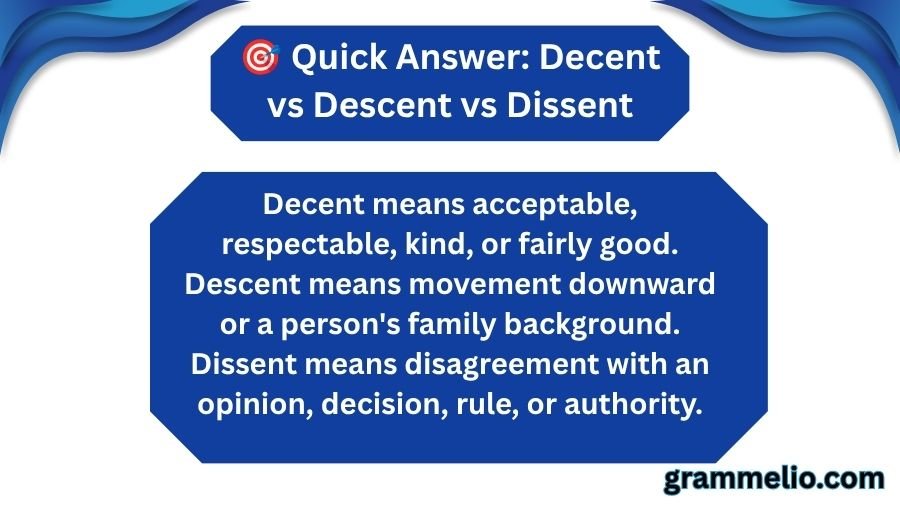
Decent means acceptable, respectable, kind, or fairly good. Descent means movement downward or a person’s family background. Dissent means disagreement with an opinion, decision, rule, or authority.
A simple memory trick is this: decent = good enough, descent = down, dissent = disagree.
| Word | Main Meaning | Part of Speech | Easy Memory Clue |
|---|---|---|---|
| Decent | Acceptable, respectable, or fairly good | Adjective | Decent = good enough |
| Descent | Movement downward or family background | Noun | Descent = down |
| Dissent | Strong disagreement | Noun or verb | Dissent = disagree |
What Is the Difference Between Decent, Descent, and Dissent?
The biggest difference is meaning. Decent describes something. Descent names an action, direction, or family background. Dissent refers to disagreement.
| Form | Type | Meaning | Example | Correct/Incorrect |
|---|---|---|---|---|
| Decent | Adjective | Acceptable or respectable | She found a decent apartment. | ✅ Correct |
| Descent | Noun | Movement downward | The plane began its descent. | ✅ Correct |
| Descent | Noun | Family background | He is of Irish descent. | ✅ Correct |
| Dissent | Noun | Disagreement | Several members expressed dissent. | ✅ Correct |
| Dissent | Verb | To disagree | Two judges dissented from the decision. | ✅ Correct |
| Decent | Adjective | Used for disagreement | ❌ She voiced decent about the rule. | ❌ Incorrect |
| Descent | Noun | Used for disagreement | ❌ His descent was clear during the debate. | ❌ Incorrect |
The spelling difference becomes easier when you connect each word to its main idea.
- Decent → acceptable or respectable
- Descent → downward movement or family line
- Dissent → disagreement
🧠 Decent vs Descent vs Dissent: Meaning Made Simple
I like to reduce these words to three short questions:
- Is something good enough or respectable? Use decent.
- Are you talking about going down or family background? Use descent.
- Are you talking about disagreement? Use dissent.
| Question | Correct Word | Example |
|---|---|---|
| Is the quality acceptable? | Decent | The restaurant serves decent food. |
| Is something moving downward? | Descent | The helicopter began its descent. |
| Are you describing family background? | Descent | She is of Korean descent. |
| Is someone disagreeing? | Dissent | The senator voiced dissent. |
| Does someone formally disagree? | Dissent | One judge chose to dissent. |
Decent: Something Acceptable or Respectable
Decent is an adjective. It usually describes something that is good enough, reasonable, proper, respectable, or kind.
For example:
The hotel was decent and clean.
Here, decent means the hotel was acceptable. It does not necessarily mean the hotel was amazing. It simply met a reasonable standard.
You can also use decent to describe behavior:
He showed decent manners at dinner.
In this sentence, decent means proper or respectable.
Other examples include:
- She found a decent job after college.
- We had a decent meal before the movie.
- He is a decent person who treats others well.
- The team made a decent effort.
Descent: Moving Down or Family Background
Descent is mainly a noun. It can describe movement from a higher point to a lower point.
The airplane began its descent.
The plane is moving downward, so descent is correct.
The word can also describe family background or ancestry.
She is of Mexican descent.
Here, the sentence is about her family background. It has nothing to do with physically moving down.
| Meaning | Word Type | Example Sentence |
|---|---|---|
| Movement downward | Noun | The hikers started their descent. |
| Family background | Noun | He is of Japanese descent. |
| Movement from higher to lower | Noun | The road becomes steep during the descent. |
Dissent: Disagreement With an Idea or Decision
Dissent means disagreement. It can be a noun or a verb.
As a noun:
There was strong dissent among the workers.
As a verb:
One judge chose to dissent.
The disagreement may be about a law, policy, opinion, decision, or authority.
| Use | Example | Meaning |
|---|---|---|
| Noun | Public dissent grew quickly. | Disagreement increased. |
| Noun | The proposal faced dissent. | People disagreed with it. |
| Verb | Several members dissented. | Several members disagreed. |
| Verb | She dissented from the majority view. | She rejected the shared opinion. |
💡 How Can You Remember Decent, Descent, and Dissent?
The easiest trick is to focus on the middle letters and meaning.
| Word | Think Of | Memory Trick |
|---|---|---|
| Decent | Good enough | “Decent” sounds like something you can approve of |
| Descent | Downward movement | S in descent can remind you of a slope |
| Dissent | Disagreement | Think of dissent = disagree |
Here is another quick method:
Decent = quality.
Descent = direction or ancestry.
Dissent = disagreement.
If you can identify the idea first, the spelling usually follows.
💡 Test Tip
Replace the word with a simpler word.
- If you can replace it with acceptable, use decent.
- If you can replace it with downward movement or ancestry, use descent.
- If you can replace it with disagreement, use dissent.
For example:
The restaurant was acceptable.
So:
The restaurant was decent. ✅
Another example:
The plane started moving downward.
So:
The plane began its descent. ✅
And:
Several workers showed disagreement.
So:
Several workers expressed dissent. ✅
Why Do People Confuse These Three Words?
People confuse these words because their spellings are close and their sounds can overlap in quick speech. The shared beginning makes the problem worse. A writer may know the meaning but still select the wrong spelling while typing.
I once edited a short business report where the writer used descent when they meant dissent. The sentence was about employees disagreeing with a new policy. Nothing about the employees was moving downward. The error was small, but it changed the meaning completely. After replacing the word, the sentence became clear.
| Common Confusion | What the Writer Means | Correct Choice |
|---|---|---|
| Decent / descent | Acceptable | Decent |
| Descent / dissent | Disagreement | Dissent |
| Descent / decent | Moving downward | Descent |
| Dissent / decent | Respectable | Decent |
| Descent / dissent | Family background | Descent |
The problem often happens for three simple reasons:
- Fast typing: You know what you mean, but your fingers choose a familiar spelling.
- Autocorrect: Software may not understand the meaning of your sentence.
- Lack of knowledge: Similar-looking words are easy to mix up if you have never learned the difference.
📝 Case Study: A Workplace Email
Imagine that a manager sends this email:
“We have heard some descent about the new schedule.”
The manager probably means that workers disagree with the schedule. Descent is wrong because there is no downward movement or family background.
The better version is:
“We have heard some dissent about the new schedule.” ✅
Now imagine a travel email:
“The aircraft began its decent.”
That spelling is wrong. The aircraft is moving downward, so the correct word is:
“The aircraft began its descent.” ✅
Finally, consider a hotel review:
“The hotel was decent for the price.” ✅
Here, the writer means the hotel was acceptable or reasonably good.
| Situation | Wrong Choice | Correct Choice | Why |
|---|---|---|---|
| Employees disagree with a policy | Descent | Dissent | The idea is disagreement |
| Plane moves downward | Decent | Descent | The idea is downward movement |
| Hotel is acceptable | Descent | Decent | The word describes quality |
| Family background | Dissent | Descent | The word refers to ancestry |
📚 Grammar Rules Explanation for Decent, Descent, and Dissent
The basic grammar rule is simple: choose the word based on its meaning and grammatical role.
Decent is an adjective. It modifies a noun.
She bought a decent car.
The adjective decent describes the car.
Descent is a noun. It can name an act of moving downward or a person’s family background.
The descent was steep.
Here, descent is the thing being described.
Dissent can be a noun or a verb.
The proposal caused dissent.
Here, dissent is a noun.
Some members dissent from the decision.
Here, dissent is a verb.
Standard English references agree on these basic distinctions. The key is not to memorize complicated rules. Instead, ask what the sentence actually means.
Correct vs Incorrect at a Glance
| Sentence | Correct/Incorrect | Why |
|---|---|---|
| She found a decent apartment. | ✅ Correct | “Decent” means acceptable. |
| The plane started its dissent. | ❌ Incorrect | A plane moves downward during a descent. |
| The committee faced strong dissent. | ✅ Correct | Dissent means disagreement. |
| He is of Italian dissent. | ❌ Incorrect | Family background is descent. |
| The hikers began their descent. | ✅ Correct | They were moving downward. |
⚠️ Common Mistakes With These Words
The most common error is choosing the spelling before thinking about the meaning. That is backwards. I teach students to identify the idea first.
Ask:
Good enough? → decent.
Going down or family background? → descent.
Disagreement? → dissent.
I once caught myself typing decent in a sentence where I was describing a downhill trail. I knew the meaning, but my fingers moved faster than my brain. I stopped, reread the sentence, and changed it to descent. That small habit—rereading before publishing—prevents many errors.
Similar Grammar Confusions
| Confusing Pair | First Word | Second Word | Main Difference |
|---|---|---|---|
| It’s / its | It’s = it is | Its = belonging to it | Contraction vs possession |
| Your / you’re | Your = belonging to you | You’re = you are | Possession vs contraction |
| Their / there / they’re | Their = belonging to them | There = place | They’re = they are |
| Affect / effect | Affect = usually influence | Effect = usually result | Different grammatical roles |
| Then / than | Then = time | Than = comparison | Time vs comparison |
Common Wrong Forms for Decent, Descent, and Dissent
| Wrong Form or Use | What’s Wrong | Correct Form |
|---|---|---|
| The plane began its decent. | “Decent” is an adjective, not the noun for downward movement. | The plane began its descent. |
| Workers showed descent. | The intended meaning is disagreement. | Workers showed dissent. |
| She is of French dissent. | Family background is descent. | She is of French descent. |
| He gave a descent opinion. | The intended idea is disagreement. | He expressed dissent. |
| We stayed at a descent hotel. | The intended adjective is “decent.” | We stayed at a decent hotel. |
| The judge voiced decent. | The intended noun is disagreement. | The judge voiced dissent. |
🏛️ Word History and Why the Spellings Diverged
These three words have different histories, even though their modern spellings look similar. Their meanings developed separately, which helps explain why they cannot be treated as interchangeable words.
The important point for modern writers is that spelling similarity does not mean meaning similarity.
| Period | Form | General Development |
|---|---|---|
| Earlier English | Forms related to decent | Connected with ideas of suitability and proper behavior |
| Earlier English | Forms related to descent | Connected with going down and later family line |
| Earlier English | Forms related to dissent | Connected with disagreement or holding a different view |
| Modern English | Decent | Common adjective for acceptable or respectable |
| Modern English | Descent / dissent | Distinct nouns and verb use with separate meanings |
You do not need to memorize their full history to use them correctly. Their modern meanings are what matter most in everyday writing.
🌎 Usage in Different Contexts
The right word stays the same across different settings, but the sentence around it may change.
Everyday Conversation
In casual conversation, decent is very common.
“How was the movie?”
“It was decent.”
Here, it means the movie was reasonably good.
Descent often appears when talking about travel, hiking, flying, or family background.
Dissent is more formal and often appears when discussing disagreement.
Professional Writing
Professional writing requires extra care because a wrong word can make an email or report look careless.
“Several employees expressed dissent.”
This is suitable for a formal report.
“The aircraft began its descent.”
This works in a professional travel or aviation context.
“We received a decent response.”
This is also possible, especially when “decent” means reasonably good.
Creative Writing
Creative writers can use all three words to create clear images.
“The hikers began their slow descent into the valley.”
Or:
“A quiet dissent spread through the room.”
Decent can describe a character, object, place, or action.
Social Media and Texting
Social media posts often use decent because it is short and casual.
“That new restaurant is actually pretty decent.”
Dissent may appear in discussions about public issues or group decisions.
Descent is common in posts about hiking, travel, flying, and family history.
| Context | Which Term to Use | Example |
|---|---|---|
| Everyday conversation | Decent | The food was decent. |
| Travel | Descent | The plane began its descent. |
| Family history | Descent | She is of Indian descent. |
| Professional debate | Dissent | The plan faced dissent. |
| Creative writing | Any, depending on meaning | The hikers began their descent. |
| Social media | Any, depending on meaning | The new café is decent. |
💬 Common Phrases With Decent, Descent, and Dissent
Some combinations appear often enough to remember as chunks.
| Phrase | Meaning |
|---|---|
| A decent job | A reasonably good or acceptable job |
| A decent person | A respectable or kind person |
| A decent amount | A reasonably large or satisfactory amount |
| Begin the descent | Start moving downward |
| Of ___ descent | Having a particular family background |
| Voice dissent | Express disagreement |
These phrases can make the words easier to recognize when you read them.
Examples in Context
- She finally found a decent job.
- He is a decent person who keeps his promises.
- The plane will begin its descent soon.
- She is of Chinese descent.
- Several members decided to voice dissent.
🔄 Synonyms and Alternatives
Sometimes another word can replace one of these terms, but the replacement depends on the exact meaning.
| Alternative | Works When | Does Not Work When |
|---|---|---|
| Acceptable | You mean reasonably good | You mean downward movement |
| Respectable | You mean proper or honorable | You mean disagreement |
| Downward movement | You mean going lower | You mean family background |
| Ancestry | You mean family background | You mean physical movement downward |
| Disagreement | You mean opposition to an idea | You mean quality or ancestry |
For example, decent can sometimes become acceptable:
The room was decent.
The room was acceptable.
But you cannot replace descent with acceptable because they describe entirely different ideas.
Likewise, dissent can often be explained as disagreement, but “disagreement” is broader and may sound less formal.
Why Does Getting These Words Right Matter?
Correct word choice makes your writing easier to understand. It also helps your writing look polished.
A spelling mistake involving these words can create an entirely different image in the reader’s mind. A person may wonder whether you meant a downward movement, family background, acceptable quality, or disagreement.
“Clear writing helps the reader understand the idea on the first read.”
| Situation | Why Getting It Right Matters |
|---|---|
| Resume | Shows care and strong language skills |
| Client email | Prevents confusion and protects professionalism |
| Published article | Improves clarity and trust |
| Social post | Makes your message easier to understand |
This matters even more when you write for work. Readers may not stop to ask what you meant. They simply interpret the sentence as written.
Is Decent the Same as Descent?
No. Decent and descent have different meanings and grammatical roles.
Decent is an adjective meaning acceptable, respectable, or reasonably good. Descent is a noun meaning downward movement or family background.
Compare:
We found a decent hotel. ✅
The plane began its descent. ✅
A useful clue is that decent describes something, while descent names something.
Is Descent the Same as Dissent?
No. Descent refers to moving downward or family background. Dissent refers to disagreement.
Compare:
The plane began its descent. ✅
The proposal caused dissent. ✅
If the sentence involves an opinion, vote, rule, law, or decision that someone disagrees with, dissent is probably the word you need.
Is Dissent a Verb or a Noun?
Dissent can be both a noun and a verb.
As a noun:
There was widespread dissent.
As a verb:
Several members dissented.
The noun names the disagreement. The verb describes the act of disagreeing.
| Form | Example | Function |
|---|---|---|
| Noun | Dissent grew among the members. | Names disagreement |
| Verb | The members dissented. | Shows disagreement |
| Noun | Her dissent was recorded. | Names her disagreement |
| Verb | She dissented from the ruling. | Describes her action |
How Can You Tell Which Word Belongs in a Sentence?
When you are unsure about decent vs descent vs dissent, start with the meaning rather than the spelling.
Start with meaning, not spelling. This is the fastest reliable method.
| If You Mean… | Use |
|---|---|
| Good enough | Decent |
| Respectable | Decent |
| Going downward | Descent |
| Family background | Descent |
| Disagreement | Dissent |
Try this mini-test:
- The restaurant was ______ for the price.
- The plane started its ______.
- The committee faced public ______.
- She is of German ______.
- He is a ______ person.
Answers:
- decent ✅
- descent ✅
- dissent ✅
- descent ✅
- decent ✅
🧩 How To Remember the Difference
A simple way to remember decent vs descent vs dissent is to connect each word with one core idea.
Use the three-word formula:
Decent = good.
Descent = down.
Dissent = disagree.
You can also build a mental picture.
Imagine a restaurant. If the food is decent, it is good enough.
Now imagine an airplane. During its descent, it goes down.
Finally, imagine a meeting. If someone dissents, they disagree.
| Word | Picture in Your Mind | Core Idea |
|---|---|---|
| Decent | 🍽️ A good-enough meal | Acceptable |
| Descent | ✈️ An airplane going down | Downward movement |
| Dissent | 🗣️ Someone disagreeing in a meeting | Disagreement |
⚠️ Special Exception and Edge Cases
There is no major spelling exception that makes these three words interchangeable. The important edge case is descent, because it has two common meanings.
It can mean physical downward movement:
The climbers began their descent.
It can also mean family background:
He is of African descent.
Both meanings are correct because the word has developed these separate uses in standard English.
Dissent also deserves attention because it can work as both a noun and verb:
The dissent was noticeable.
Several members dissented.
Decent remains an adjective:
She found a decent solution.
Knowing these grammatical roles helps prevent mistakes.
✅ Quick Recap Checklist
Use this checklist whenever you are unsure.
| Question | If Yes → Use |
|---|---|
| Do I mean acceptable or reasonably good? | Decent |
| Do I mean respectable or proper? | Decent |
| Do I mean movement downward? | Descent |
| Do I mean family background? | Descent |
| Do I mean disagreement? | Dissent |
| Do I mean the act of disagreeing? | Dissent |
Practice Examples
1. The hotel was ______, but not luxurious.
Answer: decent ✅
2. The hikers prepared for their ______.
Answer: descent ✅
3. The new rule created ______ among employees.
Answer: dissent ✅
FAQs About Decent vs Descent vs Dissent
What is the difference between decent, descent, and dissent?
Decent means acceptable, respectable, or reasonably good. Descent means movement downward or family background. Dissent means disagreement with an opinion, rule, decision, or authority.
Is descent related to going down?
Yes. Descent can mean movement from a higher position to a lower one. For example, “The plane began its descent” means the plane started moving downward.
Does descent also mean ancestry?
Yes. Descent can refer to family background or ancestry. For example, “She is of Korean descent” means her family background is Korean.
What does dissent mean?
Dissent means disagreement. It can be a noun or a verb. You can “express dissent,” or you can “dissent from” an opinion or decision.
Is decent an adjective?
Yes. Decent is an adjective. It describes a person, thing, action, or situation as acceptable, respectable, proper, or reasonably good.
Can decent mean very good?
Sometimes decent can suggest that something is fairly good, but it usually does not mean excellent. If someone says, “The food was decent,” they often mean it was good enough or reasonably good.
Is “of decent” correct when talking about ancestry?
No. When you mean family background, use of descent, not of decent.
Correct:
She is of Irish descent. ✅
Incorrect:
She is of Irish decent. ❌
Can dissent be used as a verb?
Yes. Dissent can be a verb meaning to disagree.
The judge dissented from the majority opinion. ✅
It can also be a noun:
The judge’s dissent was widely discussed. ✅
What is an easy way to remember these three words?
Remember:
Decent = good enough.
Descent = down or family background.
Dissent = disagree.
This three-part rule covers most everyday uses.
Which word should I use for disagreement?
Use dissent when you mean disagreement, especially in formal discussions involving decisions, policies, laws, groups, or authority.
The employees expressed dissent over the new policy. ✅
🏁 Conclusion
Decent vs descent vs dissent becomes much easier once you connect each spelling to its meaning. Decent is an adjective for something acceptable, respectable, or reasonably good. Descent is a noun for movement downward or family background. Dissent means disagreement and can work as either a noun or a verb.
When I teach these words, I recommend using the simplest memory rule: decent = good enough, descent = down, dissent = disagree. That short test can help you choose the right word in an email, essay, report, conversation, or social post. ✨
Before you publish, stop for one second and ask what your sentence actually means. If you mean quality, choose decent. If you mean going down or ancestry, choose descent. If you mean disagreement, choose dissent. Once those three ideas become familiar, these similar-looking words stop being a spelling trap and become easy choices. 👍
Remember the meaning first, and the spelling will follow.

[…] with confidence, whether you are writing a school assignment, a work email, or a quick text. ✍️ Decent vs Descent vs Dissent | Credible vs Creditable vs Credulous | Core vs […]