Have you ever typed a sentence with therefor vs therefore and stopped because the two words look almost identical? You are not alone. These words share the same letters, but they do not mean the same thing or work the same way in a sentence.
I have seen this mix-up in school papers, emails, business documents, and online posts. The good news is that the difference is much easier to learn than it first appears.
Once you know what each word does, choosing the right one becomes quick and natural. In this guide, I will show you how to use therefor vs therefore correctly, explain their meanings, give you clear examples, and share simple tests you can use when you are unsure. ✍️
With a few easy rules, you can write with confidence and avoid this small but noticeable error. 😊 Staid vs Stayed | Sensual vs Sensuous | Respiration vs Perspiration
🎯 Quick Answer: Therefor vs Therefore
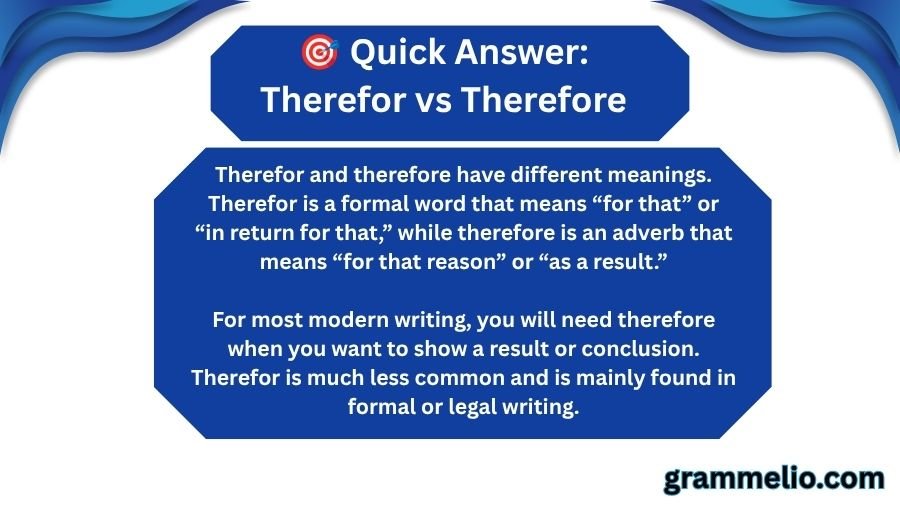
Therefor and therefore have different meanings. Therefor is a formal word that means “for that” or “in return for that,” while therefore is an adverb that means “for that reason” or “as a result.”
For most modern writing, you will need therefore when you want to show a result or conclusion. Therefor is much less common and is mainly found in formal or legal writing.
Therefor: Meaning and Correct Use
Therefor is a formal adverb that means “for that” or “in return for that.” It is not the same as therefore.
You may see it in legal documents, contracts, older formal writing, or very specific statements. It often refers back to something already mentioned.
For example:
The buyer received the property and paid the agreed amount therefor.
Here, therefor means “for that property.”
This word can sound unusual in everyday American English. Most people would rewrite the sentence in a clearer way:
The buyer received the property and paid the agreed amount for it.
That version is easier for most readers.
When Should You Use Therefor?
Use therefor only when you specifically mean “for that” or “in return for that.”
It is often connected to a noun or thing that has already been mentioned.
Consider these examples:
- The company received the equipment and paid the required fee therefor. ✅
- The company received the equipment and paid the required fee therefore. ❌
The first sentence uses therefor because the payment is for the equipment.
Another example:
- The tenant received the keys and paid the amount due therefor. ✅
- The tenant received the keys and paid the amount due therefore. ❌
Again, therefor means “for the keys.”
A Simple Meaning Test
When you see therefor, try replacing it with “for that.”
If the sentence still makes sense, therefor may be correct.
The customer received the service and paid the stated fee therefor.
Try:
The customer received the service and paid the stated fee for that.
The meaning works, although “for that” sounds less formal.
💡 Test Tip: If you mean “for that,” think therefor.
Therefore: Meaning and Correct Use
Therefore means “for that reason,” “as a result,” or “consequently.”
It connects one idea to a result or conclusion.
For example:
The road was closed; therefore, we took another route.
The road being closed is the reason. Taking another route is the result.
Another example is:
She studied every night; therefore, she felt prepared for the exam.
Her studying led to her feeling prepared.
How Therefore Works in a Sentence
Therefore usually connects two related ideas.
The basic pattern is:
Reason + therefore + result
For example:
The store was closed; therefore, we went home.
The first idea gives the reason. The second idea gives the result.
You can also place therefore later in a sentence:
The store was closed, and we therefore went home.
The meaning stays the same.
Here is a quick guide:
| Meaning | Word Type | Example Sentence |
|---|---|---|
| For that | Adverb | The buyer paid the amount therefor. |
| For that reason | Adverb | The store was closed; therefore, we left. |
| As a result | Adverb | It rained heavily; therefore, the game was canceled. |
| Consequently | Adverb | He missed the bus and therefore arrived late. |
📊 Therefor vs Therefore at a Glance
The easiest way to understand the difference is to compare what each word stands for.
| Form | Type | Meaning | Example | Correct/Incorrect |
|---|---|---|---|---|
| Therefor | Adverb | For that | The fee therefor was paid. | ✅ Correct |
| Therefore | Adverb | For that reason | It was late; therefore, we left. | ✅ Correct |
| Therefor | Adverb | For that reason | It rained; therefor, we stayed inside. | ❌ Incorrect |
| Therefore | Adverb | For that | The buyer paid the price therefore. | ❌ Usually incorrect |
| Therefor | Adverb | In return for that | Payment was made therefor. | ✅ Correct |
| Therefore | Adverb | As a result | The work was complete; therefore, we approved it. | ✅ Correct |
The key is not the spelling. The key is the meaning.
🤔 Is Therefor the Same as Therefore?
No. Therefor and therefore are different words with different jobs.
Therefor means “for that.” Therefore means “for that reason” or “as a result.”
Compare these two sentences:
The customer received the product and paid the price therefor. ✅
Here, the price was paid for the product.
Now compare:
The product was damaged; therefore, the customer requested a refund. ✅
Here, the damage was the reason for the refund request.
This difference is small in spelling but large in meaning.
🧠 Why Do People Confuse Therefor and Therefore?
People confuse these words because they look almost identical. The only visible difference is the final e in therefore.
When I was editing a formal document, I once caught a sentence where the writer had used therefor when the intended meaning was clearly “as a result.” The writer knew the correct spelling but had remembered the two words as interchangeable. That is the main trap: the words look alike, so the brain may treat them as the same.
Here are the main reasons this mistake happens:
- The words have nearly identical spelling.
- Both are formal-looking words.
- Therefore is much more common.
- Therefor appears in legal and formal documents.
- Fast typing can remove or add the final e.
- Autocorrect may not always catch the intended meaning.
- Writers may never have learned the difference.
Similar Grammar Confusions
The same type of problem appears with other word pairs.
| Confusing Pair | Correct Difference |
|---|---|
| It’s / Its | “It is” vs. possession |
| Your / You’re | Possession vs. “you are” |
| Their / There / They’re | Possession, place, and “they are” |
| Then / Than | Time/result vs. comparison |
| Affect / Effect | Usually verb vs. noun |
| They’re / Their | “They are” vs. possession |
These pairs show why spelling alone is not enough. You must understand the job each word performs.
⚠️ Common Mistakes With Therefor and Therefore
One common error is using therefor when you mean therefore.
For example:
The weather was terrible; therefor, the event was canceled. ❌
The correct sentence is:
The weather was terrible; therefore, the event was canceled. ✅
The writer means “for that reason.” Therefore is required.
Another mistake goes the other way:
The customer paid the fee therefore the service. ❌
If the meaning is “the fee for the service,” the intended word is therefor, although a clearer modern version would usually be:
The customer paid the fee for the service. ✅
Common Wrong Forms and Uses
| Wrong Form or Use | What’s Wrong | Correct Form |
|---|---|---|
| therefor = as a result | The meaning is wrong | therefore |
| therefore = for that | The meaning does not fit | therefor |
| there fore | Incorrectly split form | therefore |
| therefor, I left | Missing result meaning | therefore, I left |
| therefor means consequently | Incorrect definition | therefore means consequently |
| therefore means for that | Incorrect definition | therefor means for that |
📝 Case Study: A Workplace Email
Imagine you work for a company that has just received a shipment.
A manager writes:
The shipment arrived late; therefor, the customer received it on Monday. ❌
This sentence contains a spelling and meaning error.
The correct version is:
The shipment arrived late; therefore, the customer received it on Monday. ✅
Why?
Because the manager is showing a result. The late arrival caused the later delivery.
Now imagine a contract:
The purchaser shall receive the equipment and shall pay the agreed price therefor. ✅
Here, therefor is possible because it means “for that equipment.”
I once reviewed a contract that used several words like therefor, therein, and thereof. The language was technically formal, but the client wanted it easier to understand. We replaced several of these old-fashioned terms with plain English. The meaning stayed the same, but the document became much easier to read.
📚 Grammar Rules Explanation
The difference between these words comes down to their meaning and sentence function.
Therefore introduces or marks a result. It tells the reader that the second idea follows logically from the first.
The machine was broken; therefore, production stopped.
The broken machine is the reason. Production stopping is the result.
Therefor, by contrast, points back to something and means “for that.”
The company purchased the equipment and paid the required amount therefor.
The payment is for the equipment.
In modern US English, therefore is common in formal, academic, business, and general writing. Therefor is much less common and can sound old-fashioned or legal.
Most standard English reference sources make a clear distinction between these two forms. The safest approach is to focus on meaning rather than trying to remember the spelling alone.
Correct vs Incorrect at a Glance
| Sentence | Correct/Incorrect | Why |
|---|---|---|
| It was raining; therefore, we stayed home. | ✅ Correct | “Therefore” means “for that reason.” |
| It was raining; therefor, we stayed home. | ❌ Incorrect | The intended meaning is “for that reason.” |
| The buyer paid the price therefor. | ✅ Correct | “Therefor” means “for that.” |
| The buyer paid the price therefore. | ❌ Incorrect | “Therefore” does not normally mean “for that.” |
| He missed the deadline; therefore, the project was delayed. | ✅ Correct | The second idea is a result. |
🔎 How To Remember the Difference
A simple memory trick can make this distinction much easier.
Think:
therefor = for that
The word for is already hiding inside the meaning.
The payment therefor = the payment for that.
Now think:
therefore = for that reason
The extra e can remind you that therefore is the common word used to introduce a result or conclusion.
Another useful shortcut is:
- Therefor → for that
- Therefore → for that reason
If you are writing normal American English and want to say “as a result,” choose therefore.
Memory Table
| If You Mean… | Choose |
|---|---|
| for that | therefor |
| for that reason | therefore |
| as a result | therefore |
| consequently | therefore |
| in return for that | therefor |
💬 Usage in Different Contexts
The best choice depends on what you want to communicate.
In everyday conversation, therefore may sound somewhat formal, while therefor is very rare. In casual speech, people often use phrases such as “so” or “that’s why.”
In professional writing, therefore is useful when you need to show a clear result. Therefor may appear in contracts or other formal documents.
| Context | Which Term to Use | Example |
|---|---|---|
| Everyday conversation | Therefore, or “so” | It was late, so we left. |
| Professional writing | Therefore | Sales fell; therefore, costs were reduced. |
| Creative writing | Either, depending on meaning | He knew the risk; therefore, he waited. |
| Social media/texting | Usually therefore only if needed | It rained, therefore plans changed. |
Everyday Conversation
Most speakers would simply say:
It was raining, so we stayed home.
Instead of:
It was raining; therefore, we stayed home.
Both can be correct, but so sounds more natural in casual speech.
Therefor is rarely needed in ordinary conversation.
Professional Writing
Therefore works well in:
- Reports
- Business emails
- Academic writing
- Explanations
- Formal presentations
- Research summaries
For example:
The data showed a steady decline; therefore, the team changed its strategy.
Creative Writing
Writers can use therefore when they want a formal or thoughtful tone.
He knew the road was dangerous; therefore, he turned back.
However, writers should not add it simply to sound intelligent. A simple “so” may often feel more natural.
Social Media and Texting
Online writing usually favors shorter language.
Instead of:
The restaurant was closed; therefore, we went somewhere else.
A casual post might say:
The restaurant was closed, so we went somewhere else.
🧩 Common Phrases With Therefore
Therefore does not have many true idioms, but it appears in several useful sentence patterns.
| Phrase or Pattern | Meaning |
|---|---|
| Therefore, I decided… | Because of that, I decided |
| Therefore, we must… | As a result, we must |
| And therefore… | And for that reason |
| If so, therefore… | If that is true, as a result |
| Therefore, it follows that… | The conclusion is that |
One important point is that therefore should not be added to every sentence that contains a reason and result. Sometimes “so,” “thus,” or “as a result” is clearer.
✍️ Sentence Examples for Therefor
Because therefor is uncommon, it helps to see it in formal examples.
The buyer received the goods and paid the agreed amount therefor. ✅
Meaning:
The buyer paid the agreed amount for the goods.
Another example:
The company accepted the services and issued payment therefor. ✅
Meaning:
The company issued payment for the services.
A clearer modern rewrite would be:
The company accepted the services and paid for them. ✅
This is often preferable when writing for a general audience.
📖 Sentence Examples for Therefore
Now compare common uses of therefore:
The store closed early; therefore, we went home. ✅
She practiced every day; therefore, her performance improved. ✅
The evidence was incomplete; therefore, the report needed more work. ✅
The roads were icy; therefore, the school closed. ✅
In each case, therefore means something like “for that reason” or “as a result.”
More Examples
| Reason | Therefore | Result |
|---|---|---|
| The alarm rang. | Therefore, | everyone left. |
| The price increased. | Therefore, | fewer people bought it. |
| He forgot the appointment. | Therefore, | he missed the meeting. |
| The file was damaged. | Therefore, | we restored a backup. |
| The test was difficult. | Therefore, | many students needed more time. |
🔄 Therefor vs Therefore in Formal Writing
Both words can appear in formal writing, but they serve very different purposes.
Therefore is useful when you are drawing a conclusion.
The figures were below target; therefore, the team reviewed its plan.
Therefor can appear when something is being given or paid for something already mentioned.
The purchaser shall pay the agreed amount therefor.
The second example has a legal style. In plain English, you could write:
The purchaser shall pay the agreed amount for it.
This is why modern writing often avoids therefor unless the formal context calls for it.
🎯 When Should You Use Therefore?
Use therefore when one fact leads to another.
Ask yourself:
“Am I saying ‘for that reason’?”
If yes, use therefore.
Examples:
The deadline passed; therefore, we could not submit the form. ✅
The team won the first game; therefore, confidence was high. ✅
The road was blocked; therefore, drivers had to turn around. ✅
This rule works in most everyday and professional situations.
🤔 When Should You Use Therefor?
Use therefor when you genuinely mean “for that.”
Ask:
“Am I referring to something that payment, action, or another matter is for?”
If yes, therefor may fit.
Example:
The tenant received the apartment and paid the required deposit therefor. ✅
Here, the deposit is connected to the apartment.
Still, remember that modern plain English often gives you a better option:
The tenant received the apartment and paid the required deposit for it. ✅
That version is usually easier for readers.
🧪 Practice: Choose the Correct Word
Try these examples before looking at the answers.
Example 1
The flight was delayed; ______, we arrived late.
The correct answer is therefore because the delay caused the late arrival.
The flight was delayed; therefore, we arrived late. ✅
Example 2
The customer received the equipment and paid the agreed fee ______.
The intended meaning is “for the equipment.”
The customer received the equipment and paid the agreed fee therefor. ✅
Example 3
The store had no available seats; ______, we left.
The correct word is therefore.
The store had no available seats; therefore, we left. ✅
📋 Quick Recap Checklist
Use this checklist whenever you are unsure.
| Question | If Yes → Use |
|---|---|
| Do I mean “for that”? | Therefor |
| Do I mean “for that reason”? | Therefore |
| Do I mean “as a result”? | Therefore |
| Am I writing a legal or highly formal phrase meaning “for it”? | Therefor may fit |
| Am I explaining a conclusion? | Therefore |
Practice Examples
- The weather was dangerous; ______, the game was canceled.
- The purchaser paid the amount ______.
- She missed the bus; ______, she arrived late.
Answers:
- Therefore ✅
- Therefor ✅
- Therefore ✅
🚫 Why “Therefor” Is Often Better Rewritten
Although therefor is a legitimate English word, it can make writing feel unnecessarily formal.
Compare:
The buyer paid the amount therefor.
with:
The buyer paid the amount for it.
The second sentence is easier for most readers.
Plain English is especially useful for:
- Customer emails
- Website content
- Instructions
- Public notices
- General business writing
- Social media
- Educational content
If you do not need the formal tone, for it is often a better choice.
🏢 Therefor vs Therefore in Business Communication
Business writing should make meaning clear as quickly as possible.
Suppose a report says:
Revenue declined in the second quarter; therefore, management reduced spending. ✅
This is clear and professional.
Now consider:
The company received the equipment and paid the agreed amount therefor. ✅
This may be grammatically possible, but many modern readers will find it stiff.
A plain-English version is:
The company received the equipment and paid the agreed amount for it. ✅
The goal of professional writing is not to use the most formal word available. The goal is to communicate clearly.
📝 Editing Tips for Writers
When editing your own work, look for both words and ask what they mean.
Replace Therefor When It Adds Unnecessary Formality
If therefor can easily become for it, consider making the change.
Payment was made therefor.
can become:
Payment was made for it.
Keep Therefore When It Shows a Result
Do not replace therefore with therefor simply because the two words look similar.
The evidence was weak; therefore, the claim was rejected. ✅
Here, therefore is doing an important job. It connects the reason to the result.
🌎 American English Usage
In US English, therefore is familiar and widely understood. It appears in school writing, professional documents, reports, essays, and formal speech.
Therefor is much less common. When it does appear, it is often part of formal legal or contract language.
For a general American audience, therefore is usually the word you are looking for when you mean:
- As a result
- For that reason
- Consequently
If you mean for that, therefor can be correct, but a plain phrase such as for it may be easier to understand.
💡 A Fast Three-Second Test
Here is the fastest method I recommend.
Step 1: Look at the sentence.
Ask what relationship the word creates.
Step 2: Substitute “for that reason.”
If it works, use therefore.
It was snowing; for that reason, school closed.
Therefore is correct:
It was snowing; therefore, school closed. ✅
Step 3: Substitute “for that.”
If that works instead, therefor may be correct.
The customer paid the fee for that.
Therefore would not express this meaning.
This simple substitution test prevents most mistakes.
❓ Does Therefore Mean “As a Result”?
Yes. Therefore can mean “as a result” or “for that reason.”
For example:
The road was flooded; therefore, traffic stopped.
The flooding caused the traffic problem.
You can also write:
The road was flooded; as a result, traffic stopped.
The meaning is nearly the same.
❓ Does Therefor Mean “For That”?
Yes. Therefor means “for that” or “in return for that.”
For example:
The buyer received the goods and paid the amount therefor.
A plain-English version is:
The buyer received the goods and paid the amount for them.
Because therefor is uncommon, readers may prefer the second version.
❓ Which Is More Common: Therefor or Therefore?
Therefore is much more common in modern general writing.
You will often see it in essays, reports, professional documents, and explanations.
Therefor is rare and is mainly used in formal language where it means “for that.”
❓ Can I Use Therefor in Everyday Writing?
You can, but you usually should not unless the exact meaning is needed.
In everyday writing, for it, for that, or another plain phrase will often sound more natural.
For example:
He paid the fee for it.
is clearer for most readers than:
He paid the fee therefor.
❓ Is Therefore Always Used at the Start of a Sentence?
No. Therefore can appear in different positions.
For example:
Therefore, we canceled the meeting. ✅
You can also write:
We therefore canceled the meeting. ✅
Or:
We canceled the meeting; therefore, everyone went home. ✅
Its position can change, but its basic meaning stays the same.
❓ Should Therefor Be Written as Two Words?
No. Therefor is written as one word.
The correct spelling is:
therefor
Not:
there for
However, there for can appear as two separate words when “there” and “for” have their normal independent meanings.
For example:
I was there for the meeting. ✅
That is completely different from the formal word therefor.
❓ What Is the Difference Between Therefore and Therefor?
Therefore means “for that reason” or “as a result.”
Therefor means “for that.”
Compare:
He was sick; therefore, he stayed home. ✅
and:
He paid the fee therefor. ✅
The first shows a result. The second refers to something that a payment or action is for.
❓ Is Therefor a Common Word in Modern English?
No. Therefor is uncommon in everyday modern English.
It still has a valid use, especially in formal or legal language, but most general readers are much more familiar with therefore.
❓ Can I Replace Therefore With So?
Often, yes.
For example:
It was late; therefore, we left.
can become:
It was late, so we left.
The second version sounds more natural in casual conversation.
However, therefore can be useful when you want a more formal or logical tone.
❓ Which Word Should I Use in a School Essay?
If you mean “for that reason” or “as a result,” use therefore.
For example:
The experiment produced unexpected results; therefore, the researchers repeated it.
Use therefor only when you genuinely mean “for that.” In most school essays, that meaning is unlikely to be needed.
❓ How Can I Remember Therefor vs Therefore?
Remember this simple pair:
Therefor = for that.
Therefore = for that reason.
If you are showing a result, choose therefore.
If you mean something was done or paid for that thing, therefor may be correct.
🏁 Conclusion
Therefor vs therefore becomes easy once you focus on meaning instead of spelling. Therefor means “for that” and is uncommon in everyday English. It often appears in formal or legal language. Therefore means “for that reason” or “as a result,” and it is the word you normally need when connecting a reason to a conclusion. ✨
When I edit writing, I use one simple test: replace therefore with “for that reason” and therefor with “for that.” If the replacement keeps the intended meaning, you have likely chosen the right word. If the sentence sounds stiff with therefor, consider using plain English such as “for it” instead.
The most useful rule to remember is short: therefor points to what something is for; therefore points to why something happened. Keep that distinction in mind, and this confusing pair will become much easier to handle. ✅



[…] the end, you should be able to choose the right word with confidence. ✍️ Therefor vs Therefore | Staid vs Stayed | Sensual vs […]
[…] in school, work, medical writing, creative writing, and everyday communication. Turbid vs Turgid | Therefor vs Therefore | Staid vs […]
[…] Once you learn the basic rule, choosing the right word becomes much easier. Venous vs Venomous | Turbid vs Turgid | Therefor vs Therefore […]