Have you ever typed a sentence, looked at it twice, and wondered whether all ready vs already is the right choice? I have seen this mix-up countless times in emails, school assignments, social posts, and everyday messages. The two forms look almost identical, but they do very different jobs. One describes people or things that are completely prepared. The other tells us that something happened before now or sooner than expected. That tiny space can change the meaning of an entire sentence. 😅
If you have ever paused before writing “We are ___,” you are not alone. In this guide, I will break down the difference in plain US English, show you real examples, explain the grammar behind each form, and give you simple tricks that make the choice much easier.
By the end, you should be able to choose the right form without stopping to think twice. ✍️ Aisle vs Isle | Adapt vs Adopt | Accept vs Except
🎯 Quick Answer: All Ready vs Already
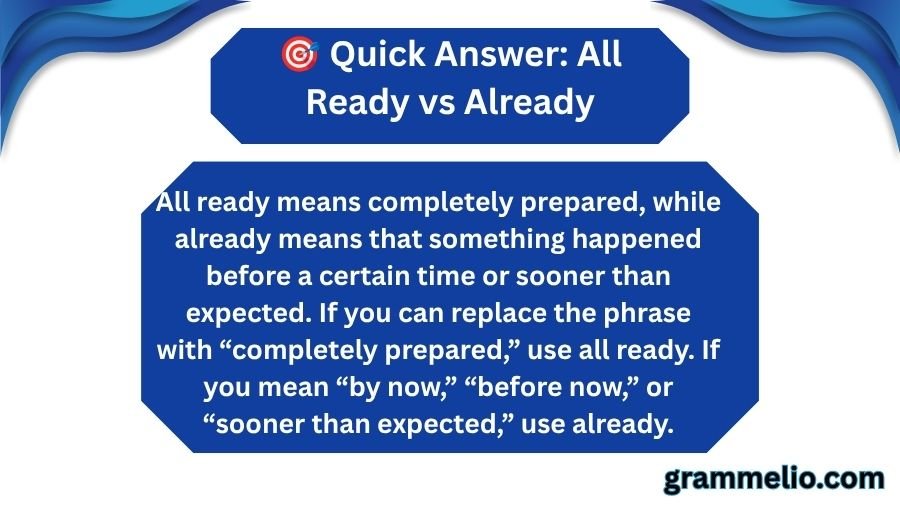
All ready means completely prepared, while already means that something happened before a certain time or sooner than expected. If you can replace the phrase with “completely prepared,” use all ready. If you mean “by now,” “before now,” or “sooner than expected,” use already.
- All ready: We are all ready to leave.
- Already: We have already left.
The space matters because these are different grammatical forms.
Is All Ready the Same as Already?
No. All ready and already are not interchangeable. All ready is a phrase made from the word “all” and the adjective “ready.” Already is one adverb.
Think of the difference this way:
All ready = prepared
Already = by now or before now
Here is a simple comparison:
| Form | Type | Meaning | Example | Correct/Incorrect |
|---|---|---|---|---|
| all ready | Phrase | Completely prepared | We are all ready. | ✅ Correct |
| already | Adverb | Before now or sooner than expected | We are already here. | ✅ Correct |
| allready | Misspelling | Not standard English | We are allready here. | ❌ Incorrect |
| all ready | Phrase | Everyone or everything is prepared | The players are all ready. | ✅ Correct |
| already | Adverb | Something has happened by now | The players have already arrived. | ✅ Correct |
The easiest clue is meaning. If the sentence talks about preparation, think of two words. If it talks about time, think of one word.
💡 All Ready: Meaning and Correct Use
All ready means completely prepared. The word “all” adds the idea that everyone or everything involved is ready.
For example:
We are all ready to go.
Here, “ready” describes the people. “All” tells us that everyone in the group is prepared.
You can often replace all ready with completely prepared without changing the basic meaning.
- We are all ready to leave.
- We are completely prepared to leave.
Both sentences tell us that the people are prepared.
When All Ready Describes People
Use all ready when a group of people has finished preparing.
✅ The students are all ready for the test.
❌ The students are already for the test.
The second sentence is wrong because “already” cannot replace the phrase “all ready” when you mean prepared.
When All Ready Describes Things
The phrase can also describe objects or tasks that are prepared.
✅ The decorations are all ready for the party.
❌ The decorations are already for the party.
The first sentence means the decorations have been prepared and are ready to use.
When All Ready Means Everyone Is Prepared
Sometimes “all” means every person in a group.
✅ Are you all ready to start?
This is a very common question. A teacher might ask it before a lesson. A coach might ask it before a game. A parent might ask it before leaving home.
The sentence means:
Are all of you ready to start?
That meaning is different from:
✅ Are you already starting?
The second sentence asks whether the action has begun sooner than expected.
Meaning Summary
| Meaning | Word Type | Example Sentence |
|---|---|---|
| Completely prepared | Phrase | We are all ready for dinner. |
| Everyone is prepared | Phrase | Are you all ready? |
| Prepared for an event | Phrase | The room is all ready for guests. |
| Before now | Adverb | She has already eaten. |
| Sooner than expected | Adverb | They already finished the work. |
⏰ Already: Meaning and Correct Use
Already is an adverb. It usually tells us that something happened before now or earlier than expected.
For example:
I have already finished my homework.
This means the homework was finished before the current moment.
Another example is:
She is already at the office.
The speaker is telling us that she is at the office by now.
Already often appears with verbs connected to completed actions, but it can also appear with forms of “be.”
Already Means “Before Now”
This is one of the most common uses.
✅ I have already seen that movie.
The person saw the movie before this conversation.
Compare that with:
✅ I am all ready to see the movie.
The first sentence is about past experience. The second is about preparation.
Already Can Show Surprise
Already can also suggest that something happened earlier than expected.
✅ It is only 8 a.m., and he has already finished the report.
The speaker may be surprised because the report was completed very early.
Another example:
✅ You are already home?
This can show surprise that someone returned earlier than expected.
Already Can Mean “By This Time”
Consider this sentence:
✅ By noon, we had already completed the first part.
The action happened before noon.
The word does not mean “prepared.” It gives the sentence a time-related meaning.
🎯 Key Differences Between All Ready and Already
The main difference is simple: all ready describes a state of preparation, while already describes timing.
| Feature | All Ready | Already |
|---|---|---|
| Number of words | Two | One |
| Main job | Describes preparation | Describes time |
| Word class | Phrase | Adverb |
| Basic meaning | Completely prepared | Before now or sooner than expected |
| Can mean “prepared”? | Yes | No |
| Can mean “by now”? | No | Yes |
| Example | We are all ready. | We have already eaten. |
A useful test is to ask yourself:
Am I talking about being prepared?
If yes, choose all ready.
Am I talking about when something happened?
If yes, choose already.
Why Do People Confuse All Ready and Already?
People confuse these forms because they sound very similar when spoken. The words are also closely related in appearance. In fast writing, it is easy to leave out the space.
I once reviewed a short email from a student who wrote, “I am already for the presentation.” The student clearly meant that the presentation was prepared and that the student was ready to give it. Once we changed “already” to “all ready,” the meaning became clear immediately.
There are three common reasons for this confusion:
- Fast typing — People often type words the way they hear them.
- Autocorrect — Spell-check tools may not understand the intended meaning.
- Lack of grammar knowledge — Writers may know both forms but not know when to use each one.
A Simple Meaning Test
Try replacing the words with another phrase.
If “completely prepared” works, use all ready.
If “by now” or “before now” works, use already.
| Original Sentence | Replacement Test | Best Choice |
|---|---|---|
| We are all ready to leave. | We are completely prepared to leave. | All ready |
| We have already left. | We have by now left. | Already |
| Is everyone all ready? | Is everyone completely prepared? | All ready |
| She has already called. | She has called before now. | Already |
📝 Case Study: A Real-World Example
Imagine a manager sending a message to a team before an important meeting. Have you ever wondered whether to write all ready vs already in a sentence? These two expressions sound almost identical, but they have completely different meanings…
The manager writes:
❌ Are you already for the meeting?
The team may understand the intended meaning, but the sentence is grammatically wrong.
The correct sentence is:
✅ Are you all ready for the meeting?
Now imagine the meeting has started earlier than expected. Someone asks:
Why are you here so early?
The answer could be:
✅ We are already in the meeting room.
These two sentences use similar-looking words, but they answer different questions.
- All ready answers: “Are you prepared?”
- Already answers: “Has it happened by now?”
That distinction is useful in workplaces, schools, travel plans, and everyday conversations.
📚 Grammar Rules Explanation
The grammar is easier once you look at the role of each word.
All ready is a phrase. “All” is a determiner or pronoun depending on how it is used, while “ready” is an adjective. Together, they express complete preparation.
Already is an adverb. It modifies a verb, verb phrase, adjective, or sometimes the whole statement by adding a time-related meaning.
The key rule is therefore based on grammar and meaning:
- Use all ready when “all” modifies or refers to people or things that are ready.
- Use already when you need an adverb that means something happened before now or earlier than expected.
Standard English reference works and dictionaries agree on this basic distinction.
Correct vs Incorrect at a Glance
| Sentence | Correct/Incorrect | Why |
|---|---|---|
| We are all ready to leave. | ✅ Correct | The group is completely prepared. |
| We are already to leave. | ❌ Incorrect | “Already” cannot mean prepared here. |
| She has already finished. | ✅ Correct | The action happened before now. |
| She is all ready finished. | ❌ Incorrect | “All ready” does not mean “already.” |
| Are you all ready for class? | ✅ Correct | The question asks about preparation. |
🧠 How To Remember the Difference
The best memory trick is to connect each form with one short idea.
All Ready = Preparation
Imagine a group standing at the door with coats on and bags packed.
They are all ready.
You can say:
We are all ready to go.
Already = Time
Now imagine that everyone has left.
You can say:
We have already gone.
A helpful memory sentence is:
All ready means prepared. Already means by now.
This short rule can solve most everyday cases.
The “Completely Prepared” Trick
Put the phrase into your sentence:
completely prepared
If the sentence still makes sense, choose all ready.
Example:
The children are all ready for school.
Try:
The children are completely prepared for school.
The meaning works.
Now try:
The children have already eaten breakfast.
Replace it:
The children have completely prepared eaten breakfast.
That does not work. So already is the right choice.
⚠️ Common Mistakes With All Ready and Already
These errors happen because the two forms are close in sound and spelling.
| Confusion | Example | Correct Idea |
|---|---|---|
| all ready vs already | We are already to go. | We are all ready to go. |
| its vs it’s | The dog wagged it’s tail. | The dog wagged its tail. |
| your vs you’re | Your going home. | You’re going home. |
| then vs than | She is taller then me. | She is taller than me. |
| affect vs effect | The news will effect him. | The news will affect him. |
| there vs their | Their going outside. | They’re going outside. |
These pairs are often confused because English contains many words that sound alike or nearly alike.
Specific Wrong Forms to Avoid
| Wrong Form | What’s Wrong | Correct Form |
|---|---|---|
| allready | The space is missing. | all ready |
| all-ready | Usually unnecessary hyphenation in this phrase | all ready |
| already prepared to | Not automatically wrong, but can be confused with “all ready” | already prepared to / all ready to, depending on meaning |
| already to go | “Already” cannot mean prepared | all ready to go |
| all ready happened | The phrase cannot mean “before now” | already happened |
| allready finished | Misspelled form | already finished |
I once caught myself typing “allready” in a quick message. I knew the rule, but my fingers were moving faster than my brain. That small mistake reminded me that even familiar words deserve a quick check when clarity matters.
Why Fast Typing Causes These Errors
Typing quickly can make two words look like one.
The brain often focuses on the message rather than individual spaces. This happens especially when people are texting or writing short work messages.
Autocorrect can add another problem. A spelling tool may recognize “already” as a valid word even when you intended “all ready.” Because “already” is correctly spelled, the software may not flag it.
That is why meaning is more useful than spell-check alone.
🌎 Usage in Different Contexts
The choice stays the same across different types of writing. What changes is the situation.
| Context | Which Term to Use | Example |
|---|---|---|
| Everyday conversation | All ready for preparation; already for time | Are you all ready to leave? |
| Professional writing | Choose based on meaning | The team is all ready for the launch. |
| Creative writing | Either, depending on meaning | She was already outside. |
| Social media/texting | Either, depending on meaning | We are all ready! |
In casual writing, people sometimes make mistakes without causing serious confusion. Still, using the correct form makes your writing cleaner.
💬 Everyday Conversation Examples
In conversation, all ready often appears before an action.
- Are you all ready to eat?
- We are all ready to leave.
- The kids are all ready for bed.
- Is everyone all ready?
Already often appears when someone reports that something has happened.
- I already ate.
- She already knows.
- We already called them.
- They are already here.
The difference becomes very natural once you listen for the meaning.
💼 Professional Writing Examples
Professional communication needs extra care because small errors can make a message look rushed.
Compare:
❌ The documents are already for review.
If you mean that the documents are prepared, write:
✅ The documents are all ready for review.
But if the documents have been reviewed before now, write:
✅ The documents have already been reviewed.
The grammar changes because the intended meaning changes.
✍️ Creative Writing Examples
Creative writers can use both forms to show different details.
All ready can show preparation:
The travelers were all ready for the long journey.
Already can create a sense of timing:
By sunrise, the travelers had already reached the valley.
One focuses on a state. The other focuses on when something happened.
📱 Social Media and Texting Examples
Text messages are often short, but correct word choice still helps.
✅ I’m all ready!
This means:
I am completely prepared.
✅ I’m already here!
This means:
I arrived before now.
A single space changes the grammar and meaning.
🔎 Common Phrases With the Correct Forms
There are several natural phrases that make the difference easy to see.
| Phrase | Meaning |
|---|---|
| all ready to go | Completely prepared to leave or begin |
| all ready for school | Completely prepared for school |
| all ready for the meeting | Completely prepared for the meeting |
| already done | Finished before now |
| already know | Knew before the current moment |
| already finished | Finished before now |
Notice that all ready is usually connected with preparation, while already is often connected with completed actions or current states.
🔄 Synonyms and Alternatives
Sometimes you can replace one of these forms with another phrase. This can be useful when you are unsure which spelling fits.
| Alternative | Works When | Does Not Work When |
|---|---|---|
| completely prepared | You mean all ready | You mean before now |
| fully prepared | You mean preparation | You mean earlier timing |
| by now | You mean already | You mean physical preparation |
| before now | You mean an earlier action | You mean someone is prepared |
| previously | You mean an earlier event | You mean someone is ready |
For example:
We are all ready to begin.
can become:
We are completely prepared to begin.
But:
We have already begun.
can become:
We have begun by now.
The alternatives help reveal the meaning.
🎯 All Ready vs Already in Sentences
Seeing the forms side by side is one of the fastest ways to learn.
| With All Ready | With Already |
|---|---|
| We are all ready to leave. | We have already left. |
| Are you all ready for dinner? | Have you already eaten? |
| The team is all ready. | The team has already arrived. |
| They are all ready for the game. | They have already started the game. |
| I am all ready to go. | I am already there. |
A useful pattern appears in these examples:
all ready + to/for
often points to preparation.
already + verb/action
often points to something that has happened before now.
Why Does the Space Matter?
The space matters because all ready contains two separate words that work together as a phrase. Already is a single word with its own grammatical function.
Compare:
We are all ready.
This describes a condition.
We are already here.
This describes timing.
The words may look similar, but the grammar is not the same.
🧪 A Quick Test You Can Use
When you are unsure, follow these three steps:
- Ask whether you mean prepared.
- If yes, try completely prepared.
- If you mean by now, use already.
Test Tip 💡
If you can say:
“We are completely prepared.”
then all ready is probably correct.
If you can say:
“We have done it by now.”
then already is probably correct.
This test is quick enough to use while writing an email or text.
📊 Practice: Choose the Correct Form
| Sentence | Answer |
|---|---|
| Are you ___ for the trip? | all ready |
| Have you ___ packed your bag? | already |
| We are ___ to begin. | all ready |
| She has ___ called the client. | already |
| The children are ___ for bed. | all ready |
| They have ___ gone home. | already |
Try answering each one before looking at the answers.
Practice Answers
- Are you all ready for the trip?
- Have you already packed your bag?
- We are all ready to begin.
- She has already called the client.
- The children are all ready for bed.
- They have already gone home.
The key is meaning, not appearance.
🚫 When Already Cannot Replace All Ready
A common mistake is assuming that because “already” contains the letters in “all ready,” it can replace the phrase.
It cannot.
❌ I am already to leave.
If the intended meaning is “I am prepared to leave,” this is incorrect.
✅ I am all ready to leave.
Likewise, “all ready” cannot replace “already” when you mean before now.
❌ I have all ready finished my homework.
If the intended meaning is “I finished my homework before now,” the correct sentence is:
✅ I have already finished my homework.
This is one of the clearest examples of why the space matters.
🧩 A Simple Memory Rule for Students
Students often benefit from a visual rule:
ALL READY → ALL = everyone/everything is prepared
ALREADY → TIME = something happened before now
Imagine a class before a field trip.
The students are all ready.
Everyone has a backpack and is waiting.
Now imagine the bus arrived earlier than expected.
The bus has already arrived.
The first sentence is about preparation. The second is about time.
📖 Why It Matters in School and Work
Correct word choice shows that you understand how English works. It also makes your writing easier to read.
| Situation | Why Getting It Right Matters |
|---|---|
| Resume | Shows careful writing |
| Client email | Prevents unclear messages |
| Published content | Improves grammar and trust |
| Social post | Makes your message easier to understand |
A simple rule can have a real effect:
Clear words make clear messages.
That is especially true when two forms look almost identical.
❓ Is All Ready or Already Correct?
Both are correct, but they are used in different situations. Use all ready for complete preparation and already for something that happened before now or earlier than expected.
Example:
- We are all ready. = We are prepared.
- We are already here. = We arrived before now.
❓ Can I Say “I Am Already Ready”?
Yes. I am already ready is grammatically possible, but it has a different structure from I am all ready.
“I am already ready” means you became ready before now or sooner than expected.
“I am all ready” means you are completely prepared.
For example:
I am already ready for the meeting.
This can suggest that you became ready earlier than someone expected.
I am all ready for the meeting.
This simply stresses complete preparation.
❓ Is “Allready” a Word?
No. Allready is not the standard spelling of either form. When you mean completely prepared, write all ready with a space. When you mean before now, write already as one word.
❓ How Do I Remember All Ready vs Already?
Connect each form with a simple clue:
All ready = all prepared.
Already = by now.
If you remember those two meanings, you can usually choose the correct form without thinking about spelling.
❓ Why Is “Already” One Word?
Already functions as a single adverb in standard English. It carries a time-related meaning such as “before now” or “by this time.” Because it is a single word, it should not be written as “allready.”
❓ Can “All Ready” Describe Things?
Yes. It can describe people, objects, rooms, plans, documents, or other things that have been completely prepared.
For example:
The room is all ready for the guests.
The room has been prepared.
❓ Can “Already” Be Used With the Present Perfect?
Yes. Already commonly appears with the present perfect.
For example:
She has already finished the project.
This tells us that the project was finished before the current point in time.
❓ What Is the Difference Between “All Ready to Go” and “Already Gone”?
They describe opposite stages of an event.
All ready to go means prepared but not necessarily gone.
Already gone means the person or thing has left.
Compare:
The guests are all ready to go.
They are prepared.
The guests are already gone.
They have left.
❓ Is “We Are All Ready” Correct?
Yes. We are all ready is correct when you mean that everyone in the group is prepared.
For example:
We are all ready to start the presentation.
❓ Is “We Are Already Ready” Correct?
Yes, it can be correct. It means that the people became ready before now or earlier than expected.
For example:
We are already ready, so we can leave whenever you are.
This is different from simply saying:
We are all ready.
The first stresses timing. The second stresses complete preparation.
❓ What Is the Easiest Way to Check My Sentence?
Ask yourself whether the sentence is about preparation or time.
- Preparation → all ready
- Time or something completed before now → already
Then read the sentence aloud. If the meaning still feels unclear, replace the word with “completely prepared” or “by now.”
✅ Quick Recap Checklist
Use this checklist whenever you hesitate.
| Question | If Yes → Use |
|---|---|
| Do I mean completely prepared? | all ready |
| Do I mean everyone is prepared? | all ready |
| Do I mean before now? | already |
| Do I mean by this time? | already |
| Do I mean sooner than expected? | already |
| Am I describing preparation? | all ready |
Practice Examples
1. We are ___ for the trip.
Answer: all ready
2. We have ___ booked the hotel.
Answer: already
3. Are you ___ to start?
Answer: all ready
These examples show the rule in action.
🔥 Final Comparison: All Ready vs Already
| If You Mean… | Use | Example |
|---|---|---|
| Completely prepared | all ready | We are all ready. |
| Everyone is prepared | all ready | Are you all ready? |
| Prepared for an event | all ready | The room is all ready. |
| Before now | already | I have already eaten. |
| By this time | already | She is already here. |
| Earlier than expected | already | They already finished. |
The most important thing is not memorizing a complicated grammar rule. It is learning the meaning behind each form.
🎯 How To Use All Ready and Already With Confidence
When I teach this difference, I tell learners to ignore the spelling for a moment and focus on the message.
Ask:
“Am I talking about being prepared?”
If the answer is yes, use all ready.
Then ask:
“Am I talking about something that happened before now?”
If the answer is yes, use already.
This approach works because it connects grammar with meaning. You are not just memorizing two spellings. You are choosing the word that matches the idea.
You can also remember this short sentence:
All ready means prepared. Already means by now.
Once that sentence becomes familiar, the difference becomes much easier.
Conclusion
All ready vs already becomes much easier when you focus on meaning instead of spelling. Use all ready when people or things are completely prepared. Use already when an action or situation happened before now, by a certain point, or sooner than expected. ✨
I recommend using the “completely prepared” test whenever you are unsure. If that phrase fits, choose all ready. If “by now” or “before now” fits, choose already.
For example, We are all ready to leave means everyone is prepared. We have already left means the action happened before now. The space is small, but the meaning is different.
Once you connect each form with its job, this common grammar problem stops being confusing. Keep the rule simple, check the meaning, and read your sentence once before sending it. 📝
Remember: all ready means prepared, while already means by now. Get that distinction right, and you will almost never mix them up again.


[…] examples, memory tricks, and real-world situations so you can choose the right word every time. All Ready vs Already | Aisle vs Isle | Adapt vs […]
[…] mistakes to avoid, and easy memory tricks that make the difference stick. ✨ Allude vs Elude | All Ready vs Already | Aisle vs […]