I have seen smart writers pause over credible vs creditable vs credulous because the three words look and sound so much alike. They all connect to the idea of belief, trust, or praise, but they do very different jobs in a sentence.
If you are a student, teacher, job seeker, blogger, editor, or professional writer, choosing the wrong word can change your meaning in an instant. I often explain these words by focusing on one simple question: Are you describing something that can be trusted, something worthy of praise, or someone who believes too easily?
Once you learn that difference, these words become much easier to handle. In this guide, I will break down their meanings, grammar, common mistakes, examples, and memory tricks so you can use each one correctly. ✍️ Understanding credible vs credulous can make everyday writing much clearer. Core vs Corps | Continual vs Continuous | Conscience vs Conscious
🎯 Quick Answer
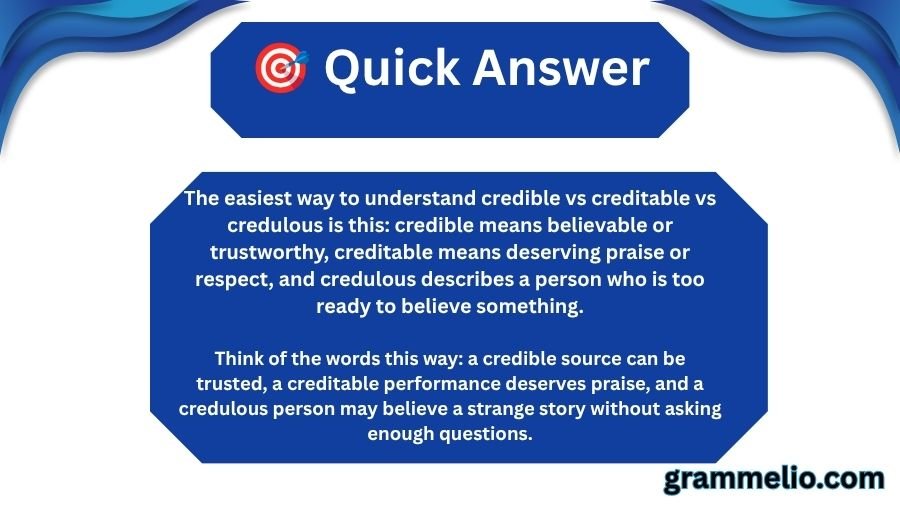
The easiest way to understand credible vs creditable vs credulous is this: credible means believable or trustworthy, creditable means deserving praise or respect, and credulous describes a person who is too ready to believe something.
Think of the words this way: a credible source can be trusted, a creditable performance deserves praise, and a credulous person may believe a strange story without asking enough questions.
| Word | Basic Meaning | Usually Describes | Simple Example |
|---|---|---|---|
| Credible | Believable or trustworthy | Claims, sources, people, evidence | The witness gave a credible account. |
| Creditable | Worthy of praise or respect | Actions, results, performances | She made a creditable effort. |
| Credulous | Too willing to believe | People or minds | The credulous buyer believed the fake story. |
Credible vs Creditable vs Credulous: The Basic Difference
The main difference is the quality being described. Credible focuses on whether something deserves belief. Creditable focuses on whether something deserves praise. Credulous focuses on a person’s tendency to believe too easily.
Here is the fastest way I teach the distinction:
- Credible = believable
- Creditable = praiseworthy
- Credulous = too trusting
| Form | Type | Meaning | Example | Correct/Incorrect |
|---|---|---|---|---|
| Credible | Adjective | Believable or trustworthy | The report seems credible. | ✅ Correct |
| Creditable | Adjective | Deserving praise | His work was creditable. | ✅ Correct |
| Credulous | Adjective | Too ready to believe | A credulous reader accepted the rumor. | ✅ Correct |
| Credulous | Adjective | Believable evidence | The evidence was credulous. | ❌ Incorrect |
| Creditable | Adjective | Easily fooled | She is creditable. | ❌ Incorrect |
The key is to notice what the adjective describes.
If you are talking about a report, explanation, source, or claim that seems believable, choose credible.
If you are praising an effort, result, performance, or action, choose creditable.
If you are describing someone who accepts things too quickly, choose credulous.
Credible: Meaning and Correct Use
Credible means believable, convincing, or worthy of trust. It can describe a person, source, explanation, claim, report, witness, story, or piece of evidence.
For example:
The journalist used credible sources for the article.
The word credible tells us that the sources are trustworthy enough to believe.
Another example:
Her explanation sounded credible.
Here, the explanation seems believable.
Creditable: Meaning and Correct Use
Creditable means deserving credit, praise, or respect. It is often used for an effort, performance, achievement, result, or action that deserves recognition.
For example:
The team gave a creditable performance despite several injuries.
The performance may not have been perfect, but it was good enough to deserve praise.
Another example:
He made a creditable attempt to solve the problem.
The focus is not on whether the attempt is believable. The focus is on whether the attempt deserves credit.
Credulous: Meaning and Correct Use
Credulous describes someone who is too willing to believe something without enough proof.
For example:
The credulous customer believed the unbelievable sales claim.
The customer is not being praised. Instead, the sentence suggests that the person was too easily convinced.
| Word | What It Emphasizes | Typical Noun | Example |
|---|---|---|---|
| Credible | Trust and belief | Source | a credible source |
| Creditable | Praise and merit | Performance | a creditable performance |
| Credulous | Easy belief | Person | a credulous person |
💡 How Can You Remember the Difference?
You can remember the three words by connecting each one to a different idea. The credible vs credulous distinction is easier when you connect each word to trust and belief.
Credible → believe it.
A credible claim is one you have good reason to believe.
Creditable → credit it.
A creditable action is one that deserves credit.
Credulous → believes too easily.
A credulous person may accept a claim without checking it.
| Memory Word | Target Word | Meaning |
|---|---|---|
| Believe | Credible | Worth believing |
| Credit | Creditable | Worth praising |
| Easily believe | Credulous | Too ready to believe |
I use this three-word test when editing. If the sentence is about trust, I look toward credible. If it is about praise, I consider creditable. If it is about being too trusting, credulous is usually the right choice.
Is Credible the Same as Creditable?
No. Credible means believable or trustworthy, while creditable means deserving praise or credit. The words may share a similar beginning, but they express different ideas.
Consider these sentences:
The scientist presented credible evidence. ✅
The evidence can reasonably be believed.
The scientist presented creditable evidence. ❌
This wording does not naturally express the intended idea of trustworthy evidence.
Now look at a different example:
The scientist gave a creditable presentation. ✅
The presentation deserves praise.
The scientist gave a credible presentation. ⚠️
This can be grammatically possible, but it changes the focus. It suggests that the presentation or its claims seemed believable rather than emphasizing its quality or merit.
| Sentence | Intended Meaning | Best Choice |
|---|---|---|
| The witness gave a ___ account. | The account seemed believable. | Credible |
| She made a ___ effort. | The effort deserved praise. | Creditable |
| He was too ___ to question the claim. | He believed too easily. | Credulous |
| The website is not a ___ source. | The website cannot be trusted. | Credible |
Why Do People Confuse Credible, Creditable, and Credulous?
People confuse these words because they look similar and share the same broad connection with belief, trust, or credit. Their endings, however, point to different meanings.
I once reviewed a student’s short essay in which the student called a reliable news source “credulous.” The student clearly meant credible. The problem was not grammar in the usual sense. It was a meaning problem. The student remembered that all three words were connected with believing but had not separated their specific uses.
Other mistakes happen because writers see the shared cred- beginning and choose the word that looks familiar.
Fast typing can also cause problems. Autocorrect may not catch a correctly spelled word that is wrong for the sentence.
| Confusion | What the Writer May Mean | Better Choice |
|---|---|---|
| Credible vs credulous | Trustworthy | Credible |
| Credible vs creditable | Worthy of praise | Creditable |
| Creditable vs credible | Believable | Credible |
| Credulous vs credible | Too willing to believe | Credulous |
| Creditable vs credulous | Praiseworthy | Creditable |
What Does Credible Mean in Real Sentences?
Credible works best when the sentence concerns trust, evidence, believability, or reliability.
Common combinations include:
- credible source
- credible evidence
- credible explanation
- credible witness
- credible claim
- credible report
- credible threat
- credible argument
For example:
The lawyer presented credible evidence during the hearing. ✅
The evidence is believable and trustworthy.
The lawyer presented credulous evidence during the hearing. ❌
Evidence cannot normally be “too willing to believe.” A person can be credulous. Evidence cannot.
| Phrase | Meaning | Example |
|---|---|---|
| Credible source | A source worth trusting | Use a credible source for your research. |
| Credible claim | A believable claim | Her claim sounded credible. |
| Credible witness | A trustworthy witness | The court heard from a credible witness. |
| Credible explanation | A convincing explanation | He offered a credible explanation. |
What Does Creditable Mean in Real Sentences?
Creditable is used when something deserves approval, praise, or respect. It often describes an effort or performance that is respectable even if it is not outstanding.
For example:
The student made a creditable effort on the difficult assignment. ✅
This tells us that the effort deserves credit.
The student made a creditable effort because the rumor was believable. ❌
That sentence mixes two separate ideas. Creditable is about merit, not simple believability.
| Situation | Natural Expression | Why |
|---|---|---|
| Sports | creditable performance | The performance deserves praise. |
| School | creditable effort | The effort deserves recognition. |
| Work | creditable achievement | The achievement deserves respect. |
| Competition | creditable result | The result is respectable. |
Can Credulous Be a Compliment?
Usually, no. Credulous normally suggests that someone is too willing to believe things without enough proof. It can therefore carry a negative or critical meaning.
For example:
The credulous shopper believed the fake discount. ✅
The sentence suggests that the shopper was easily fooled.
The credulous shopper carefully checked every source before buying. ❌
The second sentence conflicts with the usual meaning of credulous. Someone who carefully checks claims is showing caution rather than excessive belief.
| Description | Appropriate Word |
|---|---|
| Trusts a reliable expert | Credulous may be wrong; context matters |
| Believes every rumor | Credulous |
| Accepts claims without proof | Credulous |
| Checks evidence carefully | Skeptical or cautious |
| Gives a respectable performance | Creditable |
📝 Case Study: A Workplace Email
Imagine that a manager receives a report from a new employee. The report contains several facts from outside sources.
The manager might write:
“Thank you for preparing this report. Please make sure every claim is supported by a credible source.”
Here, credible is correct because the manager is asking for trustworthy information.
Now imagine the manager is praising the employee’s work:
“You made a creditable effort on a difficult assignment.”
Here, creditable is correct because the manager is praising the employee’s effort.
Finally, imagine another employee believes every online rumor:
“He can be quite credulous when reading posts on social media.”
Here, credulous is correct because the employee accepts claims too easily.
| Workplace Situation | Correct Word | Example |
|---|---|---|
| Trustworthy research | Credible | Find a credible source. |
| Praiseworthy work | Creditable | She made a creditable effort. |
| Easily fooled coworker | Credulous | He can be credulous about online claims. |
Grammar Rules Explanation
The three words are all adjectives, but they modify nouns in different ways.
Credible describes something that is believable or trustworthy. It commonly modifies things such as sources, evidence, claims, explanations, stories, and witnesses.
Creditable describes something worthy of credit, praise, or respect. It commonly modifies efforts, performances, achievements, and results.
Credulous normally describes a person or someone’s attitude toward information. It means that the person is too ready to believe something.
The difference is therefore semantic. The words are not interchangeable simply because they look alike.
Most standard English dictionaries and reference works treat these as separate words with separate meanings. A good practical rule is to focus on the meaning you want before choosing the spelling.
Correct vs Incorrect at a Glance
| Sentence | Correct/Incorrect | Why |
|---|---|---|
| The article uses credible sources. | ✅ Correct | The sources are trustworthy. |
| She gave a creditable performance. | ✅ Correct | The performance deserves praise. |
| The credulous buyer believed the scam. | ✅ Correct | The buyer believed too easily. |
| The evidence was credulous. | ❌ Incorrect | Evidence is not normally capable of being too trusting. |
| He made a credible effort. | ⚠️ Usually not the intended choice | If you mean “deserving praise,” use creditable. |
⚠️ Common Mistakes With These Words
These mistakes happen for simple reasons. Writers may type quickly, trust autocorrect, or remember only that the three words are related to belief. The credible vs credulous difference is especially important when you are describing a source versus a person.
I once caught myself typing credulous when I meant credible in a note about a research source. The spelling looked right at first glance. I stopped because the sentence was about whether the source could be trusted, not whether the source believed something too easily. That small pause fixed the problem.
Here are some broader word confusions that work in a similar way:
| Common Confusion | Correct Difference |
|---|---|
| It’s / its | It’s = it is; its = possession |
| Your / you’re | Your = possession; you’re = you are |
| Affect / effect | Affect is often a verb; effect is often a noun |
| Then / than | Then relates to time; than compares |
| Their / there / they’re | Possession, place, and “they are” |
Specific Wrong Uses to Avoid
| Wrong Form or Use | What’s Wrong | Correct Form |
|---|---|---|
| a credulous source | A source is not usually described as too willing to believe | a credible source |
| a creditable source | Does not naturally mean trustworthy | a credible source |
| a credible performance | May change the meaning from praiseworthy to believable | a creditable performance |
| a credulous achievement | An achievement cannot normally be too trusting | a creditable achievement |
| a creditable person who believes every rumor | “Creditable” does not mean easily fooled | a credulous person |
| credible person who believes everything | If the intended meaning is “too trusting,” credible is wrong | credulous person |
Where Does Credible, Creditable, and Credulous Fit in English History?
The three words are related in form because English has long used words built around the idea of belief and trust. Their modern meanings have become distinct enough that replacing one with another can change a sentence.
Rather than memorizing a complicated history, it is more useful to remember how the words function today.
| Stage | General Development | Useful Lesson |
|---|---|---|
| Earlier English use | Words connected with belief and trust developed | The shared beginning has a reason |
| Later development | Related forms gained separate uses | Similar spelling does not mean identical meaning |
| Modern English | Credible focuses on believability | Think “trust” |
| Modern English | Creditable focuses on merit | Think “credit” |
| Modern English | Credulous focuses on easy belief | Think “too trusting” |
How Should You Use These Words in Different Contexts?
The correct word depends on what you are trying to say. The same topic can sometimes use all three words, but each word will describe a different part of the situation.
Everyday Conversation
In casual speech, credible is common when discussing whether a story sounds believable.
“That explanation sounds credible.”
Creditable is less common in everyday speech, but it can still be used when praising an effort or result.
“That was a creditable performance.”
Credulous is useful when describing someone who believes things too easily.
“Don’t be so credulous.”
Professional Writing
Professional writing often needs credible when discussing sources, facts, reports, or claims.
Creditable can appear in reviews or evaluations when an action deserves recognition.
Credulous may appear when discussing behavior, risk, judgment, or a tendency to accept unsupported claims.
Creative Writing
Writers can use these adjectives to show character and conflict.
A character may trust a credible witness. That same character may be credulous enough to accept a lie. Another character may deliver a creditable performance.
Social Media and Texting
Online communication creates plenty of chances to use these words.
If you are checking a news post, ask whether the source is credible.
If someone makes a respectable effort in a challenge, you can call it creditable.
If someone believes every sensational post, you might describe that person as credulous.
| Context | Which Term to Use | Example |
|---|---|---|
| Everyday conversation | Credible | That story sounds credible. |
| Professional writing | Credible | The report relies on credible evidence. |
| Performance review | Creditable | She made a creditable effort. |
| Creative writing | Credulous | The credulous character trusted the stranger. |
| Social media | Credulous or credible | Check whether the source is credible before believing it. |
Common Phrases With Credible, Creditable, and Credulous
These words do not all have the same number of fixed expressions. Still, several common combinations are useful to remember.
| Phrase | Meaning |
|---|---|
| Credible source | A source that can reasonably be trusted |
| Credible evidence | Evidence that seems trustworthy |
| Credible explanation | An explanation that seems believable |
| Creditable performance | A respectable or praiseworthy performance |
| Creditable effort | An effort worthy of recognition |
| Credulous person | Someone too ready to believe |
A useful clue is the noun that follows the adjective. Source, evidence, and explanation often point toward credible. Performance, effort, and achievement often point toward creditable. A person who believes too easily may be credulous.
What Synonyms Can Replace These Words?
Synonyms can help you avoid repetition, but you must choose them carefully. A synonym that matches one part of a meaning may not match every use.
| Alternative | Works When | Does Not Work When |
|---|---|---|
| Believable | You mean credible | You mean deserving praise |
| Trustworthy | You mean credible | You mean easily fooled |
| Convincing | You mean credible | You mean praiseworthy in general |
| Praiseworthy | You mean creditable | You mean believable |
| Gullible | You mean credulous | You want a neutral word for trustworthiness |
For example, trustworthy source can often replace credible source.
But trustworthy performance does not normally replace creditable performance. The meaning has shifted.
Likewise, gullible person can often express the negative side of credulous person, but the two words are not identical in every context.
Why Does Getting the Right Word Matter?
Choosing between these words improves clarity because each one points the reader toward a different idea. A credible source is worthy of belief. A creditable performance deserves praise. A credulous person is too willing to believe.
This matters in school, work, publishing, and online communication. A single adjective can affect how readers understand a person, claim, or event.
“The right word does more than sound correct; it tells the reader what you mean.”
| Situation | Why Getting It Right Matters |
|---|---|
| Resume | You want achievements to sound accurate and professional. |
| Client email | Clear word choice builds trust. |
| Published content | Precise language makes information easier to understand. |
| Social post | The right adjective prevents accidental changes in meaning. |
When I edit professional content, I pay close attention to these small distinctions. A sentence can be grammatically correct and still communicate the wrong idea. Strong writing requires both correct grammar and correct word choice.
Is There a Special Exception to Remember?
There is no major spelling exception that makes these three adjectives interchangeable. The important edge case is context.
For example, credible can describe a person:
She is a credible expert.
This means that she is believable or trustworthy.
Meanwhile, creditable can also describe a person in certain contexts when the intended idea is that the person deserves credit or respect for an action or quality. The exact sentence matters.
This is why you should not rely only on the noun. Always check the intended meaning.
| If You Mean… | Choose |
|---|---|
| Believable | Credible |
| Trustworthy | Credible |
| Worthy of praise | Creditable |
| Deserving credit | Creditable |
| Too willing to believe | Credulous |
🎯 How Can You Test Yourself Before Choosing a Word?
Use the trust, credit, belief test.
Ask yourself:
- Can I replace the word with “believable” or “trustworthy”?
If yes, use credible. - Can I replace it with “deserving praise” or “worthy of credit”?
If yes, use creditable. - Am I describing someone who believes too easily?
If yes, use credulous.
| Test Question | Answer | Word |
|---|---|---|
| Does it mean believable? | Yes | Credible |
| Does it mean trustworthy? | Yes | Credible |
| Does it mean deserving praise? | Yes | Creditable |
| Does it mean worthy of credit? | Yes | Creditable |
| Does it mean too ready to believe? | Yes | Credulous |
🧠 Practice Examples
Try choosing the correct word before checking the answers.
1. The reporter used a ______ source.
Answer: credible. The source needs to be trustworthy.
2. The young athlete gave a ______ performance.
Answer: creditable. The performance deserves praise.
3. The ______ customer believed the unbelievable offer.
Answer: credulous. The customer was too ready to believe.
4. We need ______ evidence before making a decision.
Answer: credible. The evidence needs to be trustworthy.
5. The student made a ______ effort on the assignment.
Answer: creditable. The effort deserves recognition.
| Practice Sentence | Answer | Reason |
|---|---|---|
| The witness gave a ___ account. | Credible | Believable |
| She made a ___ attempt. | Creditable | Worthy of praise |
| The ___ reader believed the rumor. | Credulous | Too ready to believe |
FAQs About Credible vs Creditable vs Credulous
What is the difference between credible and creditable?
Credible means believable or trustworthy. Creditable means deserving praise, respect, or credit.
For example, a credible source can be trusted, while a creditable performance deserves praise.
What does credible mean?
Credible means believable, convincing, or trustworthy. It is often used for sources, evidence, claims, reports, explanations, and witnesses.
What does creditable mean?
Creditable means worthy of credit, praise, or respect. It often describes an effort, performance, achievement, or result.
What does credulous mean?
Credulous means too willing to believe something without enough proof. It usually describes a person or a person’s attitude toward information.
Is a credible person trustworthy?
Usually, yes. Calling someone credible generally means that the person is believable or worthy of trust in the context being discussed.
Is credulous a negative word?
Usually, credulous has a negative or critical sense because it suggests that someone believes things too easily. The word does not simply mean “trusting.”
Can I say “credible performance”?
Yes, but the meaning may differ from creditable performance. Credible performance can suggest that the performance or its claims were believable or convincing. Creditable performance emphasizes that the performance deserves praise.
Is “creditable source” correct?
It is possible in unusual contexts, but it is generally not the best choice when you mean a trustworthy source. For that meaning, credible source is the natural expression.
Is “credulous source” correct?
Usually not. Credulous describes someone who is too willing to believe something. A source itself is normally described as credible when you mean trustworthy.
What is the easiest way to remember these three words?
Remember three simple ideas: credible = believe it, creditable = praise it, credulous = believes too easily.
✅ Quick Recap Checklist
Use this final checklist whenever you are unsure.
| Question | If Yes → Use |
|---|---|
| Do I mean believable? | Credible |
| Do I mean trustworthy? | Credible |
| Do I mean worthy of praise? | Creditable |
| Do I mean deserving credit? | Creditable |
| Do I mean too ready to believe? | Credulous |
Three More Practice Sentences
1. The researcher found a credible source for the claim. ✅
The source is trustworthy.
2. The runner gave a creditable performance despite the difficult conditions. ✅
The performance deserves praise.
3. The credulous buyer believed every promise in the advertisement. ✅
The buyer was too willing to believe.
| Word | One-Word Reminder | Example |
|---|---|---|
| Credible | Trust | A credible source |
| Creditable | Praise | A creditable effort |
| Credulous | Gullible | A credulous buyer |
Final Thoughts
Once you understand credible vs credulous, you can choose the right word with much more confidence.
Credible vs creditable vs credulous becomes much easier once you stop focusing on how similar the words look and focus on what each word means. Credible describes something believable or trustworthy. Creditable describes something worthy of praise or credit. Credulous describes someone who is too ready to believe. 🔑 Learning credible vs credulous helps you make clearer and more precise word choices.
When I am unsure which word to use, I ask one simple question: What idea am I trying to express? If the answer is trust, I choose credible. If the answer is praise, I choose creditable. If the answer is excessive belief, I choose credulous.
This small habit can prevent a surprising number of word-choice mistakes. It also makes your writing clearer because readers do not have to guess what you mean. Whether you are writing a school paper, professional email, article, report, or social media post, precise word choice makes your message stronger. Keep the three-word memory trick close: credible is believable, creditable is praiseworthy, and credulous is too trusting. Once that distinction becomes automatic, you will rarely confuse them again. ✨


[…] these words apart without stopping to guess. Let’s make this confusing group much easier. ✨ Credible vs Creditable vs Credulous | Core vs Corps | Continual vs […]
[…] writing a school assignment, a work email, or a quick text. ✍️ Decent vs Descent vs Dissent | Credible vs Creditable vs Credulous | Core vs […]