Have you ever typed a sentence and stopped because you were unsure whether deprecate vs depreciate was the right choice? I have seen this mix-up many times in student papers, business emails, and even polished online content. The words look almost the same, but they do not mean the same thing. One usually deals with strongly disapproving of something or, in technology, marking something as no longer recommended.
The other usually describes a loss in value, especially the value of money, property, equipment, or another asset. That small difference can change the meaning of a whole sentence. ✍️ If you are writing for school, work, or an online audience, learning this pair can make your writing much clearer.
In this guide, I will show you the simple rule, common mistakes, useful examples, and easy memory tricks you can use whenever these two words cause confusion. 😊 Coarse vs Course | Decent vs Descent vs Dissent | Credible vs Creditable vs Credulous
🎯 Quick Answer: Deprecate vs Depreciate
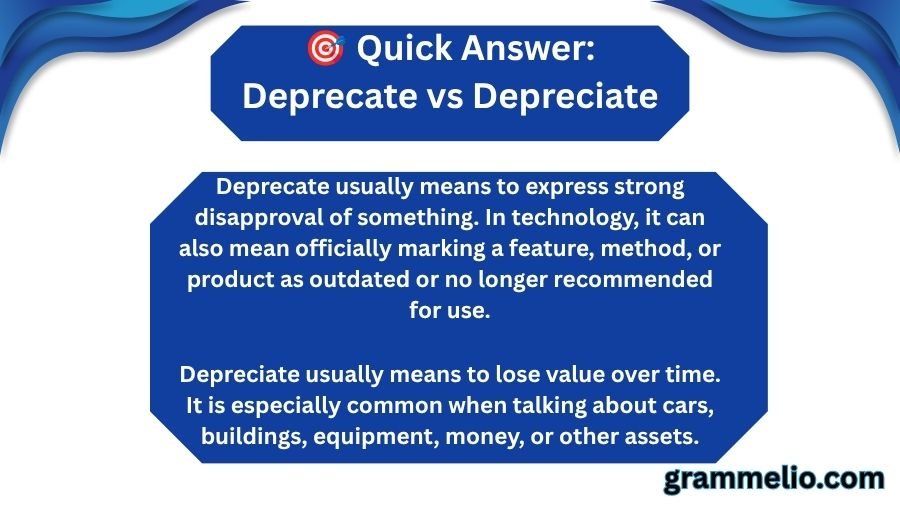
Deprecate usually means to express strong disapproval of something. In technology, it can also mean officially marking a feature, method, or product as outdated or no longer recommended for use.
Depreciate usually means to lose value over time. It is especially common when talking about cars, buildings, equipment, money, or other assets.
A simple way to remember the difference is:
Deprecate = disapprove or discourage.
Depreciate = decrease in value.
| Word | Main Meaning | Common Area | Example |
|---|---|---|---|
| Deprecate | Disapprove of or discourage | Opinions, language, technology | The company deprecated the old software feature. |
| Depreciate | Lose value | Money, property, cars, equipment | The car will depreciate over time. |
What Is the Difference Between Deprecate and Depreciate?
The main difference is what happens to the subject.
When you deprecate something, you express disapproval of it or say that it should no longer be used. When something depreciates, its value goes down.
Think about these two ideas:
- A manager may deprecate an old process because it is no longer useful.
- A car may depreciate because it becomes older and less valuable.
The first word is about approval, criticism, or recommended use. The second is about value.
Deprecate: Meaning and Correct Use
Deprecate is a verb. Its traditional meaning is to express strong disapproval of something.
For example:
The teacher deprecated the use of offensive language in the classroom.
Here, the teacher is saying that the language is unacceptable or should not be used.
In modern technology, deprecate has another very common use. Developers may deprecate a function, feature, API, or software method. This means the item may still work, but users are warned that it is outdated or should be replaced.
The developers deprecated the old login method.
This does not necessarily mean the login method stopped working immediately. It means users should move toward a newer option.
Depreciate: Meaning and Correct Use
Depreciate is also a verb. It generally means to lose value over time.
For example:
New cars often depreciate after they are purchased.
The car has not necessarily become physically worse overnight. Its market value may simply be lower because it is now used.
The word is also common in business and accounting:
The company depreciates its equipment over several years.
Here, the word describes how the cost or value of an asset is recorded over time.
| Word | Type | Meaning | Example | Correct/Incorrect |
|---|---|---|---|---|
| Deprecate | Verb | Disapprove of or discourage | The editor deprecated the harmful claim. | ✅ Correct |
| Depreciate | Verb | Lose value | The vehicle depreciated quickly. | ✅ Correct |
| Deprecate | Verb | Lose financial value | The house deprecated after ten years. | ❌ Incorrect |
| Depreciate | Verb | Officially discourage a software feature | The developer depreciated the old API. | ❌ Incorrect |
💡 How Can You Remember Deprecate vs Depreciate?
I recommend connecting each word to one simple idea.
Deprecate → disapproval or discouragement
Depreciate → decrease in value
The letter i in depreciate can remind you of an investment that loses value.
This is not a perfect memory rule for every situation, but it is useful when you are writing quickly.
Another trick is to ask yourself:
“Am I talking about an opinion or a value?”
- If you mean an opinion of disapproval, choose deprecate.
- If you mean a drop in value, choose depreciate.
For technology, ask a slightly different question:
“Am I warning people away from an old feature?”
If yes, deprecate is usually the correct choice.
| Question to Ask | Answer | Word |
|---|---|---|
| Am I expressing disapproval? | Yes | Deprecate |
| Am I discouraging use of something? | Yes | Deprecate |
| Am I talking about an outdated software feature? | Yes | Deprecate |
| Has something lost monetary value? | Yes | Depreciate |
| Am I discussing asset value in accounting? | Yes | Depreciate |
Is Deprecate the Same as Depreciate?
No. Deprecate and depreciate are different words with different main meanings.
They are easy to confuse because their spellings are almost identical. However, replacing one with the other can create a clear meaning problem.
Consider:
The accountant depreciated the machine.
This makes sense because the machine is an asset that loses value.
Now consider:
The accountant deprecated the machine.
That sounds like the accountant expressed disapproval of the machine or advised against using it. It does not communicate the normal accounting meaning.
Likewise:
The developer deprecated the old feature.
This is normal technology language.
But:
The developer depreciated the old feature.
This suggests a change in value, which is not the intended meaning.
A Simple Meaning Map
| Situation | Best Word | Why |
|---|---|---|
| Criticizing an action | Deprecate | It expresses disapproval |
| Advising against an old method | Deprecate | It discourages use |
| Marking software as outdated | Deprecate | It signals that a replacement is preferred |
| Car losing market value | Depreciate | Its value decreases |
| Equipment losing recorded value | Depreciate | It concerns asset value |
| Property becoming less valuable | Depreciate | It describes declining value |
Why Do People Confuse Deprecate and Depreciate?
People confuse these words because they share most of their letters and have related-looking forms. Fast typing also makes the problem worse.
I once edited a short business article where the writer used depreciate several times when discussing an outdated software tool. The sentences looked polished at first glance. Once I checked the meaning, however, the problem became obvious. The writer was trying to say that the software tool was no longer recommended. The correct word was deprecate.
There are three common reasons for mistakes:
- Fast typing — Writers often choose a familiar spelling without checking the meaning.
- Autocorrect — Spell-check tools may not catch a correctly spelled word used in the wrong context.
- Lack of knowledge — Many people learn one word but never learn how it differs from its near-twin.
This is why spelling alone cannot solve the problem. Both words are correctly spelled. The real question is meaning.
📝 Case Study: Deprecate vs Depreciate in the Workplace
Imagine that a software company sends this message to its customers:
“Starting next year, we will deprecate the old reporting feature.”
The message tells users that the feature is outdated or no longer recommended. Customers may be asked to switch to a newer reporting system.
Now imagine an accountant preparing a report about the company’s computers:
“The company will depreciate the computers over their useful lives.”
This sentence has a completely different purpose. It concerns the financial treatment of physical assets.
The two words may appear in the same company document, but they describe different ideas.
| Workplace Situation | Correct Word | Example |
|---|---|---|
| Software feature is outdated | Deprecate | The team deprecated the old search tool. |
| Computer equipment loses value | Depreciate | The company depreciates its computers. |
| Manager strongly disapproves of a practice | Deprecate | The manager deprecated the unsafe practice. |
| Vehicle loses market value | Depreciate | The company car depreciated after several years. |
Grammar Rules Explanation
Both deprecate and depreciate are verbs, but their meanings determine where they belong.
Use deprecate when the action involves expressing disapproval or discouraging something. In technology, use it when an older feature, method, or system is formally identified as outdated or no longer recommended.
Use depreciate when the action involves a decrease in value. It is common in discussions about assets, property, vehicles, equipment, and accounting.
Standard English reference sources distinguish these meanings. The safest approach is not to rely on spelling alone. Look at the sentence’s intended idea.
If the sentence is about approval, criticism, or recommended use, think deprecate.
If it is about financial or market value, think depreciate.
Correct vs Incorrect at a Glance
| Sentence | Correct/Incorrect | Why |
|---|---|---|
| The company deprecated the outdated software feature. | ✅ Correct | The feature is no longer recommended. |
| The old car depreciated after several years. | ✅ Correct | The car lost value. |
| The accountant depreciated the office equipment. | ✅ Correct | The equipment is treated as a declining-value asset. |
| The manager deprecated the unsafe practice. | ✅ Correct | The manager expressed disapproval. |
| The manager depreciated the unsafe practice. | ❌ Incorrect | The intended meaning is disapproval, not loss of value. |
⚠️ Common Mistakes With Deprecate and Depreciate
The most common mistake is choosing the word that looks right instead of the word that carries the right meaning.
A writer may see the word value and think of both words because they sound similar. But depreciate is the one connected to a decline in value.
Another common mistake happens in technology writing. Some writers use depreciate because they think an old software feature has “lost value.” In standard technical usage, however, a feature that is officially marked as outdated is deprecated.
I once caught myself making a similar mistake while proofreading a technical note. I had typed the wrong form automatically because my fingers followed the familiar spelling pattern. The sentence was grammatically shaped correctly, but the meaning was wrong. That small check saved the document from being published with an inaccurate technical term.
Similar Grammar Confusions
| Confusing Pair | Correct Distinction |
|---|---|
| It’s / Its | It’s = it is; its = possessive |
| Your / You’re | Your = possession; you’re = you are |
| Their / They’re | Their = possession; they’re = they are |
| Affect / Effect | Affect is often a verb; effect is often a noun |
| Advice / Advise | Advice = noun; advise = verb |
| Deprecate / Depreciate | Deprecate = disapprove or discourage; depreciate = lose value |
Common Wrong Forms and Uses
| Wrong Form or Use | What’s Wrong | Correct Form |
|---|---|---|
| The car deprecated in value. | A decline in value requires depreciate. | The car depreciated in value. |
| The developer depreciated the old API. | Technical discouragement is normally deprecate. | The developer deprecated the old API. |
| The manager depreciated the policy. | The sentence means the manager disapproved of it. | The manager deprecated the policy. |
| The equipment deprecated over five years. | The sentence concerns declining asset value. | The equipment depreciated over five years. |
| The team deprecated the machine’s market value. | The intended idea is financial loss in value. | The machine’s value depreciated. |
| The company depreciated the outdated feature. | The feature was discouraged, not financially reduced. | The company deprecated the outdated feature. |
What Does Deprecate Mean in Technology?
In technology, deprecate means that a feature, method, API, command, or other tool is no longer recommended, usually because a better replacement exists or because the old option is being phased out.
A deprecated feature may continue to work for some time. Deprecation is often a warning that developers should move to another option.
For example:
The company deprecated the old authentication method.
This tells users or developers to stop relying on the old method and move toward the newer one.
The important point is that deprecation is about recommended use, not necessarily about immediate failure.
| Technical Situation | Correct Word | Example |
|---|---|---|
| Old API is no longer recommended | Deprecate | The team deprecated the old API. |
| Old command is being phased out | Deprecate | The command was deprecated. |
| Software loses resale value | Depreciate | The hardware depreciated in value. |
| Server equipment loses asset value | Depreciate | The company depreciates the equipment. |
Can Depreciate Be Used for Money and Assets?
Yes. Depreciate is commonly used when an asset loses value.
You might hear it in sentences about:
- cars
- machinery
- computers
- buildings
- business equipment
- property
- investments or currencies in certain contexts
For example:
The truck depreciated significantly after several years of use.
In accounting, businesses can also record depreciation for certain assets over their useful lives. The exact accounting treatment depends on the asset, rules, and accounting system.
The central idea remains simple: depreciate involves a decrease in value.
Deprecate vs Depreciate in Everyday Conversation
In everyday conversation, both words can appear, but depreciate is usually easier to encounter when people discuss the value of objects.
For example:
“That car will depreciate quickly.”
You might also hear deprecate when someone talks about criticism or disapproval, although the word can sound more formal.
“She deprecated the use of insults during the debate.”
Technology has also made deprecate more common in ordinary discussions about apps, websites, and software.
| Context | Which Term to Use | Example |
|---|---|---|
| Everyday conversation about car value | Depreciate | Cars can depreciate quickly. |
| Everyday conversation about disapproval | Deprecate | He deprecated the rude behavior. |
| Professional writing | Depends on meaning | The system deprecated the old feature. |
| Creative writing | Depends on meaning | She deprecated the cruel remark. |
| Social media or texting | Depends on meaning | The app deprecated the old option. |
How Are Deprecate and Depreciate Used in Professional Writing?
Professional writing requires extra care because the wrong word can change the message.
In accounting or finance, depreciate is the natural choice when discussing declining asset value.
In software documentation, deprecate is the natural choice when discussing an old feature that should no longer be used.
In management or formal criticism, deprecate can describe strong disapproval.
Before sending a professional document, ask:
“What exactly is changing here: someone’s approval, or an item’s value?”
That one question can prevent the most common error.
Common Phrases With Deprecate and Depreciate
Neither word has a huge list of everyday idioms, but both appear in useful phrases and common word combinations.
| Phrase | Meaning |
|---|---|
| Deprecate an outdated feature | Mark a feature as no longer recommended |
| Deprecate a practice | Express disapproval of a practice |
| Depreciate in value | Become less valuable |
| Depreciate over time | Lose value as time passes |
| Depreciation of an asset | A decrease in an asset’s recorded or market value |
| Depreciating asset | An asset whose value decreases over time |
Synonyms and Alternatives for Deprecate and Depreciate
Sometimes another word can make your sentence even clearer.
For deprecate, useful alternatives include criticize, condemn, discourage, and disapprove of. The best choice depends on how strong your intended meaning is.
For depreciate, useful alternatives include decline in value, lose value, and decrease in value.
| Alternative | Works When | Does Not Work When |
|---|---|---|
| Criticize | You mean to express negative judgment | You mean a financial decline |
| Discourage | You want people to avoid something | You mean an asset lost value |
| Disapprove of | You want to show a negative opinion | You mean software lost market value |
| Lose value | An asset becomes less valuable | You mean an old feature is discouraged |
| Decrease in value | You need very clear financial wording | You mean criticism or technical retirement |
Why Does Getting This Difference Right Matter?
Using the correct word improves clarity. It also helps your writing sound professional.
Imagine a client reading:
“The old software has depreciated.”
The client may think you are talking about its financial value.
But if you write:
“The old software has been deprecated.”
the message is much clearer in a technical setting. You are saying that the software or feature is outdated or no longer recommended.
The distinction matters in several situations.
| Situation | Why Getting It Right Matters |
|---|---|
| Resume | Correct word choice makes professional writing stronger. |
| Client email | A wrong word can create confusion. |
| Published content | Readers expect accurate terminology. |
| Social post | Short messages leave little room for clarification. |
A useful writing principle is:
Clear words create clear meaning.
That rule is simple, but it is worth remembering whenever two similar words compete for the same sentence.
Does Deprecate Have a Special Technical Meaning?
Yes. The technology meaning is one of the most important modern uses of deprecate.
When developers say that something has been deprecated, they usually mean it is outdated or no longer recommended. The item may still function, but users are encouraged to adopt another solution.
This is different from saying that the feature has depreciated. That form would normally suggest a loss of value, not a software warning.
This technical use is a genuine special case because it is very common in software documentation, programming discussions, and product announcements.
How To Choose the Right Word Every Time
When I teach confusing word pairs, I prefer a short decision process instead of asking people to memorize long definitions.
Use this three-step test:
Step 1: Find the subject
What are you talking about?
Is it:
- a car?
- equipment?
- property?
- an old software feature?
- a policy?
- a behavior?
Step 2: Find the action
What happened?
Did the thing:
- lose value?
- become less valuable?
- receive criticism?
- become discouraged?
- become outdated or no longer recommended?
Step 3: Pick the word
If it lost value, use depreciate.
If it was criticized, discouraged, or marked as outdated, use deprecate.
| Meaning | Word |
|---|---|
| Express disapproval | Deprecate |
| Discourage something | Deprecate |
| Mark technology as outdated | Deprecate |
| Lose financial value | Depreciate |
| Decrease in asset value | Depreciate |
💡 Test Tip: Replace the Word
Here is a fast test I use when proofreading.
Try replacing the word with “lose value.”
If the sentence still makes sense, depreciate may be correct.
The car depreciated.
→ The car lost value. ✅
Now try replacing the word with “discourage.”
The company deprecated the old feature.
→ The company discouraged continued use of the old feature. ✅
If neither replacement works, stop and look at the sentence again. Context matters.
Quick Recap Checklist
Use this checklist before you finish your sentence.
| Question | If Yes → Use |
|---|---|
| Does something lose monetary or market value? | Depreciate |
| Does an asset decline in value over time? | Depreciate |
| Am I expressing strong disapproval? | Deprecate |
| Am I discouraging a behavior or practice? | Deprecate |
| Am I describing an outdated software feature? | Deprecate |
| Am I discussing accounting depreciation? | Depreciate |
Practice Examples
- The old car will probably ______ after several years.
Answer: depreciate ✅ - The software company ______ the outdated API.
Answer: deprecated ✅ - The manager ______ the unsafe practice.
Answer: deprecated ✅
These examples show the central rule: value decreases → depreciate; disapproval or discouragement → deprecate.
FAQs About Deprecate vs Depreciate
What is the main difference between deprecate and depreciate?
Deprecate means to express disapproval, discourage something, or mark something as outdated in technical use. Depreciate means to lose value or to account for a decline in an asset’s value.
Is a car deprecated or depreciated?
A car is normally depreciated because its value decreases over time.
The car depreciated after several years. ✅
Is old software deprecated or depreciated?
Old software or a software feature can be deprecated when it is no longer recommended for use.
The developer deprecated the old API. ✅
Can deprecate mean to criticize?
Yes. Deprecate can mean to express disapproval of something or to criticize it strongly.
Can depreciate mean to become less valuable?
Yes. Depreciate commonly means to decrease in value.
Used vehicles can depreciate as they age.
Which word is used in accounting?
Depreciate is the relevant word for the decrease in value of qualifying assets and the accounting process associated with that decline.
Why is an API deprecated?
An API may be deprecated because it is outdated, has a newer replacement, creates maintenance problems, or is no longer the preferred way to perform a task. Deprecation usually warns developers to move to another option.
Is “depreciated software” correct?
It can be grammatically possible in a context involving financial value, but it is usually not the correct word when you mean that software has been marked as outdated or no longer recommended. In that technical meaning, use deprecated.
Is “deprecated value” correct?
Usually not if you mean that something has lost value. The normal word is depreciated.
The equipment depreciated in value. ✅
What is the easiest way to remember deprecate vs depreciate?
Remember:
Deprecate = disapprove or discourage.
Depreciate = decrease in value.
If you are talking about an old software feature, think deprecate. If you are talking about a car, machine, or other asset losing value, think depreciate.
Final Thoughts on Deprecate vs Depreciate
Deprecate vs depreciate becomes much easier once you focus on meaning instead of spelling. Use deprecate when you mean disapprove, discourage, or mark something as outdated, especially in technology. Use depreciate when you mean that something loses value or when discussing the accounting treatment of an asset’s declining value. ✨
When I am proofreading, I use one simple question: “Is this about discouragement or value?” If it is about discouragement, I choose deprecate. If it is about value going down, I choose depreciate. That quick check catches most mistakes before they reach the reader.
You do not need to memorize a complicated rule. Just connect each word with its core idea: deprecate deals with disapproval or outdated use, while depreciate deals with declining value. Once that connection becomes automatic, these two look-alike words are far less likely to cause trouble.
Remember the rule, check the meaning, and let the right word do the work.

[…] memory tricks, and practice questions to help you choose the right word with confidence. 😊 Deprecate vs Depreciate | Coarse vs Course | Decent vs Descent vs […]
[…] Let’s break it down so you can choose the right word with confidence. 😊 Disperse vs Disburse | Deprecate vs Depreciate | Coarse vs […]