I have seen dyeing vs dying confuse students, writers, and even careful editors because these words look almost identical on the page. One extra letter, however, changes the meaning completely. If you have ever stopped while writing a sentence such as “She is dying her hair,” you are not alone.
I teach English writing by focusing on simple rules that are easy to remember, and this pair is a perfect example. Dyeing is about adding color to something, such as fabric, hair, or another material. Dying is the present participle of “die,” so it refers to the end of life or, in some contexts, the loss or fading of something.
Once you see the small spelling rule behind these words, the difference becomes much easier to remember. 🎨 Let’s break it down so you can choose the right word with confidence. 😊 Disperse vs Disburse | Deprecate vs Depreciate | Coarse vs Course
🎯 Quick Answer: Dyeing vs Dying
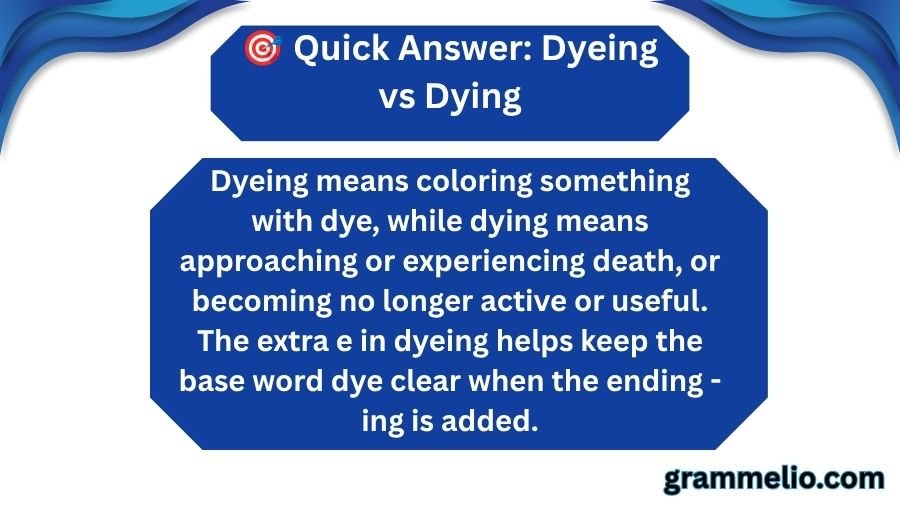
Dyeing means coloring something with dye, while dying means approaching or experiencing death, or becoming no longer active or useful. The extra e in dyeing helps keep the base word dye clear when the ending -ing is added.
| Word | Meaning | Example |
|---|---|---|
| Dyeing | Coloring something with dye | She is dyeing her hair brown. |
| Dying | Approaching or experiencing death | The plant is dying. |
| Dye | To add color | I want to dye this shirt blue. |
| Die | To stop living | Fish can die without enough oxygen. |
The easiest memory trick is this: dyeing keeps the “e” from dye because “dye” is the action of adding color.
🧩 Related Word Forms of Dyeing and Dying
Both words come from different base verbs, so their related forms are also different. Knowing those forms makes the spelling easier to understand.
| Form | Type | Example |
|---|---|---|
| dye | Base verb | I want to dye my jacket. |
| dyed | Past tense/past participle | She dyed her hair yesterday. |
| dyeing | Present participle/gerund | She is dyeing her hair today. |
| die | Base verb | Plants can die without water. |
| died | Past tense/past participle | The old tree died last winter. |
| dying | Present participle/gerund | The tree is dying. |
Notice something useful: dying belongs to die, while dyeing belongs to dye. They are not two spellings of the same word.
🔎 Understanding Dyeing vs Dying
The core difference is simple: dyeing means putting color into something, while dying means moving toward death or becoming dead.
| Form | Type | Meaning | Example | Correct/Incorrect |
|---|---|---|---|---|
| Dyeing | Verb form | Adding color | We are dyeing the fabric. | ✅ Correct |
| Dying | Verb form | Approaching death | The flowers are dying. | ✅ Correct |
| Dyeing | Verb form | Approaching death | The patient is dyeing. | ❌ Incorrect |
| Dying | Verb form | Adding color | She is dying her shirt red. | ❌ Incorrect |
| Dye | Base verb | Add color | I will dye the cloth. | ✅ Correct |
| Die | Base verb | Stop living | Some plants die in extreme heat. | ✅ Correct |
A quick way to separate them is to ask what action you mean.
- If you mean adding color, use dyeing.
- If you mean approaching death, use dying.
🎨 What Does Dyeing Mean?
Dyeing is the act of changing the color of something by applying dye. People commonly dye hair, clothing, fabric, yarn, leather, and other materials.
For example:
She is dyeing her hair red.
The sentence means she is using a coloring product to change her hair color.
Here are more examples:
- The artist is dyeing the wool with natural colors.
- We spent Saturday dyeing old shirts.
- She is dyeing the fabric before sewing the dress.
- They learned how to dye yarn at the craft workshop.
☠️ What Does Dying Mean?
Dying is the present participle of die. It usually describes someone or something that is approaching death or has stopped functioning or growing.
Examples include:
- The sick dog is dying.
- The flowers are dying because they need water.
- The battery is dying.
- The fire is dying down.
The word can also be used in less literal ways. For example, a person might say, “I’m dying of embarrassment.” This does not normally mean literal death. It is an expression used to show a very strong feeling.
💡 Test Tip: How Can You Remember the Difference?
Here is the test I recommend: remove the -ing ending and look at the base verb.
If the base verb is dye, the correct form is dyeing.
If the base verb is die, the correct form is dying.
| Question | Base Verb | -ing Form |
|---|---|---|
| Is the action about adding color? | dye | dyeing |
| Is the action about death? | die | dying |
| Is someone changing hair color? | dye | dyeing |
| Is a plant losing life? | die | dying |
| Is fabric being given a new color? | dye | dyeing |
I once caught myself typing “dying fabric” when I meant fabric that was being colored. I stopped, removed the ending, and asked myself, “Is the fabric being dyed, or is it dying?” That quick question fixed the sentence immediately.
📝 Correct Meanings and Uses
The two words appear in several different settings. Their meanings become much clearer when you look at the context.
Dyeing Hair
Hair coloring is one of the most common uses of dyeing.
- She is dyeing her hair blonde.
- I am dyeing my hair for the first time.
- They are dyeing their hair purple.
The action involves changing hair color, so dyeing is correct.
Dyeing Clothes and Fabric
The word also applies to clothing and materials.
- We are dyeing the shirts blue.
- The workers are dyeing the cotton.
- She enjoys dyeing yarn by hand.
Dying in a Literal Sense
Dying is used when someone or something is approaching death.
- The injured bird was dying.
- The old tree is dying.
- The fish are dying because the water is polluted.
Dying in a Figurative Sense
The word can describe things that are disappearing, weakening, or losing strength.
- The old tradition is dying.
- The sound of the music was dying away.
- Interest in the product is dying.
| Meaning | Word Type | Example Sentence |
|---|---|---|
| Adding color to hair | Verb form | She is dyeing her hair. |
| Adding color to fabric | Verb form | They are dyeing the fabric. |
| Approaching death | Verb form | The animal is dying. |
| Losing strength | Verb form | The fire is dying down. |
| Becoming less common | Figurative verb | The tradition is dying out. |
🆚 Dyeing vs Dying at a Glance
Dyeing vs dying is easier to understand when you compare the base verbs, meanings, and common uses side by side.
The difference can be understood through the base verbs dye and die. One relates to color, and the other relates to life.
| Feature | Dyeing | Dying |
|---|---|---|
| Base verb | Dye | Die |
| Main idea | Adding color | Approaching death |
| Common object | Hair, clothes, fabric, yarn | People, animals, plants, fires |
| Example | She is dyeing the fabric. | The plant is dying. |
| Memory clue | Keep the “e” | Drop the “e” |
This is why dyeing vs dying is not just a spelling question. It is a meaning question too.
🤔 Why Do People Confuse Dyeing and Dying?
People confuse these words because their pronunciation can be very similar, especially in ordinary speech. Their written forms are also only one letter apart. Learning the basic rule behind dyeing vs dying can prevent this mistake.
Another problem comes from the normal spelling rule for verbs ending in a silent e. For many verbs, the final e disappears before -ing:
- make → making
- write → writing
- take → taking
That pattern can make dyeing look strange. However, dyeing needs to remain connected to the base word dye, so the spelling keeps the e.
A student once showed me a sentence about a clothing project and wrote, “We are dying the shirts.” The student was not talking about death at all. They simply followed the spelling pattern they already knew. Once we connected the word to dye, the mistake made sense.
📚 Grammar Rules Explanation
The spelling difference comes from the fact that these words are forms of two separate verbs: dye and die.
The verb dye means to give something a different color. When its present participle is formed, the result is dyeing.
The verb die means to stop living. Its present participle is dying.
This distinction matters because removing the final e from dye would produce dying, which is already the present participle of die. Keeping the e in dyeing prevents the spelling from becoming identical to the form of die.
Standard English reference works agree on this basic distinction. The safest method is still to identify the base verb before choosing the -ing form.
Correct vs Incorrect at a Glance
| Sentence | Correct/Incorrect | Why |
|---|---|---|
| She is dyeing her hair black. | ✅ Correct | She is adding color to her hair. |
| She is dying her hair black. | ❌ Incorrect | “Dying” comes from “die,” not “dye.” |
| The flowers are dying. | ✅ Correct | The flowers are losing life. |
| The flowers are dyeing. | ❌ Incorrect | No coloring action is being described. |
| We are dyeing the fabric today. | ✅ Correct | The fabric is being colored. |
⚠️ Common Mistakes With Dyeing and Dying
Most mistakes happen because writers remember the sound but not the base verb. Fast typing, autocorrect, and uncertainty about spelling can all make the problem worse. A quick review of dyeing vs dying can help writers catch these errors before publishing.
| Similar Confusion | Correct Difference | Example |
|---|---|---|
| its / it’s | Possession vs. “it is” | The dog wagged its tail. |
| your / you’re | Possession vs. “you are” | You’re holding your bag. |
| their / there / they’re | Possession, place, and “they are” | They’re over there with their books. |
| affect / effect | Usually verb vs. noun | The change affected the result. |
| dyeing / dying | Coloring vs. death | She is dyeing fabric. |
Why These Mistakes Happen
Fast typing: When people type quickly, they may choose the familiar-looking word without checking its meaning.
Autocorrect: Spell-check tools may not recognize a meaning error. Both dyeing and dying are legitimate English words, so software may not flag the wrong choice.
Lack of knowledge: If someone does not know the base verbs, the difference can seem random.
I once edited a short online article where the writer used “dying” several times in a section about hair color. Every sentence was grammatically shaped correctly, but the meaning was wrong. A simple search for the base verb fixed every instance.
Common Wrong Spellings and Uses
| Wrong Form | What’s Wrong | Correct Form |
|---|---|---|
| dying fabric | Uses the death-related form | dyeing fabric |
| dyeing plant | Usually wrong when the plant is losing life | dying plant |
| dying my hair | Uses the wrong base verb | dyeing my hair |
| dyeing animal | Wrong if the animal is approaching death | dying animal |
| dyeing out | Incorrect phrase for something disappearing | dying out |
| dying the shirt blue | Wrong when changing color | dyeing the shirt blue |
🕰️ A Brief History of the Two Words
The words have separate histories because they come from separate verbs. Dye is tied to the long history of coloring materials, while die developed with the meaning of losing life. Their modern -ing forms happen to look very similar, which creates the spelling problem.
The exact historical path is less useful for everyday writing than remembering the two base verbs.
| Stage | Form | Note |
|---|---|---|
| Modern English | dye | Verb for adding color |
| Modern English | dyeing | Present participle of dye |
| Modern English | die | Verb related to loss of life |
| Modern English | dying | Present participle of die |
For practical grammar, the key point is that these are different verbs. You do not need to memorize complicated language history to spell them correctly.
🌎 Usage in Different Contexts
The correct word depends on what you are describing. The context may be casual, professional, creative, or digital, but the basic distinction never changes.
| Context | Which Term to Use | Example |
|---|---|---|
| Everyday conversation | Dyeing for coloring | I’m dyeing my hair today. |
| Professional writing | Dyeing for coloring | The company is dyeing the fabric. |
| Creative writing | Either, depending on meaning | The sunset was dying behind the hills. |
| Social media/texting | Either, depending on meaning | Dyeing my shirt today! |
| Health or life-related writing | Dying | The plant is dying. |
Everyday Conversation
People often talk about dyeing when discussing hair, clothes, or crafts.
“Are you dyeing your hair this weekend?”
The answer could be:
“Yes, I’m dyeing it dark brown.”
For dying, everyday conversation may involve health, plants, animals, or figurative expressions.
“My flowers are dying because I forgot to water them.”
Professional Writing
Professional writing needs extra care because a single letter can change the meaning of a sentence.
Compare:
“Our team is dyeing the fabric.”
with:
“Our team is dying the fabric.”
The first sentence describes a coloring process. The second could suggest that the fabric itself is somehow losing life, which makes little sense in the intended context.
Creative Writing
Creative writers may use both forms for effect.
“The leaves were dying as autumn moved in.”
But:
“She was dyeing the old curtains blue.”
The first creates an image of decline. The second describes a practical action.
Social Media and Texting
Casual writing is still clearer when the correct spelling is used.
- “Dyeing my hair today! 🎨”
- “My roses are dying again! 🌹”
- “I’m dyeing these jeans a darker shade.”
Even short posts can communicate the wrong idea if the wrong word is selected.
💬 Common Phrases With Dyeing and Dying
Neither word has a huge collection of fixed expressions, but dying appears in several common phrases, while dyeing is often used in practical phrases about coloring.
| Phrase | Meaning |
|---|---|
| dyeing your hair | Coloring your hair |
| dyeing fabric | Giving fabric a new color |
| dying out | Gradually disappearing |
| dying down | Becoming weaker or quieter |
| dying of laughter | Laughing extremely hard |
| dying to know | Being extremely eager to know |
The phrase “dying to know” is usually figurative. It does not mean that a person is literally approaching death.
🔄 Synonyms and Alternatives
Sometimes you can replace these words with another phrase. However, the best replacement depends on the sentence.
| Alternative | Works When | Does Not Work When |
|---|---|---|
| coloring | Talking about changing color | You need the specific word “dyeing” |
| tinting | Adding a lighter or softer color | The process specifically involves dye |
| coloring with dye | You want maximum clarity | The sentence needs a short verb |
| passing away | Referring politely to death | You are discussing color |
| fading | Something is losing color or strength | Something is actively being dyed |
For example, “She is coloring her hair” can sometimes replace “She is dyeing her hair.” But “coloring” does not always describe the exact process.
Likewise, “passing away” can replace “dying” when talking respectfully about a person’s death, but it cannot replace dying in every figurative expression.
🎯 How To Remember the Difference
A simple memory trick can make dyeing vs dying much easier.
Think of the Letter E
When you see dyeing, notice the E.
Think:
E = extra color
That is not a formal grammar rule. It is simply a memory aid.
Ask One Question
Ask:
“Am I adding color?”
If yes, use dyeing.
If no, and the sentence describes death or something fading away, dying may be the right choice.
Check the Base Verb
| If You Mean… | Base Verb | Correct -ing Form |
|---|---|---|
| Add color | dye | dyeing |
| Stop living | die | dying |
| Change fabric color | dye | dyeing |
| Lose life | die | dying |
| Disappear gradually | die | dying |
This three-step check takes only a few seconds.
❓ Is Dyeing the Same as Dying?
No. Dyeing and dying have different meanings and come from different base verbs. Dyeing means adding color, while dying usually means approaching death or becoming weaker or less active.
For example:
- “She is dyeing her hair.” 🎨
- “The flowers are dying.” 🌸
Changing the spelling changes the meaning.
❓ Is Dyeing Spelled With an E?
Yes. Dyeing is spelled d-y-e-i-n-g when it means adding color. The e helps distinguish it from dying, which comes from die.
Remember:
dye → dyeing
not:
dye → dying
❓ Why Is Dyeing Not Spelled Dying?
Dyeing keeps the e because it comes from the verb dye. If the e were removed, the result would look exactly like dying, the present participle of die.
This spelling helps readers see which verb is intended.
❓ Is It Dyeing My Hair or Dying My Hair?
The correct sentence is “I am dyeing my hair.” You use dyeing because the action involves changing your hair color.
Example:
“I am dyeing my hair brown this weekend.”
The word dying would suggest that your hair is approaching death, not that you are coloring it.
❓ Is It Dyeing Clothes or Dying Clothes?
The correct phrase for changing the color of clothes is “dyeing clothes.”
For example:
“We are dyeing our old clothes blue.”
If you are talking about clothes becoming worn out or being destroyed, a different sentence would be needed. Dying does not mean “coloring.”
❓ Is Dying the Correct Word for a Plant?
Yes. When a plant is losing its life, dying is correct.
“The plant is dying because it has not received enough water.”
You could also say that a plant is wilting, fading, or withering, depending on the exact situation.
❓ What Is the Difference Between Dye and Die?
Dye means to change the color of something. Die means to stop living.
| Base Word | Meaning | Example |
|---|---|---|
| dye | Add color | I will dye the shirt. |
| die | Stop living | Some plants die without water. |
Their -ing forms are dyeing and dying.
❓ How Can I Quickly Check Dyeing vs Dying?
Remove -ing and check the base verb.
If the base is dye, use dyeing.
If the base is die, use dying.
This method is more reliable than trying to remember the spelling by sight alone.
❓ Can Dying Be Used Figuratively?
Yes. Dying can be used figuratively in phrases such as “dying to know,” “dying of laughter,” and “dying down.”
In these expressions, the word does not necessarily describe literal death.
For example:
“I’m dying to hear the news.”
This means the speaker is extremely eager to hear the news.
❓ Which Word Should I Use for Hair Color?
Use dyeing when someone is changing hair color.
Correct:
“She is dyeing her hair.”
Incorrect:
“She is dying her hair.”
The first sentence clearly describes a coloring action.
❓ Why Does Spell-Check Sometimes Miss This Mistake?
Spell-check programs often recognize both dyeing and dying as correctly spelled words. The problem is that software may not understand the meaning you intended.
For that reason, you still need to check the context. A sentence can contain a correctly spelled word that is still the wrong word for the meaning.
⚡ Quick Recap Checklist
Use this checklist whenever you are unsure.
| Question | If Yes → Use |
|---|---|
| Am I adding color to something? | Dyeing |
| Am I coloring hair? | Dyeing |
| Am I coloring fabric or clothing? | Dyeing |
| Is someone or something approaching death? | Dying |
| Is something becoming weaker or disappearing? | Dying |
| Can I replace the word with “dye”? | Dyeing |
| Can I replace the word with “die”? | Dying |
📝 Practice Examples
- “She is ___ her wedding dress blue.”
Answer: dyeing 🎨 - “The flowers are ___ without water.”
Answer: dying 🌷 - “He is ___ to hear the results.”
Answer: dying because this is a figurative expression meaning very eager.
📌 Three Fast Sentence Tests
When you are editing your own writing, these examples can serve as quick models.
| Sentence | Correct Word | Reason |
|---|---|---|
| I am ___ my hair today. | dyeing | Hair is being colored. |
| My plant is ___. | dying | The plant is losing life. |
| We are ___ the fabric red. | dyeing | The fabric is receiving color. |
| The old custom is ___. | dying | The custom is disappearing. |
| She is ___ to know what happened. | dying | Figurative expression for strong curiosity. |
🌟 Why Getting This Difference Right Matters
Correct word choice makes your writing easier to understand. A reader should not have to stop and guess what you mean.
| Situation | Why Getting It Right Matters |
|---|---|
| Resume | Shows careful editing and strong language skills |
| Client email | Prevents confusing or embarrassing meanings |
| Published content | Builds trust with readers |
| Social post | Makes short messages clearer |
Imagine sending a salon message that says, “I am dying my hair tomorrow.” The reader may understand your meaning from context, but the spelling still creates an unnecessary distraction.
Clear writing is not about using difficult words. It is about using the right simple word.
“Small spelling choices can create big differences in meaning.”
That is especially true with word pairs such as these.
🧠 A Simple Memory Rule for Writers
If you only remember one rule from this article, remember this:
Dyeing has an E because it comes from dye. Dying has no E because it comes from die.
You can make the rule even shorter:
Color = dyeing. Death = dying.
That one sentence covers most everyday cases.
❓ What Is the Most Common Error With These Words?
The most common error is using dying when the writer means dyeing. This often happens in sentences about hair, clothing, fabric, or crafts.
For example:
❌ “I am dying my hair blue.”
✅ “I am dyeing my hair blue.”
The opposite mistake can also happen:
❌ “The flowers are dyeing.”
✅ “The flowers are dying.”
The meaning determines the spelling.
❓ Can I Use Dyeing for Something Other Than Hair?
Yes. Dyeing can describe coloring many materials, including fabric, clothing, yarn, leather, and other items that can receive dye.
Examples include:
- dyeing fabric
- dyeing wool
- dyeing yarn
- dyeing clothing
- dyeing leather
- dyeing hair
The key idea is always the same: adding or changing color with dye.
❓ Can Dying Describe Things That Are Not Alive?
Yes. Dying can be used figuratively for things that are losing strength, activity, popularity, or sound.
Examples include:
- a dying fire
- a dying tradition
- a dying industry
- a dying sound
- a dying interest
The word can also appear in common expressions where it is not literal.
❓ What Is the Easiest Way to Teach a Child the Difference?
Use a simple picture in the child’s mind: dyeing is about color, while dying is about life.
You can say:
“If you are making something colorful, it is dyeing. If something is losing its life, it is dying.”
Then practice with easy sentences:
- “I am dyeing my shirt.” 🎨
- “The flower is dying.” 🌼
Repeated practice makes the spelling much easier to remember.
❓ Is Dyeing a Verb?
Yes. Dyeing is the -ing form of the verb dye. It can function as part of a verb phrase or as a gerund.
For example:
“She is dyeing the fabric.”
Here, is dyeing forms the verb phrase.
In:
“Dyeing fabric can be messy.”
Dyeing functions as a noun-like gerund.
❓ Is Dying a Verb?
Yes. Dying is the -ing form of die. It can also function as a gerund or appear in figurative expressions.
For example:
“The tree is dying.”
Here, is dying is the verb phrase.
In:
“Dying of laughter is not literal.”
The word can be discussed as a form of the verb die.
❓ Can Dyeing and Dying Ever Be Interchangeable?
No. They are not interchangeable when they carry their normal meanings. Dyeing refers to coloring, while dying refers to death, decline, or related figurative meanings.
The words may sound alike or nearly alike in speech, but their meanings and spellings are different.
🏁 Final Takeaway
Dyeing vs dying becomes easy once you connect each word to its base verb. Dyeing comes from dye and means adding color to something. Dying comes from die and usually means approaching death, losing life, weakening, or disappearing. 🎨 If you are talking about hair, clothes, fabric, or another material receiving color, choose dyeing. If you are talking about a person, animal, plant, fire, tradition, or other thing that is losing life or strength, choose dying. 😊 The easiest way to remember dyeing vs dying is to connect each word with its base verb.
My best editing trick is to remove -ing and ask which base verb makes sense: dye or die? That tiny check can prevent a surprisingly common mistake. Once you learn that rule, you will rarely have to stop and wonder which spelling belongs in your sentence. Dyeing comes from dye and means adding color…
Remember: color is dyeing; death or decline is dying. When the meaning is clear, the spelling becomes clear too.


[…] mistakes, examples, and practical uses so you can choose the right word with confidence. ✍️ Dyeing vs Dying | Disperse vs Disburse | Deprecate vs […]