I have seen many writers pause over epic vs epoch because the two words look and sound somewhat alike. Yet they describe very different ideas. If you are a student, blogger, teacher, editor, or professional writer, knowing the difference can help you choose the right word with confidence. An epic can describe a long story about heroic deeds, something grand or impressive, or a work of literature.
An epoch is a major period of time, often one marked by an important event or change. ✍️ I find this pair easier to remember once you connect each word with its main idea. In this guide, I will explain epic vs epoch with clear definitions, examples, tables, memory tricks, and common mistakes.
By the end, you should be able to tell these two words apart quickly. 😊 Empathy vs Sympathy | Economic vs Economical | Dyeing vs Dying
🎯 Quick Answer: Epic vs Epoch
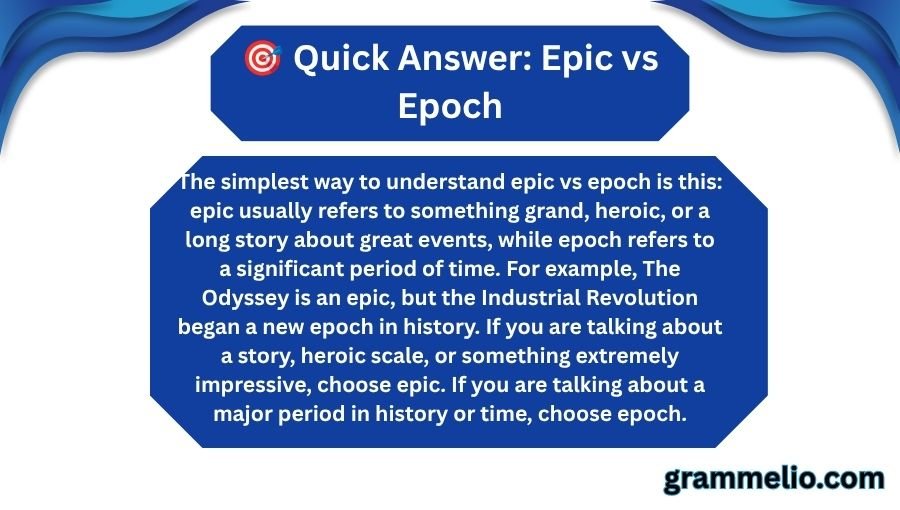
The simplest way to understand epic vs epoch is this: epic usually refers to something grand, heroic, or a long story about great events, while epoch refers to a significant period of time. For example, The Odyssey is an epic, but the Industrial Revolution began a new epoch in history. If you are talking about a story, heroic scale, or something extremely impressive, choose epic. If you are talking about a major period in history or time, choose epoch.
| Word | Main Meaning | Part of Speech | Simple Example |
|---|---|---|---|
| Epic | A long heroic story or something very grand | Noun/Adjective | The novel is an epic. |
| Epoch | A major period of time | Noun | The discovery began a new epoch. |
Epic and Epoch: Meaning and Correct Use
The key difference between epic vs epoch is the idea each word carries. Epic is connected with greatness, heroic stories, and very large or impressive events. Epoch is connected with time and historical periods.
What does epic mean?
Epic can be a noun or an adjective.
As a noun, an epic is a long story, poem, or literary work about heroic people and major events. Classic works such as The Iliad and The Odyssey are commonly described as epics.
As an adjective, epic means unusually large, impressive, exciting, or important.
Examples:
- The poet wrote an epic about a legendary warrior.
- The team made an epic comeback.
- They went on an epic road trip.
- The battle became an epic moment in the story.
The adjective is common in modern informal English. Someone might say, “That concert was epic!” to mean it was extremely impressive.
What does epoch mean?
Epoch is a noun. It means a particular period of time, especially one that is important because something major happened or changed during it.
Examples:
- The invention of the internet opened a new epoch.
- Scientists study the epoch in which early humans developed.
- The country entered a new political epoch.
- That discovery marked an important epoch in medicine.
The word epoch is strongly connected with time. When you see it, think period.
| Word | Word Type | Core Idea | Example |
|---|---|---|---|
| Epic | Noun | A long heroic story | The epic tells of a brave king. |
| Epic | Adjective | Grand or impressive | They had an epic adventure. |
| Epoch | Noun | A major period of time | The event began a new epoch. |
Is Epic the Same as Epoch?
No. Epic and epoch are not synonyms. Epic describes a story, something grand, or something highly impressive. Epoch describes a period of time.
This is one of the most useful rules to remember. If your sentence needs an idea such as story, hero, adventure, grand, or impressive, epic may be the right choice. If it needs an idea such as period, era, age, or historical time, epoch may be correct.
Consider these examples:
- ✅ Correct: The novel is an epic tale of war and courage.
- ❌ Incorrect: The novel is an epoch tale of war and courage.
Why? The sentence describes a large heroic story. Epic fits the meaning.
- ✅ Correct: The invention marked a new epoch in transportation.
- ❌ Incorrect: The invention marked a new epic in transportation.
Why? The sentence describes a major period of change. Epoch fits the meaning.
Epic vs Epoch at a Glance
The easiest way to compare epic vs epoch is to focus on their basic concepts. Epic points toward greatness or a heroic story. Epoch points toward time.
| Feature | Epic | Epoch |
|---|---|---|
| Main idea | Greatness, heroic story, or impressive event | Important period of time |
| Part of speech | Noun and adjective | Noun |
| Can describe a story? | Yes | No |
| Can describe time? | Not in the normal sense | Yes |
| Can mean impressive? | Yes | No |
| Common synonym | Heroic tale, grand event | Era, age, period |
| Example | It was an epic battle. | It was a new epoch. |
Epic as a noun
When epic is a noun, it commonly refers to a long, grand story about heroes or major events.
- The Iliad is an ancient epic.
- She is writing an epic about a family at war.
- The film feels like a modern epic.
Epic as an adjective
When epic is an adjective, it describes something unusually large, impressive, dramatic, or memorable.
- We watched an epic movie.
- That was an epic mistake.
- The hikers faced an epic storm.
Epoch as a noun
Epoch is a noun used for a major period of time.
- The invention started a new epoch.
- Historians study the epoch carefully.
- The two leaders belonged to different political epochs.
| Sentence | Word | Why |
|---|---|---|
| The hero belongs to an epic tale. | Epic | It describes a heroic story. |
| The discovery started a new epoch. | Epoch | It describes a period of time. |
| The concert was epic. | Epic | It means highly impressive. |
| The nation entered a new epoch. | Epoch | It refers to a new historical period. |
Why Do People Confuse Epic and Epoch?
People often confuse epic vs epoch because the words begin with the same letter and have similar-looking spellings. Their meanings, however, are quite different.
Pronunciation can also make the pair feel confusing. Both words are short, and both are common in academic or literary writing. A writer who remembers only the shape of the word may select the wrong one.
I once edited a student’s history paper in which the student wrote that a famous invention had created an “epic of change.” The intended meaning was a period of change, so epoch was the better word. The student knew both words but had connected the wrong one with the idea of history.
A useful trick is to ignore their similar spelling. Ask yourself what the sentence is really talking about.
- Is it about a grand story or impressive event? → Epic
- Is it about a major period of time? → Epoch
| If You Mean… | Choose | Example |
|---|---|---|
| A heroic story | Epic | The poem is an epic. |
| Something impressive | Epic | That was an epic performance. |
| A major historical period | Epoch | It was a new epoch. |
| An age or period | Epoch | The epoch lasted for centuries. |
| A dramatic adventure | Epic | They began an epic journey. |
💡 Test Tip: How Can You Remember Epic vs Epoch?
Use the E = Era trick for epoch.
Epoch → think “era.”
Both words relate to a period of time.
For epic, think extraordinary or heroic. An epic is often something large, dramatic, or memorable.
Here is the quick mental test:
Epic = extraordinary or heroic.
Epoch = era or period.
If you can replace the word with era, epoch may be correct.
For example:
The discovery began a new epoch.
Try replacing epoch with era:
The discovery began a new era.
The sentence still works.
Now try:
The movie was an epic.
Replacing it with era gives:
The movie was an era.
That does not work. So epic is clearly the correct word.
| Memory Question | Answer |
|---|---|
| Can I replace it with “era”? | Use epoch if the sentence still makes sense. |
| Does it mean grand or impressive? | Use epic. |
| Is it a heroic story? | Use epic. |
| Does it describe a historical period? | Use epoch. |
Correct Meanings and Uses of Epic
The word epic has several common uses, but they all connect to the idea of something large, heroic, dramatic, or impressive.
Epic as a heroic literary work
In literature, an epic is a long narrative about heroic actions and major events.
Example:
The ancient epic follows a hero through war, travel, and danger.
Here, epic is a noun.
Epic as something impressive
In casual modern English, epic often means amazing or extremely impressive.
Example:
We had an epic weekend at the beach.
The speaker does not mean the weekend was a long heroic poem. The word is being used informally to show that the experience was memorable.
Epic as something very large
Epic can also describe something that feels unusually large in scale.
Example:
The company faced an epic challenge.
The word adds emphasis. It tells the reader that the challenge was especially large or serious.
| Meaning | Word Type | Example Sentence |
|---|---|---|
| Heroic long story | Noun | The epic tells the story of a warrior. |
| Grand or impressive | Adjective | It was an epic performance. |
| Very large or dramatic | Adjective | They faced an epic challenge. |
Correct Meanings and Uses of Epoch
The meaning of epoch is narrower. It is mainly used as a noun for an important period of time.
Epoch in history
Historians can use epoch to describe a major period marked by important events or changes.
Example:
The invention helped begin a new epoch in industry.
Epoch in science
The word may also appear in scientific writing when a particular period is being discussed.
Example:
Researchers examined changes during that epoch.
Epoch for major change
Writers sometimes use epoch when they want to emphasize that a new period has begun.
Example:
The new technology may mark an epoch in communication.
| Meaning | Word Type | Example |
|---|---|---|
| Historical period | Noun | The epoch changed society. |
| Scientific period | Noun | Scientists studied the epoch. |
| Major period of change | Noun | The invention began a new epoch. |
📝 Case Study: Epic vs Epoch in a Workplace Email
Imagine a manager sends this message:
“The launch of our new service marks an exciting new ___ for the company.”
Which word belongs in the blank?
The answer is epoch.
The manager is talking about a new period in the company’s history. The sentence could also use era:
The launch of our new service marks an exciting new era for the company.
Now consider a different message:
“The launch event was ___, and the whole team received great feedback.”
Here, epic works because the writer is describing something highly impressive or memorable.
I once caught myself making a similar choice while reviewing a marketing draft. The writer had used epoch to describe a huge product launch. The launch itself was impressive, but the sentence was not talking about a period of history. I changed it to epic, and the meaning became much clearer.
| Workplace Situation | Correct Word | Example |
|---|---|---|
| A new period for the company | Epoch | A new epoch began for the company. |
| An impressive launch | Epic | The launch was epic. |
| A heroic story in an ad | Epic | The campaign told an epic story. |
| A major period of growth | Epoch | The company entered a new epoch. |
Grammar Rules Explanation
The grammar rule behind epic vs epoch is simple: choose the word based on its meaning and grammatical role.
Epic can work as both a noun and an adjective.
As a noun:
The poem is an epic.
As an adjective:
The poem is epic.
Epoch is a noun.
You can say:
The invention began a new epoch.
You would not normally use epoch as an adjective to mean “impressive.” That meaning belongs to epic.
Standard English references agree on the basic distinction: epic is associated with heroic or grand works and, in modern informal use, something highly impressive; epoch refers to a significant period of time.
Correct vs Incorrect at a Glance
| Sentence | Correct/Incorrect | Why |
|---|---|---|
| The movie was epic. | ✅ Correct | “Epic” means very impressive. |
| The movie was epoch. | ❌ Incorrect | “Epoch” is a noun for a period of time. |
| The invention began a new epoch. | ✅ Correct | The sentence refers to a new period. |
| The invention began a new epic. | ❌ Incorrect | “Epic” does not mean a historical period. |
| The poet wrote an epic. | ✅ Correct | An epic can be a long heroic work. |
⚠️ Common Mistakes With Epic and Epoch
Most errors happen because writers remember the spelling but forget the meaning. The words look related, but they serve different jobs.
Three common causes are:
- Fast typing: You may choose the familiar-looking word without stopping.
- Autocorrect: Software may not recognize that you selected the wrong word.
- Lack of knowledge: You may know both words but not know the difference.
Other word pairs create similar problems.
| Confusing Pair | Difference |
|---|---|
| It’s / its | “It’s” means “it is”; “its” shows possession. |
| Your / you’re | “Your” shows possession; “you’re” means “you are.” |
| Their / there / they’re | Possession, place, and “they are.” |
| Affect / effect | Usually an action versus a result or noun. |
| Then / than | Time or sequence versus comparison. |
Specific Wrong Forms and Uses
| Wrong Form or Use | What’s Wrong | Correct Form |
|---|---|---|
| A new epic in history | Wrong word for a period | A new epoch in history |
| The event was epoch | “Epoch” is not the normal adjective here | The event was epic |
| An epoch adventure | “Epoch” does not mean grand | An epic adventure |
| A heroic epoch | Usually wrong if you mean a heroic story | A heroic epic |
| The story was an epoch | Wrong noun choice | The story was an epic |
| A new epic began | Wrong word if you mean a new era | A new epoch began |
How Context Helps You Choose the Right Word
Context is your strongest tool when deciding between these words. Look at the words surrounding the blank.
Words that often point toward epic include:
- hero
- battle
- adventure
- story
- poem
- journey
- dramatic
- impressive
- amazing
- grand
Words that often point toward epoch include:
- period
- era
- history
- century
- began
- marked
- change
- historical
- age
- time
These clues are not absolute rules, but they can help you make a quick decision.
| Context Clue | Likely Word | Example |
|---|---|---|
| Hero | Epic | An epic hero |
| Adventure | Epic | An epic adventure |
| Impressive event | Epic | An epic performance |
| Historical period | Epoch | A new epoch |
| Era of change | Epoch | An epoch of change |
| Major period | Epoch | A major epoch |
Usage in Different Contexts
The difference between epic vs epoch becomes even clearer when you look at real writing situations.
Everyday conversation
Epic is much more common in casual speech.
“That concert was epic!”
Epoch sounds more formal and is usually used when discussing history, science, or major changes.
Professional writing
Both can appear in professional writing, but their roles remain different.
The project was an epic success.
The merger marked a new epoch for the company.
The first focuses on impressive results. The second focuses on a new period.
Creative writing
Creative writers may use epic to describe grand stories, journeys, conflicts, or adventures.
Epoch can help create a sense of historical scale.
Social media and texting
Epic is common in informal online language.
Someone might post:
“That was an epic game!”
Epoch is much less common in casual posts unless someone is discussing history or a major social change.
| Context | Which Term to Use | Example |
|---|---|---|
| Everyday conversation | Epic | That party was epic! |
| Professional writing | Epic or Epoch | The result was epic. / A new epoch began. |
| Creative writing | Epic or Epoch | An epic adventure / a historical epoch |
| Social media/texting | Usually Epic | That concert was epic! |
Common Phrases With Epic
There are many natural phrases that use epic. Some are literary, while others are modern and informal.
| Phrase | Meaning |
|---|---|
| Epic poem | A long poem about heroic events |
| Epic tale | A large or dramatic story |
| Epic journey | A long, difficult, or memorable journey |
| Epic battle | A very large or dramatic fight |
| Epic adventure | A major or exciting adventure |
| Epic failure | A very serious or memorable failure |
These phrases show why epic is strongly connected with size, drama, and memorable experiences.
Common Expressions With Epoch
Epoch has fewer everyday fixed expressions than epic, but several combinations are natural in formal writing.
| Phrase | Meaning |
|---|---|
| New epoch | A new important period |
| Historical epoch | A major period in history |
| Scientific epoch | A period used in a scientific or technical context |
| Epoch of change | A period marked by major change |
| Beginning of a new epoch | Start of an important new period |
| End of an epoch | End of a significant period |
The phrase “end of an epoch” can be useful when a major period or chapter in history is coming to a close.
Synonyms and Alternatives
Choosing a synonym can help you check whether you understand the intended meaning.
For epic, possible alternatives include heroic story, grand, huge, amazing, and dramatic, depending on the sentence.
For epoch, possible alternatives include era, period, age, and historical period.
| Alternative | Works When | Does Not Work When |
|---|---|---|
| Era | You mean a major period of time | You mean an impressive story |
| Period | You mean a span of time | You mean a heroic poem |
| Age | You mean a historical period | You mean something impressive |
| Grand | You mean impressive or large | You mean a time period |
| Heroic story | You mean a literary epic | You mean a historical period |
A simple replacement test works well. If era fits, consider epoch. If grand, heroic, or impressive fits, consider epic.
Why Does Getting Epic vs Epoch Right Matter?
Correct word choice improves clarity. A reader should not have to guess whether you mean a story, an impressive event, or a period of time.
It also improves professionalism. In a school essay, article, report, or business email, the wrong word can distract readers from your main idea.
Digital communication makes this even more important. A single wrong word can change the meaning of a sentence, especially when there is no spoken context.
I like to follow one simple writing principle:
Choose the word that makes your intended picture clear.
| Situation | Why Getting It Right Matters |
|---|---|
| Resume | Shows careful word choice |
| Client email | Prevents confusion |
| Published content | Builds trust with readers |
| Social post | Keeps the intended meaning clear |
Is There a Special Exception for Epic or Epoch?
There is no major spelling exception that changes the basic distinction. However, epic has a wider range of modern uses than epoch.
For example, epic can describe a literary work:
The poem is an epic.
It can also be a casual adjective:
That was an epic game.
Epoch, by contrast, remains closely tied to the idea of a significant period of time.
This difference in flexibility explains why you may see epic in casual speech much more often than epoch.
How To Remember the Difference
I recommend using a two-word memory trick:
Epic = Extraordinary
Epoch = Era
The first letters are different, but the meanings make the distinction easy.
Imagine a giant heroic movie poster. Put the word EPIC across the top. Now imagine a history book divided into large sections labeled by different periods. Put EPOCH on the timeline.
| Word | Memory Link | Picture in Your Mind |
|---|---|---|
| Epic | Extraordinary | A huge heroic adventure |
| Epoch | Era | A long section of a timeline |
You can also ask yourself one question:
“Am I describing a thing, story, or experience, or am I naming a period of time?”
If it is the first group, epic may be right. If it is the second, epoch is likely the answer.
Epic vs Epoch in Practice
Try these examples before looking at the answers.
Practice 1
The invention of electricity opened a new ___.
Answer: epoch
Why? The sentence describes a new period of change.
Practice 2
The children went on an ___ adventure.
Answer: epic
Why? The adventure is described as grand and exciting.
Practice 3
The historian studied the political ___.
Answer: epoch
Why? The historian is studying a period.
Practice 4
The final game was ___.
Answer: epic
Why? The speaker means extremely exciting or impressive.
| Practice Sentence | Answer | Reason |
|---|---|---|
| A new ___ began. | Epoch | Period of time |
| An ___ journey | Epic | Grand adventure |
| A historical ___ | Epoch | Historical period |
| An ___ battle | Epic | Dramatic battle |
✅ Quick Recap Checklist
Use this checklist whenever you are unsure about epic vs epoch.
| Question | If Yes → Use |
|---|---|
| Does the word mean a heroic story? | Epic |
| Does it mean impressive or amazing? | Epic |
| Does it describe a grand adventure? | Epic |
| Does it mean an era? | Epoch |
| Does it describe a major period of time? | Epoch |
| Does it refer to an important historical period? | Epoch |
Practice Examples
- The novel is an ___ about a legendary warrior.
Answer: epic - The invention began a new ___ in communication.
Answer: epoch - They had an ___ vacation.
Answer: epic
The core rule is simple: epic is about greatness, while epoch is about time.
FAQs About Epic vs Epoch
What is the main difference between epic and epoch?
Epic refers to a heroic or grand story, or something very impressive. Epoch refers to a significant period of time.
Is an epic a period of time?
No. An epic is not normally a period of time. It can be a long heroic story or something described as grand or impressive.
Is an epoch a story?
No. An epoch is a period of time, especially one that is important because of major events or changes.
Can epic be an adjective?
Yes. Epic can be an adjective meaning very grand, impressive, dramatic, or memorable.
Example: The team made an epic comeback.
Can epoch be an adjective?
No. Epoch is normally used as a noun. You would say a new epoch, not use epoch as a general adjective meaning “impressive.”
What is an easy way to remember epic vs epoch?
Think Epic = Extraordinary and Epoch = Era. If you mean something grand or impressive, use epic. If you mean a period of time, use epoch.
Which word should I use for a historical period?
Use epoch when you mean a significant historical period.
Example: The invention marked a new epoch in human history.
Can I say “an epic adventure”?
Yes. An epic adventure is a natural phrase. It means a very large, exciting, dramatic, or memorable adventure.
Can I say “a new epoch”?
Yes. A new epoch is a standard phrase for a new significant period.
Example: The discovery marked the beginning of a new epoch.
Is “epoch” a synonym for “era”?
Yes, in many contexts. Both can refer to a period of time. However, epoch often carries a stronger sense of a significant or defining period.
Is “epic” a synonym for “amazing”?
In informal modern English, yes, epic can mean very impressive or amazing. However, in literary contexts, it can specifically refer to a long heroic work.
Which word is more common in everyday speech?
Epic is generally more common in everyday informal speech, especially when people mean “amazing” or “impressive.” Epoch is more common in formal, historical, scientific, or academic contexts.
Conclusion
Epic vs epoch becomes easy once you remember the central difference: epic is about something grand, heroic, dramatic, or impressive, while epoch is about a significant period of time. If you are describing a heroic poem, an exciting adventure, or an amazing event, choose epic. If you are describing an era or a major chapter in history, choose epoch. 🧠
When I edit writing, I always recommend checking the meaning before checking the spelling. Similar-looking words can still have completely different jobs. Ask yourself whether you are talking about greatness or time. That one question will solve most cases.
So remember the shortcut: Epic = extraordinary. Epoch = era. ✨ Once that connection becomes automatic, you will be able to use both words naturally in essays, emails, articles, conversations, and creative writing. The spelling may look similar, but their meanings point in very different directions. Choose the word that matches your meaning, and your writing will stay clear.

[…] a quotation used to introduce a larger work, the difference becomes much easier to remember. 😊 Epic vs Epoch | Empathy vs Sympathy | Economic vs […]
[…] behind epitaph vs epithet so you can use both words with confidence. 📝 Epigram vs Epigraph | Epic vs Epoch | Empathy vs […]